

FROM ANY LEGACY SOAR TO MORPHEUS
The Legacy SOAR Migration Program
Your legacy SOAR contract is your agentic SOC budget. D3 ports your playbooks, runs beside your SOAR until you sign the cutover, and starts billing when your current contract ends.
Renewing a SOAR this year? The renewal hub has the dates and the math
Why Choose D3?
Empower More Teams
80%
80% of D3’s customers ditched Legacy SOAR.
Investigate Every Alert
Up to 95%
Alerts investigated at L1 and L2 depth in under two minutes, per customer-reported production data, July 2026.
Keep Your Stack
800+
Self-healing integrations. Your SIEM, EDR, identity provider and ticketing stay where they are.
FOR CORTEX XSOAR CUSTOMERS
The XSOAR Exit Program
A fixed offer for Cortex XSOAR customers on 6.x or 8.x, SaaS or on-premises, with a renewal inside the next 12 months. Orders signed by June 30, 2027.
| Element | What it means |
|---|---|
| Playbook conversion by D3 | D3 migration architects convert your playbooks, with a side-by-side diff per playbook and your sign-off on each one. |
| Agentic-ready delivery | Choose which playbooks go agentic. Delivered in Deterministic mode with the agentic steps gated. |
| Replay and parallel run | Your closed incidents replayed for a parity report, then Morpheus runs beside XSOAR on live alerts. |
| No double payment | Billing starts on your XSOAR contract end date, up to 6 months. The migration happens inside that window at no charge. |
| Contract match | Year one at or under your current XSOAR line, as one capped annual number. |
| Your whole tech stack, unchanged | Keep your SIEM, EDR, email security, identity provider and ticketing. 800+ self-healing integrations. |
| Written plan | The 60-day phase plan, acceptance criteria and agentic-ready scope are attached to the order form. |
EVERY LEGACY SOAR
Running a Different SOAR?
The migration harness, the written 60-day plan and your sign-off on each playbook are the same for every platform. Here is where each one stands today.
IBM QRadar SOAR
The cloud editions reached end-of-life on April 14, 2026, per the Palo Alto Networks End-of-Life Policy. On-premises QRadar SOAR stays with IBM and is still supported, with no announced end date as of September 2026. Morpheus moves the SOAR layer and leaves QRadar SIEM and your deployment boundary where they are.
Splunk SOAR
Splunk SOAR 6.4.0 removed the classic visual playbook editor in February 2025, per Splunk’s release notes. The product is actively developed. If your playbooks were built in the classic editor, the harness converts them into Morpheus with a diff for each one.
Microsoft Sentinel
After March 31, 2027, Sentinel is supported only in the Defender portal, per Microsoft Learn. Keep Sentinel as your SIEM. Morpheus takes on the Logic Apps playbooks and the investigation work around them.
Google SecOps (Siemplify)
Google SecOps SOAR works and is included in every package, per Google’s published packages. Teams move for fit: per-tenant control for service providers, and an annual subscription sized to an alert volume envelope with the AI included.
Swimlane
Swimlane is funded and actively developed. Where a deployment has stalled behind a growing automation backlog, the harness ports the playbooks you have and Morpheus investigates the alerts they never reached. Evaluate both side by side on your own alerts.
FortiSOAR
FortiSOAR is actively sold, with no end-of-life announced. The question is scope and cost in a multi-vendor SOC. Morpheus works beside FortiGate and your non-Fortinet EDR and SIEM, on one annual subscription.
On Torq, Tines or another platform? The same program applies: the harness, the written plan and your sign-off on every playbook.
Legacy SOAR Users Are Flocking to D3
80% of D3 customers came to us from a legacy SOAR. Morpheus gives them the SOAR and case management they relied on, and investigates every alert before an analyst opens it.
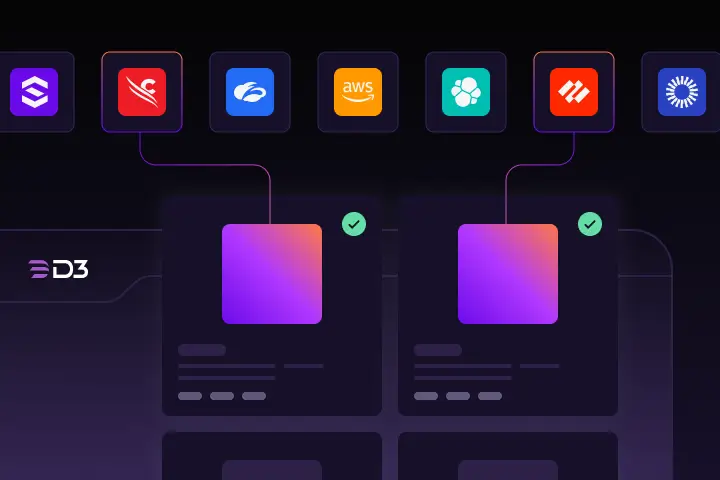
Breathtakingly Fast
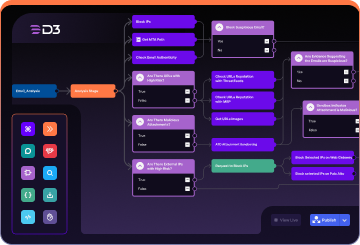
Profoundly Simple
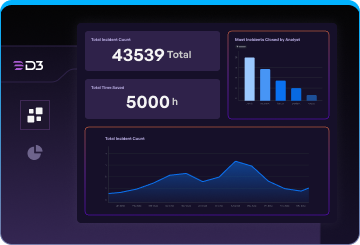
Everything Aligned
Customers who Made the Switch to D3
THE 60-DAY PLAN
Eight Weeks, Written Into the Order Form
The phase plan, the acceptance criteria and the agentic-ready scope are attached to your order form. D3 runs the conversion. Your team signs off on each playbook and on each cutover.
Weeks 1–2:
Discovery
A readiness report sizes your playbook estate, and together we set the acceptance criteria for cutover.
Weeks 3–4:
Conversion
The harness converts playbooks, reports and integration mappings. You get a diff per playbook and a review list.
Weeks 5–6:
Replay and Parallel Run
Your closed incidents replay for a parity report. Then Morpheus runs beside your SOAR on live alerts.
Weeks 7–8:
Validation and Cutover
Validation in week 7. Cutover by incident type in week 8, on your written sign-off against the criteria.
THE MIGRATION HARNESS
What Does the Migration Harness Do?
A D3 porting harness reads your exported playbooks, rebuilds them inside Morpheus step for step, and returns a review list for anything it cannot map with confidence. Custom scripts and steps tied to a tool you are retiring get a decision from your team.
Export and parse
Your platform’s native export of playbooks, reports and integration mappings, read as structured data: steps, order, branch conditions, inputs and outputs.
Map and rebuild
Actions matched to Morpheus connectors across 800+ integrations, then rebuilt as Morpheus playbooks with the same steps, branching and order of operations.
Diff and review
A side-by-side diff for every playbook and a review list of anything the harness could not map with confidence. Your team approves each one.
Replay and parallel run
Closed incidents replayed through the converted playbooks for a parity report, then a parallel run on live alerts against your acceptance criteria.
Scoped in discovery: custom integrations outside the D3 library, incident history beyond the agreed scope, and custom development.
WHERE YOUR PLAYBOOKS LAND
Four Autonomy Modes, Starting With Deterministic
Every converted playbook starts in Deterministic mode, one of four autonomy modes, and runs exactly as it did. You raise autonomy per alert type, and lower it again without re-migrating.
| Mode | What happens | Where it fits |
|---|---|---|
| Deterministic | The converted playbook runs alone. No AI in the response chain, and identical behavior on every run. | Where every migrated playbook starts, and where regulated or highest-risk playbooks can stay. |
| AI-Assisted | Read-only Attack Path Discovery investigates the alert before the analyst opens it. The analyst takes the action. | Usually the noisiest alert types first. |
| AI-Led | Morpheus completes the investigation and drafts the response. The analyst approves or modifies it before it runs. | Mature alert types with clear response criteria. |
| Autonomous | The playbook runs end to end against approval gates your team set in advance. | High-volume L1 alert types and around-the-clock coverage. |
Every verdict is graded Confirmed, Inferred or Gap, with one audit trail per incident. The playbook, the approval gates and the audit format stay the same in every mode.
Cortex XSOAR, Cortex AgentiX, IBM QRadar SOAR, Splunk SOAR, Microsoft Sentinel, Google Security Operations, Swimlane, FortiSOAR, Torq and Tines are trademarks of their respective owners and are named for identification only. D3 Security is not affiliated with any of these vendors. Vendor facts on this page were retrieved September 23, 2026.
Ready to see Morpheus?
Bring your SOAR version and a playbook you care about. In 30 minutes we show you the conversion and the 60-day plan.