

Investigations arrive pre-solved.
You run the response.
Morpheus triages, investigates across your stack, and hands incident response a high-confidence case with a recommended response plan in under two minutes. From there: deterministic playbook, AI-assisted, AI-led, or fully autonomous. Same engine. Same audit trail.
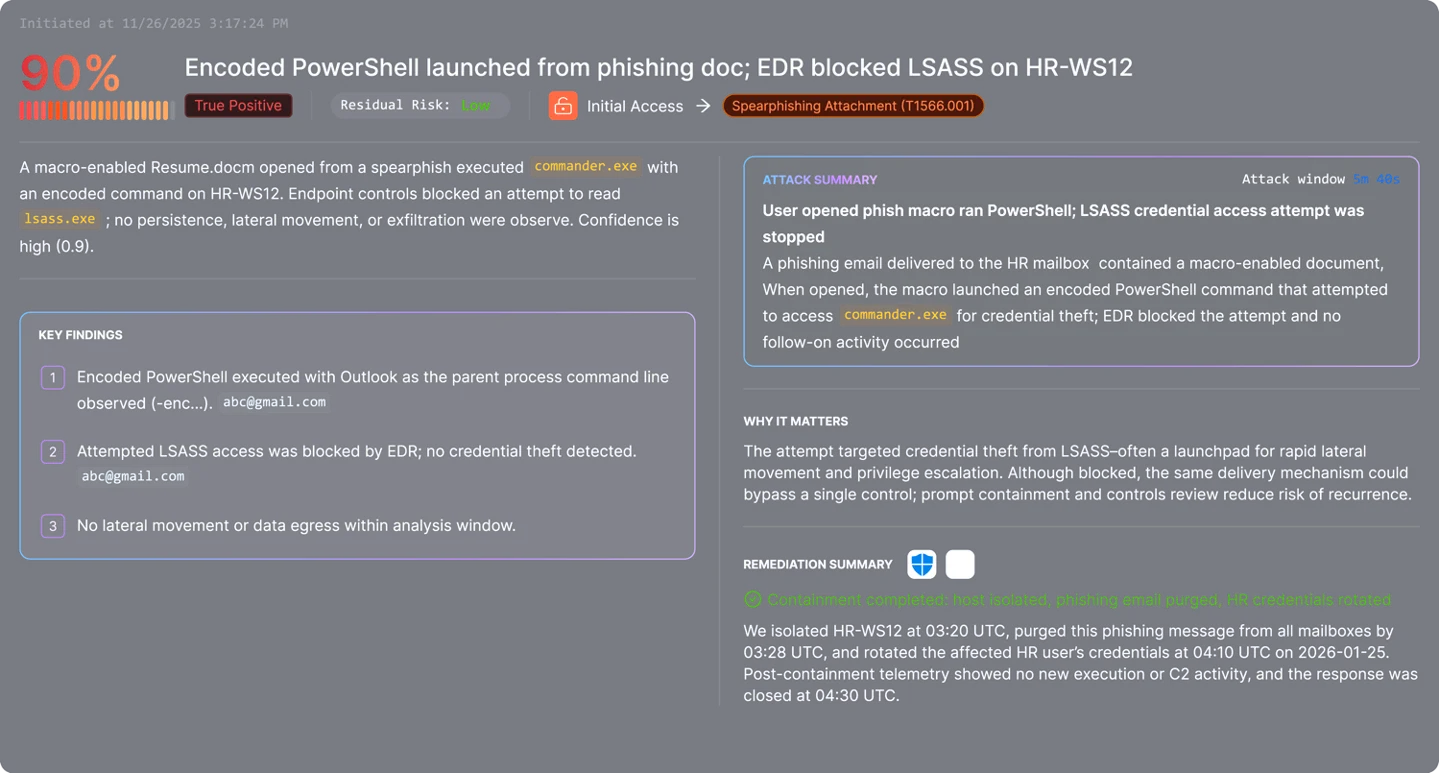
What lands on your queue
IR starts where other tools stop.
Most incident response teams open a queue of partially-triaged tickets and start from scratch. With Morpheus, the L1 and L2 work is done before the case is assigned. Attack Path Discovery has already traced the alert across identities, endpoints, cloud, and email. The Cybersecurity Triage Reasoning Graph has already classified the case, scored confidence, and drafted a response plan. Your IR team starts at minute three of the case, not minute zero.
-
✓A confidence-scored verdict True Positive, False Positive, or Suspicious — with the supporting evidence visible, not buried.
-
✓A reconstructed attack timeline Across identity, endpoint, cloud, email, and network — pivoted automatically across your full stack.
-
✓MITRE ATT&CK mapping Every step in the attack tagged to the right technique. Audit-friendly. Reviewer-friendly.
-
✓A recommended response plan Containment, eviction, eradication, recovery — ready to execute, revise, or escalate.
-
✓One contiguous audit trail Every query, artifact, and decision in one place — the same artifact the CISO certifies against.
The Takeaway
Cases arrive on the IR queue high-confidence, high-fidelity, and already investigated. Your team starts with the case 80% solved — and spends time on the calls that benefit from human judgment, not the work that doesn’t.
Cross-stack querying
Ask the case. Get an answer.
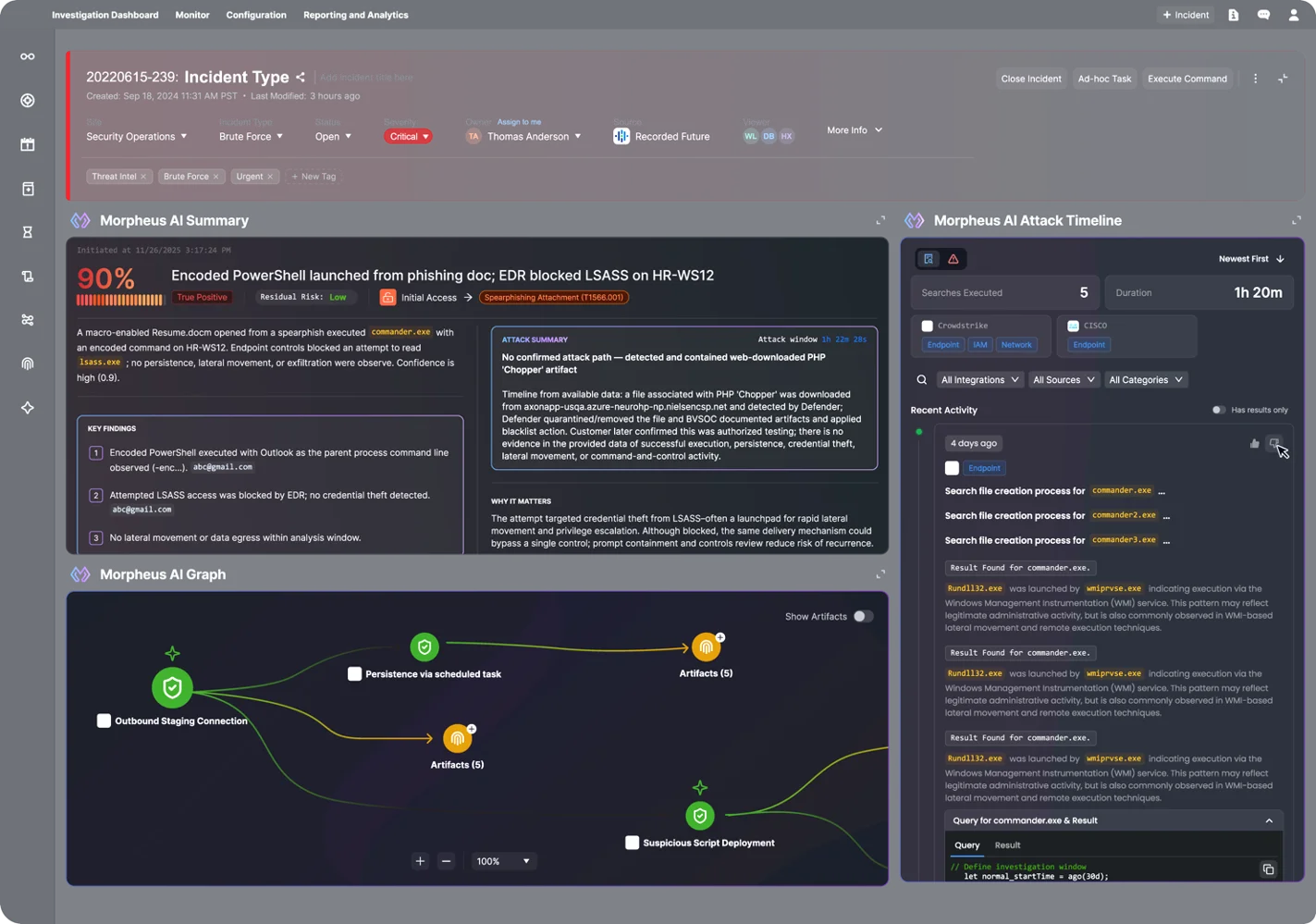
When you need more than what’s already in the investigation summary, Adaptive Tasking is a conversational copilot inside every Morpheus case. It is grounded in the case’s evidence and bounded by the same governance that runs the rest of the platform — and it can dispatch agents to gather more intel from any of your 800+ integrations.
Ask in natural language. Get a structured answer with the work shown.
- Has this IP been seen anywhere else in the last 90 days?
- Show me every endpoint that has run this hash.
- What did this user do in the 30 minutes before the alert?
- Pull the parent process tree from CrowdStrike.
- Change the severity from High to Low and document the justification.
Every prompt, every response, every executed action is recorded in the same audit trail as the rest of the case. No prompt vanishes. No reasoning hides. No second tool to reconcile.
Five places Morpheus buys you time.
Time to contain is the only metric that matters once an alert is real. Here is where Morpheus compresses the lifecycle, measured against the work most teams still do by hand.
| Step number# | Lifecycle step | Industry baseline | With D3 Morpheus |
|---|---|---|---|
| 01 |
Triage on arrivalThe Cybersecurity Triage Reasoning Graph classifies the alert, scores confidence, and decides whether it warrants a full investigation, within seconds of the alert hitting the queue. |
Average alert dwell 35 min Average alert dwell in triage queue before an L1 even looks at it. | Triage Reasoning Graph < 30 sec Triaged the moment it lands. Every alert, every shift, no sampling. |
| 02 |
Cross-stack investigationAttack Path Discovery pivots across identities, endpoints, cloud, email, and network. Builds a reconstructed timeline. Identifies blast radius and root cause. Returns to the case in under two minutes. |
Manual investigation 90+ min L2 cross-tool pivoting: queries, copy-paste, console switching. | Attack Path Discovery < 2 min Timeline, verdict, and recommendation, attached to the case automatically. |
| 03 |
Case opens with a planIR opens a high-confidence case with verdict, evidence, MITRE mapping, and a recommended response plan already drafted. Reviewing the plan replaces the work of building one from scratch. |
Plan from scratch 45 to 90 min Reading the alert, gathering context, drafting an action sequence. | Plan in hand Minutes to review Approve, revise, or escalate. The plan is the starting point, not the work. |
| 04 |
Response executesDeterministic playbook, AI-led plan, or fully autonomous run. Your choice per alert type. Actions flow through 800+ self-healing integrations: host isolation, account suspension, mailbox purge, ticket creation. |
Median dwell time 62 min Industry average between confirmed compromise and containment. | Containment time 4 to 8 min Common containment patterns close in single-digit minutes once the plan is approved. |
| 05 |
Case closes, one trailIncident summarized. Evidence packaged. Audit trail signed. Same artifact the CISO certifies against and the regulator reads. No reconciliation across platforms, no second sign-off, no separate audit format. |
Multi-tool close-out 2 to 5 hrs Stitching evidence and timelines from triage, SOAR, ticketing, and SIEM. | One trail, one click Minutes Auto-generated summary. Open YAML record. Signed and exportable. |
Response, your way
Deterministic, AI-assisted, AI-led, or autonomous. Per alert type.
Morpheus ships four configurable autonomy levels on the same engine. Pick the mode that fits the alert, your environment, and your regulator. Move modes per alert type. Move modes per regulator. No re-platforming. Same audit format throughout.
The dial moves both directions.
Run a high-volume category on Autonomous to clear a 10,000-alert backlog overnight — then move that same category back to AI-Assisted once the queue is normal. Autonomy is configurable per alert type and reversible at any time. No data migration. No second engine. Same audit format throughout.
Same platform, zero handoffs
AI triage. IR. Agentic SOC. One engine.
Most AI SOC tools handle triage. Then hand the case to your SOAR. Then hand it to your case management. Then hand it to your audit tool. Every handoff costs minutes. Every handoff splits the audit trail.
Morpheus runs triage, investigation, Adaptive Tasking, response, and case management on the same engine. The case triaged at 03:18 UTC is the same case the analyst opens at 03:20, the same case Adaptive Tasking is queried against at 03:24, the same case the deterministic playbook runs at 03:26, the same case that closes at 04:30.
One case ID. One contiguous trail. One artifact across the full lifecycle.
For IR teams already racing the clock, the shaved minutes compound across every case in the queue.
Response only works when the integrations do.
The best response plan in the world is useless if the EDR connector broke yesterday. Morpheus monitors its 800+ integrations for API drift, schema changes, and credential rotation — and auto-generates corrective code when something shifts.
One Audit Trail Per Incident
Open YAML. Versioned. Auditable end-to-end.
Whether the playbook was authored by your team or generated at runtime, it serializes to the same open YAML format. Every action, every Adaptive Tasking prompt, every approval — one contiguous artifact per incident. The CISO certifies against the same artifact the regulator reads.
Common questions from IR leads.
Does my IR team still investigate, or just review what Morpheus did?
IR still owns the decision. Morpheus delivers the triage, the cross-stack investigation, and a recommended plan — so the team opens the case with the L1 and L2 work already complete. The hours that used to go to context-gathering now go to judgment calls, scope decisions, communications, and the actions that benefit from human approval.
What is Adaptive Tasking?
A conversational copilot inside every Morpheus case. Grounded in that case’s evidence. Bounded by the same governance that runs the rest of the platform. Can dispatch agents across 800+ integrations to gather context — IP reputation, hash lookups, parent-process trees, user activity windows. Every prompt and every action is recorded in the same audit trail as the case.
How does Morpheus run a response — playbook or AI?
Both, on the same engine. Pre-authored deterministic YAML playbooks run known scenarios. Runtime-generated plans handle novel and multi-source incidents. Each alert type can be configured to one of four autonomy levels (Deterministic, AI-Assisted, AI-Led, Autonomous), and the level can change per alert type, environment, or regulator without re-platforming.
Can I run an alert category on full autonomy and then dial it back?
Yes. Autonomy is configurable per alert type and reversible at any time. A common pattern: run a high-volume category on Autonomous to clear a backlog, then move it back to AI-Assisted once the queue normalizes. No data migration. Same audit format throughout.
What does “same platform, no handoffs” actually save?
Time and audit-trail fragmentation. Most stacks separate triage, investigation, response, and case management across different products. Each handoff costs minutes per case and produces a different audit artifact. Morpheus runs all of it on one engine with one case ID and one contiguous audit trail. Across a full queue, the recovered minutes compound.
How does Morpheus avoid integration outages breaking the response?
Morpheus monitors 800+ integrations for API drift, schema changes, and credential rotation, and generates corrective code autonomously when a vendor pushes a breaking change. Production MTTR from a vendor break is 18 minutes; the manual-patching industry baseline is four to six weeks.