

The Splunk SOAR Alternative: When You’re Rebuilding Playbooks Anyway
If Splunk SOAR’s removal of the classic playbook editor and the move to Python 3.13 already have you rebuilding automation, the cleanest Splunk SOAR alternative is D3 Morpheus, the autonomous SOC platform from D3 Security. Keep your Splunk SIEM, retire your SOAR, and let D3 migrate you for free in 60 days.

See Morpheus in Action
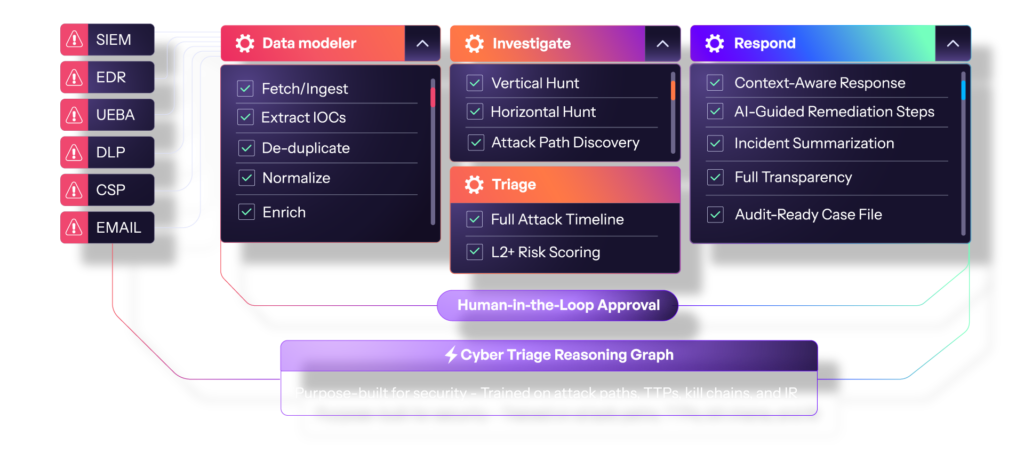
Morpheus AI implements the Unified Intelligence Model architecture: one purpose-built cybersecurity LLM performing complete autonomous investigation within a single reasoning context, producing one unified audit trail per incident. Where playbook flexibility is needed, Morpheus’s Agentic Task nodes run bounded agentic reasoning, autonomous reasoning with explicit iteration, cost, tool-scope, and approval-gate limits, inside the parent workflow’s audit trail. This is architecturally distinct from Splunk SOAR’s playbook-only approach, which routes work through static decision branches without autonomous reasoning at the node level. For regulated environments under NIS2, DORA, or the EU AI Act, the UIM produces one audit trail per incident, mapping structurally to Article 20 and Article 14 oversight obligations without additional governance tooling.
The pain: you’re being asked to rebuild playbooks on a tool you’re paying more for
Two things are squeezing Splunk SOAR teams at once.
First, the rebuild. Per Splunk’s own release notes, Splunk SOAR 6.4.0 removed the classic visual playbook editor (Cloud release, February 20, 2025); classic playbooks still run, but editing them visually means converting them first. Then Splunk SOAR (Cloud) 8.7.0, released September 2, 2026, ended Python 3.9 support, so playbooks, custom functions and apps that are not compatible with Python 3.13 stop running. The playbook library you spent years building is already on a migration clock. You’re rebuilding automation logic whether you like it or not.
Second, the renewal. Under Cisco’s ownership, customers have reported renewal and pricing pressure across the Splunk portfolio. Pay more and rebuild your playbooks at the same time, and the renewal stops being a rubber stamp. It’s a decision.
So here’s the reframe. If you’re rebuilding automation anyway, rebuild it once, somewhere it maintains itself.
Why isn’t staying on Splunk enough?
Plenty of teams love their Splunk SIEM. That’s fine, and it’s exactly why “keep your SIEM, retire your SOAR” is the right framing. Staying on Splunk SOAR specifically carries costs that staying on the SIEM does not:
- You’re rebuilding either way. The classic editor is gone, Python 3.9 support has ended, and re-authoring in the modern editor is itself a migration project. The marginal cost of moving to a better platform is small.
- Playbook maintenance is forever. Even modern Splunk playbooks break when integration APIs and versions drift. That’s a standing tax on your automation team.
- Pricing leverage sits with the vendor. Renewal pressure compounds when your SOAR rides the same contract as your SIEM.
- SOAR orchestrates; it doesn’t investigate. Splunk SOAR runs the steps you define. It won’t investigate an alert to L2 on its own and tell you whether it’s real.
Keep the Splunk SIEM you trust and replace only the SOAR layer. D3 Morpheus integrates directly with Splunk and adds what SOAR never did: autonomous investigation, self-healing integrations, and one audit trail per incident.
The D3 difference: keep your SIEM, retire your SOAR
D3 Morpheus is the governed autonomous SOC. Every autonomous action is governed, bounded by your chosen autonomy mode and approval gates. It’s explainable: every step is a real, timestamped, attributed tool query you can challenge. And it’s auditable, with one unified audit trail per incident. Agentic on architecture. Autonomous on outcomes. Accountable on every decision.
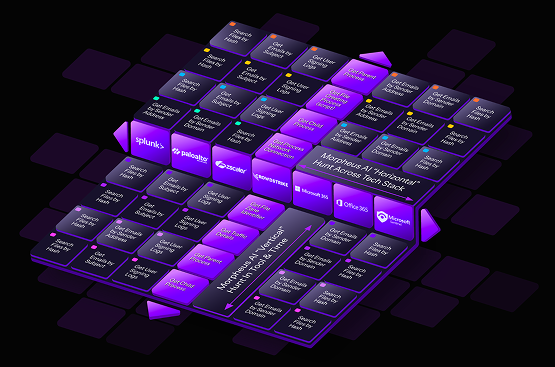
Attack Path Discovery (APD), D3’s read-only L2 investigation engine, replaces hand-built playbooks. It traces every alert across identity, endpoint, cloud, and email, maps blast radius, aligns to MITRE ATT&CK, and drafts remediation. Up to 95% of alerts are triaged and L2-investigated in under two minutes.
And the maintenance problem that follows every SOAR product disappears: D3 runs 800+ self-healing integrations with production MTTR on integration drift of 18 minutes, versus an industry baseline of 4–6 weeks.
Comparison: Splunk SOAR vs. D3 Morpheus
| Dimension | D3 Morpheus | Splunk SOAR (Cisco) |
|---|---|---|
| Playbook authoring | Agentic Tasks: bounded LLM reasoning inside deterministic playbooks with approval gates | Classic visual playbook editor removed in 6.4.0 (Feb 20, 2025); Python 3.9 support ended in Cloud 8.7.0 (Sep 2, 2026) |
| Keep your SIEM? | Yes: integrates with Splunk; replace only the SOAR layer | SOAR included in the Splunk Enterprise Security Premier edition, not in Essentials |
| Investigation | Autonomous L2 investigation via Attack Path Discovery; up to 95% of alerts in under two minutes | Orchestrates analyst-defined steps |
| Integration upkeep | 800+ self-healing integrations; 18-min MTTR on drift vs. 4–6 weeks baseline | Playbooks break on API/version drift; manual fixes |
| Commercial pressure | Decoupled from your SIEM contract | Licensed per user seat; reported renewal/pricing pressure under Cisco |
| Governance & audit | One reasoning engine, one unified audit trail per incident | Per-playbook execution logs |
| Migration | Free 60-day Legacy SOAR Migration Program with migration architects on staff | Convert classic playbooks and update automation for Python 3.13 yourself |
Morpheus AI Capabilities Splunk SOAR Cannot Match
The following six capabilities are core to the Morpheus AI architecture. Splunk SOAR is not designed to deliver them.
Self-Healing Integrations
800+ vendor connections that detect API drift, schema changes, and authentication updates and autonomously generate corrective code. Splunk SOAR custom Python apps break on the same drift and require manual rewrites. From Splunk SOAR (Cloud) 8.7.0, released September 2, 2026, apps and playbooks that are not compatible with Python 3.13 stop running.
Contextual Playbook Generation
Morpheus generates a playbook at runtime from live evidence for each incident. Each playbook is specific to the attack, the customer environment, and available tools. In Splunk SOAR, the customer authors the playbooks that run and maintains them indefinitely.
Attack Path Discovery (Every Alert)
Morpheus traces North-South (external-to-critical) and East-West (lateral) attack paths on every alert, in real time, across 800+ integrated tools and 90 days of telemetry. Splunk SOAR responds to the alert in front of the analyst and does not map attack chains.
Autonomous Investigation
Morpheus investigates end-to-end on one reasoning engine. The analyst approves remediation at the autonomy tier the customer sets. Splunk SOAR runs the playbooks your team authors and maintains.
Cybersecurity Triage Reasoning Graph
The technical moat. Built over 24 months by 60 security specialists for SOC reasoning, attack context, tool integration syntax, and incident escalation criteria. One reasoning engine, one audit trail. Splunk’s AI agents sit in Enterprise Security rather than in SOAR, and its Triage Agent requires the ES Premier edition on Splunk Cloud.
Four Autonomy Tiers
Deterministic, AI-Assisted, AI-Led, and Autonomous. The customer sets the tier per command-risk policy, with per-action approval gates and one audit trail across every tier. In Splunk SOAR, each playbook runs at whatever level of automation your team authored into it. See d3security.com/morpheus/autonomy-modes/ for the tier definitions.
“But Cisco says SOAR is staying.”
True. Cisco hasn’t announced an end-of-life for Splunk SOAR, and nobody here is claiming one. But “the product still exists” isn’t the same as “this is the best place to rebuild.” The facts that matter to your renewal are narrower and verifiable. The classic playbook editor has been removed and Python 3.9 support has ended, so you’re re-authoring automation regardless, and renewal and pricing pressure under Cisco keeps coming up in renewal conversations. If you’re going to spend the rebuild effort anyway, the only question is where it goes: into a tool you still have to babysit, or one that maintains itself and investigates on its own.

See it on your own alerts. A 30-minute walkthrough, live on real alerts, no slides.
WHY MORPHEUS
Why SOC Teams Choose Morpheus AI

Complete Platform, No Fragmentation
One reasoning engine, one audit trail, one orchestration layer across 800+ tools. Investigation feeds directly into playbook generation feeds directly into remediation. No SIEM lock-in, no separate playbook authoring tool, no custom Python apps to maintain.
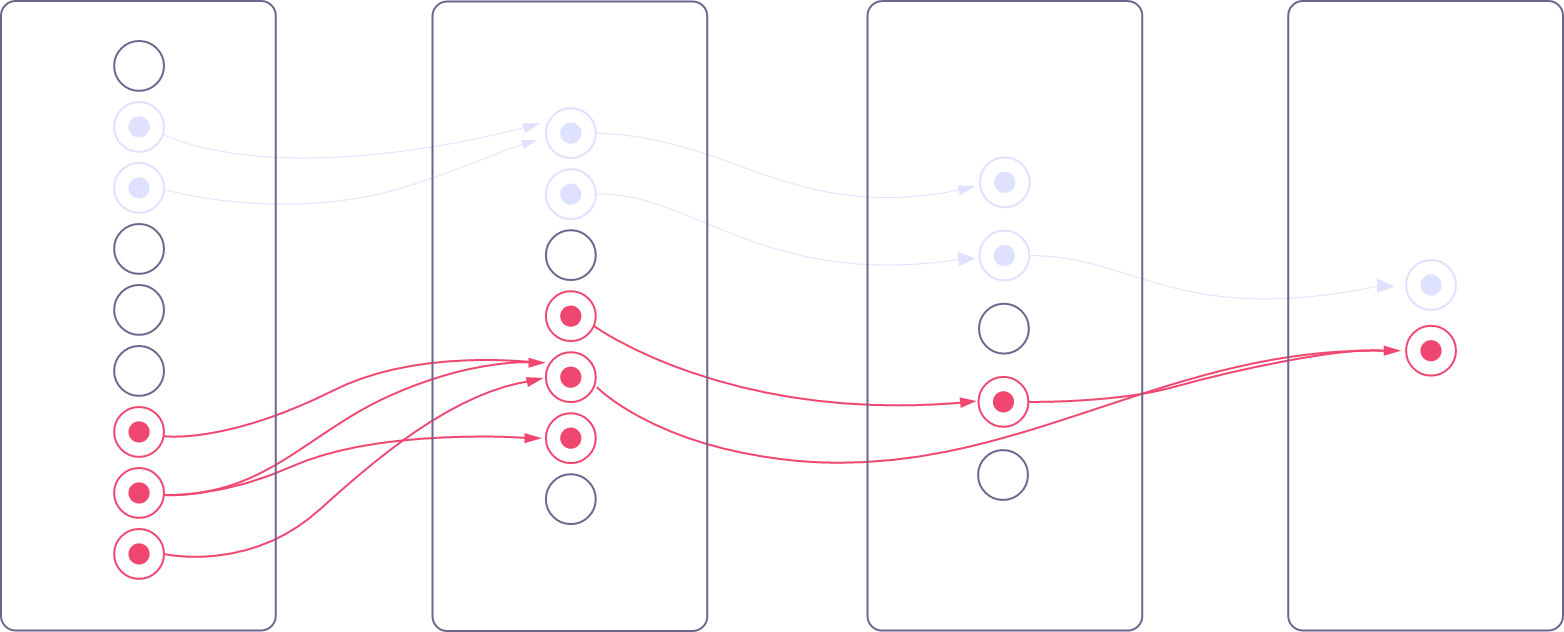
80% Faster Remediation
Attacks are stopped in minutes, not hours. Playbooks are generated from live evidence and executed through 800+ Self-Healing Integrations without manual handoffs. No one has to have authored a playbook for the attack in advance.

7,800 Analyst Hours Saved Annually
Per 1,000 alerts, Morpheus removes the busywork of triage, playbook authoring, orchestration planning, and post-incident forensics. Splunk SOAR customers spend that time writing and rewriting playbooks and apps. Morpheus customers spend it on strategic threats.
99% False Positive Elimination
Morpheus’s contextual investigation cuts false positives to roughly 1%. Analysts review actual attacks with evidence trees and confidence scores, not playbook outputs that route them back to a queue.

Lower Total Cost of Ownership
Morpheus uses a subscription pricing model. The customer pays a Platform Subscription plus User Licenses that together form the Expected Cost of running an AI SOC. The model is designed to absorb the operational cost of token consumption and AI compute internally rather than passing it through as a usage meter. Splunk SOAR couples SOAR spend to Splunk Enterprise Security consumption and to per-analyst seat licensing, and the SOC still has to author and maintain the playbooks and apps in-house. One platform, one budget line. Visit d3security.com/morpheus/pricing/ for details.

Bounded Reasoning, Customer-Extensible
Morpheus runs bounded reasoning inside deterministic governance. The Cybersecurity Triage Reasoning Graph is the moat; the reasoning model underneath it is interchangeable. Customers can fine-tune for their threats, their tools, and their playbooks without losing the audit trail. Splunk SOAR’s customization burden lands on the SOC engineer, not the platform.
Start in Deterministic mode: keep the control SOAR gave you
Splunk SOAR teams often hear “autonomous” and assume loss of control. It isn’t. D3 Morpheus runs four autonomy modes on one engine with one audit format: Deterministic (SOAR) → AI-Assisted → AI-Led → Autonomous.
Land in Deterministic mode and it behaves exactly like the SOAR discipline you’re used to. Every step explicit, every action gated by approval. Then dial autonomy up one alert class at a time as your confidence grows. Moving between modes is a config change, not a re-platform. The migration Splunk’s changes forced on you becomes the last of its kind. From here, shifts in how much you automate are a dial, not a project.
What makes that safe is the Agentic Task: bounded LLM reasoning inside a deterministic playbook, with iteration caps, tool-scope limits, output-schema validation, and approval gates. Compare that to a multi-agent mesh, where a swarm of agents trades messages and produces a result nobody can fully reconstruct. With D3 there’s one reasoning engine and one audit trail per incident, which is what makes an autonomous action defensible to your change-advisory board and to a regulator.
What you actually gain by leaving the playbook editor behind
The hidden cost of any SOAR is that the intelligence lives in playbooks you author and maintain. D3 inverts that. Investigation runs on the Cybersecurity Triage Reasoning Graph, purpose-built SOC reasoning built over 24 months by 60 specialists. The graph is the moat. It’s why Attack Path Discovery can take a Splunk-detected alert and run the pivots a senior analyst would make across identity, endpoint, cloud, and email. A SOAR playbook executes a fixed sequence you wrote.
Concretely: in Splunk SOAR you encode triage logic by hand, then patch it whenever an integration changes. In D3 Morpheus the triage reasoning is the product and the 800+ integrations self-heal. You go from authoring and babysitting automation to supervising it. That’s the whole point of leaving rather than re-authoring. Re-authoring inside Splunk SOAR keeps the same maintenance burden.
The 60-day free migration
D3’s Legacy SOAR Migration Program moves your playbooks and integrations to D3 Morpheus in 60 days, at no cost, with D3 migration architects on staff. You keep your Splunk SIEM. You stop re-authoring classic playbooks, and you’re off the maintenance treadmill.
D3 Morpheus deploys on Microsoft Azure with data residency in the US, Canada, the EU (Ireland), and Japan, and on-prem is available. D3 is a Microsoft Intelligent Security Association (MISA) member and holds SOC 2 Type II. It’s trusted by organizations including PwC, Scotiabank, S&P Global, Cummins, Cybereason, the U.S. Department of Defense, and the London Stock Exchange.
Related
Running the numbers on a renewal? See Morpheus for the price of Splunk SOAR and bring us your real figure.
Morpheus Performance Metrics at a Glance
Real-world data from live Morpheus deployments:
Frequently asked questions
Is Splunk SOAR being discontinued?
Cisco has not announced an end-of-life for Splunk SOAR, and new releases continue: Splunk SOAR (Cloud) 8.7.0 shipped on September 2, 2026. What has changed is the automation underneath it. Splunk SOAR 6.4.0 removed the classic visual playbook editor (Cloud release, February 20, 2025), and 8.7.0 ended Python 3.9 support. Most teams are re-authoring automation either way, which makes this a natural moment to evaluate alternatives like D3 Morpheus.
Has Splunk SOAR removed the classic playbook editor?
Yes. Splunk SOAR 6.4.0 (Cloud release, February 20, 2025) no longer includes the classic visual playbook editor. Existing classic playbooks still run, but editing them visually means converting them to modern playbooks first. New automation is built in the modern editor, so a classic playbook library faces a re-authoring effort either way.
Can I keep Splunk as my SIEM but replace Splunk SOAR?
Yes. D3 Morpheus is SIEM-agnostic and integrates directly with Splunk. You keep the Splunk SIEM your team trusts and replace only the SOAR layer, adding autonomous L2 investigation and self-healing integrations while decoupling your automation from the SIEM renewal contract.
What is the best alternative to Splunk SOAR?
For teams rebuilding automation after the classic editor removal and the Python 3.13 cutover, D3 Morpheus, the autonomous SOC platform from D3 Security, is the leading Splunk SOAR alternative. It keeps your Splunk SIEM, replaces brittle playbooks with self-healing integrations and autonomous investigation, and includes a free 60-day migration program.
Is Splunk getting more expensive under Cisco?
In renewal conversations we observe reported renewal and pricing pressure across the Splunk portfolio under Cisco ownership. Specifics vary by contract. We present this as an observation, not documented industry consensus. The practical takeaway: when a renewal also requires re-authoring classic playbooks, it’s a reasonable moment to evaluate a decoupled, self-maintaining alternative.
How long does migrating from Splunk SOAR to D3 Morpheus take?
D3’s Legacy SOAR Migration Program runs in 60 days at no cost, with D3 migration architects handling playbook and integration conversion. You keep your Splunk SIEM throughout, so the migration replaces only your SOAR layer and leaves your detection and data pipeline intact.
Does D3 Morpheus do more than orchestration like Splunk SOAR?
Yes. Splunk SOAR orchestrates analyst-defined steps. D3 Morpheus adds autonomous L2 investigation through Attack Path Discovery, tracing alerts across identity, endpoint, cloud, and email, mapping blast radius, aligning to MITRE ATT&CK, and drafting remediation. It triages up to 95% of alerts in under two minutes.
Is D3 Morpheus auditable for compliance?
Yes. Every autonomous action is governed, explainable, and auditable, producing one unified audit trail per incident. D3 Morpheus supports defensibility under SEC Item 1.05, NYDFS 23 NYCRR 500, HIPAA, NERC CIP, NIS2, DORA, and EU AI Act Article 14, and holds SOC 2 Type II.
Sources
Splunk SOAR (Cloud) release notes: classic visual playbook editor removed in 6.4.0 (February 20, 2025); Python 3.9 support ended in 8.7.0 (September 2, 2026): help.splunk.com. Splunk Enterprise Security editions (SOAR included in Premier): help.splunk.com. Splunk SOAR licensing by user seat: help.splunk.com. Splunk Enterprise Security agentic AI offerings (Triage Agent: Premier, Cloud only): help.splunk.com. Renewal/pricing pressure across the Splunk portfolio under Cisco ownership: an observation from D3’s renewal conversations, not documented industry consensus. Presented as reported, not as stated Splunk policy. D3 Security Splunk integration: d3security.com/integrations/splunk/
D3 Security is not affiliated with Splunk or Cisco. Splunk SOAR and Phantom are trademarks of their respective owners. This comparison reflects publicly available information and our team’s evaluation as of October 2026.