Somewhere around 3 a.m., an alert fires in your security operations center. No analyst is watching. An autonomous system investigates it, reaches a conclusion, and, depending on how you’ve configured it, may take an action: isolating a host, disabling an account, closing the case. By the time anyone looks, the decision is made. Who owns what just happened, and can you prove what the system did? A risk committee will treat those as liability questions.
The organization stays liable for what the machine does
The machine acts, and the organization that deployed it is accountable. That’s no reason to avoid autonomy, because the operational case for it is strong. Organizations that used AI and automation extensively across their security operations saved an average of $1.9 million per breach and cut the breach lifecycle by 80 days, according to IBM’s 2025 Cost of a Data Breach Report. It does sharpen what responsible autonomy has to mean, and the bar is exacting: you can prove what the AI did, you can show a human could have stopped it, and you can point to the gate every consequential action passed. Absent that, an autonomous SOC is an unbounded, undocumented liability that nobody has priced, whatever it looks like as a productivity gain on the books.
Regulators are moving in this direction. The EU AI Act’s Article 14 centers on meaningful human oversight of high-risk systems. DORA imposes operational-resilience and oversight expectations on financial entities. NIS2 raises accountability for security practices across a broad set of sectors. The specifics differ, but the requirement underneath is the same: a human must be able to understand, monitor, and intervene in high-stakes automated decisions.
You cannot oversee what you cannot retrace. Oversight is the ability to reconstruct, faithfully, what happened and why, and a policy document alone can’t deliver it.
This is where most autonomous tooling fails the risk test. The system acts, but the record of why it acted is thin, scattered across logs, or assembled after the fact by someone trying to reverse-engineer a decision the machine already made. When the board asks what it did and whether anyone could have caught it, the honest answer is a shrug dressed up as a report.
Make the investigation the record
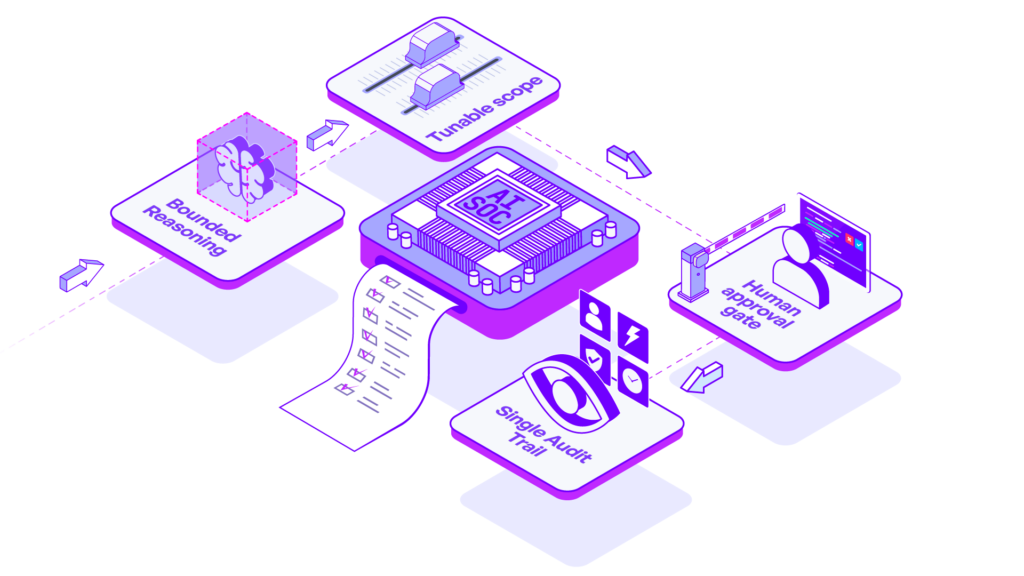
The design that passes the test makes the investigation itself the record. In a governed agentic SOC, every query the system runs, every piece of evidence it weighs, every confidence judgment, and every action it takes is captured as a single chain of custody per incident. Because the work and the audit record are the same artifact, there’s nothing to reconstruct. The proof exists the moment the incident closes. That’s what control evidence by design means: the documentation a risk committee needs is a byproduct of how the system runs, produced without a separate reporting burden.
Two more design choices give the record its defensibility. First, investigation is read-only: the engine that assembles the attack path takes no action of its own, so a human can read the entire picture before anything consequential happens. Second, consequential actions are approval-gated and risk-tiered across autonomy modes. A human stays in command of the actions that carry real-world impact, can override at any stage, and every action is reversible and logged.
Put those together and the 3 a.m. question has an answer you can give a regulator, an auditor, or your own board. You can show exactly what the system did, the evidence it weighed, where a human approved the action, and the record that proves it. Autonomy you can’t retrace is what turns a good operational decision into a bad line in a risk review.
The insurance question
On insurance, since it comes up: we won’t claim this lowers your premium. That’s a conversation between you and your broker, and it depends on your carrier and your posture. The control evidence an accountable agentic SOC produces is increasingly the kind of documentation those conversations ask for. Provability is the asset.
In your next risk review, ask whether you can prove what the autonomous system does. If you can, autonomy is a control you can defend. If you can’t, it’s a liability you haven’t named yet.
See the per-incident audit trail on a live investigation, and the control mapping your GRC team can work from. Book a governance demo.