

What Good Looks Like
What good looks like in a governed agentic SOC
A governed agentic SOC investigates on its own and acts only with a human in the loop, every step logged and explainable. Walk its eight-stage lifecycle, autonomous and governed at every stage, then ask the five questions that separate production-ready from a demo.
Up to 95%
of alerts triaged and L2-investigated in under two minutes
800+
self-healing integrations
18 min
integration-drift MTTR, versus 4 to 6 weeks by hand
4
autonomy modes, human in command
A governed agentic SOC is a security operations center in which AI agents investigate and triage alerts autonomously while a human stays in command of consequential actions, with every step logged and explainable. A clean alert tells you little. What defines a governed agentic SOC is how it behaves across the whole lifecycle: it fails toward a human when it cannot be sure, exposes the factors and evidence behind every disposition, sets approval gates from the risk of the action itself, makes the investigation its own audit record, and learns from analysts without acting on that learning unsupervised. Morpheus is built to answer each of those tests directly.
What is a governed agentic SOC?
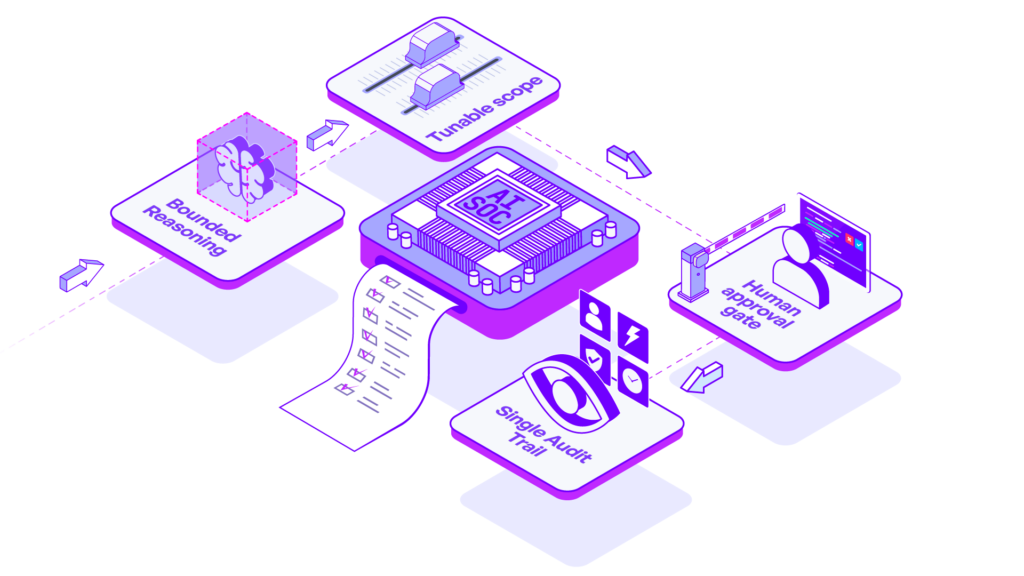
A governed agentic SOC combines autonomy with oversight at every stage. The AI investigates, scores, and proposes response on its own, but consequential actions run only with a human in the loop, and every step (the queries, the evidence, the reasoning, the actions) is recorded. The word that matters is governed. Autonomy without a retraceable record and human command is just automation you cannot defend.
How is it different from a SOAR or a chatbot bolted onto a SIEM?
A traditional SOAR runs fixed, rule-based playbooks. A chatbot answers questions about alerts. A governed agentic SOC reasons across tools to build the case, scores the real risk, proposes and, with approval, takes action, and records the whole thing as one audit trail. Nearly every tool claims AI now. The real difference is whether the autonomy is legible and governed end to end, or a black box with a confident voice.
| Capability | Governed agentic SOC | Traditional SOAR / SIEM chatbot |
|---|---|---|
| Investigation | Reasons across your tools to build the case | Runs fixed, rule-based playbooks or answers questions |
| Risk scoring | Scores Effective Alert Risk and shows the breakdown | Static rules, or no scoring at all |
| Action | Proposes and, with approval, takes the action | Executes preset automations on a trigger |
| When it is unsure | Fails toward a human with a scoped, flagged case | Follows the rule or returns a confident guess |
| Audit | The investigation is the audit record | The audit is assembled after the fact |
| Oversight | Human in command, every step logged and explainable | Depends on how the playbook was authored |
The five questions that separate production-ready from a demo
Ask any vendor these five questions, ours included, and ask to see each answer live rather than on a slide.
When your tool is wrong, does it produce an answer anyway, or stop and hand the case to a human?
Can analysts open a disposition and see the factors, the weights, and the evidence behind each, or just a score?
When the agent acts, what set the approval gate?
Is the investigation itself the audit record, mapped to your regulatory obligations?
When it learns from your team, does it act on what it learns, or only tune suggestions a human approves?
How Morpheus answers the five
When it is wrong, does it answer anyway or hand off to a human?
It fails toward a human
Below the confidence bar it escalates a flagged, scoped case with what it tried and what is missing.
Can analysts open a disposition, or just see a score?
Every disposition is legible
Open a verdict and see the factors, weights, and evidence, with contradicting evidence surfaced, never buried.
What set the approval gate when the agent acts?
The gate is set by the action
Command-risk tagging self-sets the gate from risk metadata shipped with the action catalogue, across four autonomy modes.
Is the investigation itself the audit record?
The investigation is the audit trail
One chain of custody for every query, evidence item, and action. Aligned to Article 14 and DORA.
Does it act on what it learns, and is that scoped to your tenant?
Learning is governed and tenant-scoped
It learns inside your tenant and tunes suggestions a human approves. It never acts on what it learns on its own.
The eight-stage triage lifecycle
Every stage is autonomous and governed. Here is the whole loop, from the alert landing to the system learning from your analysts.
Intake
autonomous · governed
The alert lands and enters the loop with its context attached, ready for investigation instead of a queue.
Investigate
read-only · fails toward a human
Morpheus works read-only, assembling the attack path and taking no action, so a human can read the whole path end to end. When it cannot resolve a case, it fails toward a human.
Score and dispose
EAR · recoverable gate
Effective Alert Risk (EAR) weighs exposure, identity blast radius, data proximity, and intel match. The validity gate is recoverable, so a disposition is never a trapdoor.
Synthesize the story
evidence-first · no claim without a link
The narrative is evidence-first. No claim appears without a link to the evidence behind it, so a reviewer can verify the story rather than believe it.
Recommend and plan
copilot proposes · four autonomy modes
The copilot proposes a remediation rather than imposing one. Four autonomy modes let each team decide how much runs before a person signs off.
Respond and act
command-risk gate · human by default
Command-risk tagging ships with the action catalogue, so the risk of an action sets its own approval gate. High-consequence actions wait for a human by default.
Capture and audit
chain of custody · per incident
The investigation becomes the record. Every query, every piece of evidence, and every action is captured as one chain of custody per incident.
Learn
tenant-scoped · never acts on its own
The system reasons, skillifies what it learns, codifies it, and falls back when it should. Learning is scoped to your tenant and never acts on its own.
faqs
Frequently Asked Questions
The short answers evaluators, architects, and practitioners ask most about a governed agentic SOC.
What is a governed agentic SOC?
A security operations center in which AI agents investigate and triage alerts autonomously while a human stays in command of consequential actions, with every step logged and explainable.
What is the difference between an agentic SOC and a SOAR?
A SOAR runs fixed, rule-based playbooks. An agentic SOC reasons across tools to build the case, score risk, and propose action, under human oversight. Morpheus is both: deterministic SOAR automation plus a governed agentic layer.
How do I evaluate an agentic SOC?
Ask five questions and require live proof: what it does when it is wrong; whether dispositions are legible; what sets the approval gate; whether the investigation is the audit record; and whether learning is governed and tenant-scoped.
Does autonomous mean the AI acts without approval?
No. Consequential actions run only with a human in the loop through risk-tiered approval gates and four autonomy modes. Every action is logged and reversible.
Stop grading agentic SOCs on the demo. Grade them on the lifecycle.
Bring the five questions to any vendor, ours included. We will answer all five on a live investigation: watch it fail toward a human, open a disposition, and produce its own audit trail.