-
What Is Human in the Loop? | D3 Security Glossary
Human in the loop describes a system in which a person reviews or approves automated decisions. Because the phrase covers everything from a real approval…
-
What Is Graduated Autonomy? | D3 Security Glossary
Graduated autonomy widens a system’s authority one class of work at a time as its record justifies it, with the boundary always explicit and testable.
-
What Is Fail Toward a Human? | D3 Security Glossary
Fail toward a human is the design rule that an automated investigation which cannot get the evidence it needs escalates to a person, so missing…
-
What Is Capacity Reallocation? | D3 Security Glossary
Capacity reallocation is the second return on agentic triage: analyst hours recovered from manual work redirected into detection engineering, threat hunting, and the projects a…
-
Cost Savings or Freed Capacity? Field Notes From Agentic SOC Deployments
Field notes from production agentic SOC deployments: where the returns land, what the no-analysts pitch skips, and the proof to demand from any vendor.
-
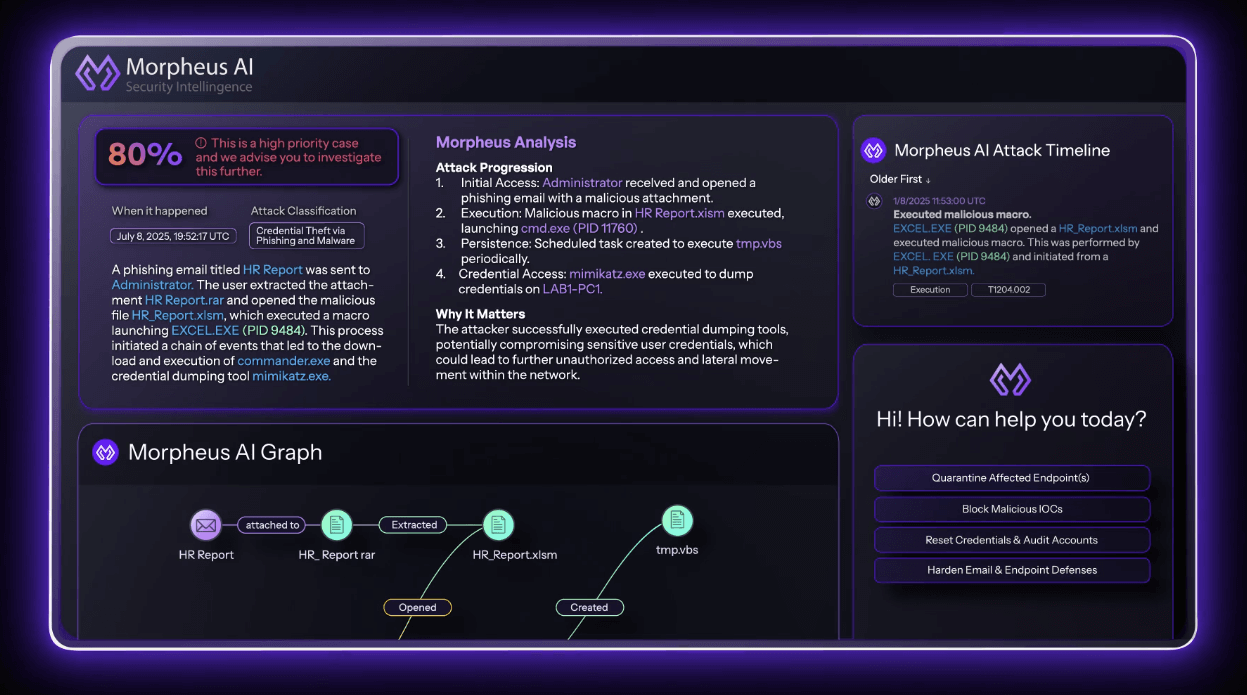
Morpheus for MSSPs | Autonomous Investigation. Response You Control.
Morpheus is the multi-tenant AI SOC platform for MSSPs. It runs L1 and L2 investigation end to end, with a built-in SOAR for response. Serve…
-
The 12 Best Agentic SOC Platforms in 2026: Architectures, Autonomy Levels, and a Full Comparison
Definitive 2026 comparison of agentic SOC platforms. 12 vendors scored by agentic architecture, autonomy level, integrations, and pricing, with a vendor-neutral evaluation framework.
-
Control Evidence by Design: How To Oversee an AI You Can’t Watch in Real Time
You can’t watch an autonomous SOC in real time. Here’s the architecture that makes human oversight provable: read-only investigation, gated actions, one record.
-
The 3 a.m. Question: Who’s Liable When Your AI Acts Alone?
When your AI acts in the SOC at 3 a.m., liability stays with you. Here’s how to prove what it did and defend autonomy in…


autonomous soc
Select a term…