The completely autonomous SOC makes a great demo and a poor operating model. These are our field notes from customer deployments of the agentic SOC in production, and what changes is better than the pitch. The people stay. The queue goes. The returns show up on two budget lines instead of one.
Investigation Stops Being Manual Work
An alert almost never contains enough information to judge on its own, so analysts have spent two decades pulling process lists, querying identity providers, and reconstructing timelines by hand. An agentic SOC does that investigation itself. It reaches into surrounding systems, fills the gaps, weighs the case for escalation against the case for closure, and writes the story down. Work that took hours completes in minutes. An intrusion that starts with a phishing message, drops a loader, and begins beaconing out can scatter a hundred alarms across your sensors, and grouped triage resolves them into one investigation with one narrative.
The Return Lands on Two Budget Lines
Triage labor is the largest cost in most security operations. Proper investigation of a single alert is worth roughly $20 to $45 of analyst time, and a SOC handling a thousand alerts a day is spending millions a year on it. When an agentic SOC takes that work over, the savings land in places a finance team can point at: budgets that stop growing with alert volume, requisitions that never get filed, overtime that stops being structural. For some organizations the savings alone justify the deployment. Our own cost per alert is $0.97, achieved through architecture and design, at 98% triage accuracy in production. When Morpheus is uncertain, it defers to a human.
The second return is the one boards remember. No security organization has ever had enough people for the threats it faces, and every SOC carries a backlog it has never been able to staff: detection coverage gaps, log sources never onboarded, tuning debt, threat hunting that happens in name only. When triage stops consuming the majority of analyst hours, that backlog finally gets worked. The deployments that satisfy a risk committee count both returns, the savings and the coverage.
What the No-Analysts Pitch Skips
Run the arithmetic on the vendors promising you can empty the SOC. At 10,000 alerts a day, a system that is 99% accurate gets 100 dispositions wrong every day, and an unsupervised loop owns every one of them with no one positioned to catch them. Regulators are already sending questionnaires that ask who decided, on what evidence, and under whose authority.
One rule governs that moment, and we hold ourselves to it: missing evidence must increase uncertainty, not increase confidence in benignity.
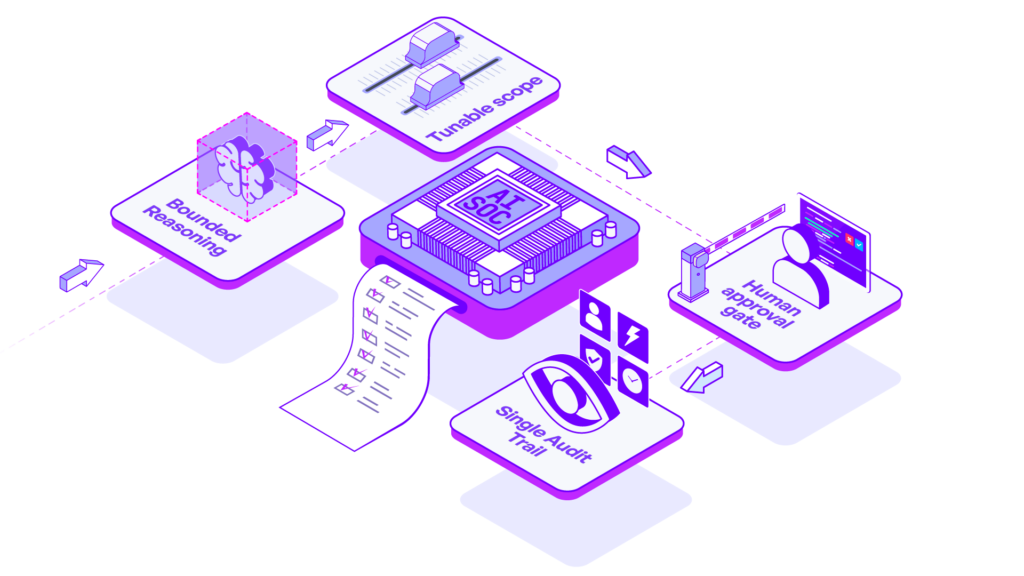
That is why autonomy in Morpheus is a dial you turn on evidence, not a switch you flip on faith.
The full field observations cover the vendor claims to test, the ten questions to ask in any evaluation, and the cost thresholds that survive a finance review. Read the field observations, then bring a week of your own alerts to a 30-minute demo and watch Morpheus show its work on them.