SOC automation vendor risk is the chance that the platform you standardize on is acquired, repriced, re-platformed, or strategically deprioritized before you’ve recouped your investment, leaving your detection-to-response workflow exposed. In 2026, the right defense is a repeatable evaluation framework: score every vendor on corporate stability, lock-in, integration durability, autonomy governance, and migration cost before you commit. Below: the framework, applied to publicly observable examples, plus what a low-risk architecture actually looks like.
Why vendor risk is a security risk
You can’t swap SOC automation in a weekend. It’s the connective tissue between every detection source and every response action. When the vendor behind it stumbles, whether through an acquisition, a reprice, or a roadmap pivot, the blast radius is your whole incident-response capability. In this context vendor risk is operational risk.
The 2026 market makes that concrete. Consolidation, activist pressure, AI-pricing experiments, forced platform migrations: all of it is visible right now. Judging vendor durability used to be a procurement nicety. Now it’s part of the security architecture.
A five-factor vendor-risk framework
Score each candidate 1–5 on every factor. Anything below 3 is a flag worth a mitigation plan.
1. Corporate stability
Is the vendor independent and well-capitalized, freshly acquired, or under activist/strategic pressure? Ownership changes routinely reset roadmaps and pricing.
2. Lock-in and switching cost
How proprietary is the automation format? Can you export your logic? Editor migrations and bespoke playbook languages raise the cost of leaving, which is the one moment you need to leave cheaply.
3. Integration durability
SOAR value lives in connectors, and connectors break as APIs drift. Across the industry, repairing one runs four to six weeks per significant drift event. Ask who owns that repair: you, or the platform.
4. Autonomy governance
If the platform acts autonomously, can every action be governed, explained, and audited? Ungoverned autonomy is its own risk class, independent of corporate health.
5. Migration cost and exit support
If you had to leave in 12 months, what would it cost, in dollars, engineering, and downtime? Does the destination offer migration help, or are you on your own?
Applying the framework: worked examples
These are sourced, factual observations. Inputs to a stability review, not verdicts.
Palo Alto Cortex XSOAR. XSOAR professional-services SKUs reached end-of-sale effective February 1, 2026, and Palo Alto named Cortex AgentiX as the next-generation XSOAR successor (standalone expected early 2026, today delivered within Cortex XSIAM/XDR).¹ That’s end-of-sale of PS SKUs plus a migration push, not a product-wide end-of-life. Read it as a factor-2 and factor-5 signal: re-platforming pressure and fewer purchasable services.
Splunk SOAR (Cisco). The classic playbook editor is deprecated. You can’t create classic playbooks since SOAR Cloud 6.2.1.² Customers and analysts have reported and observed renewal and pricing pressure across the portfolio under Cisco. We present that as reported, not stated policy, and we assert no SOAR EOL. Call it a factor-1 and factor-2 signal.
Rapid7. There’s been publicly reported activist involvement and exploration of strategic options, and Rapid7 acquired agentic-AI security operations startup Kenzo Security in March 2026.³ To be precise: we do not state as fact that Rapid7 is being sold. No transaction has been announced. These are publicly reported developments and a fair reason to check vendor stability, a factor-1 signal to track and nothing more.
Naming these puts the framework to work: real, sourced signals, mapped to factors and turned into mitigation plans.
What a low-risk architecture looks like
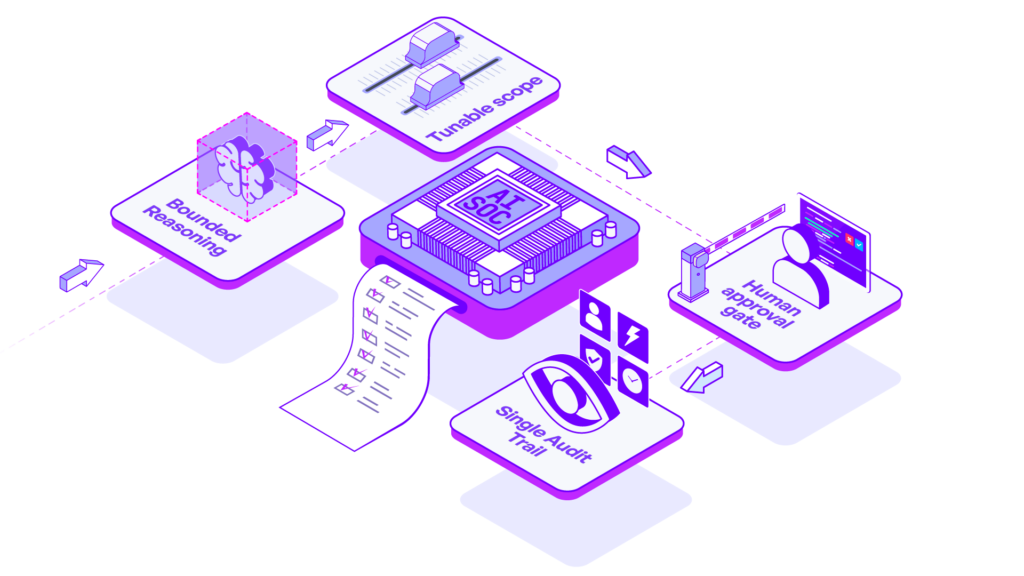
D3 Morpheus, the autonomous SOC platform from D3 Security, is designed to score well on each factor. Not by being immune to market forces. By lowering the structural costs that make vendor risk bite.
Lock-in (factor 2). One Cybersecurity Triage Reasoning Graph and one reasoning engine replace proprietary editor generations, so there’s no playbook-language migration treadmill. Four autonomy modes (Deterministic → AI-Assisted → AI-Led → Autonomous) change behavior by configuration, not re-platforming.
Integration durability (factor 3). 800+ self-healing integrations with a production 18-minute MTTR on integration drift, against the 4–6-week industry baseline. The platform owns connector upkeep.
Autonomy governance (factor 4). The governance trinity: every action governed (bounded by autonomy mode and approval gates), explainable (each step a real, timestamped, attributed, challengeable tool query), and auditable (one unified trail per incident). That maps to SEC Item 1.05, NYDFS 23 NYCRR 500, HIPAA, NERC CIP, NIS2, DORA, and EU AI Act Article 14.
Migration cost (factor 5). A Legacy SOAR Migration Program with migration architects on staff, 60-day scope, “migrate to D3 for free.”
On outcomes: Attack Path Discovery (APD) investigates across identity, endpoint, cloud, and email, delivering up to 95% of alerts triaged and L2-investigated in under two minutes.
Vendor-risk scorecard (illustrative)
| Factor | What to ask | Lower-risk signal |
|---|---|---|
| Corporate stability | Independent? Under pressure? | Stable ownership, clear roadmap |
| Lock-in | Can I export my logic? | One engine, config-driven modes |
| Integration durability | Who fixes drift? | Self-healing; short MTTR |
| Autonomy governance | Governed, explainable, auditable? | Unified audit per incident |
| Migration cost | What’s the exit cost? | Funded migration program |
Agentic on architecture. Autonomous on outcomes. Accountable on every decision.
FAQ
What is SOC automation vendor risk? It’s the risk that the automation platform underpinning your detection-to-response workflow is acquired, repriced, re-platformed, or deprioritized before you’ve recouped your investment. Because that platform connects every detection and response action, vendor instability translates directly into operational and incident-response risk.
How do I evaluate whether a security vendor is stable? Score corporate stability, lock-in, integration durability, autonomy governance, and migration cost. Track public signals like acquisitions, end-of-sale notices, activist involvement, and editor deprecations, then map each to a factor and a mitigation, so you act on patterns across signals.
Should activist investor involvement worry me? It’s a fair reason to evaluate stability, not a reason to panic. For example, there is publicly reported activist involvement and exploration of strategic options at Rapid7, plus its March 2026 Kenzo Security acquisition.³ Treat such reports as one input to weigh. They do not confirm that any sale or change is certain.
How does D3 Morpheus reduce vendor risk specifically? By lowering switching costs structurally: one reasoning engine that survives across editor generations, 800+ self-healing integrations with an 18-minute drift MTTR, a governance trinity that keeps autonomy auditable, and a funded 60-day migration program with architects on staff if you ever need to move.
Run the framework on your own shortlist
Bring your current platform and your top alternative; score both on the five factors against your real alerts.
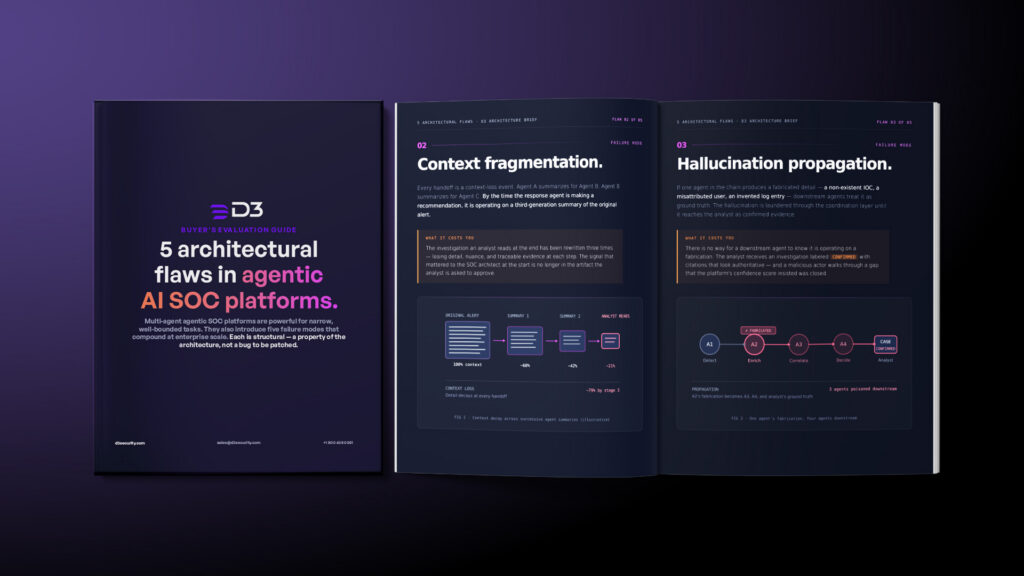
Book a 30-minute demo, live on real alerts, no slides. Or read 5 Architectural Flaws of the Agentic AI SOC.
About D3 Security
D3 Security makes D3 Morpheus, the AI SOC platform for autonomous alert investigation and accountable response, trusted by global financial infrastructure operators, Big Four accounting firms, industrial manufacturers, and banks. Learn more at d3security.com.
¹ Palo Alto Networks end-of-sale announcement — paloaltonetworks.com/services/support/end-of-life-announcements/end-of-sale. XSOAR professional-services SKUs end-of-sale (Feb 1, 2026); not a product-wide EOL. ² Splunk SOAR Cloud release notes — help.splunk.com. Classic playbook editor deprecated; cannot create classic playbooks since SOAR Cloud 6.2.1. Portfolio pricing/renewal pressure under Cisco is reported/observed, not stated policy; no SOAR EOL asserted. ³ Rapid7 — publicly reported activist involvement (Jana Partners) and exploration of strategic options, reported via Reuters/investing.com; acquisition of agentic-AI security operations startup Kenzo Security, announced March 26, 2026 (Rapid7 press release). No sale or transaction has been announced.