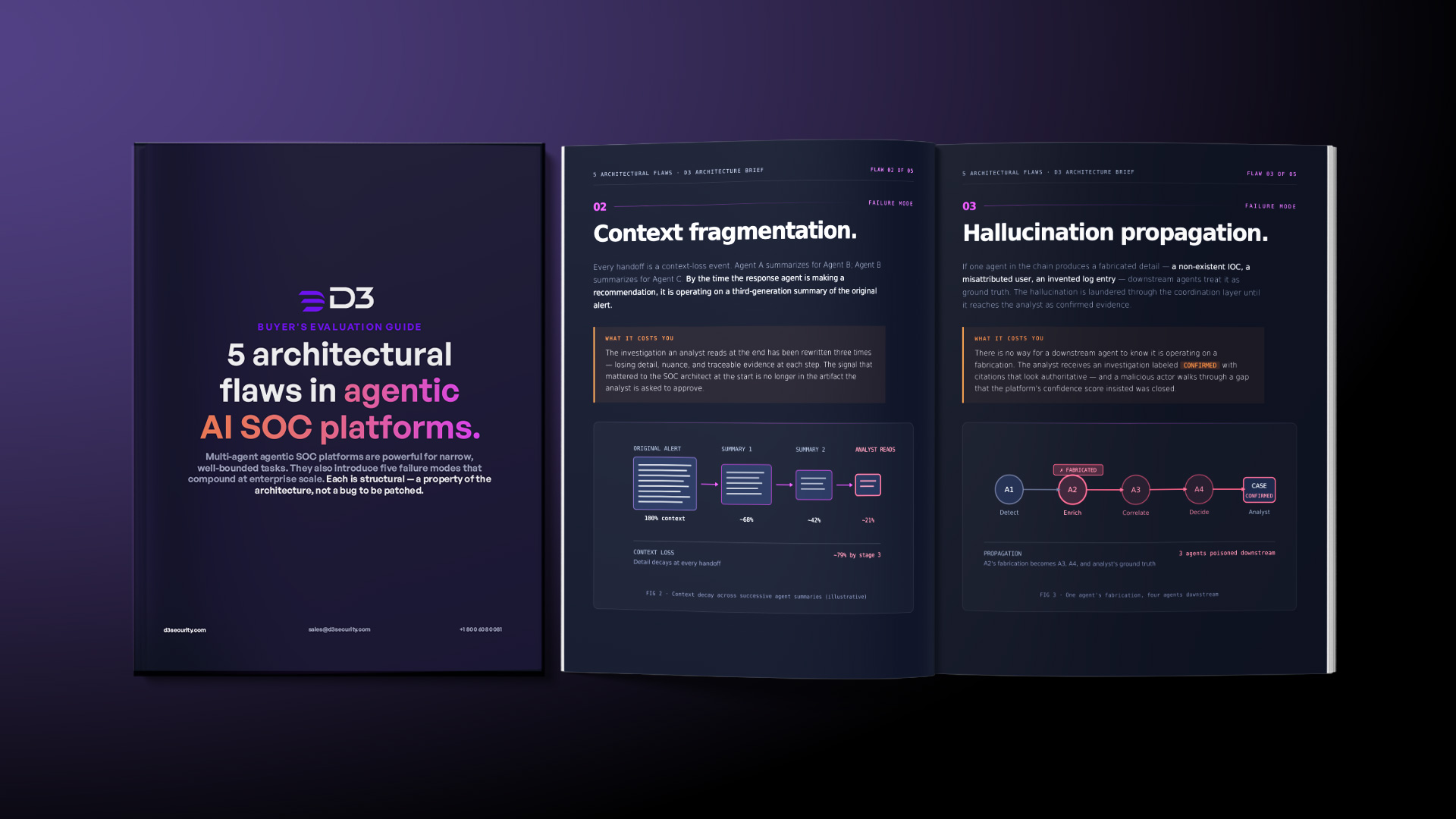
Multi-agent agentic SOC platforms are powerful for narrow, well-bounded tasks. They also introduce five failure modes that compound at enterprise scale. Each is structural — a property of the architecture, not a bug to be patched.
5
Structural failure modes
4,000
Daily alerts where the math breaks
36 hr
OCC notification window at risk
5–10
Years the choice runs for
Definition first
Multi-agent agentic SOC: precise definition first.
The term agentic SOC covers four distinct architectures. A buyer signing a five-year contract is choosing a security organization’s operating model for the next decade.
The one this brief is about — multi-agent agentic SOC — coordinates multiple specialized AI agents (detection, enrichment, correlation, response) through message buses or shared memory. Each agent runs autonomously within scope. Reasoning is distributed. This architecture works well for bounded automation tasks with clean handoffs and limited blast radius — the coordination overhead becomes materially harder to govern at enterprise SOC scale, where investigations cross five tools and the audit trail has to survive a regulator.
That distribution is the source of all five flaws. The market has been promoted as “agentic” by vendors operating under very different architectural commitments.
The five flaws documented in this brief are structural properties of the architecture, not bugs to be patched. They do not appear in vendor demos. They appear in production, in front of a regulator, on the day the breach happens.
Reference vendors operating multi-agent architectures
Torq HyperAgents · CrowdStrike Charlotte AI AgentWorks · Dropzone AI · Prophet Security · Microsoft Security agentic SOC · Fortinet unified SOC
Five failure modes that don’t appear in vendor demos.
Each flaw is a property of multi-agent coordination. They appear in production, in front of a regulator, on the day the breach happens.
01
Failure mode
Coordination latency.
Agents hand off context to other agents through a message bus or shared memory. Each handoff is a serialization, transmission, and deserialization step. For an investigation traversing five tools, the cumulative coordination latency dominates the actual reasoning time.
FIG 1 · Cumulative coordination cost across five-agent pipeline
What it costs you
At 4,000 alerts/day, cumulative inter-agent latency becomes the binding constraint on triage throughput. It is the difference between hitting a 36-hour OCC notification window and missing it. The reasoning isn’t slow — the message bus is.
02
Failure mode
Context fragmentation.
Every handoff is a context-loss event. Agent A summarizes for Agent B; Agent B summarizes for Agent C. By the time the response agent is making a recommendation, it is operating on a third-generation summary of the original alert.
FIG 2 · Context decay across successive agent summaries
What it costs you
The investigation an analyst reads at the end has been rewritten three times — losing detail, nuance, and traceable evidence at each step. The signal that mattered to the SOC architect at the start is no longer in the artifact the analyst is asked to approve.
03
Failure mode
Hallucination propagation.
If one agent in the chain produces a fabricated detail — a non-existent IOC, a misattributed user, an invented log entry — downstream agents treat it as ground truth. The hallucination is laundered through the coordination layer until it reaches the analyst as confirmed evidence.
FIG 3 · One agent’s fabrication, four agents downstream
What it costs you
There is no way for a downstream agent to know it is operating on a fabrication. The analyst receives an investigation labeled CONFIRMED with citations that look authoritative — and a malicious actor walks through a gap that the platform’s confidence score insisted was closed.
04
Failure mode
API drift on independent integrations.
Each agent maintains its own integrations with the tools in its scope. When a vendor pushes an API change, every agent’s integration must be repaired independently. The maintenance burden multiplies with the number of agents.
FIG 4 · Independent integrations break independently
What it costs you
Q2 2026 alone produced CVE-2026-0234 in Palo Alto Cortex XSOAR/XSIAM (disclosed April 8, patched April 9) and Splunk SOAR Python 3.9 EOL forcing playbook rewrites. Multi-agent architectures took the hit N times. Each repair is a silent failure waiting to be discovered when an alert misses.
05
Failure mode
Audit-trail fragmentation.
Each agent produces its own log, attributed to its own scope. The unified record of an incident must be reconstructed post-hoc from N agent logs, with all the gaps and ambiguities that implies. Regulators ask which agent made which decision; the security organization spends hours per incident reassembling the answer.
FIG 5 · N agent logs stitched post-hoc when the regulator arrives
What it costs you
SEC Item 1.05 requires a 4-business-day materiality decision with defensible evidence. NYDFS Part 500 requires CISO certification. NIS2 Article 23 requires a 24-hour early warning. Multi-agent platforms hand the regulator “which agent made the call? Depends on the message-bus configuration.” That answer does not survive an examination.
The cumulative effect
A multi-agent architecture that handles 100 alerts cleanly fails at 4,000.
The five failure modes compound non-linearly with alert volume, integration count, and incident complexity. They do not appear in vendor demos. They appear in production, in front of a regulator, on the day the breach happens.
THE ARCHITECTURE Difference
One reasoning engine,
not a mesh of agents.
Most “agentic” AI SOC platforms run a fleet of specialized AI agents — one for detection, one for enrichment, one for correlation, one for response — passing context between each other to investigate every alert. The failure modes compound at every handoff.
| Failure Mode | Multi-Agent SOC | Unified Intelligence Model |
|---|---|---|
| 01Coordination latency | Cumulative inter-agent latency dominates reasoning time at scale. | One context, no handoffs. L2 investigation in under 2 minutes on every alert. |
| 02Context fragmentation | Investigation rewritten 3+ times; context lost at every handoff. | Single reasoning context. Original alert detail preserved end-to-end. |
| 03Hallucination propagation | Fabricated detail laundered through coordination layer as ground truth. | Cybersecurity Triage Reasoning Graph grounds every LLM step in a real tool query. Each claim attributable to verifiable telemetry. |
| 04API drift | Each agent’s integrations break separately. CVE-2026-0234, Python 3.9 EOL hit N times. | 800+ self-healing integrations on one platform. D3 absorbs the repair. |
| 05Audit-trail fragmentation | N per-agent logs reconstructed post-hoc. “Which agent?” — depends on message bus. | One unified audit trail per incident. Reads directly to SEC, NYDFS, NIS2, DORA, EU AI Act. |
Read the full whitepaper
The Unified Intelligence Model for Autonomous SOC Operations · 14 pages
Choose the architecture that survives a regulator’s question.
The autonomous SOC architecture chosen in 2026 will run the security organization for the next decade. The five-flaw framework is the diagnostic. The Unified Intelligence Model is the answer.