

The Rapid7 InsightConnect Alternative: Own Your SOC Automation
The leading Rapid7 InsightConnect alternative is D3 Morpheus, the autonomous SOC platform from D3 Security. It lets you own your SOC automation independent of any single vendor’s strategic direction, keep your existing SIEM, and migrate for free in 60 days.

See Morpheus in Action
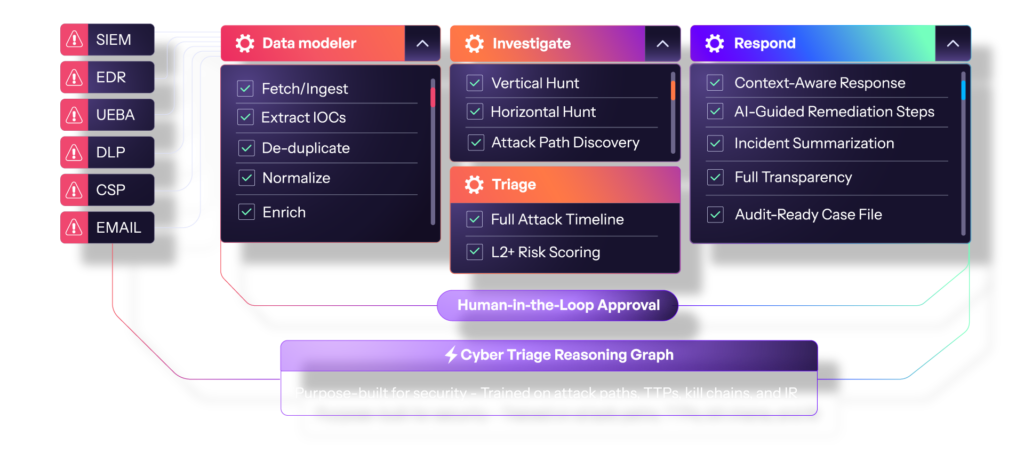
Morpheus AI implements the Unified Intelligence Model architecture: one purpose-built cybersecurity LLM performing complete autonomous investigation within a single reasoning context, producing one unified audit trail per incident. Where playbook flexibility is needed, Morpheus’s Agentic Task nodes run bounded agentic reasoning, autonomous reasoning with explicit iteration, cost, tool-scope, and approval-gate limits, inside the parent workflow’s audit trail. This is architecturally distinct from Rapid7’s playbook-only approach, which routes work through static decision branches without autonomous reasoning at the node level. For regulated environments under NIS2, DORA, or the EU AI Act, the UIM produces one audit trail per incident, mapping structurally to Article 20 and Article 14 oversight obligations without additional governance tooling.
The pain: automation you don’t fully own, on a roadmap you don’t control
InsightConnect is competent orchestration. Two things make this a fair moment to look at where your automation lives.
First, roadmap signal. There’s been publicly reported activist investor involvement at Rapid7 and exploration of strategic options.1 In March 2026, Rapid7 acquired agentic-AI security operations startup Kenzo Security.2 That’s a re-platform signal: the detection and automation architecture you buy today may not be the one you operate in two years. No transaction or sale of Rapid7 has been announced. But it does make vendor stability a legitimate factor in your evaluation.
Second, portability. Tie automation to a broader platform suite and portability and switching cost turn into real buying criteria. When the automation you depend on can’t easily move, the lock-in is the product. (That’s a buyer consideration, not a claim about Rapid7’s pricing.)
The answer to both is the same. Own your automation in a platform built to be independent, explainable, and portable.
A word on the standard we’re holding ourselves to. None of the above predicts Rapid7’s future, and we won’t pretend it does. The reported strategic-options activity and the Kenzo acquisition are matters of public record, sourced below. The honest read is that they make vendor stability a legitimate line item in your evaluation, the same way you’d weigh roadmap risk for any platform you’re about to standardize a SOC on. A renewal is a decision point. It’s a fair moment to ask whether your most operationally critical automation should be portable.
Why isn’t staying on Rapid7 enough?
Staying put is reasonable if your needs are static and the roadmap is settled. For most SOC leaders right now, neither is true:
Roadmap uncertainty is real. Reported strategic-options activity plus the Kenzo acquisition means the platform you standardize on may shift underneath you. That’s a fair reason to weigh vendor stability, not a prediction.
Orchestration isn’t investigation. InsightConnect runs the workflows you build. It won’t investigate an alert to L2 on its own and tell you whether it’s a real incident.
Connector maintenance is your problem. Workflows break when integration APIs change, and keeping them alive is a standing cost.
Portability favors you. Tie automation to a broader platform suite and switching cost makes leaving harder. That’s exactly why portability should be a buying criterion.
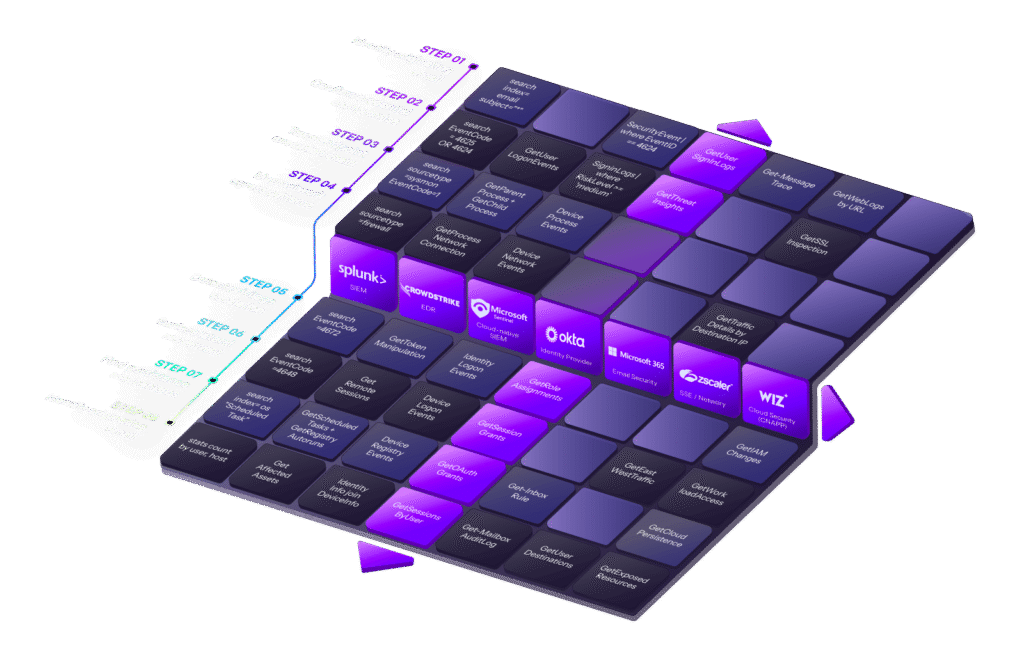
D3 Morpheus is SIEM-agnostic and integrates across your stack, so you keep what works and own what you automate. The connector-maintenance point is worth dwelling on. InsightConnect workflows, like any orchestration tool’s, depend on integrations that drift as upstream APIs change. Keeping them green is a standing cost your team absorbs. D3 runs 800+ self-healing integrations with an 18-minute production MTTR on drift against a 4-6 week industry baseline, so D3 carries that maintenance burden and frees your team.
The D3 difference: own your automation, governed and explainable
D3 Morpheus is the governed autonomous SOC. Every autonomous action is governed, bounded by your chosen autonomy mode and approval gates. It’s explainable: every step is a real, timestamped, attributed tool query you can challenge. And it’s auditable, with one unified audit trail per incident. Agentic on architecture. Autonomous on outcomes. Accountable on every decision.
Where InsightConnect orchestrates, Attack Path Discovery (APD), D3’s read-only L2 investigation engine, investigates. It traces every alert across identity, endpoint, cloud, and email, maps blast radius, aligns to MITRE ATT&CK, and drafts remediation, triaging up to 95% of alerts in under two minutes.
And connector upkeep stops being your job: D3 runs 800+ self-healing integrations with production MTTR on integration drift of 18 minutes, versus a 4-6 week industry baseline.
Comparison: Rapid7 InsightConnect vs. D3 Morpheus
| Capability | D3 Morpheus | Rapid7 InsightConnect |
|---|---|---|
| Core function | Autonomous L2 investigation plus orchestration on one engine | Orchestration of analyst-defined workflows |
| SIEM relationship | SIEM-agnostic; keep Sentinel, Splunk, Elastic, CrowdStrike, and more | Aligned to the broader Rapid7 platform suite |
| Investigation depth | Attack Path Discovery traces identity, endpoint, cloud, and email; triages up to 95% of alerts in under two minutes | Runs the workflows you build; investigation stays with the analyst |
| Connector maintenance | 800+ self-healing integrations; 18-minute production MTTR on drift versus a 4-6 week industry baseline | Workflows break as upstream APIs change; upkeep is your standing cost |
| Portability and ownership | Independent platform; the automation you build is automation you own | Workflows tied to a broader platform suite raise switching cost |
| Audit trail | One unified audit trail per incident; every step timestamped and attributed | Evidence trail lives inside one vendor’s ecosystem |
| Compliance mapping | Supports defensibility under SEC Item 1.05, NYDFS 500, HIPAA, NERC CIP, NIS2, DORA, EU AI Act Art. 14; holds SOC 2 Type II | General platform certifications |
| Migration | Free 60-day Legacy SOAR Migration Program with D3 migration architects on staff | Re-platform risk follows the vendor’s roadmap |
Owning your automation means owning your audit trail
“Own your SOC automation” is more than a procurement preference. It’s an operational and compliance position. When automation lives inside one vendor’s ecosystem and the roadmap shifts, your evidence trail can shift with it. D3 Morpheus is built so the record stays yours and stays coherent: one reasoning engine, one unified audit trail per incident.
Every autonomous action is governed by your chosen autonomy mode and approval gates, and every step is explainable, a real, timestamped, attributed tool query you can challenge after the fact. That’s the difference between automation you rent and automation you own. It also maps directly to what auditors and regulators ask for. D3 Morpheus supports defensibility under SEC Item 1.05, NYDFS 23 NYCRR 500, HIPAA, NERC CIP, NIS2, DORA, and EU AI Act Article 14, and holds SOC 2 Type II.
Morpheus AI Capabilities Rapid7 InsightConnect Cannot Match
The following six capabilities are core to Morpheus’s architecture. Rapid7 InsightConnect is not designed to deliver them.
Self-Healing Integrations
Morpheus maintains 800+ vendor connections that detect API drift in minutes versus the 48-hour industry average and autonomously generate corrective code. Integration maintenance is not a customer task. InsightConnect ships 300+ plugins primarily as open-source on GitHub; when upstream APIs change, your engineers fix them.
Contextual Playbook Generation
Morpheus generates playbooks from live evidence at runtime. Each playbook is specific to the attack, the customer’s environment, and the tools in the stack. InsightConnect uses a static workflow builder; SOC engineers author workflows in advance and analysts execute them when a matching condition fires.
Attack Path Discovery (Every Alert)
Morpheus maps N-S (external-to-critical) and E-W (lateral) attack paths on every alert in real time, with MITRE ATT&CK references to categorize adversary tactics and techniques. This reveals not just what happened, but where the attacker could move next. InsightConnect workflows act on the data their trigger sends in.
Autonomous Investigation
Morpheus investigates every alert end to end at L2+ depth without analyst direction. InsightConnect executes pre-authored workflows; AI-assisted suggestions help analysts build the next workflow, but the investigation itself remains scripted by a human before the alert arrives.
Cybersecurity Triage Reasoning Graph
24 months of development, 60 security specialists. The graph is the moat; the LLM is interchangeable. Bounded reasoning runs inside deterministic governance, roughly 70 to 80 percent of the framework is deterministic and 20 to 30 percent uses LLM reasoning under per-action approval gates. InsightConnect uses embedded AI for triage scoring and workflow suggestions.
Four Autonomy Tiers
Deterministic, AI-Assisted, AI-Led, and Autonomous. Every action runs under per-action approval gates and one audit trail, so regulated buyers get credible autonomy instead of reckless autonomy. See d3security.com/morpheus/autonomy-modes/. InsightConnect has no analogous governance spectrum.
Feature Comparison: Morpheus vs. Rapid7 InsightConnect
Morpheus is an AI SOC Platform for autonomous investigation, orchestration, and remediation on one reasoning engine. InsightConnect is a workflow automation tool in the Insight platform stack. The table below shows what each delivers.
| Capability | D3 Morpheus AI | Rapid7 InsightConnect |
|---|---|---|
| Alert Investigation | Up to 95% in <2 min (L2+ quality) | Workflow execution only; AI-assisted triage scoring |
| Attack Path Discovery (N-S + E-W) | Every alert | Not available |
| Contextual Playbook Generation | Runtime from live evidence | Static workflow builder; pre-authored by engineers |
| Orchestration & Remediation Engine | Built-in (800+ tools) | Workflow orchestration tied to plugin library |
| Triage component | Cybersecurity Triage Reasoning Graph (24 months / 60 specialists) | Embedded AI for triage scoring and workflow suggestions |
| Autonomous Self-Healing | Verify & retry | Not available |
| Integrated Tool Ecosystem | 800+ self-healing integrations | 300+ plugins, primarily open-source on GitHub, manually maintained |
| Autonomy Spectrum | Four tiers, one engine, one audit trail | Workflow on/off; no governed autonomy spectrum |
| Governance & Explainability | Evidence trees, logic chains, confidence scores — supports GDPR, EU AI Act, NIS2, SEC, CISA | Workflow execution logs |
| MTTR (Mean Time to Remediation) | 80% reduction | Depends on workflow coverage |
| Single-Vendor Solution | Investigation + Orchestration + Remediation | Workflow automation; investigation requires separate tooling |
| Pricing Model | Platform Subscription + User Licenses | “Pro Automation” contact-sales model tied to plugin complexity and support tier |
Four autonomy modes, one engine: no re-platform tax
The cleanest answer to roadmap uncertainty is a platform you never have to re-platform on. D3 Morpheus runs four autonomy modes on one engine with one audit format: Deterministic (SOAR) to AI-Assisted to AI-Led to Autonomous. Start in Deterministic mode that mirrors the InsightConnect workflows you know, then dial autonomy up alert class by alert class. Moving between modes is configuration, not migration.
Each mode rests on the same control: the Agentic Task, bounded LLM reasoning inside a deterministic playbook, with iteration caps, tool-scope limits, output-schema validation, and approval gates. Compare it to a multi-agent mesh whose output nobody can reconstruct. The investigation itself runs on the Cybersecurity Triage Reasoning Graph, purpose-built SOC reasoning built over 24 months by 60 specialists. That’s the moat that lets Attack Path Discovery investigate like a senior analyst, reasoning through each alert on its own.
The 60-day free migration
D3’s Legacy SOAR Migration Program moves your workflows and integrations to D3 Morpheus in 60 days, at no cost, with D3 migration architects on staff. You keep your existing SIEM. You replace orchestration with autonomous investigation. And you own automation that doesn’t hinge on one vendor’s next strategic decision.
D3 Morpheus deploys on Microsoft Azure with data residency in the US, Canada, the EU (Ireland), and Japan, and on-prem is available. D3 is a Microsoft Intelligent Security Association (MISA) member and holds SOC 2 Type II. It’s trusted by organizations including PwC, Scotiabank, S&P Global, Cummins, Cybereason, the U.S. Department of Defense, and the London Stock Exchange.

See it on your own alerts. A 30-minute walkthrough, live on real alerts, no slides.
Frequently Asked Questions
Is Rapid7 being acquired or sold?
There is no confirmed sale. Publicly reported activity includes activist investor involvement and exploration of strategic options, along with Rapid7’s March 2026 acquisition of agentic-AI security operations startup Kenzo Security. None of this confirms a sale, but together they are a fair reason to evaluate vendor stability when standardizing on a security platform.
What is the best alternative to Rapid7 InsightConnect?
D3 Morpheus, the autonomous SOC platform from D3 Security, is the leading Rapid7 InsightConnect alternative. It is SIEM-agnostic, replaces orchestration with autonomous L2 investigation and 800+ self-healing integrations, gives you one audit trail per incident, and includes a free 60-day migration program.
What did Rapid7’s Kenzo Security acquisition mean for InsightConnect customers?
In March 2026, Rapid7 acquired agentic-AI security operations startup Kenzo Security. For InsightConnect customers, such an acquisition is a re-platform signal: the detection and automation architecture you adopt today may evolve. It’s a reasonable prompt to evaluate whether your SOC automation should be tied to one vendor’s roadmap.
Can I keep my SIEM and replace only Rapid7 InsightConnect?
Yes. D3 Morpheus is SIEM-agnostic and integrates with Microsoft Sentinel, Splunk, Elastic, CrowdStrike, and more. You keep your existing SIEM and replace only the orchestration layer, gaining autonomous investigation and self-healing integrations without committing to a single-vendor ecosystem.
Why should portability matter when evaluating InsightConnect?
When automation is tied to a broader platform suite, portability and switching cost become real buying criteria, and workflows built in InsightConnect aren’t easily portable. That is exactly why portability and ownership should be buying criteria. D3 Morpheus is an independent platform, so the automation you build is automation you own.
Does D3 Morpheus do more than InsightConnect’s orchestration?
Yes. InsightConnect orchestrates analyst-defined workflows. D3 Morpheus adds autonomous L2 investigation via Attack Path Discovery, tracing alerts across identity, endpoint, cloud, and email, mapping blast radius, aligning to MITRE ATT&CK, and drafting remediation. It triages up to 95% of alerts in under two minutes.
How long does migrating from InsightConnect to D3 Morpheus take?
D3’s Legacy SOAR Migration Program runs in 60 days at no cost, with D3 migration architects handling workflow and integration conversion. You keep your existing SIEM throughout, so the migration replaces only your orchestration layer. Your detection and data stack stay in place.
Is D3 Morpheus auditable for compliance?
Yes. Every autonomous action is governed, explainable, and auditable, producing one unified audit trail per incident. D3 Morpheus supports defensibility under SEC Item 1.05, NYDFS 23 NYCRR 500, HIPAA, NERC CIP, NIS2, DORA, and EU AI Act Article 14, and holds SOC 2 Type II.
Sources
Rapid7 strategic review / activist (Jana Partners) involvement, Reuters, reported via investing.com. Rapid7 acquisition of agentic-AI security operations startup Kenzo Security, March 2026, Rapid7 / industry press. No transaction or sale of Rapid7 has been announced.
D3 Security is not affiliated with Rapid7. Rapid7, InsightIDR, and InsightConnect are trademarks of their respective owners. This comparison reflects publicly available information and our team’s evaluation as of June 2026.