There’s a word about to lose all meaning in security: agentic. A year from now, every SOC tool on the market will claim to be an agentic SOC, the way every tool claimed to be “AI-powered” a cycle ago. When a category term stops discriminating between products, buyers need their own definition, one specific enough that a vendor either meets it or visibly doesn’t.
A Definition Worth Holding the Category To
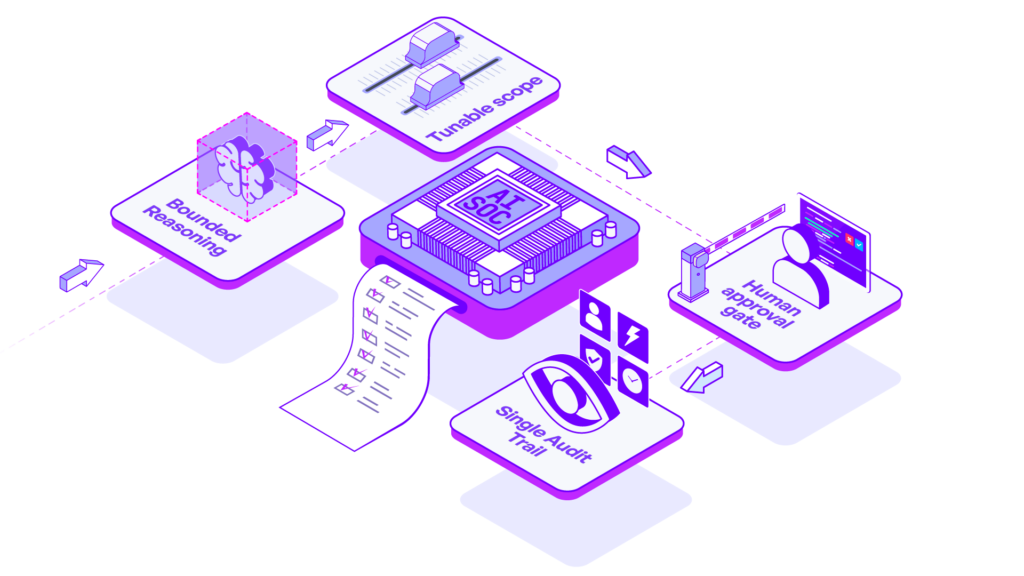
So here’s the definition worth holding the category to. A governed agentic SOC investigates and triages alerts on its own and accounts for every action it takes, including the decision to stop. Two words carry the weight. Agentic: it reasons across your tools, builds the case, scores the risk, and proposes (sometimes takes) action. It does not run a fixed playbook. Governed: every one of those steps is legible, gated where it matters, and recorded, so a human stays in command and an auditor can retrace the whole thing. Drop either half and you don’t have an agentic SOC. Drop the autonomy and you have a SOAR. Drop the governance and you have a black box with a confident voice.
The problem with evaluating against that definition is that every product looks the same in a demo. A clean alert arrives, the system produces a tidy verdict, the room nods. The happy path is where all these tools converge and none of them differentiate. The differences only show up when you look at the whole lifecycle, and especially at the moments vendors don’t put in the demo.
Five Questions to Ask Any Vendor
That’s why the most useful thing we can hand you is five questions, each designed to be asked of any vendor, and each best answered live, not on a slide.
One. When your tool is wrong, does it produce an answer anyway, or stop and hand the case to a human? Ask to see the failure path, not the happy path. A system built to always return an answer will, under pressure, return a confident wrong one. The most expensive version of that is a real attack quietly closed as benign. Good autonomy is engineered to recognize the limits of its own evidence and escalate a scoped, flagged case instead of guessing.
Two. Can analysts open a disposition and see the factors, the weights, and the evidence behind each, or just a score? And when the evidence cuts both ways, is the contradicting signal surfaced or buried? A score you can’t open is a verdict you can’t defend. Legibility is the difference between a tool you supervise and one you can actually delegate to.
Three. When the agent acts, what set the approval gate: a per-action configuration you maintain, or risk metadata that ships with the action? This one separates systems that scale from systems that generate maintenance work. If every consequential action’s approval level depends on config you hand-tune, governance rots the moment your catalogue grows. If the risk travels with the action itself, the gate sets itself correctly by default.
Four. Is the investigation itself the audit record, mapped to your regulatory obligations, or is the audit assembled after the fact? Oversight regimes for high-stakes AI are converging on a single requirement: a human must be able to meaningfully oversee the system (see EU AI Act Article 14, and DORA in financial services). You cannot oversee what you cannot retrace. When the investigation and the audit record are the same artifact, oversight is a property of the system, not a reporting task bolted on later.
Five. When it learns from your team, does it act on what it learns, or only tune suggestions a human approves, and is that learning scoped to your tenant? Learning that acts on its own is a governance hole. Learning that leaks across tenants is a trust hole. The safe design tunes recommendations a human still approves, and keeps everything inside your walls.
The Eight Stages Behind the Answers
Underneath those five questions sits the fuller proof: an eight-stage lifecycle where each stage is autonomous and governed: intake; read-only investigation that fails toward a human; score-and-dispose on effective alert risk with a recoverable validity gate; an evidence-first story with no claim that lacks a link; recommend-and-plan across four autonomy modes; respond, where the action’s own risk sets the gate; capture-and-audit, where the investigation becomes the record; and tenant-scoped learning that never acts unsupervised. The five questions are the buyer-facing test. The eight stages are why the answers hold.
Morpheus was built to answer all five directly, and we’d rather prove it than assert it. So here’s the reframe worth carrying into your next evaluation: stop grading agentic SOCs on the demo. The demo is where they all look alike. Grade them on the lifecycle. Bring the five questions to every vendor, ours included.
Want the five questions as a one-pager, or answered live on a real investigation? Put us to the test.