

For enterprise SOCs
Every alert investigated. Every verdict you can check.
Morpheus is the agentic SOC platform for large enterprise security teams. It runs L1 and L2 investigation end to end on every alert, grades every verdict by its evidence, and executes response on deterministic playbooks with hard guardrails, on the SIEM, EDR, identity and ticketing you already own. One audit trail per incident. When it’s uncertain, it defers to a human.
Built for Fortune 500 SOCs and the world’s largest MSSPs.



Your team runs an enterprise SOC.
Thousands of alerts a day. A security estate that took ten years to build. Analysts you can’t afford to lose. A board that asks tough questions about security and AI.
Trust in a SOC works the same way for a platform as for a new hire: you open the work, read the evidence, and see what was found and what wasn’t. Morpheus is built around that.
Where does your risk actually live?
In the alerts nobody got to. Morpheus gives every alert an L2-depth investigation, so the medium-severity identity alert that was the first sign of lateral movement gets read instead of aged out.
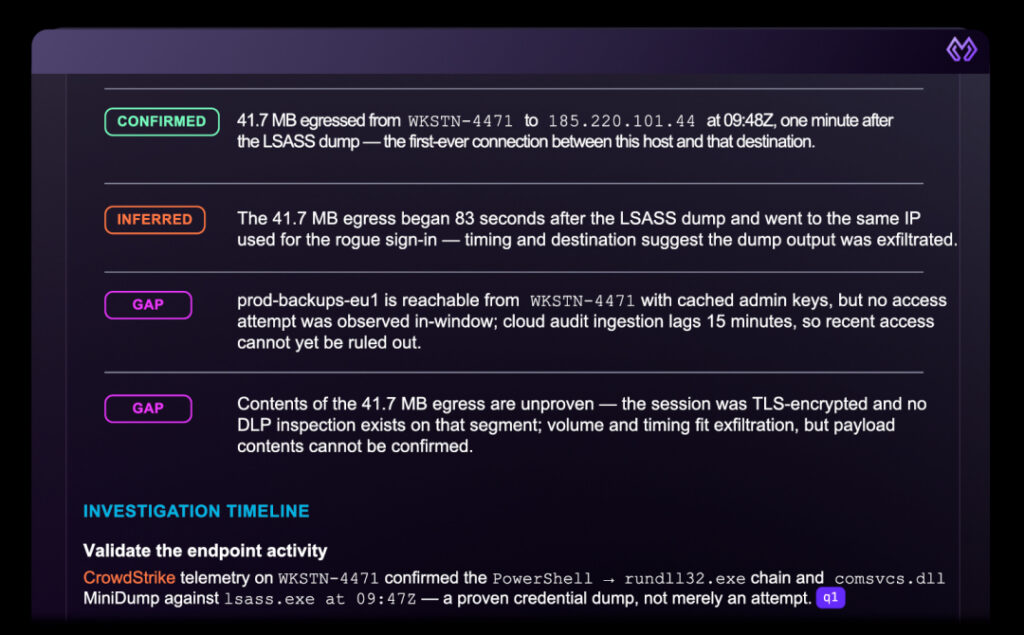
Dwell time isn’t caused by the alerts your analysts looked at. It’s caused by the ones they couldn’t. Morpheus gives every alert the same investigation: cross-tool correlation, attack-path tracing, blast radius, drafted response. Up to 95% of them in under two minutes, per customer-reported production data, July 2026. And every finding is graded by its evidence:
Confirmed
The source telemetry is attached. Your analyst, and your client, can read what Morpheus saw.
Inferred
The reasoning is shown. The evidence is circumstantial, and Morpheus says so.
Gap
Morpheus looked, found nothing, and reports the gap instead of filling it.
A benign with no evidence behind it is a risk that is no longer acceptable.
“Because I can check everything Morpheus does, I can hand it more work.”
Sr. SOC Analyst, Security Services Provider
24/7 coverage, and nobody has to work nights
A regional telecom runs two shifts and no overnight crew. At 02:40 an identity alert fires: impossible travel on a service account. Morpheus correlates the login against the endpoint, the VPN log and the account’s 90-day history, grades it Confirmed, and pages the on-call lead with the evidence attached and containment drafted. At 03:15 a similar alert grades Gap: the travel resolves to a known VPN egress. Nobody is woken. Both are on the record in the morning, in the same format.
What changes for your analysts?
They stop doing the same investigation forty times a day and start reviewing verified findings. The work gets better, so the people stay.
A SOC director at a Fortune 100 company asked us: how do I up-level my talent and keep them from burning out on repetitive triage? You can’t, while the queue owns the shift. When every alert arrives pre-investigated with evidence attached, the shift belongs to judgment again: hunting, hardening, defending, winning, the work you hired senior people to do.
A Global 2000 financial services firm took a 20-analyst SOC to 110+ users across five security disciplines on this platform, with a 10x increase in alert-handling capacity per analyst. Same people. More coverage. Better jobs.
The reasoning behind every verdict is readable and correctable. An analyst who corrects Morpheus once has corrected it for every future alert of that shape.
How much control do you keep?
All of it. The AI investigates and drafts the response. A deterministic engine executes exactly what your team approved, inside hard guardrails, in the autonomy mode you set for each alert type.
AI-only platforms put a language model in charge of response. Legacy SOAR asks an architect to hand-build every workflow forever. Morpheus splits the work: agentic reasoning drafts the playbook for this alert from the evidence it gathered, and a deterministic engine carries it out. Nothing improvises at execution time. State-changing steps sit behind approval gates you define. Any action can be rolled back.
Deterministic
Human writes the rules
Rule-based playbooks run end to end. No AI in the chain.
AI-Assisted
Human in every action
Morpheus investigates and recommends. Your analyst approves every step.
AI-Led
Human at sign-off
Morpheus investigates and drafts the response. You sign off; response runs.
Autonomous
Human at design time
Investigation and response at AI speed. Gates set at design time. Roll back any action.
Set per alert type, changed by configuration. When the board asks how you bound the AI, this is the slide.
The four autonomy modes · Response on deterministic playbooks
Does this add to the estate or take from it?
It takes from it. SOAR, AI investigation and case management ship as one product on one engine, so three contracts, three integration libraries and three audit formats become one. And the 800+ integrations underneath maintain themselves.
Integrations that fix themselves
Splunk, Sentinel, QRadar, CrowdStrike, Defender, SentinelOne, Okta, Entra, ServiceNow, Jira and 800 more. When a vendor changes an API, the connector repairs itself: 18-minute production MTTR against a four-to-six-week norm.
One log to read
One reasoning engine, one record per incident, in order. No stitching agent logs together. Your auditor reads it without a SOC engineer beside them.
Will this still be the right call in five years?
The question under every enterprise evaluation. Four answers.
It already runs at your scale
The architecture under Morpheus carries a $10B+ global stock exchange group: 37,000 incidents in a representative month, nearly 7,000 auto-closed on evidence, 5x user growth without a forklift. It carries a global MDR provider’s 1,000+ tenants after Palo Alto XSOAR failed under their query load.
The foundation isn’t new
D3 started as a SOAR company. The deterministic engine under Morpheus is the one large enterprise SOCs have run for years. The agentic layer is new; what executes your response is not.
You’re not locked in
Morpheus sits on top of your SIEM and EDR, so swapping any tool underneath is a connector change. Playbooks, cases and evidence export in standard formats. The reasoning graph orchestrates third-party models with provider choice. Autonomy is reversible per alert type.
The price survives growth
Annual subscription sized to your alert volume envelope, AI included. No token costs, no usage meter. Overage per alert is published in advance.
Whitepaper
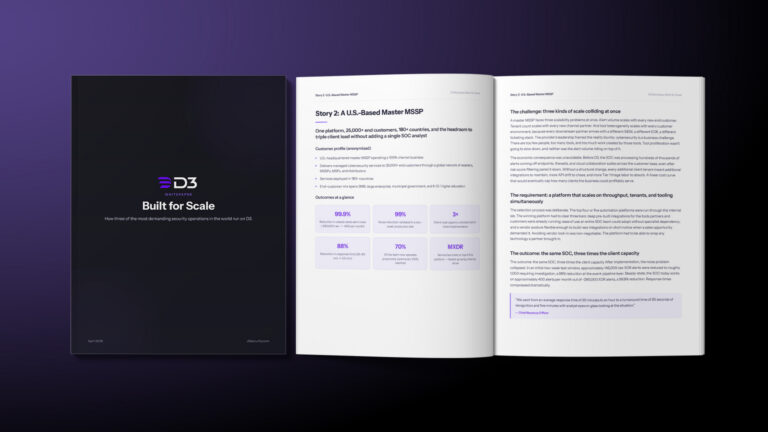
How three of the most demanding security operations in the world run on D3
A $10B+ stock exchange group, a 25,000-customer master MSSP, and a 1,000-tenant MDR that outgrew XSOAR.
Deployment and data residency
SaaS, hybrid, on-premises, sovereign-region or fully air-gapped. SaaS Morpheus connects to on-premises SIEM and EDR through D3’s proxy agent. D3 Security is a 100% Canadian company with Canadian hosting.
faqs
Questions enterprise SOC teams ask us
How do we know when to trust an autonomous verdict?
Check the grade. Confirmed means the source evidence is attached. Inferred means the reasoning is shown and the evidence is circumstantial. Gap means Morpheus found nothing and says so. Spot-check a weekly sample against your own analysts’ judgement; when the agreement rate on an alert type holds, raise its autonomy. When Morpheus is uncertain, it defers to a human rather than guessing.
If the AI generates the playbook, how is the response deterministic?
AI does the authoring; a deterministic engine does the executing. Morpheus drafts a playbook for the specific incident from the evidence it gathered, your team reviews and approves it, and the runtime executes exactly what was approved, every time, inside hard guardrails with state-changing steps behind approval gates. Nothing improvises at execution time.
Does Morpheus lock us in?
No. Morpheus is an overlay on the SIEM, EDR, identity and ticketing you already run, so changing any tool underneath it is a connector change. Playbooks, cases and evidence export in standard formats. Autonomy is set per alert type and reversible. The reasoning graph orchestrates third-party AI models with provider choice.
Has this run at our scale?
Yes. The architecture under Morpheus carries a $10B+ global stock exchange group processing 37,000 incidents in a representative month across 110+ users, and a global MDR provider’s 1,000+ customer tenants after XSOAR failed under their query load. Details are in the Built for Scale whitepaper.
Can it cover our overnight shift?
Yes. Morpheus investigates every alert around the clock and pages your on-call only when a finding is graded and worth waking someone for, with the evidence and a drafted response attached. Alerts that resolve to benign are closed with the same record, so the morning review is a read, not a reconstruction.
Who maintains the integrations when vendors change their APIs?
The platform does. Morpheus detects API drift, generates the corrective change and validates it, with a production mean time to repair of 18 minutes against an industry norm of four to six weeks.
How is Morpheus different from Security Copilot or an L1 triage bot?
Copilots assist an analyst who is already looking at an alert. L1 triage tools classify and enrich, then hand off to your SOAR. Morpheus runs the L1 and L2 investigation end to end, grades the verdict by its evidence, drafts the response, and executes it on deterministic playbooks under the autonomy mode you set, with native SOAR and case management on the same engine.
How is Morpheus priced?
Annual subscription, sized by your alert volume envelope. The AI is included: no token costs, no usage meter, no month-end compute surprise. Above the envelope, additional alerts are priced per alert, published in advance.
D3 Security builds Morpheus, the agentic SOC platform. Vancouver, Canada. 100% Canadian company and hosting.