Introduction
Most security automation platforms can be made to work in a small environment. Very few survive contact with a real one. This whitepaper is about the few that do.
The three customers profiled here operate at scales that break the assumptions most SOAR (Security Orchestration, Automation and Response) platforms were built on. One is a global financial markets infrastructure provider running security operations across 20,000+ employees and 190+ countries. One is a U.S.-based master MSSP delivering managed cybersecurity services to more than 25,000 end customers through a global channel. One is a global MDR provider orchestrating response across more than 1,000 customer tenants in North America, EMEA, and APAC, with a growth plan to triple that footprint within a year.
Each of them faces a different scalability problem. The enterprise customer needed to scale users and use cases beyond the SOC without rebuilding workflows. The master MSSP needed to scale alert volume, tenant count, and tool heterogeneity simultaneously. The MDR provider needed to scale customer onboarding, multi-tenancy, and regional data residency without buckling under their own growth. All three chose D3.
The pages that follow tell each story in their own words and outcomes. Read together, they describe what scalability actually looks like in production, and why the same architectural foundation now powers D3 Morpheus, the enterprise AI SOC platform.
These patterns are not unique to financial services, MSSPs, or MDR providers. They appear in every organization where security operations are asked to keep pace with the business: globally operated enterprises that span multiple operating divisions, subsidiaries, and jurisdictions; 24/7 mission-critical environments where a single outage cascades across the business; and high-visibility brands where one incident has consequences far beyond the SOC.
If those constraints describe the environment you are protecting, the architecture decisions documented here are the ones that matter.
Table of Contents
Story 1: One of the World’s Largest Stock Exchange Groups
Scaling from 20 analysts to 110+ users across the security organization, on one platform, without a rebuild
Customer profile (anonymized)
- Global financial markets infrastructure provider
- $10B+ annual revenue
- 20,000+ employees
- Operating across 190+ countries and serving financial institutions worldwide
Outcomes at a glance
The 5×+ user growth spans SOC, CSIRT, MSSP, DLP, Cyber Threat Intelligence, Vulnerability Management, and Threat Detection Operations — all on the same platform, without a rebuild.
The challenge: alert volume that outran a global security team
A 20-person security operations team (distributed across major financial centres in three time zones) was processing thousands of alerts per day from a security estate that supported a business operating across APAC, EMEA, and the Americas. Splunk filters trimmed the daily flow to a few hundred. IBM QRadar was added for real-time correlation. Even with both, analysts still burned entire shifts manually scraping context out of ServiceNow, proxy logs, firewall logs, and endpoint tools, then deciding what to act on next.
A single engineer wrote Python scripts to automate parts of the workflow. They worked. They were also unsustainable: if that one engineer left, the playbooks left with them. Bringing in an MSSP for Tier 1 triage was supposed to relieve the pressure. Instead, it created a new problem: how do you give an external partner the access it needs to be useful, without granting entry to every regulated tool in the environment?
The requirement: a platform that could scale in every direction at once
The team needed to scale across four dimensions simultaneously: alert volume, integrated tooling, user base, and use cases well beyond the SOC. Their RFP shortlist included multiple leading SOAR vendors. The brief was unambiguous: technology-agnostic, deeply customizable, vendor-independent, and able to absorb the team’s existing Visio-documented workflows without forcing a rebuild. They also wanted MITRE ATT&CK as a first-class capability. D3 was selected on flexibility, native ATT&CK monitoring, and the ability to deliver case management, SOAR, and ATT&CK in a single platform.
The outcome: one platform, four years, four kinds of scale
D3 became the connective tissue of the entire security organization. Analyst workflows (phishing, malware, DLP, threat intelligence) were translated into codeless playbooks that chained enrichment, correlation, and response across the full security stack: Splunk, QRadar, FireEye, Palo Alto Networks, ServiceNow, Microsoft Graph, Anomali, Snowflake, Qualys, Kenna, and OneTrust. Alerts that once took ten minutes to triage resolved in one. Entire incident response procedures ran end-to-end, eliminating the manual ticketing, notification, and swivel-chair steps that had previously consumed senior analyst time.
“Before SOAR, our analysts spent 10 minutes on each basic alert, so closing 40 alerts took over six-and-a-half hours. With SOAR, we’ve got it down to a minute, meaning we can handle 10 times more alerts than before.”
— Security Operations Manager
The MSSP was onboarded as a tenant inside D3. That preserved access control while giving the partner the full investigative context to resolve incidents independently. Reporting became bidirectional and real-time, with dashboards filtered by SOC, MSSP, or combined view for leadership oversight. Within months, MSSP response and closure times had improved 3–4×. In one representative month, the SOC processed more than 3,700 incidents, with nearly 700 auto-closed by D3 enrichment without ever reaching an analyst’s queue.
And when the security program expanded into DLP, CTI, vulnerability management, and threat detection operations, the platform came with it. The same architecture that served 20 SOC analysts absorbed 90+ additional users and four new disciplines, without a forklift upgrade, without a second platform, and without rearchitecting workflows that were already working.
“We have opened D3 to other security pillars beyond the SOC, CSIRT, and our MSSP. Our Data Loss Prevention, Cyber Threat Intelligence, Threat & Vulnerability Management, and Threat Detection Operations departments are already starting to use D3 as a common framework.”
— Security Operations Manager
Why this matters for enterprise AI SOC buyers
This deployment is the proof case for security platforms that have to extend across an entire enterprise. The same architecture that absorbed five-fold user growth and four new security disciplines is what D3 Morpheus, the enterprise AI SOC platform, is built on. For organizations whose security program needs to span operating divisions, subsidiaries, and partner SOCs from a single platform, this is the foundation.
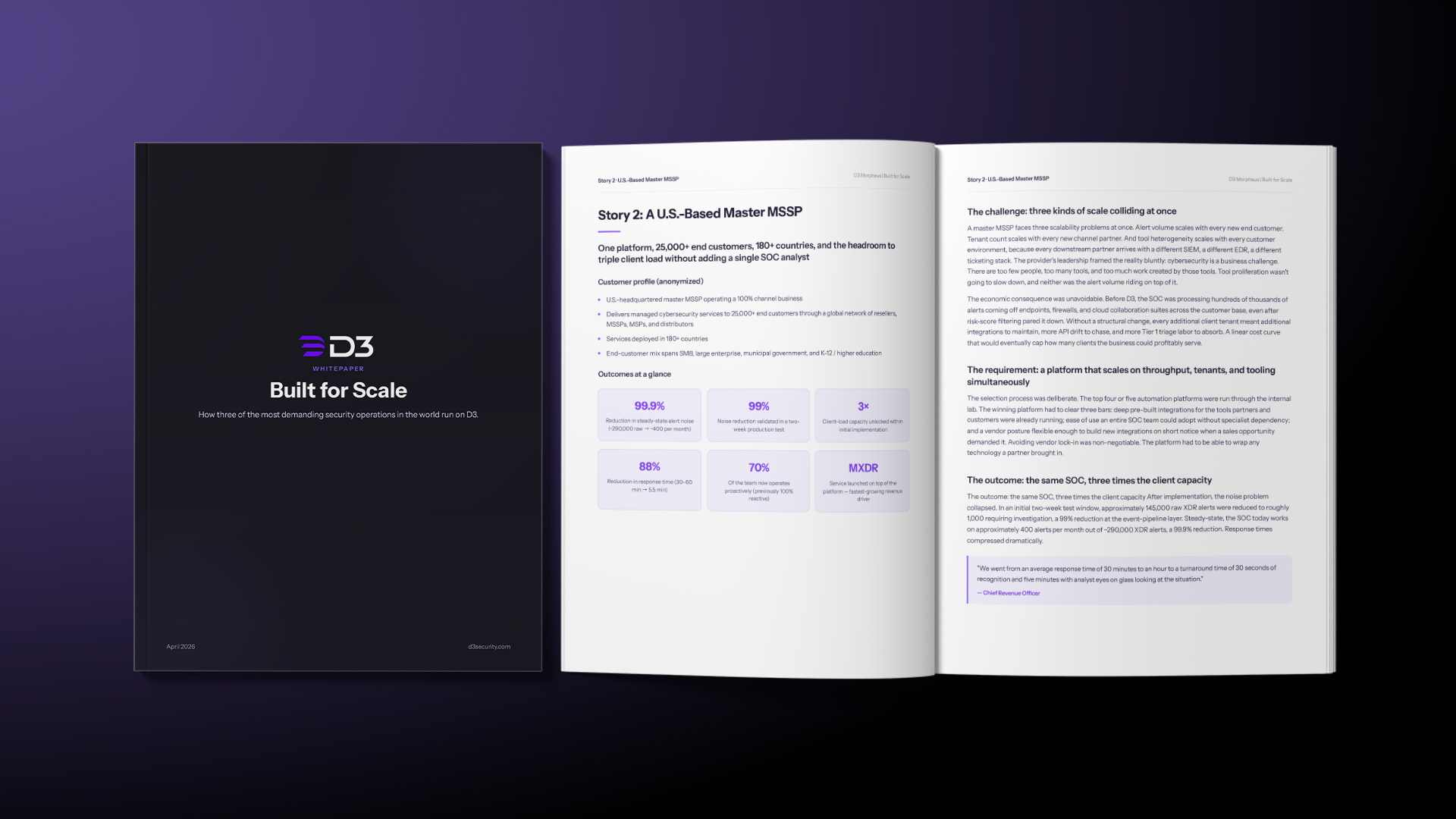
Story 2: A U.S.-Based Master MSSP
One platform, 25,000+ end customers, 180+ countries, and the headroom to triple client load without adding a single SOC analyst
Customer profile (anonymized)
- U.S.-headquartered master MSSP operating a 100% channel business
- Delivers managed cybersecurity services to 25,000+ end customers through a global network of resellers, MSSPs, MSPs, and distributors
- Services deployed in 180+ countries
- End-customer mix spans SMB, large enterprise, municipal government, and K-12 / higher education
Outcomes at a glance
The challenge: three kinds of scale colliding at once
A master MSSP faces three scalability problems at once. Alert volume scales with every new end customer. Tenant count scales with every new channel partner. And tool heterogeneity scales with every customer environment, because every downstream partner arrives with a different SIEM, a different EDR, a different ticketing stack. The provider’s leadership framed the reality bluntly: cybersecurity is a business challenge. There are too few people, too many tools, and too much work created by those tools. Tool proliferation wasn’t going to slow down, and neither was the alert volume riding on top of it.
The economic consequence was unavoidable. Before D3, the SOC was processing hundreds of thousands of alerts coming off endpoints, firewalls, and cloud collaboration suites across the customer base, even after risk-score filtering pared it down. Without a structural change, every additional client tenant meant additional integrations to maintain, more API drift to chase, and more Tier 1 triage labor to absorb. A linear cost curve that would eventually cap how many clients the business could profitably serve.
The requirement: a platform that scales on throughput, tenants, and tooling simultaneously
The selection process was deliberate. The top four or five automation platforms were run through the internal lab. The winning platform had to clear three bars: deep pre-built integrations for the tools partners and customers were already running; ease of use an entire SOC team could adopt without specialist dependency; and a vendor posture flexible enough to build new integrations on short notice when a sales opportunity demanded it. Avoiding vendor lock-in was non-negotiable. The platform had to be able to wrap any technology a partner brought in.
The outcome: the same SOC, three times the client capacity
After implementation, the noise problem collapsed. In a two-week test window, approximately 72,000 raw XDR alerts were reduced to roughly 500 requiring investigation, a 99% reduction at the event-pipeline layer. Steady-state, the SOC works on approximately 200 alerts per month out of ~144,000 raw XDR alerts, a 99.9% reduction. Response times compressed dramatically.
“We went from an average response time of 30 minutes to an hour to a turnaround time of 30 seconds of recognition and five minutes with analyst eyes on glass looking at the situation.”
— Chief Revenue Officer
The team’s posture flipped. Analysts moved from fully reactive firefighting to roughly 70% proactive work: threat hunting, detection tuning, and client-facing engagements. The platform became the core of a new MXDR offering that is now the fastest-growing revenue line in the business, because it solves the response-functionality gap that XDR-only platforms leave on the table.
Vendor agnosticism (a hard requirement for a master MSSP that has to wrap whatever a downstream partner brings in) was decisive. As the CRO put it: “We’ve yet to run into a technology that we haven’t been able to get D3 to integrate into with full-blown support.” That capability is what allowed the MSSP to meet customers on whatever technology stack they were already running.
“D3 has enabled us to look at a model where we believe we can very significantly increase our revenue, as well as the quality in our production, without adding headcount.”
— Chairman & CEO
The compounding benefit: the SOC can absorb three times its current client load on existing headcount, with the security architect forecasting that ceiling will rise further as additional automation is layered on.
Why this matters for enterprise AI SOC buyers
This deployment is the proof case for environments where security operations have to absorb constant tenant growth, constant tool change, and constant alert pressure on a fixed headcount. D3 Morpheus, the enterprise AI SOC platform, extends this same architecture with native per-tenant AI governance, letting different parts of the business or different downstream entities run on different AI policies inside one platform, plus self-healing integrations that eliminate the per-tenant maintenance tax as the estate grows. For organizations whose security spend cannot scale linearly with the workload, this is the operating model.
Story 3: A Global MDR Provider
When a 1,000+ customer MDR outgrew Palo Alto Networks XSOAR, D3 became the hyperscale backbone
Customer profile (anonymized)
- U.S.-headquartered managed detection and response (MDR) provider
- 1,000+ direct MDR customers
- Global footprint across North America, EMEA, and APAC
- Growth plan: triple the customer base in the next year (2,000+ new tenants onboarded annually)
Outcomes at a glance
- 100% of POC requirements met across 30+ technical evaluation criteria, including ease of use, integration troubleshooting, playbook debugging, MITRE ATT&CK categorization, and SOC metrics tracking
- Full replacement of Palo Alto Networks XSOAR after scale-driven failure
- 1,000+ customer tenants orchestrated from a single platform with full data segregation, dynamically scaled via Kubernetes-orchestrated containerized proxy agents
- ~10 mouse clicks to onboard a new customer, from a multi-day manual process
- 30 min → seconds query times: the previous platform took 30 minutes for a single similarity check; D3 returns the same query in seconds, with the most complex queries completing in two to three minutes
- Zero data-ingestion loss: failed ingestion resumes automatically from the point of failure
- GDPR-compliant EU customer isolation via a dedicated Azure Ireland deployment, with the same regional pattern repeating in any sovereignty region the business enters
- Embedded MITRE ATT&CK Matrix driving kill-chain analysis and TTP-based gap analysis as a service line
The challenge: an MDR whose SOAR platform couldn’t keep up with its own growth
The provider was already a global MDR leader, running Palo Alto Networks XSOAR as the orchestration layer behind its services. On paper, that choice should have held. In production, it didn’t. At the scale of 1,000+ customer tenants the platform buckled in four specific ways:
Performance collapse under query load
Entering a query in the main dashboard regularly triggered hours-long delays or crashed the system entirely. A single similarity check across the customer’s incident corpus took roughly 30 minutes, long enough that the team avoided running them.
Silent data-ingestion failures
Ingesting too many alerts at once would crash the tool, with no visibility into which alerts had succeeded and which had been dropped. As one engineer put it: “If an incident doesn’t arrive in [the SOAR], but we know it’s in our product’s UI, then it is very difficult to find out what happened. It’s like finding a needle in a haystack.” For an MDR, that is a coverage liability with direct SLA consequences.
No meaningful multi-tenancy
Hundreds of customers fed into a single instance, viewed through a single dashboard. When one tenant server hit a problem (even a disk space issue), the master became flooded with alerts and effectively unusable. A structural contradiction with the MDR’s service model and a non-starter for any regulated customer.
Minimal vendor support
Upgrades shipped once a year. The provider was forced to write extensive custom Python to bend the tool toward its requirements, then carry the maintenance cost of that code indefinitely.
The requirement: an architecture built for hyperscale
The provider ran a structured proof-of-concept evaluation against more than 30 technical criteria: ease of use, custom playbook authoring, integration troubleshooting, playbook debugging, MITRE ATT&CK categorization, incident grouping, and SOC metric tracking among them. The requirement was an architecture purpose-built for hyperscale service delivery, with true multi-tenancy, dynamic ingestion resilience, rapid onboarding, regional data residency, and a vendor willing to engineer alongside them. D3 met 100% of the POC requirements, and was deployed across both the MDR’s service delivery platform and its internal SOC.
The outcome: a platform that scales with the service
D3’s distributed multi-tenancy gave each customer its own segregated data and workflows, while a master instance handled management, configuration, testing, and synchronization across the entire estate. Containerized proxy agents, orchestrated with Kubernetes, introduced dynamic scalability for all data flowing from customer endpoints, with the ability to scale resources up and down on demand for specific integrations or background commands. No more ingestion crashes, and if any ingestion failed, the platform resumed it automatically from the point of failure. Custom aggregated dashboards were built on top, so the MDR retained cross-customer visibility when needed without breaking tenant isolation.
“A single query would take 30 minutes. We were able to bring it down to a few seconds. Even the most complex queries take two or three minutes at most.”
— Senior Cyber Security System Engineer
Customer onboarding (previously a multi-day exercise) was compressed to roughly ten mouse clicks. A Zendesk integration ingests the onboarding ticket; D3’s Event Pipeline then creates the new customer’s site, pre-configured with the correct playbooks and integrations for the customer’s geographic region. The only manual step is scheduling data ingestion from the customer’s tools. With a growth plan of 2,000+ new customers per year, onboarding at that speed was not optional.
Regional scale came next. To serve EU customers under GDPR, the D3 team stood up a dedicated Azure deployment in Ireland, keeping European data in Europe with no manual work for the MDR or its customers. The same regional-isolation pattern applies anywhere local data sovereignty or residency obligations demand it: Gulf, EMEA, APAC, or fully air-gapped national deployments. The architecture is identical; only the deployment region changes. Customer notifications are automatically translated into local languages, so the service reads as native in every market it enters.
D3’s embedded MITRE ATT&CK Matrix allows the MDR to automatically tag security events with the appropriate TTPs, enabling kill-chain analysis, TTP-based gap analysis, and smarter resource allocation, delivered as a service line.
Why this matters for enterprise AI SOC buyers
This is the proof case for hyperscale and sovereignty. The MDR migrated off Palo Alto Networks XSOAR (one of the most widely deployed SOAR platforms on the market) because the architecture could not carry the workload, and stood up a sovereign EU deployment in Ireland the same way it would stand up one in any other jurisdiction.
D3 Morpheus, the enterprise AI SOC platform, is built on this same hyperscale, region-isolatable architecture and adds autonomous AI investigation, Attack Path Discovery, and regional deployment options that include cloud, on-premises, hybrid, sovereign-region, and fully air-gapped. For any enterprise whose data residency obligations and growth trajectory both have to be planned for at the architecture level, this is the foundation.
What These Three Stories Have in Common
These three customers operate in different markets, serve different end users, and entered their D3 deployments with different problems. The structural lesson is the same in all three:
Scale is multi-dimensional
Alert volume, tenant count, tool heterogeneity, user expansion, regulatory geography, and use-case breadth all scale at once. A platform that handles only one of those dimensions is not a scalable platform.
Architecture beats configuration
Every one of these customers tried to solve scale with a platform that wasn’t built for it: custom Python scripts, single-tenant SOAR, manual onboarding. Every one of them eventually replaced that approach with an architecture purpose-built for the workload.
Headcount is not the answer
The defining outcome across all three customers (5× user growth without forklift change, 3× client load on the same SOC, 1,000+ tenants on one platform) is decoupling growth from headcount. That is the only economically defensible model at this scale.
D3 Morpheus, the enterprise AI SOC platform, is built on the same architectural foundation that delivered these outcomes. It extends that foundation with autonomous AI investigation, self-healing integrations, native per-tenant AI governance, and Attack Path Discovery. The same architecture runs today across financial services, government and defense, energy and utilities, pharma, manufacturing, transportation and logistics, and other 24/7 mission-critical industries, with cloud, on-premises, hybrid, regional-sovereign, and fully air-gapped deployment options to meet whatever resilience, residency, or operational constraints the business operates under.
Critically, Morpheus absorbs the detection and tooling investments organizations have already made. Splunk, Microsoft Sentinel, IBM QRadar, Google SecOps, CrowdStrike, SentinelOne, Microsoft Defender, Palo Alto Networks Cortex, and 800+ other tools feed a single autonomous investigation layer. No rip-and-replace, no forced migration, no change to the underlying detection stack. Existing platforms keep doing what they do well; Morpheus does what they were never designed to do. The hyperscale workload is the proof. The AI SOC is the next layer.