

Who maintains your SOAR’s playbooks? Exactly.
As Turbine estates grow, so does the Python, and the headcount that owns it.¹ Morpheus investigates without prebuilt workflows: Attack Path Discovery takes alerts to L2+ depth in under 2 minutes, Adaptive Tasking plans the next step on the fly, and integrations heal themselves in minutes. Two platforms, autonomous SOC and modern SOAR, run on one engine, one price, at or under your Turbine contract. Multiple enterprises have already made the switch.

See Morpheus in Action
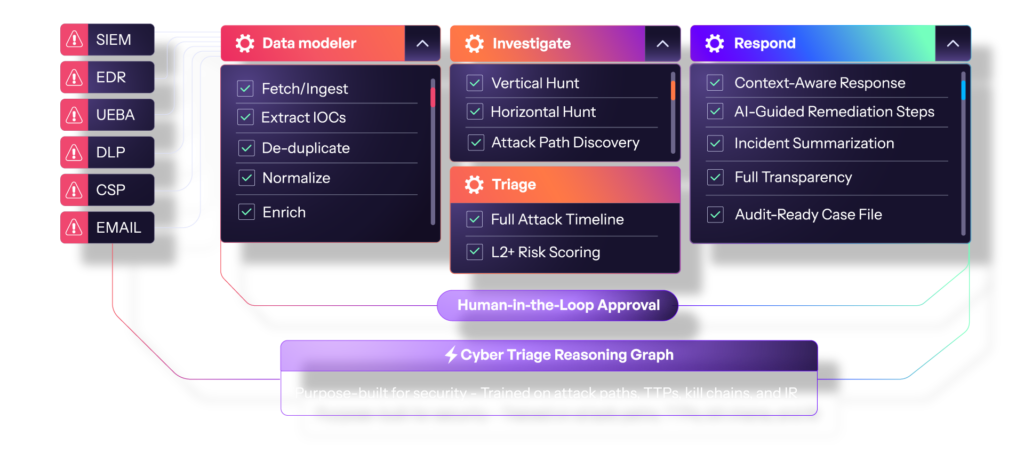
Morpheus AI implements the Unified Intelligence Model architecture: one purpose-built cybersecurity LLM performing complete autonomous investigation within a single reasoning context, producing one unified audit trail per incident. Where playbook flexibility is needed, Morpheus’s Agentic Task nodes run bounded agentic reasoning, autonomous reasoning with explicit iteration, cost, tool-scope, and approval-gate limits, inside the parent workflow’s audit trail. This is architecturally distinct from Swimlane’s playbook-only approach, which routes work through static decision branches without autonomous reasoning at the node level. For regulated environments under NIS2, DORA, or the EU AI Act, the UIM produces one audit trail per incident, mapping structurally to Article 20 and Article 14 oversight obligations without additional governance tooling.
Swimlane Turbine + Hero AI vs. Morpheus + D3 SOAR
| Capability | Morpheus + D3 SOAR | Swimlane Turbine + Hero AI |
|---|---|---|
| How coverage grows | Attack Path Discovery + AI Adaptive Tasking: investigation without prebuilt workflows | More playbooks; advanced work in Python¹ |
| Investigation depth | Cross-domain attack tracing (identity, endpoint, cloud, email), blast radius, MITRE ATT&CK mapping, drafted remediation: up to 95% of alerts at L2+ depth in <2 min² | Playbook-defined |
| Maintenance model | Self-healing integrations: 18-minute mean repair vs the 4–6-week industry norm; no Python prerequisite for advanced playbooks | Reviewers: “high learning curve for those without Python experience… more reliance on professional services”¹ |
| AI architecture | Built ground-up as an autonomous/agentic SOC platform: governance is the architecture | Hero AI + agents added to the Turbine platform (launches Nov 2025–Feb 2026)³ |
| AI usage limits | No prompt caps. Limits are the autonomy modes and approval gates you configure | 2025 datasheet: 50–500 prompts/day by tier, off by default⁴ |
| What ticks the bill | Nothing. Automation volume doesn’t raise the price | Any playbook trigger: CRON, webhook, button click, record update⁴ |
| Audit trail | One audit trail, identical to a regulator across all four autonomy modes | Platform + agent layer to reconcile |
| AI governance | Every LLM step boxed in deterministic playbooks, validation gates before/after; command-risk tagging auto-drives approval gates | Agent guardrails |
| Compliance mapping | SEC 1.05, NYDFS 500, HIPAA, NERC CIP, NIS2, DORA, EU AI Act Art. 14 | General |
| Learning | Reasoning Graph learns from your analysts’ decisions + your TI and vuln feeds, in your tenant | Agent library grows by vendor release |
| Pricing | Two platforms, one price, at or under what you pay today | Event tiers + AI allowance + support tiers⁴ ⁵ |
See the full feature-by-feature comparison: Morpheus vs Swimlane
¹ Gartner Peer Insights reviews (third-party): “high learning curve for those without Python experience, which tends to foster more reliance on professional services”; “complex setup.” ² d3security.com/morpheus/investigation (Attack Path Discovery). ³ Swimlane PR: IR agents Nov 2025; AI Agent workforce Jan 27, 2026; “AI SOC with Intelligent Deep Agents” Feb 18, 2026 (vendor-published). ⁴ Swimlane datasheet, 2025 PDF (vendor-published); packaging may have changed with 2026 releases, ask Swimlane for current caps in writing. ⁵ Vendr document-confirmed contract data, fetched Jun 11, 2026 (third-party).
The Switch Program
Weeks 1–2, Discovery: playbook-estate inventory and triage. The revealing step: most estates split into (a) use cases Attack Path Discovery and Adaptive Tasking handle with no playbook at all, (b) deterministic processes worth translating to D3 SOAR, (c) dead weight to retire. Connector map; case-data and SLA mapping.
Weeks 3–6, Translation: category-(b) playbooks rebuilt without a Python prerequisite; integrations live on self-healing connectors; governance gates and command-risk tiers configured.
Weeks 7–8, Parallel run & cutover: side-by-side on live alerts; audit-trail review with your compliance owner; cutover + hypercare.
Multiple enterprises have completed the switch from Swimlane SOAR to D3 SOAR. Program scope for typical deployments; complex estates scoped in discovery.

Ask your team who maintains the playbooks. Then bring us your Turbine quote. Two platforms, one engine, no allowances, and your engineer gets their job back.
Frequently Asked Questions
We’ve built hundreds of Turbine playbooks. Isn’t that sunk investment a reason to stay?
Run the discovery split first. In converted deployments, a large share of the playbook estate exists to script investigation steps, exactly the work Attack Path Discovery and Adaptive Tasking perform without any playbook. The remainder is deterministic process automation, which translates to D3 SOAR without a Python prerequisite, and dead weight you stop paying to maintain. The real sunk investment is the engineer who maintains the playbooks, and you get that resource back.
Swimlane just shipped an AI agent workforce. Doesn’t that fix the maintenance problem?
Ask what the agents operate on. An AI layer on a playbook platform accelerates the playbooks you wrote, authoring them faster and running them smarter. The inventory and its maintenance remain yours, and historically the AI carried a daily prompt allowance by pricing tier (2025 datasheet; ask for current terms in writing). Morpheus was built the other way up: the investigation engine needs no prebuilt workflow, so there’s no inventory for the AI to babysit.
How is Morpheus’s autonomy safe enough for our auditors?
Every action auto-tiered by command risk, automatically driving approval gates. Every LLM step between validation gates inside deterministic playbooks. One audit trail identical across all four autonomy modes, mapped to seven frameworks including DORA and EU AI Act Article 14. The Reasoning Graph learns from your analysts’ decisions, in your tenant, inside its gates.
What does switching actually cost us in time and risk?
An 8-week program with a parallel run before cutover. The discovery split in weeks 1–2 tells you the real scope before you commit. Bring us your Turbine quote; the price lands at or under it.
D3 Security is not affiliated with Swimlane. Swimlane, Turbine, and Hero AI are trademarks of their respective owners. This comparison reflects publicly available information and our team’s evaluation as of June 2026.