

What is an AI SOC?
An AI SOC is a security operations center where software investigates every alert, reaches a verdict, and acts on it within limits a human sets. Morpheus, the accountable agentic SOC platform from D3 Security, grades every verdict by its evidence and keeps every step on one record. When Morpheus is uncertain, it defers to a human.
Your analysts stop working the queue and start directing the work.
Updated September 2026
What does an AI SOC do?
An AI SOC uses AI to investigate every alert end to end and act on what it finds, within limits your analysts set and can check.
It sits on the stack you already run: SIEM, EDR, identity, cloud, email and ticketing. For each alert it does the work an L2 analyst would do. It gathers evidence from every tool that holds some, pivots across them, builds a timeline, and decides whether the alert is real. Then it drafts the response, or runs it, depending on how much authority you have given it.
What an AI SOC is not
- A chatbot on your SIEM. Answering questions about your data still leaves the investigation to your analysts.
- SOAR with more scripts. SOAR runs steps someone wrote in advance. An AI SOC works out the steps from the alert in front of it.
- A replacement for your analysts. It takes the queue off their desks, and they decide how much it does alone.
AI SOC, autonomous SOC or agentic SOC platform: which term is right?
Each term names a different thing. AI SOC names the technology. Autonomous SOC names the goal. Agentic SOC platform names how the work gets done.
An autonomous SOC is a maturity model, the point where most alerts are resolved without an analyst touching them. You work toward it; you don’t buy it. An agentic SOC platform is the software that gets you there. It investigates, decides and acts, while a human sets the limits and can check every result. Morpheus is an agentic SOC platform. For teams leaving legacy SOAR, it is the SOAR alternative that keeps deterministic playbooks and adds the agentic layer on the same engine.
You’ll also hear it called an AI-driven SOC, an AI-powered SOC or an AI-augmented SOC.
“We’re still coming to terms, I don’t think anyone has a standard industry term, even the Gartners and the Forresters of the world have come to any one particular terminology.”
Odum preferred “AI-augmented SOC” and expected a time for “autonomous” and “agentic.” Both are now common, which is why the distinction above matters when you compare vendors.
What problems does an AI SOC solve?
Most SOCs can’t investigate every alert, so they sort by severity and hope the low-priority ones stay harmless. An AI SOC removes that trade.
Alerts nobody investigates
When the queue outgrows the team, analysts work the criticals and the rest age out or get closed in bulk. Quiet intrusions hide in the medium and low alerts nobody opened. Morpheus investigates every alert to L2 depth, whatever its severity.
Playbooks that can’t keep up
Legacy SOAR runs the steps someone scripted in advance, and every new alert type or vendor API change means more scripting. Morpheus builds a runtime playbook for each incident on a deterministic engine. Its 800+ integrations repair themselves when a vendor changes an API.
AI you can’t check
A confidence score tells an analyst how sure the model is. It says nothing about what was proven. If you can’t check a verdict, you can’t hand the AI more work. Morpheus grades every finding Confirmed, Inferred or Gap, with the evidence attached and the reasoning readable.
Another platform to rip in
Most SOCs have spent years wiring their SIEM, EDR and ticketing together. Morpheus runs on top of that stack, so your tools and your analysts’ workflows stay where they are.
How does an AI SOC work?
An AI SOC architecture has five stages: ingestion, triage, investigation, response and learning. Follow one alert through each of them in Morpheus.
Step 1 of 5
The alert arrives with its context
Morpheus connects to your tools through 800+ integrations across SIEM, EDR, identity, cloud, SaaS, email and network. Alerts from all of them land in one data model, enriched before anyone looks at them.
Duplicates collapse into one case, and when a vendor pushes a breaking API change, the connector repairs itself.
Step 2 of 5
Triage at L2 depth, on every alert
Up to 95% of alerts reach a graded verdict in under two minutes, per customer-reported production data, July 2026. When Morpheus is uncertain, it defers to a human.
The Cybersecurity Triage Reasoning Graph governs that work. The model reasons inside bounded steps, with limits on iteration, cost, tool scope and approval, and the language model underneath can be swapped without changing how Morpheus reasons.
Step 3 of 5
Attack Path Discovery traces the whole attack
On every alert, Attack Path Discovery, D3’s investigation engine, follows the attack across identity, endpoint, cloud and email. It maps blast radius, validates indicators of compromise, lines the techniques up against MITRE ATT&CK, and looks back through the history your tools hold.
By the time an analyst opens the case, the timeline is built and the remediation is drafted. That work takes a senior analyst hours.
Step 4 of 5
Response runs at the autonomy level you chose
Morpheus drafts remediation for the incident in front of it: isolate the endpoint, suspend the account, revoke the tokens, block the domain. What happens next depends on the autonomy mode you set for that use case.
In AI-Assisted mode, your analyst approves every step. In AI-Led mode, Morpheus drafts the response and runs it once you sign off. In Autonomous mode, it acts at machine speed inside approval gates set at design time, and any action can be rolled back. Deterministic playbooks, with no AI in the chain, run beside all three. Every action lands on one audit trail per incident.
Step 5 of 5
A correction made once stays made
The reasoning behind every grade is readable, and your analysts can correct it. The correction carries into future investigations, so the same mistake doesn’t come back next week.
Morpheus also tunes its confidence scoring to your alert volume and its recommendations to what your analysts act on. It works from day one, and accuracy compounds over the first 60 to 90 days.
How do you know when an AI SOC’s verdict deserves your trust?
Check what the verdict rests on. Morpheus grades every finding by evidence quality, as Confirmed, Inferred or Gap, and shows the reasoning behind each grade.
Confirmed
The source telemetry is attached. You can read it.
Inferred
The reasoning is shown. The evidence is circumstantial, and Morpheus says so.
Gap
Morpheus looked, found nothing, and reports the gap instead of filling it.
Evidence can only be attached to a finding when one system produced both. That is why Morpheus runs one reasoning engine with one record per incident, and why your analysts can check its work fast enough to hand it more.
“Because I can check everything Morpheus does, I can hand it more work.”
What does an AI SOC investigation look like in practice?
Two common alerts, a reported phishing email and an EDR malware detection, as Morpheus works them from arrival to response.
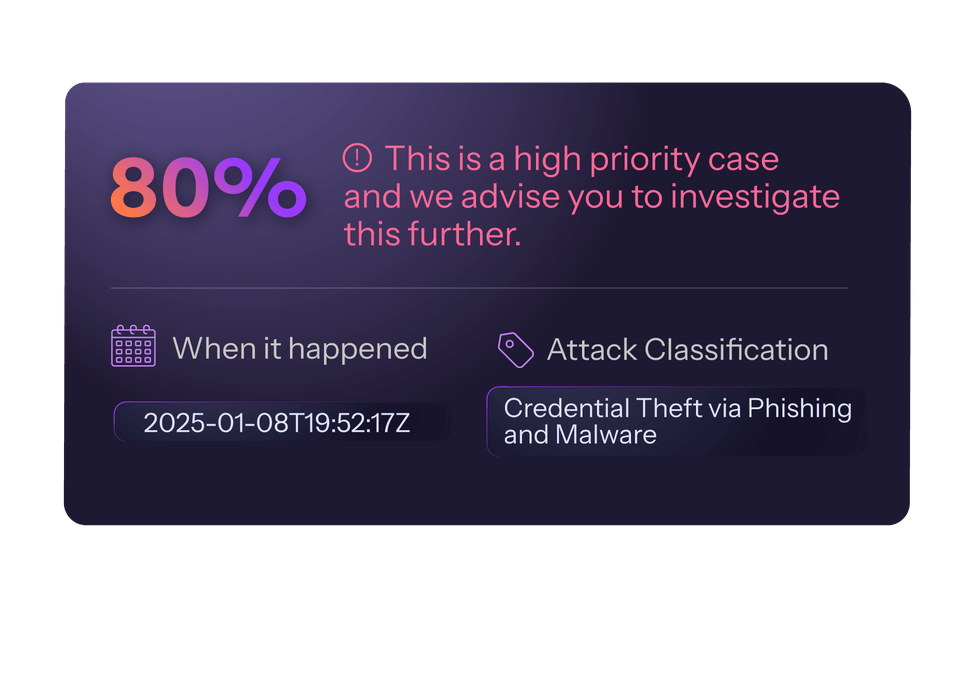
A reported phishing email
A user reports an invoice email that looks wrong. Morpheus pulls the headers, checks the sender and domain, detonates the attachment, and searches for the same message in other mailboxes. It checks identity logs for anyone who clicked and then signed in from somewhere new.
Findings with mail and sandbox telemetry attached come back Confirmed. If no endpoint telemetry covers a recipient’s laptop, that finding reads Gap and goes to an analyst. In AI-Led mode, Morpheus drafts the purge, the domain block and the password resets, and runs them once your analyst signs off.
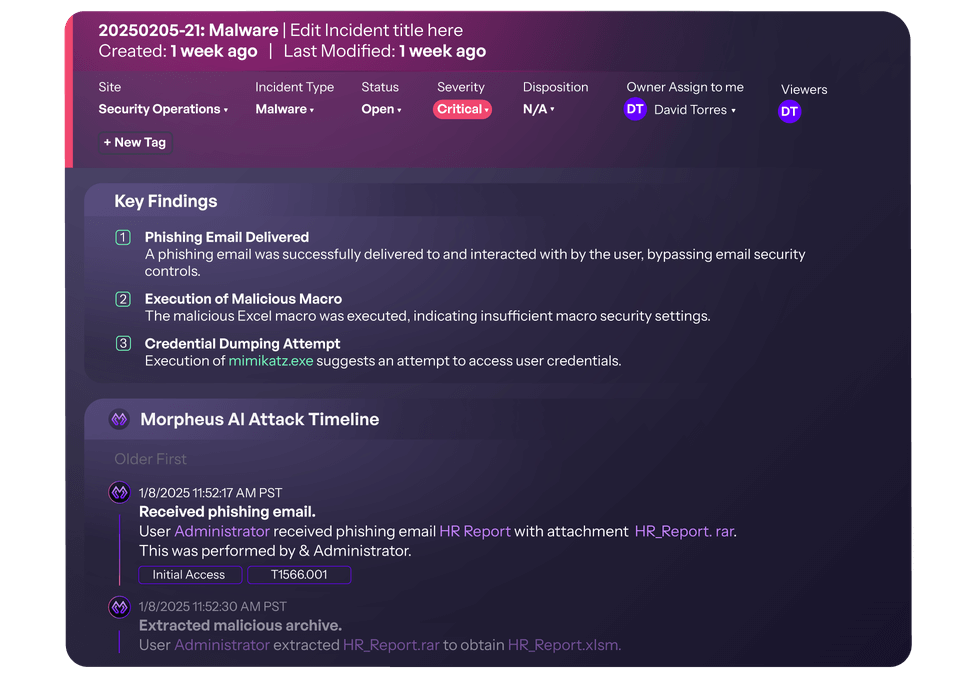
Malware on an endpoint
EDR flags a suspicious process on a finance workstation. Attack Path Discovery walks the process tree, checks which accounts ran on that machine, and follows those accounts to other hosts and cloud sessions to map the blast radius.
For a known-bad hash on a use case you have set to Autonomous, Morpheus isolates the endpoint and suspends the account inside the gates you set at design time. Either action can be rolled back. The investigation and every action sit on one record your analyst reads in order.
What changes when every alert gets a verdict?
Every alert gets investigated, most reach a verdict in minutes, and each finding arrives graded and on one record, at a price agreed in advance.
| Measure | With Morpheus | Basis |
|---|---|---|
| Alert coverage | Every alert investigated to L2 depth, whatever its severity | Platform design |
| Time to verdict | Up to 95% of alerts reach a graded verdict in under two minutes | Customer-reported production data, July 2026 |
| Evidence | Every finding graded Confirmed, Inferred or Gap, with source telemetry attached where it exists | Every investigation |
| Integration upkeep | 800+ integrations that repair themselves when a vendor changes an API | Platform design |
| Audit | One record per incident across triage, investigation, response and case notes | Platform design |
| Autonomy | Four modes, set per use case and changed by configuration | Platform design |
| Cost | Annual subscription sized to your alert volume, with the AI in the price | Morpheus pricing |
When Morpheus is uncertain, it defers to a human.
How should you evaluate an AI SOC platform?
Judge the architecture on three questions: how the platform reasons, who holds authority over its actions, and what it costs in your worst month.
How does it reason?
Ask whether you can read how it reached a verdict. Many AI SOC platforms run a fleet of specialized agents, one each for triage, enrichment, correlation and response, passing context on every alert. The reasoning ends up spread across four agent logs, and an error in one travels downstream to the rest.
Morpheus runs its agentic reasoning under one engine, inside one deterministic playbook, with hard bounds on iteration, cost, tool scope and approval. You read one log and verify one chain, and a correction you make holds everywhere.
Who can take action?
Ask who approves an action and whether it can be undone. Morpheus gives you four autonomy modes on one engine: Deterministic, AI-Assisted, AI-Led and Autonomous. You can start with Morpheus investigating and recommending while analysts approve every step, then move a use case up once its record earns it.
Attack Path Discovery is read-only by design. The investigation produces context, and the action layer follows the mode you chose. See the four autonomy modes
What happens to the bill on a bad day?
Ask what an incident spike does to your costs. Per-investigation and credit-based pricing rise with alert volume, so your worst month costs the most.
Morpheus is an annual subscription sized to your alert volume, with the AI in the price. Above your envelope, additional alerts are priced per alert, published in advance.
AI SOC questions, answered
What does AI SOC stand for?
AI SOC stands for artificial intelligence security operations center. The term covers any SOC where AI does investigation work analysts used to do by hand, from alert triage through response.
Will an AI SOC replace SOC analysts?
No. An AI SOC takes the queue, the repetitive L1 and L2 investigation that fills an analyst’s day. Analysts decide how much the AI does alone, review what it can’t confirm, and handle the incidents that need judgment. In Morpheus, anything graded Gap goes to a human with the evidence gathered so far.
What is an AI SOC analyst?
An AI SOC analyst is software that does the work of a tier 1 or tier 2 analyst. It reads an alert, gathers evidence across your tools, and reaches a verdict. In Morpheus, that work runs on every alert and every verdict is graded by its evidence, so a human analyst can check it quickly. More on the AI SOC analyst
How is an AI SOC different from SOAR?
SOAR automates predefined steps; an AI SOC produces investigation conclusions. SOAR enriches an alert and hands it to an analyst, while an AI SOC runs the L1 and L2 investigation itself and drafts the remediation. Morpheus is built on a SOAR-class deterministic engine, so existing playbooks, integrations and case data carry over.
How is an AI SOC different from a SIEM copilot?
A SIEM copilot answers questions and summarizes alerts inside one vendor’s console, and the analyst still runs the investigation. An AI SOC runs the investigation across every tool in your stack and returns a verdict, with its evidence, for the analyst to check.
What happens when an AI SOC gets it wrong?
Morpheus grades every finding by its evidence, so a finding with thin evidence says so in its grade. Analysts can correct the reasoning behind a grade, and the correction carries into future investigations. Autonomous actions stay inside gates set at design time and can be rolled back.
Can an AI SOC run in a regulated industry?
Yes, when every action is governed and recorded. Morpheus keeps one audit trail per incident covering triage, investigation, response and case notes, and every finding carries its evidence grade. That record supports evidence requirements under SEC, NYDFS, HIPAA, NIS2, DORA and the EU AI Act. Morpheus for regulated SOCs
Does an AI SOC work with my existing SIEM and EDR?
Morpheus does. It integrates with 800+ tools across SIEM, EDR, XDR, IAM, cloud, email, NDR, DLP and ITSM, including Microsoft Sentinel, Splunk, CrowdStrike Falcon, SentinelOne, Okta and ServiceNow. Its integrations repair themselves when a vendor pushes a breaking API change.
How long does an AI SOC take to deploy?
Morpheus deploys in days. Integrations connect, the deterministic playbook engine runs, and Attack Path Discovery investigates from day one. Accuracy then compounds over the first 60 to 90 days as Morpheus tunes to your alert volume and your analysts’ decisions.
How are AI SOC platforms priced?
Three models are common: per investigation, consumption credits, and subscription. The first two rise with alert volume. Morpheus is an annual subscription sized to your alert volume envelope, with the AI in the price. Above the envelope, additional alerts are priced per alert, published in advance.
What should you measure in an AI SOC pilot?
Seven things: alert coverage, investigation time, verdict trust, the human factor, integration health, audit response, and autonomy granted. Take a baseline for each before the pilot starts and set a 90-day target.
Go deeper on the AI SOC
Recent research, a field test and a webinar on how to test, measure and trust an AI SOC.
-
On-demand webinar
How to catch an AI SOC analyst bluffing
An AI analyst that’s confidently wrong is worse than no analyst at all. Four tests that force a bluffing verdict into the open.
-
Case study
The agentic SOC that refuses to guess: a large US-based MSSP tried to break APD 2.0 and couldn’t
Adversarial acceptance testing with induced data-source failures, degraded telemetry and cross-tenant probes. Attack Path Discovery 2.0 passed all five scenarios with zero critical findings and zero false negatives. When Morpheus is uncertain, it defers to a human.
-
Brief
Turn agentic SOC into measurable results
Seven measurements that turn an AI SOC pilot into a business case, each with the metric, the baseline and the 90-day target.
-
Field report
The SOC after the agentic SOC
What changes once an agentic SOC runs in production, from the economics of investigation to the proof worth demanding. Field observations from D3 deployments.
Renewing a legacy SOAR contract? The Legacy SOAR Migration Program converts your playbooks and runs Morpheus in parallel until it passes your acceptance criteria. See the migration program. On Cortex XSOAR? See the XSOAR Exit Program.
Noise Down, Security Up.
Watch Morpheus investigate.
Bring your use cases. Watch a full L1 and L2 investigation run end to end, every verdict graded, while you stay in control.
Book a Demo