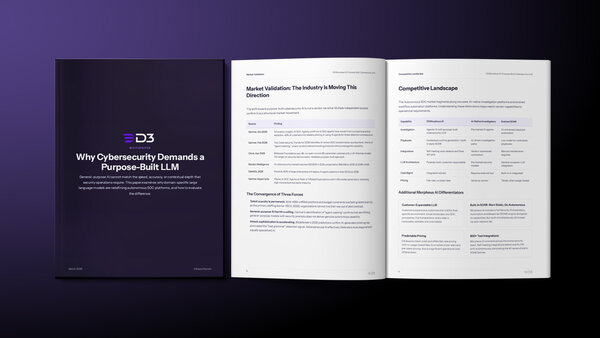
Executive Summary
The cybersecurity industry has a structural problem that talent alone cannot solve. Organizations face thousands of security alerts daily, false positive rates exceed 50%, and 4.8 million cybersecurity positions remain unfilled globally. Large language models offer a path forward, but not all LLMs are equal.
General-purpose models trained on internet-scale data lack the domain knowledge, contextual precision, and operational reliability that security operations demand. A purpose-built cybersecurity LLM is trained from the ground up on security telemetry, attack patterns, and investigation methodologies. It understands how adversaries move through networks, how attacks manifest across different vendor tools, and how to correlate signals that span the entire security stack.
It is a fundamentally different architecture, designed for a fundamentally different problem, trained from the ground up on security data.
This paper examines why the distinction between general-purpose and purpose-built cybersecurity AI matters, what independent market evidence confirms, and how D3 Security’s Morpheus AI operationalizes the Cybersecurity Triage Reasoning Graph in production environments today.
Table of Contents
- The Problem: General-Purpose AI Fails in the SOC
- Why General-Purpose LLMs Make It Worse
- What Makes a Purpose-Built Cybersecurity LLM Different
- Market Validation: The Industry Is Moving This Direction
- How D3 Morpheus AI Operationalizes the Purpose-Built LLM
- Competitive Landscape
- Honest Assessment: Limitations and Risks
- Questions for Your Evaluation
The Problem: General-Purpose AI Fails in the SOC
The rush to apply AI to cybersecurity has produced a market flooded with products that bolt general-purpose language models onto security workflows. Models like GPT-4, Claude, and Gemini are remarkably capable across broad domains. But broad capability is precisely the wrong attribute for Security Operations Center (SOC) environments.
Alert Volumes That Exceed Human Capacity
The average enterprise SOC ingests alerts from 28+ security tools. The SANS 2025 SOC Survey found 66% of security teams cannot keep pace with incoming alert volumes. SOC analysts spend an average of 70 minutes investigating a single alert, and 56 minutes pass before anyone acts. The math is unambiguous: human-scale investigation cannot keep pace with machine-scale alert generation.
False Positives Dominate the Queue
Research from Devo’s 2024 SOC Performance Report found over half of all alerts are false positives. Academic research published by USENIX documented environments where false positive rates exceeded 99%. The consequence: 40% of alerts go uninvestigated, and 61% of security teams report ignoring alerts that later proved critical.
Analyst Burnout Is an Existential Threat
ISC2’s 2025 Cybersecurity Workforce Study documents 4.8 million unfilled cybersecurity positions globally. Among working analysts, 71% report burnout and 64% are considering leaving the role within one year (Tines 2025). The SANS 2025 survey reveals 70% of SOC analysts with five years or less experience leave within three years.
Almost 50% of alerts go uninvestigated. 61% of teams admit to ignoring alerts that later proved critical. This is a capacity failure, not a process failure, and it demands an architectural solution.
Why General-Purpose LLMs Make It Worse
General-purpose LLMs were trained on internet-scale data to be broadly useful. When applied to cybersecurity, this creates specific, measurable failures:
Hallucination in Specialized Contexts
Research published by the ACM and USENIX confirms that LLMs applied to specialized domains produce factually incorrect but syntactically fluent outputs. These “confident errors” are harder to catch than obvious mistakes. In cybersecurity, a hallucinated indicator of compromise or a fabricated MITRE ATT&CK mapping can misdirect an entire investigation.
No Understanding of Attack Propagation
A general-purpose model can summarize a phishing alert. It cannot trace how a phishing payload transitions to credential theft, how those credentials enable lateral movement, or how each stage manifests differently across vendor telemetry. This requires training on security-specific data at a foundational level.
Context Window Limitations
SOC investigations require correlating signals across 28+ tools simultaneously. General-purpose models lack the architectural understanding to perform multi-dimensional correlation: vertical inspection within a tool and horizontal correlation across the full security stack.
Prompt Sensitivity
Research from Frontiers in AI (2025) documents that small variations in prompt phrasing significantly affect hallucination likelihood. In a SOC where alert formats vary across hundreds of vendor integrations, this inconsistency is operationally dangerous.
What Makes a Purpose-Built Cybersecurity LLM Different
The distinction between a general-purpose LLM adapted for security and a purpose-built cybersecurity LLM is not marketing semantics. It is an architectural difference with measurable operational consequences.
Training Data: Security Telemetry, Not the Internet
A purpose-built cybersecurity LLM is trained on curated datasets of security telemetry, attack patterns, threat intelligence, incident investigation records, and adversary behavior frameworks. Cisco’s Foundation AI team validated this approach: their Foundation-sec-8b model (8B parameters, trained on cybersecurity data) outperforms general-purpose models nearly 10x its size on core security benchmarks.
Understanding Attack Propagation
General-purpose models treat each alert as an isolated text input. A purpose-built model understands the causal chains connecting discrete security events: phishing to credential theft to lateral movement, and how each stage manifests differently across vendor telemetry. This understanding is learned during training, not prompted.
Multi-Dimensional Correlation
Security threats traverse email gateways, endpoints, identity providers, cloud workloads, and network sensors. A purpose-built model performs vertical (North-South) deep inspection and horizontal (East-West) correlation across the full security stack simultaneously. That is architecturally different from sending an alert summary to a chat model.
Reduced Hallucination in Domain Context
IBM’s research on domain-specific LLMs confirms that models trained on industry-specific data understand technical jargon, formatting conventions, and contextual nuances, producing outputs that are more relevant and precise. Springer’s Cybersecurity journal documents improved accuracy in threat detection and forensic investigation with domain-fine-tuned models.
Alert Ingestion (28+ tools) → North-South (Deep inspection) → East-West (Cross-stack correlation) → Attack Path (Full chain mapped) → Response (Contextual playbook)
Market Validation: The Industry Is Moving This Direction
The shift toward purpose-built cybersecurity AI is not a vendor narrative. Multiple independent sources confirm it as a structural market movement.
| Source | Finding |
|---|---|
| Gartner, Oct 2025 | Innovation Insight: AI SOC Agents confirms AI SOC agents have moved from concept to practical adoption. 42% of cybersecurity leaders piloting or using AI agents for threat detection and response. |
| Gartner, Feb 2026 | Top Cybersecurity Trends for 2026 identifies AI-driven SOC transformation as a top trend. Warns of “agent washing,” where vendors rebrand existing products without real agentic capability. |
| Cisco, Apr 2025 | Released Foundation-sec-8b, an open-source 8B-parameter cybersecurity LLM. Matches models 10x larger on security benchmarks. Validates purpose-built approach. |
| Mordor Intelligence | AI cybersecurity market reached $30.92B in 2025, projected to $86.34B by 2030 at 22.8% CAGR. |
| Deloitte, 2025 | Predicts 40% of large enterprises will deploy AI agent systems in their SOCs by 2026. |
| Gartner Hype Cycle | Places AI SOC Agents at Peak of Inflated Expectations with 1–5% market penetration, indicating high momentum but early maturity. |
The Convergence of Three Forces
- Talent scarcity is permanent. With 4.8M unfilled positions and budget constraints overtaking talent scarcity as the primary staffing barrier (ISC2, 2025), organizations cannot hire their way out of alert overload.
- General-purpose AI has hit a ceiling. Gartner’s identification of “agent washing” confirms that retrofitting general-purpose models with security prompts does not deliver genuine autonomous capability.
- Attack sophistication is accelerating. Bitdefender’s 2026 predictions confirm AI-generated phishing has eliminated the “bad grammar” detection signal. Adversaries use AI effectively. Defenders must respond with equally specialized AI.
How D3 Morpheus AI Operationalizes the Purpose-Built LLM
D3 Security’s Morpheus AI is an AI SOC Platform built on the Cybersecurity Triage Reasoning Graph, developed over 24 months by 60 specialists, including red teamers, data scientists, AI engineers, and SOC analysts. This model understands how cyber attacks propagate across tools and time at a foundational level.
Attack Path Discovery on Every Alert
Morpheus AI maps telemetry to D3’s proprietary attack path graph, connecting events based on adversary behavior patterns. Output: a structured investigation report with step-by-step reasoning, delivered in minutes.
Contextual Playbook Generation
Morpheus AI generates a bespoke playbook for each incident at runtime, based on alert context and the customer’s tool stack. No static authoring, no versioning, no emergency updates when a new attack variant appears.
Self-Healing Integrations
When APIs drift or schemas change across 800+ integrations, Morpheus AI detects the issue and generates corrective code autonomously. This addresses the #1 cause of silent SOAR failures.
AI SOP: Human-in-the-Loop by Design
D3’s AI SOP lets customers build natural-language playbooks combining API calls, data processing, and AI agent tasks. Every analyst approval or override feeds back into the model, continuously improving triage accuracy.
Competitive Landscape
The Autonomous SOC market fragments along two axes: AI-native investigation platforms and evolved workflow automation platforms. Understanding these distinctions helps match vendor capabilities to operational requirements.
| Capability | D3 Morpheus AI | AI-Native Investigators | Evolved SOAR |
|---|---|---|---|
| Investigation | Agentic AI with the Cybersecurity Triage Reasoning Graph | Pre-trained AI agents | AI-enhanced playbook automation |
| Playbooks | Contextual runtime generation + built-in static SOAR | AI-driven investigation paths | Low-code/no-code static playbooks |
| Integrations | Self-healing: auto-detects and fixes API drift | Vendor-maintained connectors | Manual maintenance required |
| LLM Architecture | Purpose-built, customer-expandable | Pre-trained security models | General-purpose LLM integration |
| Case Mgmt | Integrated natively | Requires external tool | Built-in or integrated |
| Pricing | Subscription pricing | Varies by vendor | Tiered, often usage-based |
Additional Morpheus AI Differentiators
Customer-Expandable Cybersecurity Triage Reasoning Graph
Customers expand and customize the Cybersecurity Triage Reasoning Graph for their specific environment, threat landscape, and SOC procedures. Full transparency: every step is reviewable, editable, and overridable.
Built-In SOAR: Start Static, Go Autonomous
Morpheus AI includes a full Security Orchestration, Automation and Response (SOAR) engine alongside AI capabilities. Run both simultaneously. Eliminate rip-and-replace risk.
Predictable Pricing
D3’s pricing model is designed to absorb token and compute costs internally rather than passing them to customers. Subscription pricing is designed for predictable SOC coverage.
800+ Tool Integrations
Morpheus AI connects across the entire security stack. Self-Healing Integrations detect and fix API drift autonomously, eliminating the #1 cause of silent SOAR failures.
Honest Assessment: Limitations and Risks
The Myth of Full Autonomy
No Autonomous SOC platform operates without human oversight. “Autonomous” describes the investigation model, not the governance model. Organizations that expect to eliminate their SOC team will be disappointed and exposed.
AI Reliability Risks
Purpose-built models reduce hallucination but do not eliminate it. Robust safeguards, explainable reasoning, and human review checkpoints are non-negotiable requirements.
Skill Erosion
Multiple research firms warn that over-dependence on automation may degrade foundational analysis skills over time. Organizations must invest in analyst development alongside AI adoption.
How Morpheus AI Mitigates These Risks
- Explainability: Every investigation produces step-by-step reasoning analysts can review and override.
- Human-in-the-loop: AI SOP captures approvals and corrections, creating continuous improvement loops.
- Gradual adoption: Built-in SOAR lets organizations run static and autonomous models simultaneously.
- Customer-expandable: Organizations control how the model reasons about their specific environment.
Questions for Your Evaluation
These questions separate genuine purpose-built capability from general-purpose models with security wrappers:
- Is the AI model purpose-built for cybersecurity, or a general-purpose LLM with a prompt layer?
- Can the platform investigate alerts across your entire security stack?
- Does it generate playbooks contextually at runtime or require static authoring?
- How does it handle integration drift when vendor APIs change?
- Can analysts see, review, and override every step of the AI’s reasoning?
- Does the pricing model include token or usage-based fees that scale unpredictably?
- Can it run alongside your existing SOAR investment during transition?
- Can you customize and expand the AI model for your environment?