

Better Together
Keep the workflows you built. Add the investigation you’re missing.
Morpheus AI is the accountable agentic SOC platform. It triages up to 95% of alerts in under two minutes. When Morpheus is uncertain, it defers to a human. Its verdicts trigger the Tines stories you already built.

See Morpheus AI Investigate Your Alerts
Morpheus AI implements the Unified Intelligence Model architecture: one purpose-built cybersecurity triage graph performing complete autonomous investigation within a single reasoning context, producing one unified audit trail per incident. Where playbook flexibility is needed, Morpheus’s Agentic Task nodes run bounded agentic reasoning, autonomous reasoning with explicit iteration, cost, tool-scope, and approval-gate limits, inside the parent workflow’s audit trail. This is architecturally distinct from Tines’ workflow-builder approach, which provides automation primitives without an investigation reasoning layer. For regulated environments under NIS2, DORA, or the EU AI Act, the UIM produces one audit trail per incident, mapping structurally to Article 20 and Article 14 oversight obligations without additional governance tooling.
Two Layers, One Alert Pipeline
Workflow platforms execute what you already know. Morpheus AI investigates what you don’t.
Tines is one of the strongest execution layers in security automation. Your automation team built a library of stories that fire the moment somebody decides what an alert is. That decision is the bottleneck. Every alert still waits on an analyst, or on a pre-built path, before a story can run.
Morpheus AI sits in front of that decision. It investigates the full alert stream autonomously, writes a reasoning record for every alert, and passes a verdict to the story that should run. Your stories stay yours. The triage queue stops being yours.
How the Integration Works
Four steps, and none of them ask your team to rebuild a story.
Alerts arrive
Morpheus AI ingests the full alert stream from your SIEM, EDR, cloud, identity, and email tools across 800+ bidirectional integrations.
Morpheus investigates
Attack Path Discovery traces the alert North-South through up to 90 days of telemetry and East-West across the stack in real time. Every query it runs is recorded.
A verdict lands
Morpheus AI returns a verdict with its evidence tree, logic chain, and confidence score. When Morpheus is uncertain, it defers to a human, with the evidence attached.
Your story fires
The verdict triggers the Tines story your team already built. Execution stays where your automation team put it.
Who Does What, Stage by Stage
Morpheus AI investigates. Tines executes. The table below shows where each layer does its work across a single alert.
| Stage in the alert lifecycle | Morpheus AI | Tines |
|---|---|---|
| Alert ingest | Full alert stream across 800+ bidirectional integrations | Alerts routed into the stories your team defines |
| Deciding what an alert is | Autonomous investigation at L2+ depth on every alert | An analyst or a pre-built path makes the call before a story runs |
| Investigation depth | Attack Path Discovery, North-South through up to 90 days of telemetry and East-West across the stack | Enrichment inside the steps a story author specifies |
| Reasoning record | Evidence tree, logic chain, and confidence score on every alert | Run logs showing which steps executed |
| Uncertain alerts | Handed to an analyst by design, with the evidence attached | Routed by the branch the story author wrote |
| Response execution | Runtime playbooks across 800+ Self-Healing Integrations, or a verdict that triggers your Tines story | The stories your automation team authored and owns |
| Connector upkeep | Self-Healing Integrations detect API drift and generate corrective code | Connector updates handled by your automation team |
| Governance | Four autonomy tiers under one audit trail, with per-action approval gates | Story-level change control and run history |
WHAT MORPHEUS ADDS
The Investigation Layer in Front of Your Stories

A Reasoning Layer in Front of Your Stack
Morpheus AI reads every alert your tools raise and decides what it is before anything executes. Your Tines stories keep doing what they do well, triggered by a verdict instead of a human judgment call. You add the reasoning layer and keep the workflow investment.
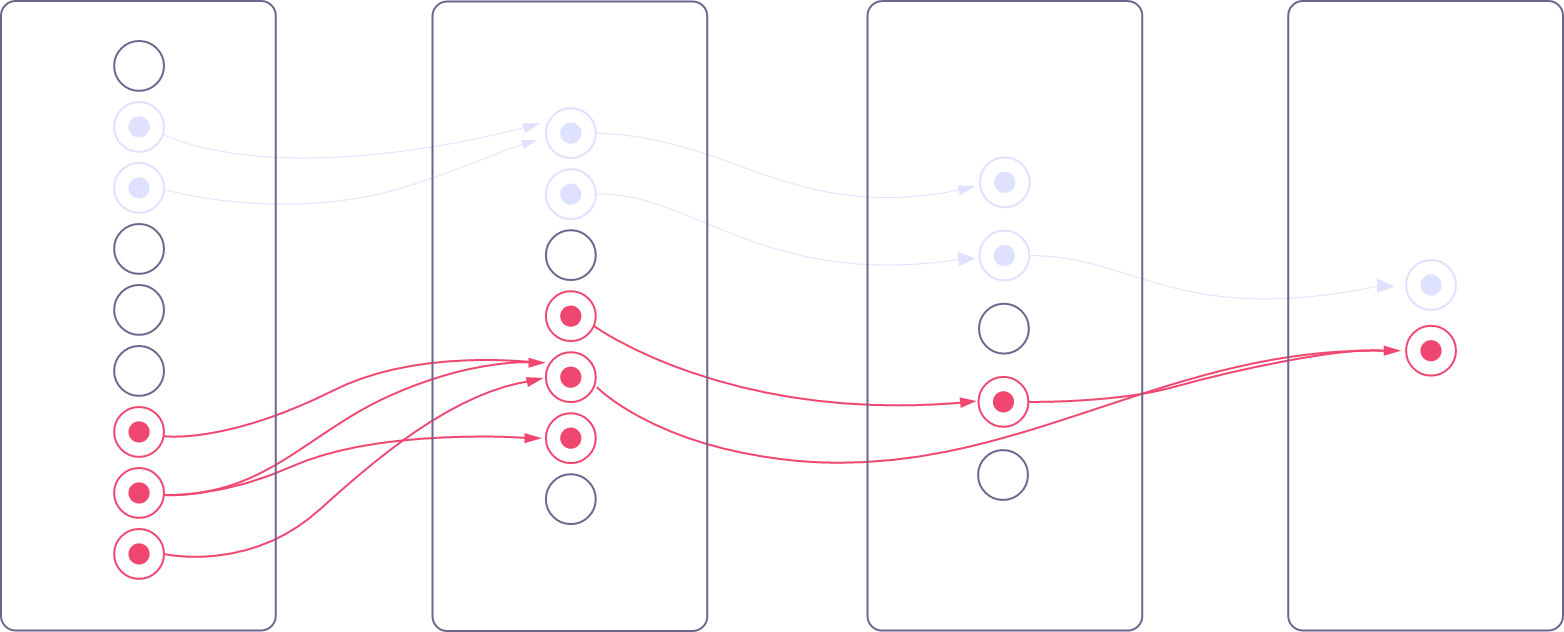
Attack Path Discovery on Every Alert
Morpheus AI traces each alert on two axes. North-South inspection follows the alert origin through up to 90 days of telemetry. East-West correlation queries 800+ tools across the stack in real time. The result is MITRE ATT&CK-aligned, and it runs on every alert rather than on the ones somebody flagged.
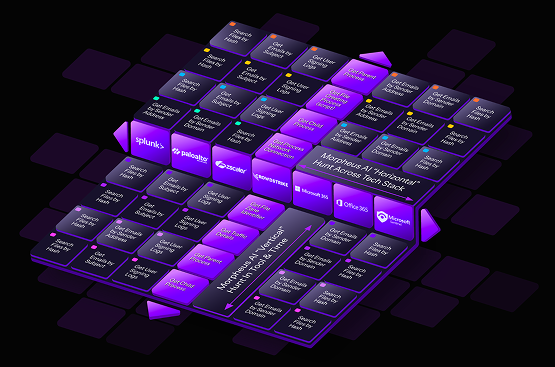
A Reasoning Record for Every Alert
The Cybersecurity Triage Reasoning Graph documents how it reached each conclusion. Every verdict ships with an evidence tree, a logic chain, and a confidence score, and every conclusion traces back to a real tool query. Investigations replay months later. When Morpheus is uncertain, it defers to a human.

Self-Healing Integrations Across 800+ Tools
Morpheus AI monitors its own connectors. When a vendor API drifts, it detects the change and generates corrective code, so the investigation layer keeps reading your stack without a maintenance ticket landing on your automation team.

Runtime Playbooks When You Want Morpheus to Execute
Where you would rather Morpheus AI act than hand off, it generates a playbook at runtime from live evidence and executes across the stack. Four autonomy tiers govern how far it goes: Tier 1 Deterministic, Tier 2 AI-Assisted, Tier 3 AI-Led, and Tier 4 Autonomous. Per-action approval gates decide where each tier applies, and all four run under one audit trail.
Request your free Tines cost comparison
Four Tests for Any Investigation Layer, Including Ours
Autonomy claims are easy to write and hard to verify. Ask every vendor the same four questions. Ask us too.
- Coverage. What share of a real day’s alerts does the system fully investigate with no pre-built path?
- Evidence. Show the complete reasoning record for one alert, start to finish.
- Fail-back. What does the system demonstrably do with an alert it cannot confidently resolve?
- Cost under load. What does a month at five times your alert volume cost, in writing?
Morpheus AI answers all four in a working session against your own alerts.
Frequently Asked Questions
Is Morpheus AI replacing Tines?
No. The integration is live today and D3 maintains it. Your stories stay where they are and get better triggers. Morpheus AI investigates in front of them and fires them on a verdict. Zero rip-and-replace is the design.
Does the Morpheus AI integration with Tines exist today?
Yes. D3 builds and maintains it. Morpheus AI investigates the alert stream, and its verdicts trigger the Tines stories your team already built. There is no migration project and no story rebuild.
Our automation team built all of this. Do they lose their work?
They keep everything they built. What changes is what they stop doing, which is hand-triaging the queue to decide which story should run. Investigation happens in Morpheus AI. Execution stays theirs.
Tines has AI agents. What does Morpheus AI add?
Tines agents are components a team embeds inside workflows the team designs. Morpheus AI adds the layer in front of them: full-stream autonomous investigation, a reasoning record on every alert, and human fail-back by design. Run the four tests on this page against any vendor, including us.
What are the four tests for evaluating an autonomous investigation layer?
First, what share of a real day’s alerts does the system fully investigate with no pre-built path? Second, show the complete reasoning record for one alert, start to finish. Third, what does the system demonstrably do with an alert it cannot confidently resolve? Fourth, what does a month at five times your alert volume cost, in writing? Ask every vendor the same four questions, and ask us too.
How does Morpheus AI pricing work?
Morpheus AI uses a subscription pricing model. The customer pays a Platform Subscription plus User Licenses that together form the Expected Cost of running an agentic SOC. The model is designed to absorb the operational cost of token consumption and AI compute internally rather than passing it through as a usage meter. Visit d3security.com/morpheus/pricing/ for details.
How does Morpheus AI support compliance and audit requirements?
Morpheus AI documents every autonomous decision with an evidence tree, a logic chain, and a confidence score. When Morpheus is uncertain, it defers to a human. Those artifacts support audit and reporting obligations under GDPR, the EU AI Act, NIS2, SEC, and CISA guidance. Every AI action is traceable and every decision is explainable. D3 Security is SOC 2 Type II certified.
Bring a Day of Your Own Alerts
The gap most teams describe sits in front of their workflows, where every alert waits on a human to decide what it is. Bring a real day of alerts and watch Morpheus AI work through them, then send the verdicts to the stories you already built.
About D3 Security
D3 Security is the maker of Morpheus AI, the accountable agentic SOC platform. It combines autonomous investigation, orchestration, and remediation in one reasoning engine with one audit trail. Since 2015, D3 has provided SOC automation solutions to Fortune 500 enterprises, government agencies, and leading financial institutions.
Learn more: www.d3security.com
Tines is a trademark of its respective owner. This page describes the D3-maintained Morpheus AI integration with Tines and reflects publicly available information as of August 2026.