

AI SOC PLATFORM
What Is an Autonomous SOC?
An autonomous SOC is a security operations model where AI investigates, triages, and responds to every alert at analyst depth, without routing alerts to a queue that never clears. D3 Morpheus is purpose-built for this model: one reasoning engine, four autonomy modes, one audit trail.
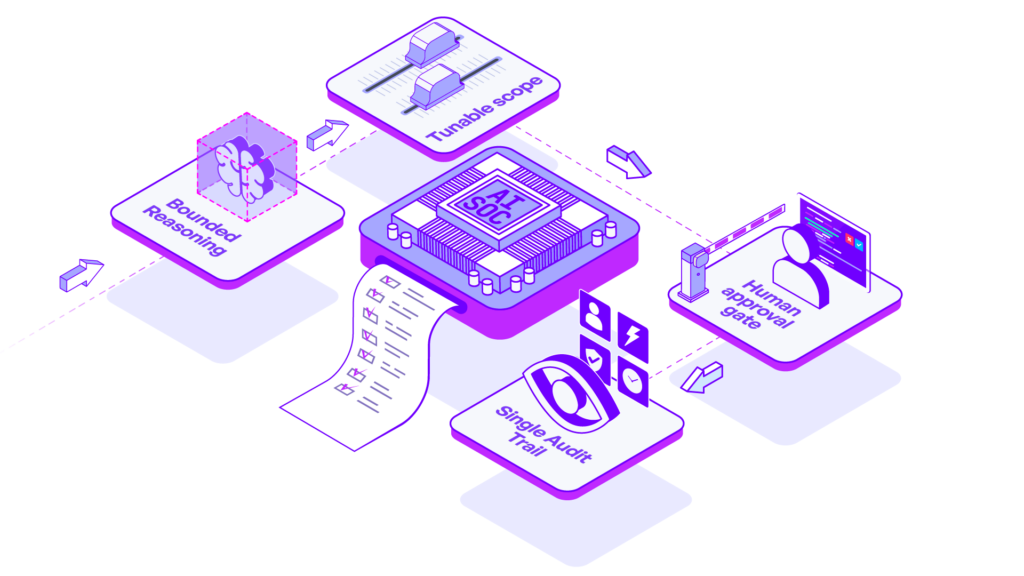
Up to 95%
of alerts triaged at L2+ depth
Under 2 min
per alert investigation
800+
bidirectional integrations
80%
reduction in MTTR
An autonomous SOC closes cases. Most platforms that claim autonomous SOC capabilities stop at noise filtering or alert forwarding. They reduce alert volume. They do not resolve incidents. A genuine autonomous SOC, built on D3’s Cybersecurity Triage Reasoning Graph, correlates signals across tools, validates IOCs, and reconstructs attack timelines at up to 95% of alert volume, in under 2 minutes, at L2+ depth. When Morpheus is uncertain, it defers to a human.
D3 Morpheus does both jobs most SOCs still split between two separate platforms: deterministic SOAR for response orchestration and agentic AI investigation for triage. Attack Path Discovery, D3’s investigation engine, traces each incident across identities, endpoints, cloud, and email infrastructure, reaching back 90 days of telemetry to map blast radius and draft remediation. Deterministic, AI-Assisted, AI-Led, and Autonomous: four configurable autonomy modes let security teams set exactly how much control they keep at each decision point.
This page covers what distinguishes a genuine autonomous SOC from alert-forwarding tools, how the vendor landscape breaks down across legacy SOAR, pure-play agentic tools, and platform incumbents, and what makes the D3 Morpheus architecture structurally different.
In practice, an autonomous SOC platform operates across five layers: data ingestion and normalization from SIEM, EDR, and email security sources; entity extraction and deduplication to consolidate duplicate signals; vertical investigation (in-depth per incident) and horizontal hunting (cross-system pattern detection); cross-stack threat scoring that aggregates risk signals into a unified severity rating; and automated response with incident summaries and optional human-in-the-loop approval gates.
Why SOC Teams Can’t Scale Without It
Seven structural problems that manual triage and legacy SOAR cannot solve at scale.
- Alert Fatigue. SOC teams process an overwhelming volume of alerts daily, many of which are false positives. Analyst time runs out before case queues do.
- Siloed Functions. Disparate tools and isolated teams create communication gaps and fragmented threat responses. Correlation that should take seconds takes hours.
- Resource Shortages. Budget and staffing constraints limit continuous monitoring. Hiring analysts does not scale with alert volume.
- Relentless Threat Landscape. Attack sophistication and volume are increasing. Response speed requirements are outpacing what human-led triage can deliver.
- Legacy Automation Limitations. Legacy SOAR requires significant investment in playbook development and maintenance. When attack patterns evolve, static playbooks break.
- High Operational Costs. Maintaining traditional SOC infrastructure and monitoring tools is increasingly expensive. Cost per alert keeps rising as volume scales.
- Visibility Gaps. Even top-tier SOCs miss critical alerts due to sheer volume and data-source diversity. Coverage drops precisely when threat volume peaks.
How an Autonomous SOC Closes Cases
Four capabilities that separate a genuine autonomous SOC from an alert-forwarding tool.
Alert Investigation, Not Alert Forwarding
An autonomous SOC resolves alerts. Morpheus triages at L2+ depth: correlating signals across tools, validating IOCs, and reconstructing attack timelines. Cases are closed, not queued.
Runtime Playbooks Per Incident
Legacy SOAR requires pre-built playbooks for every scenario. Morpheus generates playbooks contextually, based on what Attack Path Discovery finds in each incident. No playbook maintenance backlog. No blind spots for novel attack paths.
One Engine, Two Capabilities
Most autonomous SOC deployments require a SOAR and a separate agentic investigation tool. Morpheus runs both from one engine: the deterministic response backbone and the agentic investigation layer share the same audit trail and the same 800+ integration surface.
Predictable Pricing, Token Costs Included
Platform incumbents meter AI usage per token or per alert volume. D3 Morpheus pricing is subscription-based and includes LLM token costs. No consumption spikes at the end of a high-incident month.
Key Components of an Autonomous SOC
An autonomous SOC continuously monitors, investigates, and responds to threats with minimal human intervention. Below are the core elements D3 Morpheus delivers across this workflow.
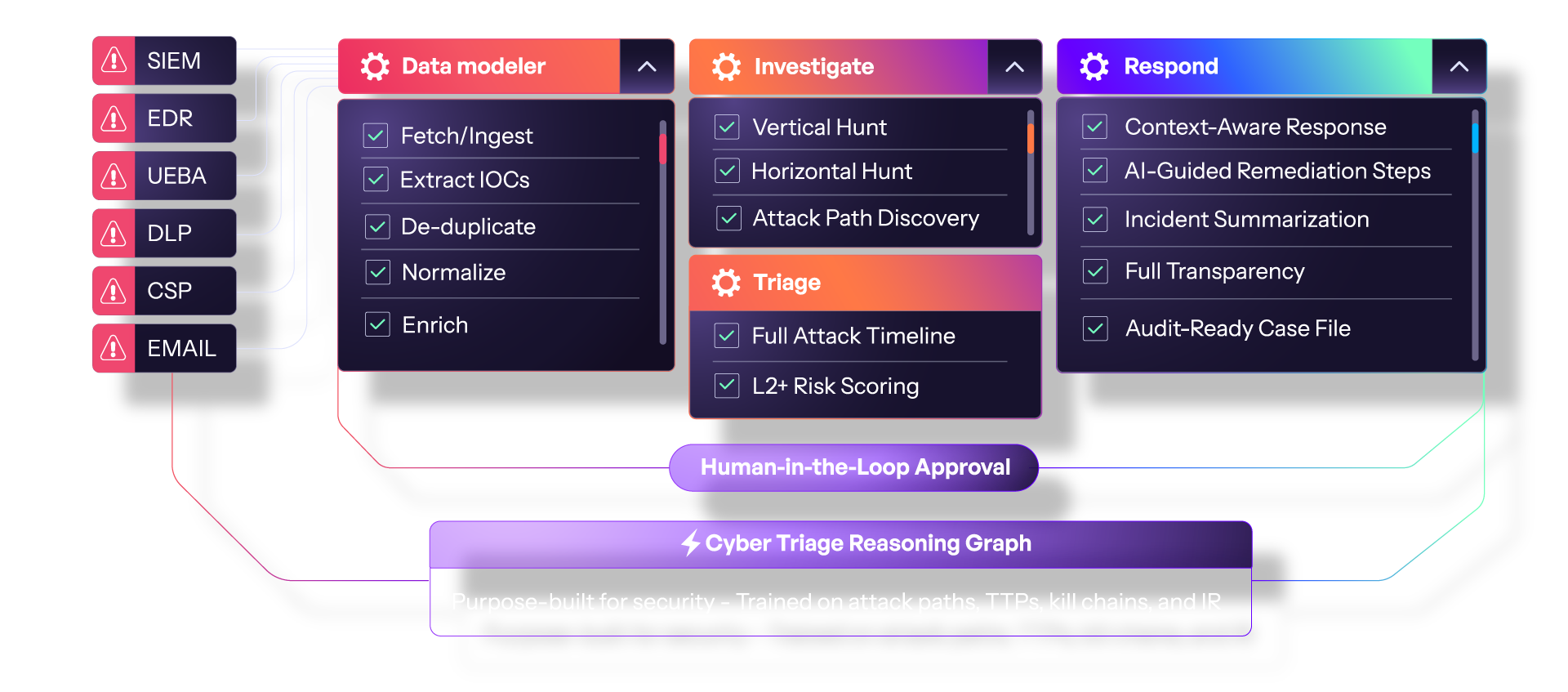
D3 Morpheus provides an AI-driven, end-to-end security operations workflow that executes autonomous responses with optional human oversight.

Data Ingestion and Modeling
Diverse Data Sources
Collect security events and alerts from a broad range of tools, including SIEM, EDR, and email security solutions.
Entity Extraction and Deduplication
Identify key objects (IP addresses, file hashes, user identities) while consolidating duplicate signals into single incidents.
Normalization and Enrichment
Convert disparate data into a consistent format and augment it with threat intelligence, asset context, and vulnerability data.

Investigation and Triage
Vertical and Horizontal Hunts
Explore incidents in depth per case (vertical) and hunt for related threats across multiple systems simultaneously (horizontal).
Contextualization
Automatically link relevant intelligence — vulnerability data, known adversary profiles, asset criticality — to each investigation.
Cross-Stack Threat Scoring
Aggregate risk signals from all integrated systems to produce a unified severity rating, ensuring critical threats receive immediate attention.

Automated Response
Playbook Generation and Execution
Automatically build and execute incident response workflows — isolating a host, blocking an IP, closing a ticket — based on what the investigation finds.
Incident Summaries
Generate concise reports on incident scope, actions taken, and outcomes — ready for analyst review or compliance documentation.

Human-in-the-Loop (Optional)
Analyst Oversight
While automation covers routine triage and response, analysts intervene at command-risk thresholds they configure. Autonomy without accountability is not a product — it is a liability.

AI-Assisted Case Management
AI-Driven Search and Hunt
Identify patterns, anomalies, and potential threats across historical and real-time data without manual query writing.
Summarization
Transform large volumes of raw security data into actionable insights scoped to each incident.

Extensive Integrations
Broad Tool Compatibility
800+ bidirectional integrations connect D3 Morpheus to the security tools already in your stack, ensuring a comprehensive view of your threat landscape without ripping and replacing existing investments.
VENDOR LANDSCAPE
Where D3 Morpheus Fits in the AI-SOC Market
The market has two technical foundations: deterministic SOAR for response orchestration and agentic AI investigation for triage. Every vendor is converging on both. The question is whether they do it in one engine or two.
The Governed Center: Both Foundations. One Engine.
Legacy SOAR vendors handle deterministic response but lack agentic investigation. Pure-play agentic tools handle L1 triage but route back to a SOAR for response. Platform incumbents offer both, locked to their own telemetry stack. D3 Morpheus delivers both foundations in an open, self-learning engine, independent of any vendor stack.
| Vendor Category | SOAR Backbone | Agentic Investigation | Stack Independence | LLM / Token Pricing |
|---|---|---|---|---|
| Legacy SOAR (e.g., XSOAR, Splunk SOAR) | Yes | No | Partial | Not applicable |
| Pure-Play Agentic (L1 SOC tools) | No — integrates externally | Yes | Yes | Per-token / usage-metered |
| Platform Incumbents (CrowdStrike, Palo Alto, Microsoft) | Yes | Yes | No — own telemetry stack only | Metered per use |
| D3 Morpheus | Yes | Yes | Yes — 800+ integrations, any stack | Subscription-based, token costs included |
Why Pure-Play Agentic SOC Tools Still Need a SOAR
Pure-play agentic SOC platforms market themselves as SOAR replacements. The claim breaks on response execution. An agentic tool can triage an alert, generate a case summary, and draft a remediation recommendation. It cannot execute a containment action, modify a firewall rule, or close the ticket without routing to a SOAR for the deterministic playbook. That is why most pure-plays now advertise SOAR integrations as a feature rather than a limitation. Some integrate directly with D3’s own SOAR platform.
For buyers, the math is clear. One agentic SOC tool plus one SOAR platform means two procurement processes, two vendor relationships, and two integration surfaces to maintain. D3 Morpheus delivers both capabilities in one engine. One enterprise MSSP ran this comparison directly: it had separately purchased a SOAR and an L1 agentic SOC platform. It replaced both by adopting Morpheus.
THE CONSOLIDATION CASE
One D3 Morpheus deployment replaces three or four separate tools: SOAR, agentic investigation layer, case management, and often a standalone L1 triage platform. Three or four procurement decisions become one. The AI-SOC market is converging on this architecture. D3 Morpheus is already there.
Industry analysts have tracked the autonomous SOC thesis from skepticism to mainstream acceptance. In 2022, Forrester’s Allie Mellen called fully autonomous SOC operations a “pipe dream,” citing fragmented data and incompatible tools as the core obstacles. By 2024, SentinelOne introduced a five-stage Autonomous SOC Maturity Model, reframing the goal as a “symbiotic relationship” where AI handles repetitive investigation tasks and frees analysts for strategic work. The analyst is the hero — not the machine.
Current industry consensus on autonomous SOC deployments holds three points. First, human-machine collaboration is essential: autonomous SOCs perform best when AI handles structured triage and analysts handle exception management and strategic defense. Second, continuous adaptation is critical: systems must incorporate feedback loops from new threat intelligence and analyst overrides to stay accurate. Third, ethical governance matters: AI systems require auditability, transparency, and bias review to meet regulatory and enterprise requirements. D3 Morpheus is designed around all three.
One Engine. One Audit Trail.
D3 Morpheus runs a deterministic shell with LLM reasoning gates and human oversight at each step — the architecture frontier AI research recommends for governed autonomous systems.
Deterministic Shell (70–80%)
The majority of every investigation runs on predefined, auditable logic with no LLM in the chain. Every action is traceable. Every step is documentable for a compliance audit.
Cybersecurity Triage Reasoning Graph
Purpose-built for SecOps, the reasoning graph handles the open-ended 20–30%: correlating novel signals, validating unknown IOCs, and reconstructing attack paths across your specific environment. Built over 24 months by 60 specialists. Not a wrapper on a general-purpose LLM.
Tenant-Scoped Learning
Every case adds to a knowledge base scoped to your organization. Analyst overrides harden back into the deterministic shell as playbooks. The engine improves on your data. Rivals running commodity LLMs do not have per-tenant decision capture. This loop cannot be replicated without it.
BUILT THE WAY AI SHOULD BE BUILT
Anthropic’s research on effective AI agents draws the same architectural line D3 does: prefer deterministic workflows with LLM reasoning gates, keep humans in the loop at each step, and reserve full agent autonomy for genuinely open-ended tasks. D3 Morpheus follows that pattern precisely. The “let the agent run” model is the one frontier AI research recommends using sparingly.
Same Engine. Your Rules.
D3 Morpheus supports four autonomy modes. Switch between them per alert class, per integration, or per team, with no architectural changes and no new deployment.
Deterministic
No AI in the investigation chain. Morpheus runs predefined playbook logic, fully auditable. Use when you need complete determinism: regulated environments, critical infrastructure, change-controlled assets.
AI-Assisted
Morpheus investigates and drafts the response. Every action requires analyst approval before execution. The reasoning graph does the legwork. The analyst makes the call.
AI-Led
Morpheus investigates, prioritizes, and executes lower-risk actions automatically. Analyst oversight applies to decisions above your configured command-risk tier. The Cybersecurity Triage Reasoning Graph surfaces the cases that warrant human judgment.
Autonomous
Full investigation, triage, and response at the thresholds you configure, without analyst touchpoints. Every action is logged in the audit trail. Autonomy you can document for a compliance review.
faqs
Frequently Asked Questions
Common questions about autonomous SOCs, the vendor landscape, and how D3 Morpheus compares.
What is the difference between an autonomous SOC and a legacy SOAR?
A legacy SOAR executes predefined playbooks. It automates response after a human — or a rule — has determined what to do. An autonomous SOC runs investigation first: the platform reads the alert, correlates signals across tools, validates IOCs, and reconstructs the attack timeline before routing to response. The difference is whether the platform closes cases or executes them.
Do autonomous SOC platforms replace SOAR, or do they work alongside it?
It depends on the platform. Pure-play agentic SOC tools handle L1 triage and investigation but cannot execute response without routing to a SOAR for deterministic playbook execution. That is why most pure-play vendors advertise SOAR integrations. D3 Morpheus includes both a SOAR backbone and an agentic investigation engine in one deployment, so neither is needed separately.
What autonomy modes does D3 Morpheus support?
D3 Morpheus supports four autonomy modes: Deterministic (no AI in the investigation chain), AI-Assisted (Morpheus investigates, the analyst approves every action), AI-Led (Morpheus executes lower-risk actions, analyst oversight applies to command-risk decisions), and Autonomous (full investigation and response at your configured thresholds). All four run on the same engine with no architectural fork and no new deployment required.
How does D3 Morpheus support compliance and audit requirements?
Every action Morpheus takes — whether triggered by a playbook, the Cybersecurity Triage Reasoning Graph, or an analyst override — is written to a single audit trail per incident. That trail maps to evidence requirements for NIS2, DORA, and EU AI Act inquiries. D3 Security holds SOC 2 Type II certification.
Is a fully autonomous SOC realistic for most security teams?
Full autonomy is appropriate for well-understood alert categories where confidence is high: phishing triage, known IOC blocks, routine isolation tasks. D3 Morpheus lets you configure autonomous thresholds per alert class. You set autonomy where confidence supports it and keep analyst oversight where it does not. You do not choose between autonomy and control — you configure both.
How is D3 Morpheus priced compared to other autonomous SOC platforms?
D3 Morpheus uses a subscription-based pricing model with LLM token costs included. Platform incumbents typically meter AI inference per token or per alert, which can produce unpredictable bills during high-incident periods. Specific pricing details are covered in the demo conversation.
What is the difference between an autonomic SOC and an autonomous SOC?
Autonomic systems are self-managing: they adapt to changing conditions but operate within predefined boundaries and rules. Autonomous systems are self-governing: they can make independent decisions without human intervention. In a SOC context, an autonomic approach focuses on maintaining a stable security state through adaptive rules and self-healing integrations. An autonomous SOC goes further — it independently investigates, decides, and acts within the governance framework the organization configures. D3 Morpheus supports both, from fully Deterministic (autonomic-style, no AI in the chain) through fully Autonomous, selectable per alert class with no architectural fork.
See What a Genuine Autonomous SOC Looks Like
D3 Morpheus investigates every alert at L2+ depth, orchestrates governed response across 800+ integrations, and lets you choose your level of autonomy. No queue. No handoffs. Cases closed.