“Investigate every alert” is easy to put on a slide and hard to build. The reason is that investigation is a sequence of steps, and each step introduces a way to be wrong. A tool that automates the sequence without governing each step just gives you a faster way to reach a bad conclusion. So it’s worth walking the actual lifecycle, stage by stage, because that’s where the discipline lives.
Read-only investigation makes “investigate everything” safe to say
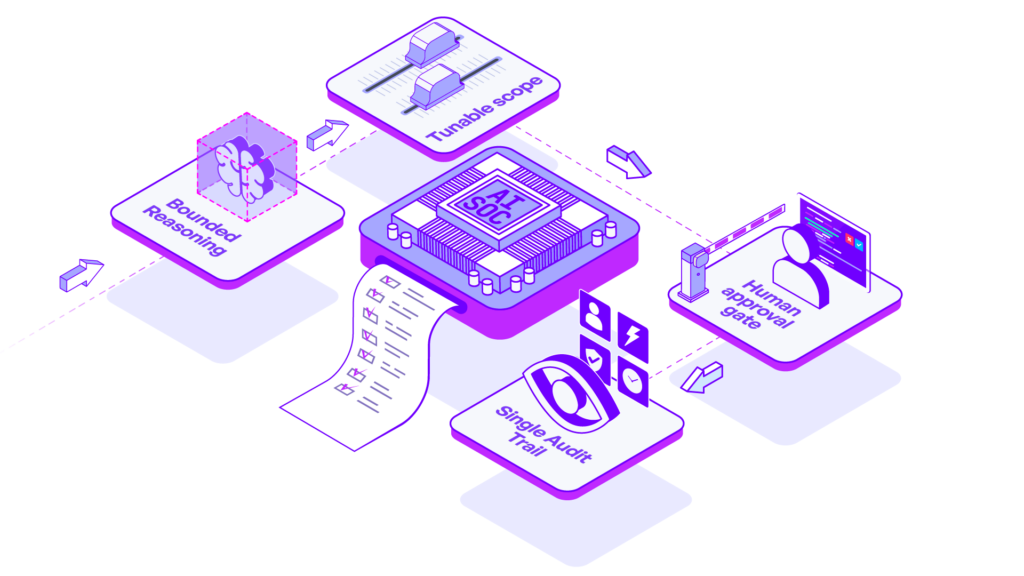
It starts at intake, and the first real decision is how the investigation behaves. Morpheus investigates read-only. The engine gathers evidence, reconstructs the attack path, and takes no action. That matters for two reasons. It means a human can read the whole path without wondering whether the tool altered state while it looked, and it means the investigation can run on every alert without anyone worrying it will do something rash on the way to understanding. Read-only investigation is what makes “investigate everything” safe to say.
EAR shows its work: factors, weights, and contradicting evidence
Then the alert has to be scored and disposed. This is where Effective Alert Risk comes in, and where the honesty of the whole system is tested. EAR weighs exposure, identity blast radius, data proximity, and intel match. What matters is the breakdown behind the number. An analyst has to be able to open a disposition and see the factors, the weights, and the evidence behind each, including the evidence that contradicts the verdict. A system that hides the reasoning behind a clean score is asking for trust it hasn’t earned. And the validity gate is recoverable: every disposition has a way back.
Next the system synthesizes the story, and there is one rule that governs it: no claim without a link. Every statement in the narrative resolves to a specific piece of evidence. This is the difference between an investigation and a plausible-sounding summary. The latter reads well and cannot be checked. Evidence-first synthesis is what lets a reviewer, an auditor, or a skeptical analyst verify the story for themselves.
From there Morpheus recommends and plans. The copilot proposes the remediation; the analyst decides. Four autonomy modes let a team decide how much runs on its own and how much waits for a person. The right amount of autonomy is a decision each SOC makes for itself. When it comes time to respond and act, command-risk tagging ships with the action catalogue, so the risk of an action sets its own gate. High-consequence actions wait for a human by default, without an engineer maintaining a global setting.
Then two stages that are easy to skip and expensive to skip. Capture and audit: the investigation becomes the record. The record is the actual work itself, captured as it happens: every query, every piece of evidence, every action, one chain of custody per incident. When the work and the record are the same artifact, oversight stops being a separate tax. And finally, learn: the system reasons, skillifies what it learns, codifies it, and falls back when it should, all tenant-scoped, so what it learns from your team stays inside your environment and never acts on its own.
The through-line is a single sentence: autonomous at every stage, governed at every stage. It’s worth being precise about why both halves are load-bearing. Autonomy without governance is the failure mode everyone fears: a confident machine you can’t retrace. Governance without autonomy is just the manual SOC with extra paperwork. The value is in refusing to trade one for the other at any stage of the sequence.
800+ Self-Healing Integrations, 18-minute drift repair
And it has to hold up operationally as well as architecturally. An investigation engine is only as good as its reach into your tools, which is where most automation quietly rots: a connector drifts, an API changes, and the coverage you thought you had develops holes nobody sees. Morpheus runs 800+ self-healing integrations, and when one drifts, the median repair is 18 minutes rather than the four to six weeks a manual fix typically takes. Coverage you can’t maintain is a screenshot of coverage from the day you bought the tool.
Put it together and “investigate every alert” stops being a slogan. It’s a read-only investigation on every alert, a scored and explained disposition you can open, an evidence-linked story you can verify, a governed response with the gate set by the action’s own risk, and a record that is the work itself. That’s what it takes. And it’s why the demo to ask for is the one where a source goes dark and you watch what the system does next.
Want to walk the lifecycle on a real alert? Book a demo.