

SOAR PLATFORM — EVOLVED
SOAR Hit a Ceiling. Here’s What Comes Next.
SOAR automated 30-40% of alerts with static playbooks. D3 Morpheus handles up to 95% of alerts in under 2 minutes at L2+ depth, no playbooks required, no maintenance tax. When Morpheus is uncertain, it defers to a human. The accountable agentic SOC platform is what SOAR was always meant to become.
80%
Customers migrated from legacy SOAR
91%
False alert reduction in 12 months
800+
Self-healing integrations
When Morpheus is uncertain, it defers to a human.

See SOAR Migration
in Action
The SOAR Ceiling: Why Static Playbooks Stopped Working
SOAR (Security Orchestration, Automation and Response) was built for a different era: fewer alerts, slower attackers, and simpler attack paths. Today’s SOCs face problems that static playbooks can’t solve.
Outcome Automation vs. Task Automation
The core limitation of SOAR is architectural: it automates tasks within predefined playbooks, not outcomes. SOAR says, “If this condition exists, run this action.” It requires humans to author every possible scenario upfront. With 145,000+ alerts per month and novel threats emerging daily, this approach fails.
D3 Morpheus uses a different model: outcome automation. Rather than executing fixed playbook logic, Morpheus reasons through security problems end-to-end. Given an alert and your security context, it determines the optimal investigation path and generates the necessary response, all at runtime. This works for novel threats, complex scenarios, and corner cases that no playbook anticipated.
The gap in coverage: Static playbooks top out at 30-40% alert coverage. Organizations implement 12-18 months of playbook development to reach that ceiling. D3 Morpheus covers 100% of alerts from day one because it reasons, not just executes.
The Playbook Maintenance Tax
SOAR platforms require manual playbook authoring. You define workflows in conditional logic: if field A equals value B, then execute action C. But threats evolve. New attack variants appear. Your team authors new playbooks. Tests them. Versions them. Updates them. Redeploys them. This cycle never ends.
A 50-person SOC team with 200+ playbooks spends 4-6 weeks per year on playbook maintenance alone. That’s engineering time you could spend on threat hunting or architecture improvements. And that assumes your playbooks stay current with threats. They often don’t.
Integration Brittleness & the Self-Healing Alternative
Your SIEM vendor releases an API update. Suddenly your playbooks fail silently. Your EDR changes authentication. Connectors break. Splunk deprecates an endpoint. Your Palo Alto integration stops updating device groups.
SOC engineering teams spend 30% of their time keeping SOAR integrations alive. When APIs drift or schemas change, connectors fail without alerting your team. You lose visibility. Attackers move.
Enterprise security stacks have 50+ tools x 4-6 updates per year, creating constant integration breakage. SOAR requires manual intervention for each change. D3 Morpheus takes a different approach: self-healing integrations that detect API drift in minutes, understand the semantic meaning of schema changes, and regenerate integration code autonomously. Adding the 51st tool adds zero maintenance burden. Target: 99.9% integration uptime without engineering overhead.
Partial Coverage & Contextual Playbook Generation
SOAR automates 30-40% of alerts: the simple, repeatable ones. Deduplication, low-confidence cases, basic enrichment. The other 60-70% of alerts pile up in analyst queues. Your team does triage manually. Alert fatigue kills productivity.
The root cause: 67% of alerts go uninvestigated because there’s no playbook for them. Threat landscape diversity is too broad for static playbooks. D3 Morpheus solves this with contextual playbook generation. At runtime, Morpheus generates bespoke investigation playbooks based on the alert evidence, your security posture, and your policies. No authoring required. Full Python code visibility: transparent, editable, overridable if your team needs to tweak logic. This means 100% alert coverage from day one, with no pre-authoring tax.
Alert Volume Outpaced Design
Modern SOCs see 4,484+ daily alerts (or 145,000 per month). SOAR was designed for 100-200 alerts per day. If-then logic doesn’t scale. You add more playbooks. Complexity grows. Maintenance burden grows. Performance degrades. Your team falls further behind.
New Threats = Playbook Delays
A new ransomware variant emerges. Your SOAR team writes a playbook. Tests it. Deploys it. By the time the playbook is live, the threat has evolved. You’re always one step behind.
THE FINANCIAL IMPACT
Organizations spending $500K+/year on SOAR platform licensing, playbook engineering, and integration maintenance often achieve less than 40% alert automation coverage. That’s $15K+ per 1% of automation, before you count analyst burnout and missed threats.
SOAR vs. the agentic SOC: What Actually Changed
SOAR is a workflow engine. The agentic SOC is an investigator. D3 Morpheus doesn’t execute playbooks. It reasons through ambiguous security problems and generates response actions in real time.
| Dimension | D3 Morpheus (agentic SOC) | Legacy SOAR |
|---|---|---|
| Playbook Approach | Contextual, generated at runtime per incident | Static, pre-authored, versioned |
| Playbook Customization | Full Python visibility, edit at runtime | Edit YAML, rebuild, redeploy |
| Alert Coverage | 100% investigated at L2+ depth | 30-40% automated |
| Investigation Depth | Full L2+ Attack Path Discovery | L1 triage only (dedup, enrich) |
| Triage Speed | Up to 95% in under 2 minutes | Minutes to hours (analyst-dependent) |
| Integration Maintenance | Self-healing, auto-detects and repairs | Manual, engineering troubleshoots |
| Integration Uptime | 99.9%, handles API drift autonomously | Depends on engineering team responsiveness |
| New Threat Response | Adapts in real time | Wait for playbook update (weeks) |
| AI Architecture | Purpose-built Cybersecurity Triage Reasoning Graph | Rule-based or generic LLM wrapper |
| Cyber Triage Reasoning Graph Development Depth | 24 months, 60 specialists, 8M+ incidents | N/A or general-purpose training |
| Cross-Vendor Schema Understanding | Semantic understanding of any vendor schema | Limited to hardcoded mappings |
| Pricing Model | Platform Subscription plus User Licenses | Per-alert or per-token common |
| MSSP Support | Native multi-tenant with data isolation | Varies by platform |
| Case Management | Built-in, alert to closed case | Separate tool often needed |
| Night Shift Coverage | Autonomous 24/7 investigation | Requires SOC staffing |
| SOC Engineering Burden | Near-zero, self-healing handles it | 30% of time on maintenance |
When Morpheus is uncertain, it defers to a human.
KEY DIFFERENCE
Static playbooks solve known problems. D3 Morpheus reasons through unknown problems. When a novel attack pattern appears, SOAR needs a new playbook. Morpheus adapts immediately.
Why D3 Morpheus — Not Another SOAR Vendor
D3 Security didn’t build Morpheus by bolting an LLM onto legacy SOAR code. We evolved the entire category.
D3 Created the SOAR Category
D3 Security founded incident response automation in 2015, before Gartner even coined the term “SOAR.” We were the first to automate playbook execution, integration orchestration, and alert triage at scale. We know SOAR inside and out, because we invented it.
We’re Not Claiming SOAR is Dead
SOAR is mature technology. It’s excellent at orchestrating simple, deterministic workflows. But the market has moved beyond simple alerts. Attackers are faster. Alert volumes have exploded. Cloud infrastructure is complex. SOAR hit a ceiling.
D3’s angle: the accountable agentic SOC platform is what SOAR was always meant to become. We evolved it. We didn’t trash it.
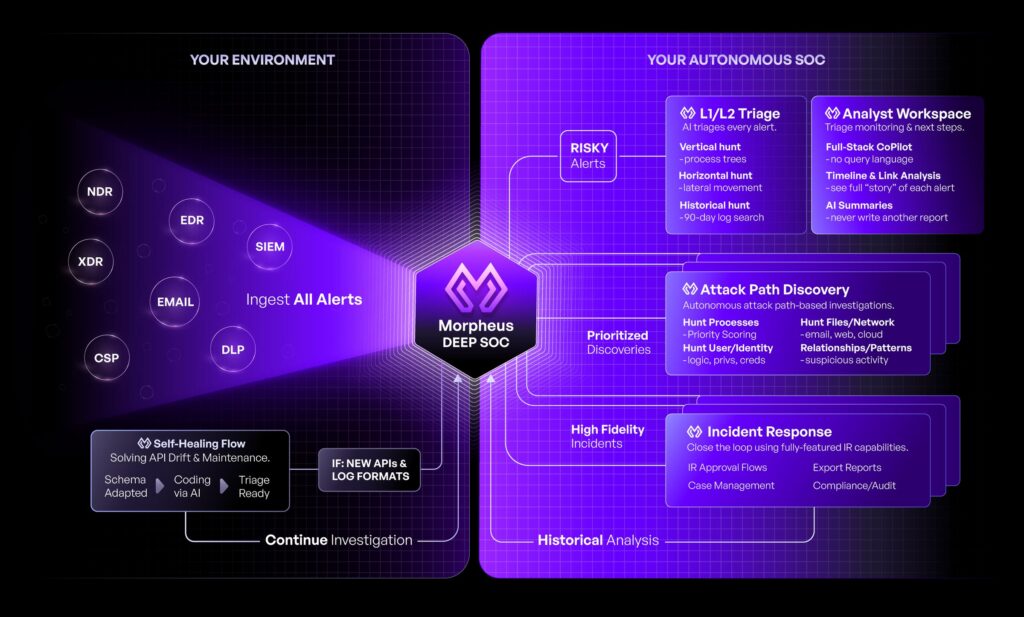
Purpose-built Cybersecurity Triage Reasoning Graph, Not Generic AI
Morpheus runs on the Cybersecurity Triage Reasoning Graph, built exclusively for cybersecurity triage. Not a general-purpose model bolted onto SOAR. Not one trained on the open web. The Cybersecurity Triage Reasoning Graph was developed over 24 months by 60 security specialists on 8M+ real incident investigations. It understands:
- Cross-vendor attack semantics: lateral movement, privilege escalation, persistence across 800+ tools
- Schema normalization at the semantic level, not just field mapping
- Industry-specific threat patterns and false positive signatures
- Enterprise policy reasoning and compliance context
This depth means Morpheus investigates at L2+ without requiring manual rule authoring or continuous model retuning.
Customer-Expandable Cybersecurity Triage Reasoning Graph: Your Proprietary Triage Engine
Each organization’s Morpheus instance adapts to your unique environment, processes, and analyst preferences. The triage capability that emerges from your deployment belongs to you, not to D3. As Morpheus learns your threat landscape and your team’s decision patterns, the proprietary knowledge you build stays with your organization. Competitors cannot access it. You’re building your own specialized investigator tailored to your business.
Governance: Trust Through Transparency
The enterprise buyer replacing a known-quantity tool needs trust. D3 Morpheus earns it through three pillars of quality proof and a hardening lifecycle that reduces AI dependency over time.
- Visible Framework: Every reasoning step is exposed. Evidence traces, confidence scoring, and decision logic are visible to analysts. You see exactly why Morpheus recommended an action.
- Attack Simulation: Simulated multi-stage attacks with known ground truth validate investigation depth. Morpheus surfaces attack paths that human analysts miss. 87% attack path revelation rate proves this capability. When Morpheus is uncertain, it defers to a human.
- Trust Model: Investigation decisions live in deterministic zones (hardened patterns) or indeterministic zones (LLM reasoning). As Morpheus learns your environment, more decisions graduate to deterministic code, making them faster, cheaper, and fully auditable.
Reasoning Explorer & Pattern Hardening
Drill into the Cybersecurity Triage Reasoning Graph for any investigation. Challenge, accept, or override recommendations. When patterns prove reliable, Morpheus converts them from probabilistic LLM reasoning to hardcoded deterministic logic. This means your system gets faster, cheaper, and more predictable with every month of use, directly addressing the cost predictability concerns that SOAR buyers have. You can edit and override at any time.
Proven Results
- Investigation Closure: Morpheus closes investigations decisively with clear dispositions and remediation recommendations. When Morpheus is uncertain, it defers to a human.
- 87% Attack Path Revelation Rate: Morpheus uncovers multi-stage attack chains that static SOAR rules cannot reach. When Morpheus is uncertain, it defers to a human.
HERITAGE MATTERS
D3 understands playbook maintenance, integration brittleness, alert fatigue, and SOC engineering burden because we lived through them. We built Morpheus to solve problems we witnessed every day.
Replacing Your Current SOAR Platform
Whether you run Cortex XSOAR, Splunk SOAR, Tines, Torq, or Google Cloud SecOps, Morpheus is the next step. Here’s why teams migrate from each platform.
Replacing Cortex XSOAR
Teams migrating from XSOAR cite playbook authoring burden, custom Python development, and integration maintenance overhead. D3 Morpheus eliminates playbook coding entirely. Self-healing integrations adapt to API changes automatically. Runtime playbooks are generated per incident.
Replacing Splunk SOAR
Splunk SOAR users face high per-alert licensing costs and playbook maintenance tax. D3 Morpheus uses a subscription pricing model: a Platform Subscription plus User Licenses. High-volume alert investigation is core to the platform.
Replacing Tines
Tines excels at workflow automation but doesn’t investigate at L2+ depth. D3 Morpheus traces attack paths across your security stack: lateral movement, privilege escalation, persistence. Full L2 analysis without manual correlation.
Replacing Torq
Torq is a workflow platform like SOAR. D3 Morpheus is an AI investigator. Where Torq requires playbook design, Morpheus generates them at runtime. Attack Path Discovery solves problems Torq workflows can’t reach: cross-tool correlation at scale, novel threat adaptation, zero playbook maintenance.
Replacing Google Cloud SecOps
Google Cloud SecOps users rely on Google-native tools but lack depth for cross-cloud investigation and legacy infrastructure. D3 Morpheus investigates across any cloud and on-premises systems. Full L2 analysis across your entire security landscape.
For detailed head-to-head comparisons with your current platform, see our Comparison Hub.
What Happens After You Switch
SOAR migration is simple. Deployment takes 2 weeks. No playbook rewriting. No analyst retraining. Just data ingestion, tuning, and go-live.
Related
Keeping your SIEM? D3 Morpheus works beside your existing SIEM investment as an intelligence layer without requiring a platform replacement.
2-Week Deployment Timeline
800+ Pre-Built Integrations
D3 Morpheus ships with connectors to all major security platforms. No custom development. No integration coding. Self-healing integrations adapt automatically as APIs change.
- SIEM & Detection: Microsoft Sentinel, Splunk, Elastic, Datadog
- Endpoint Security: Defender, CrowdStrike, SentinelOne, Carbon Black
- Network & Cloud: Palo Alto Networks, Fortinet, Azure, AWS, GCP
- Identity & Access: Okta, Azure AD, Duo
- Custom Tools: REST/SOAP API framework for any tool
Azure Marketplace Availability
D3 Morpheus is available on Azure Marketplace. Deploy natively in Azure, leverage your Azure spending commitments, and integrate directly with Azure costs.
Subscription Pricing: Critical SOAR Replacement Differentiator
Legacy SOAR vendors charge per alert or per token, making predictable budgeting impossible. D3’s pricing model is designed to absorb token and compute costs internally rather than passing them to customers. Morpheus uses a subscription pricing model: a Platform Subscription plus User Licenses. This is the critical differentiator for SOAR replacement buyers accustomed to predictable licensing.
- High-volume alert investigation is core to the platform
- All 800+ integrations included. No per-connector fees
- User Licenses for analysts and investigators
- Predictable subscription pricing built for SOC teams
Financial Reality
A 50-person SOC with legacy SOAR pays $600K+/year (licensing, engineering, token overages). D3 Morpheus delivers the same alert volume under a Platform Subscription plus User Licenses, eliminates 30% of engineering time spent on playbook maintenance, and delivers 3x better coverage.
Customer Results
Teams migrating from legacy SOAR see immediate improvements in alert coverage, investigator productivity, and mean time to response.
56 min → <2 min
Triage time (alert to initial investigation)
80%
MTTR reduction for confirmed threats
312 → 5–10
Analysts needed for equivalent coverage
60–70% → 5–10%
Analyst time on triage (shift to review)
91%
False alert reduction in 12 months
145,000 → 200
Alerts reduced through triage (99% noise elimination)
When Morpheus is uncertain, it defers to a human.
“We went from 60% of analyst time on triage to 5%. Now they hunt threats instead of clicking buttons.”
Enterprise SOC, migrated from legacy SOAR
“Level I and II analysis are fully automated. We focus on what’s actually important.”
MSSP Customer, 50+ managed environments
“We eliminated 4 full-time playbook engineers. Morpheus maintains itself.”
Enterprise SOC Team, formerly running Cortex XSOAR
faqs
Frequently Asked Questions
Common questions from teams evaluating SOAR replacement options.
Can D3 Morpheus replace Cortex XSOAR?
Yes. Morpheus is built to replace XSOAR. We handle all L1-L2 investigation without playbook authoring. Self-healing integrations eliminate integration maintenance. Most XSOAR teams reduce their SOAR engineering burden by 80%+ after migration. See our platform comparison for details.
Can D3 Morpheus replace Splunk SOAR?
Yes. Morpheus provides autonomous alert triage, investigation, and response without the per-alert licensing model that makes Splunk SOAR expensive at scale. Morpheus uses a subscription pricing model: a Platform Subscription plus User Licenses. High-volume alert investigation is core to the platform.
What is the difference between SOAR and an agentic SOC?
SOAR (Security Orchestration, Automation and Response) is a workflow engine that executes predefined playbooks. An agentic SOC is an AI investigator that reasons autonomously through security problems. SOAR handles simple, repeatable cases (30-40% of alerts). Agentic SOC handles complex investigations at L2+ depth (100% of alerts).
How long does SOAR migration take?
Deployment takes 2 weeks. Connect your integrations, establish baseline triage patterns, run in shadow mode alongside your existing SOAR, then go live. No playbook rewriting. No downtime. Your team learns Morpheus through hands-on tuning during deployment.
Will I lose my existing playbooks?
D3 Morpheus doesn’t use static playbooks. Instead, it generates playbooks at runtime for each incident based on the attack context and your policies. Your existing SOAR playbooks represent valuable institutional knowledge. We help you extract that logic into Morpheus triage rules and escalation policies. Nothing is lost, everything is improved.
How much does D3 Morpheus cost compared to legacy SOAR?
D3 Morpheus uses a subscription pricing model: a Platform Subscription plus User Licenses, with no per-connector fees. At 145,000 alerts/month, legacy SOAR platforms charge $15K-$50K/month in fees plus engineering costs. High-volume alert investigation is core to the platform. Additionally, Morpheus eliminates the 30% of SOC engineering time spent on playbook maintenance and integration upkeep.
Does Morpheus require my team to learn a new tool?
Morpheus is designed to be intuitive for SOC analysts and investigators. You configure triage sensitivity, escalation rules, and response automation policies through a web UI. No coding required. No playbook authoring. Your team typically reaches full proficiency in 1-2 weeks.
What happens if I still need my legacy SOAR for compliance or reporting?
Morpheus runs alongside your legacy SOAR during migration. After go-live, you can keep the legacy SOAR in read-only mode for historical data and compliance reporting. Over time, Morpheus becomes your system of record. The transition is gradual and risk-free.
Is Morpheus available in the cloud I use (Azure, AWS, GCP)?
D3 Morpheus is cloud-native and available on all major cloud providers. We’re listed on Azure Marketplace for native Azure deployment. We also support AWS and GCP. You can run a hybrid model (some data on-premises, some in cloud) if needed.
What about data privacy and compliance when migrating from SOAR?
D3 Morpheus supports SOC 2, HIPAA, and PCI-DSS requirements. Data is encrypted in transit and at rest. Each customer’s data is isolated in dedicated tenant environments. We never share your data with third parties or use it to train the Cybersecurity Triage Reasoning Graph.
Is Morpheus just a generic LLM wrapped around SOAR?
No. Morpheus runs on the Cybersecurity Triage Reasoning Graph, developed over 24 months by 60 security specialists on 8M+ incident investigations. It understands cross-vendor attack semantics, schema normalization, compliance context, and threat patterns that generic LLMs cannot reason about effectively. This specialization is why Morpheus investigates every alert that reaches it and closes the large majority without escalation. When Morpheus is uncertain, it defers to a human.
How do I know I can trust Morpheus’s recommendations?
Trust is earned through transparency. Every Morpheus investigation shows complete reasoning chains, evidence traces, and confidence scoring. When Morpheus is uncertain, it defers to a human. Use the Reasoning Explorer to drill into the Cybersecurity Triage Reasoning Graph, challenge recommendations, or override them. Patterns that Morpheus identifies reliably get graduated to deterministic code, making them faster, cheaper, and more predictable. You can edit and override at any time.
What’s “deterministic pattern hardening”?
As Morpheus identifies reliable detection and investigation patterns, those patterns get converted from LLM-based reasoning to hardcoded deterministic logic. This makes them faster to execute, cheaper to run, and more transparent for audits. Over time, your Morpheus instance becomes a hybrid: LLM for novel cases, deterministic code for well-understood patterns. This addresses cost predictability concerns that SOAR buyers have. You see costs decline as the platform learns your environment.
Can I run Morpheus across multiple customer environments (MSSP model)?
Yes. MSSPs run D3 Morpheus across dozens or hundreds of customer environments in a single platform. Each customer’s data is fully isolated. One analyst team handles triage for all customers. This scales MSSP security services without proportional headcount growth.