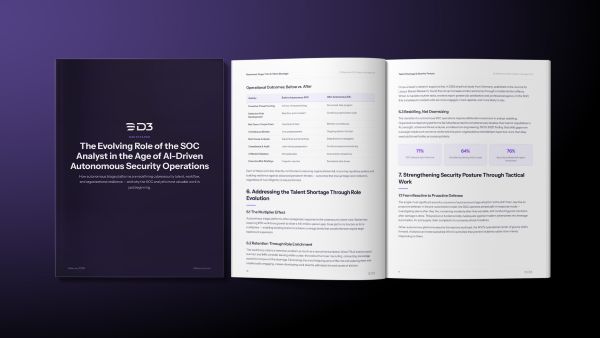
Executive Summary
The SOC analyst role is at an inflection point. Enterprise security teams receive over 4,400 alerts daily, yet 67% go uninvestigated because manual triage cannot keep pace with volume. Each alert takes an average of 70 minutes to investigate. At that rate, a 10-person team can cover fewer than 70 alerts in an eight-hour shift. The remaining thousands are guesses, gambles, or silent gaps.
The result is predictable and measurable: 71% of SOC analysts report burnout, 64% are considering leaving within the year, and 4.8 million cybersecurity positions remain unfilled globally. The industry needs 87% workforce growth to meet current demand, a gap that hiring alone cannot close.
D3 Morpheus AI is an AI-autonomous Security Orchestration, Automation and Response (SOAR) platform that breaks this cycle. Morpheus AI absorbs the exhausting, repetitive triage work, processing 100% of incoming alerts with L2-quality depth in under two minutes each, so analysts can redirect 3+ hours per day toward threat hunting, detection engineering, and strategic security architecture.
This paper examines how the SOC analyst role transforms when autonomous triage eliminates the alert backlog, what new responsibilities emerge, and why organizations that invest in AI-autonomous platforms gain both stronger security and better talent retention.
Who should read this: CISOs, SOC directors, HR leaders, and security operations managers who need to understand how AI-autonomous platforms reshape team structure, talent strategy, and daily workflow. The analyst’s most valuable work is just beginning.
Table of Contents
- A System Under Strain
- Morpheus AI: The Platform That Frees the Analyst
- AI Transforms Roles. It Does Not Eliminate Them.
- The SOC Analyst Before and After Autonomous Triage
- What 3+ Hours of Recovered Analyst Time Enables
- Solving the Talent Shortage Through Role Evolution
- Implementation: Start Static, Go Autonomous
- The Analyst’s Most Valuable Work Is Just Beginning
A System Under Strain
The Triage Burden
Manual alert triage follows a predictable pattern: an alert fires, an analyst opens the console, pivots across 3–7 tools, correlates context, makes a classification decision, and documents the outcome. That process averages 70 minutes per alert. Across 4,484 daily alerts, the math is unforgiving: a team would need 5,231 analyst-hours per day to investigate every alert at that pace. No organization staffs to that level.
The practical consequence is triage-by-priority: analysts handle the alerts that look most dangerous, skip the rest, and hope the skipped ones are benign. That hope fails regularly. Sixty-one percent of SOC teams have ignored alerts later confirmed as genuine compromise.
Alert Fatigue and Analyst Burnout
The psychological cost is equally measurable. When analysts know they are leaving threats uninvestigated, stress compounds. Industry data confirms 71% of SOC analysts report burnout, and 64% are actively considering leaving the field within 12 months. The annual cost of manual triage in the U.S. alone is estimated at $3.3 billion, a figure that does not include the downstream cost of breaches that uninvestigated alerts enable.
The Global Workforce Crisis
With 4.8 million unfilled cybersecurity positions globally and a requirement for 87% workforce growth to meet current demand, hiring is not a viable solution at scale. Even organizations that can recruit experienced analysts face a paradox: they invest in skilled talent, then assign that talent to repetitive triage work that a purpose-built system could handle faster and more consistently.
The core problem is structural, not operational. Adding headcount, buying another SIEM, or layering a chatbot on top of existing SOAR does not change the math. The 70-minute investigation cycle must be replaced, not accelerated.
Morpheus AI: The Platform That Frees the Analyst
D3 Morpheus AI is an AI-autonomous SOAR platform purpose-built to handle the triage work that consumes analyst capacity. Unlike natural-language overlays on legacy SOAR engines, Morpheus AI performs autonomous investigation from first principles, powered by the Cybersecurity Triage Reasoning Graph that understands how attacks propagate across tools and time.
1. Cybersecurity Triage Reasoning Graph
At the core of Morpheus AI is the Cybersecurity Triage Reasoning Graph developed over 24 months by a team of 60 specialists, including red teamers, data scientists, AI engineers, and SOC analysts. This model understands attack propagation at a foundational level: how a phishing payload transitions to credential theft, how compromised credentials enable lateral movement, and how each stage manifests differently across vendor telemetry. It is a security model from the ground up.
2. Attack Path Discovery on Every Alert
On every incoming alert, Morpheus AI performs multi-dimensional correlation: vertical (North-South) deep inspection into the alert’s origin tool and horizontal (East-West) correlation across the full security stack. The result is a structured investigation report with step-by-step reasoning, delivered in under two minutes. This is the same depth an experienced L2 analyst provides, but at machine speed, without fatigue, and with consistent quality regardless of shift or volume.
3. Contextual Playbook Generation
Because Morpheus AI understands the alert context, the customer’s tool stack, and the organization’s SOC preferences, it generates a bespoke playbook for each incident at runtime. There is no static playbook lifecycle to manage: no authoring, no versioning, no emergency updates when a new attack variant appears. The playbook adapts to the evidence, not the other way around.
4. Self-Healing Integrations
When APIs drift, schemas change, or detection outputs shift across 800+ integrations, Morpheus AI detects the change and generates corrective code autonomously. This eliminates SOAR’s most persistent operational challenge: the silent-failure windows that traditional deployments accept as a cost of doing business. For the analyst, this means integrations simply work. No more debugging broken connectors during a shift.
5. AI Adaptive Tasking
Morpheus AI’s AI Adaptive Tasking uses the Cybersecurity Triage Reasoning Graph to suggest tasks on the fly based on alert data, user feedback, and the results of completed tasks. Grounded in full investigation context, it recommends the next step. Query an endpoint, check lateral movement, or escalate with a pre-built evidence package. This shifts analysts from navigating consoles to reviewing recommendations. The analyst remains in control while the platform handles the investigative legwork.
6. AI SOP (Standard Operating Procedures)
D3’s AI SOP allows SOC teams to build natural-language playbooks that combine API call tasks, data processing tasks, and AI agent tasks per their own standard operating procedures. Every analyst interaction improves triage accuracy. The system uses the Claude agent SDK for error correction with human-in-the-loop oversight, ensuring the analyst always has final authority over decisions that matter.
7. Customer-Expandable Reasoning Graph
Customers can customize Morpheus to their environment and SOC workflows. The entire customization process is transparent: analysts have full visibility into how the model reasons, and every step is reviewable, editable, and overridable. Morpheus AI earns analyst trust by making its decisions visible.
8. Built-In SOAR: Start Static, Go Autonomous
Morpheus AI includes a full built-in SOAR engine alongside its autonomous AI capabilities. Organizations can run both models simultaneously: static playbooks for alert categories where deterministic behavior is required, and autonomous triage for categories where AI-driven investigation adds value. The transition happens on the customer’s timeline, not the vendor’s. For analysts, this means familiar SOAR workflows remain available while autonomous capabilities expand incrementally.
9. Tool Consolidation
Morpheus AI consolidates AI-driven autonomous automation, a full-featured traditional SOAR engine, and integrated case management into a single platform. Total cost of ownership should be compared not to a SOAR license alone, but to the combined cost of SOAR + case management + AI tooling + the integration labor required to make them work together. For analysts, tool consolidation means fewer consoles, fewer context switches, and more time spent on actual security work.
10. Predictable Subscription Pricing
Other vendors charge per token consumed by their AI models, creating unpredictable costs that scale with alert volume, exactly the wrong incentive for a SOC that needs to investigate more alerts, not fewer. D3’s pricing model is designed to absorb token and compute costs internally rather than passing them to customers. SOC leaders can budget with certainty regardless of how alert volumes fluctuate.
AI Transforms Roles. It Does Not Eliminate Them.
Every major industry that has adopted AI-driven automation has followed the same pattern: repetitive tasks are absorbed by machines, human roles shift toward judgment, oversight, and strategic decision-making, and net employment in the field grows rather than shrinks. The World Economic Forum projects that while 85 million jobs will be displaced by AI globally, 97 million new roles will be created, a net gain of 12 million positions.
The SOC is following this pattern precisely. The tasks being automated (initial alert triage, log correlation, false-positive filtering) are the same tasks that analysts consistently rank as the least fulfilling and most exhausting parts of their jobs. What remains is the work that requires human judgment, creativity, and contextual understanding.
Radiology
AI reads imaging scans faster and more consistently than humans. Radiologists did not disappear. They shifted to complex case interpretation, treatment planning, and patient communication. Demand for radiologists has increased, not decreased.
Financial Trading
Algorithmic trading handles 60–70% of market volume. Human traders shifted to strategy, risk management, and oversight of algorithmic behavior. The role became more sophisticated, not obsolete.
Manufacturing
Robotic automation eliminated assembly-line repetition. Human workers shifted to quality control, process optimization, and robot maintenance. Overall manufacturing employment has grown alongside automation adoption.
Legal Discovery
AI-powered document review handles millions of pages in hours. Attorneys shifted from document review to case strategy, client counsel, and courtroom advocacy. The profession gained capacity, not headcount reduction.
The pattern holds in every case: AI absorbs the volume problem. Humans provide the judgment layer. The role becomes more valuable, more engaging, and harder to replace. Morpheus AI applies this same pattern to the SOC, with one critical addition: every analyst interaction with the platform, approving, overriding, or refining AI decisions through AI SOP and AI Adaptive Tasking, generates quality data that makes the system smarter over time.
The SOC Analyst Before and After Autonomous Triage
The following table maps every key operational dimension from the manual-triage era to the AI-autonomous era, showing the full scope of the analyst role transformation.
| Dimension | Before Morpheus AI | After Morpheus AI |
|---|---|---|
| Primary activity | Reactive alert triage: opening tickets, correlating logs across 5–7 consoles, classifying, documenting | Reviewing AI-generated investigation reports, validating escalations, refining detection logic |
| Alert coverage | 33% of daily alerts investigated; 67% dropped | 100% coverage: Morpheus AI triages every alert with L2-quality depth via Attack Path Discovery |
| Investigation time | 70 minutes per alert, manual correlation | Under 2 minutes per alert; analyst reviews structured report with full evidence chain |
| Playbook management | Weeks to author, version, and maintain static playbooks; emergency updates during incidents | Contextual Playbook Generation creates bespoke workflows at runtime, with zero maintenance |
| Integration upkeep | 20–40% of engineering time spent fixing broken connectors after vendor updates | Self-Healing Integrations detect and repair API drift across 800+ integrations autonomously |
| AI interaction model | No AI assistance, or generic chatbot that answers only when asked | AI Adaptive Tasking proactively suggests next investigative steps based on full case context |
| Workflow customization | Rigid playbooks written in vendor-specific syntax | AI SOP: natural-language playbooks combining API calls, data processing, and AI agent tasks |
| Model ownership | Vendor-controlled black box; no ability to adapt | Customer-Expandable: transparent, reviewable, customizable per environment |
| Tool sprawl | Separate SOAR + case management + AI tooling + integration labor | Tool Consolidation: single platform for autonomous automation, SOAR, and case management |
| Cost predictability | Per-token AI pricing scales with alert volume | Predictable subscription pricing built for SOC teams. |
Morpheus AI uses AI SOP and AI Adaptive Tasking to automate T1/T2 work. It uses Attack Path Discovery to automate advanced SOC work, delivering triage comparable to L2 analyst depth without requiring prebuilt workflows. The analyst’s role shifts from processing alerts to governing AI decisions and pursuing threats that require human creativity.
What 3+ Hours of Recovered Analyst Time Enables
When Morpheus AI handles autonomous triage, each analyst recovers 3+ hours per day, time previously consumed by repetitive alert processing. For a 10-person team, that translates to 30 additional hours of strategic capacity per day, or approximately 7,800 hours per year. The question shifts from “how do we keep up with alerts?” to “what should our best people focus on?”
AI Auditor
Review Morpheus AI’s investigation reports, validate triage decisions, and refine the graph based on organization-specific threat patterns. Every correction makes the model smarter. This is the quality assurance layer that ensures autonomous triage earns and keeps organizational trust.
Threat Hunter
Proactively search for threats that no alert has triggered. Use Attack Path Discovery insights to identify dormant attack paths, compromised credentials that haven’t been exploited yet, and environmental weaknesses before adversaries find them.
Detection Engineer
Build and refine detection rules, tune alert fidelity, and reduce false-positive rates. With AI Adaptive Tasking surfacing investigative patterns, detection engineers see exactly which alert types generate false positives and can fix the source rather than filter the symptom.
Strategic Security Advisor
Participate in architecture reviews, risk assessments, and executive briefings. Translate operational SOC data, including Morpheus AI’s triage metrics and Attack Path Discovery outputs, into actionable security strategy that reduces organizational risk.
These roles are not theoretical. They are the natural outcome of removing the triage bottleneck. Organizations running Morpheus AI report that analysts voluntarily shift toward higher-value work within weeks of deployment, because the grunt work simply stops arriving at their consoles.
Solving the Talent Shortage Through Role Evolution
Morpheus AI reframes the cybersecurity talent shortage as a leverage problem. AI-autonomous triage lets each analyst cover 10× the alert volume. A team of 5 delivers the coverage of 50.
64% of analysts considering leaving are doing so because of the triage grind. Shifting analysts into threat hunting, AI auditing, and detection engineering increases retention and capability.
Implementation: Start Static, Go Autonomous
Morpheus AI’s Built-In SOAR engine means organizations do not face an all-or-nothing transition.
Deploy alongside existing workflows
Run Morpheus AI in parallel with current SOAR playbooks. Self-Healing Integrations connect to existing tools without disruption. Static playbooks continue to run for alert categories where deterministic behavior is required.
Enable autonomous triage on high-volume alert categories
Let Attack Path Discovery and Contextual Playbook Generation handle the alert types that generate the most triage volume. Analysts audit the results through AI SOP, building trust in the system’s reasoning.
Expand autonomy as confidence grows
Use the Customer-Expandable graph to tailor the model to your environment. AI Adaptive Tasking learns from every analyst interaction, continuously improving recommendations. Expand autonomous coverage on your timeline.
Realize full platform consolidation
Consolidate SOAR, case management, and AI tooling into a single Morpheus AI instance. Predictable subscription pricing ensures budget certainty as coverage scales. The SOC team shifts permanently from reactive triage to proactive security.
The Analyst’s Most Valuable Work Is Just Beginning
The SOC analyst role is being liberated from the triage assembly line that has defined it for the past decade. Morpheus AI absorbs the volume, speed, and consistency demands of alert triage so that analysts can focus on the judgment, creativity, and strategic thinking that no AI can replicate.
The ten capabilities that make this transformation possible work as a unified system:
- Cybersecurity Triage Reasoning Graph provides the foundational intelligence, developed over 24 months by 60 specialists who understand how attacks actually propagate.
- Attack Path Discovery delivers L2-quality investigation on every alert in under two minutes, replacing the 70-minute manual correlation cycle.
- Contextual Playbook Generation eliminates the static playbook lifecycle, creating bespoke response workflows from the evidence itself.
- Self-Healing Integrations keep 800+ connectors operational autonomously, ending the silent-failure windows that undermine SOAR deployments.
- AI Adaptive Tasking proactively suggests investigative steps grounded in full case context. The analyst governs; the platform investigates.
- AI SOP enables natural-language playbooks with human-in-the-loop oversight via the Claude agent SDK, generating continuous quality data from every analyst interaction.
- Customer-Expandable ensures the triage graph adapts to each organization’s environment, with full transparency into reasoning.
- Built-In SOAR allows organizations to run static and autonomous models side by side, transitioning on their own timeline.
- Tool Consolidation unifies autonomous automation, traditional SOAR, and case management in a single platform, reducing tool sprawl and context-switching.
- Predictable Subscription Pricing means SOC leaders can scale coverage without scaling cost uncertainty.
The organizations that invest in AI-autonomous platforms today give their security teams the leverage to do the work that actually reduces risk: threat hunting, detection engineering, architecture review, and strategic security advisory. The analysts who feared being replaced will instead become the most valuable people in the building.
The question is no longer “Will AI replace our analysts?” It is: “What will our analysts accomplish when they are no longer drowning in alerts?” Morpheus AI makes the answer measurable.