Executive Summary
Anthropic’s Mythos vulnerability discovery model is expected to produce thousands of zero-day findings across critical infrastructure when it reaches general availability. For organizations operating under EU regulations, each Mythos finding is a compliance event with legally mandated response timelines.
Three EU regulations converge on the same problem: NIS2 requires essential and important entities to report significant incidents within 24 hours and produce full assessments within 72 hours. The Cyber Resilience Act (CRA) mandates that manufacturers of products with digital elements report actively exploited vulnerabilities to ENISA within 24 hours. DORA requires financial entities to classify, report, and remediate ICT-related incidents under strict timelines.
When Mythos discloses thousands of vulnerabilities simultaneously, manual triage cannot meet any of these deadlines. A SOC processing Mythos findings manually will face a 3–6 month backlog before the first compliance artifact is produced, by which time the reporting window has long closed.
The core argument: Automated Mythos vulnerability triage is a compliance requirement under EU regulation. Organizations that cannot process Mythos findings within NIS2, CRA, and DORA timelines face fines of up to €10 million or 2% of global turnover.
Morpheus AI, D3 Security’s AI SOC Platform for autonomous alert investigation and accountable response, processes 100% of incoming vulnerability findings at L2+ analyst depth. Its contextual playbook generation, attack path discovery, and adaptive tasking architecture map directly to the triage, assessment, and reporting requirements of all three EU regulations.
Table of Contents
- The Regulatory Collision: Mythos and EU Compliance
- NIS2: What Mythos Findings Trigger
- Cyber Resilience Act: Product Liability at Mythos Scale
- DORA: Financial Sector Obligations
- Three Regulations, One Triage Problem
- How Morpheus AI Supports EU Compliance Timelines
- Implementation: From Mythos Finding to Compliance Artifact
- The Cost of Non-Compliance
The Regulatory Collision: Mythos and EU Compliance
The EU’s cybersecurity regulatory framework was designed for a world where vulnerability disclosure happened at human speed: a few dozen CVEs per week, manually analyzed, with days or weeks to assess impact. Mythos destroys that assumption.
During its preview period, Mythos identified thousands of zero-day vulnerabilities, with 99%+ remaining unpatched at the time of coordinated disclosure through Anthropic’s Project Glasswing framework. Each Mythos finding includes code-level analysis, exploitation steps, severity scoring, verification agent results, and a human validation loop: the exact data that triggers EU reporting obligations.
The multi-model reality is already here. In March 2026, OpenAI launched Codex Security, which scanned 1.2 million commits in 30 days and surfaced over 10,000 high-severity findings. Each AI-discovered vulnerability, whether from Mythos, Codex Security, or models yet to launch, triggers the same EU reporting obligations. The compliance burden compounds with every new source.
Three Regulations, One Trigger Event
A Mythos disclosure does not trigger just one regulation. Depending on the organization’s profile, a single Mythos finding can simultaneously activate obligations under NIS2, the Cyber Resilience Act, and DORA. A vulnerability discovered in a banking application’s authentication stack, for example, would trigger NIS2 (the bank is an essential entity), CRA (the application vendor must report to ENISA), and DORA (the bank must classify and report the ICT incident).
This regulatory overlap means that Mythos triage must produce compliance artifacts for multiple frameworks from a single finding. Manual processes cannot generate parallel outputs for three regulatory bodies within a 24-hour window. At Mythos scale, with thousands of concurrent findings, the math is unambiguous: automation is the only viable approach.
Timeline Reality: An organization that receives 500 Mythos findings affecting its infrastructure must triage, classify, and file early warnings for every reportable incident within 24 hours. At 30 minutes per manual triage, that is 250 analyst-hours, more than 31 eight-hour shifts. One analyst would need 31 working days to meet a 24-hour deadline.
NIS2: What Mythos Findings Trigger
The NIS2 Directive (Directive (EU) 2022/2555) applies to essential and important entities across 18 sectors including energy, transport, banking, health, digital infrastructure, and ICT service management. When a Mythos finding reveals a zero-day vulnerability in an essential entity’s systems, NIS2’s incident reporting cascade activates immediately.
NIS2 Reporting Timeline Applied to Mythos
| Deadline | Requirement | What Mythos Triage Must Produce |
|---|---|---|
| 24 hours | Early warning to CSIRT / competent authority | Classification of the Mythos finding as a significant incident: whether it affects cross-border services, and suspected cause. Morpheus AI’s contextual playbook generation auto-classifies each finding against NIS2 criteria. |
| 72 hours | Incident notification with initial assessment | Severity assessment, impact scope, and indicators of compromise. Morpheus AI’s attack path discovery correlates Mythos exploitation steps with the organization’s asset inventory. |
| 1 month | Final report | Root cause analysis, remediation actions taken, cross-border impact. Morpheus AI’s full investigation record serves as the audit-ready final report. |
Why Mythos Amplifies NIS2 Exposure
NIS2 defines a “significant incident” as one that causes or is capable of causing severe operational disruption or financial loss. A Mythos zero-day with verified exploitation steps in an essential entity’s authentication infrastructure falls under this definition by default.
At Mythos scale, the challenge multiplies. If Mythos discloses 200 findings affecting a single essential entity’s supply chain, each finding requires individual classification. The classification decision itself, determining which Mythos findings cross the NIS2 threshold, requires L2+ analyst depth for every finding. Without automation, this classification step alone exhausts the 24-hour window.
Morpheus AI’s NIS2 Advantage: Morpheus AI processes every Mythos finding at L2+ depth and automatically classifies it against NIS2’s significant incident criteria. Findings that meet the threshold are flagged for immediate early warning generation, while sub-threshold findings are documented for the final report. No analyst bottleneck. No missed deadlines.
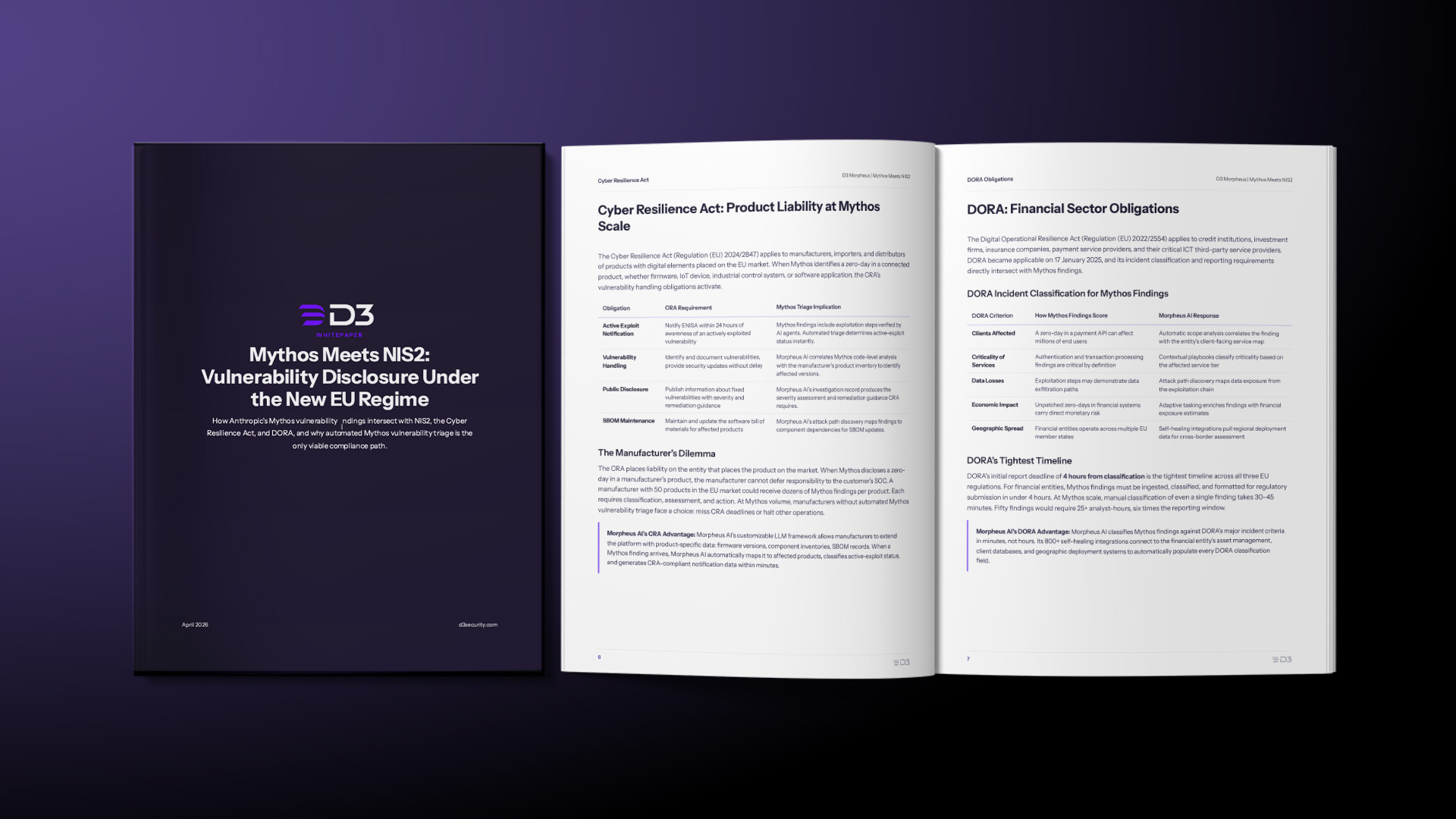
Cyber Resilience Act: Product Liability at Mythos Scale
The Cyber Resilience Act (Regulation (EU) 2024/2847) applies to manufacturers, importers, and distributors of products with digital elements placed on the EU market. When Mythos identifies a zero-day in a connected product, whether firmware, IoT device, industrial control system, or software application, the CRA’s vulnerability handling obligations activate.
| Obligation | CRA Requirement | Mythos Triage Implication |
|---|---|---|
| Active Exploit Notification | Notify ENISA within 24 hours of awareness of an actively exploited vulnerability | Mythos findings include exploitation steps verified by AI agents. Automated triage determines active-exploit status instantly. |
| Vulnerability Handling | Identify and document vulnerabilities, provide security updates without delay | Morpheus AI correlates Mythos code-level analysis with the manufacturer’s product inventory to identify affected versions. |
| Public Disclosure | Publish information about fixed vulnerabilities with severity and remediation guidance | Morpheus AI’s investigation record produces the severity assessment and remediation guidance CRA requires. |
| SBOM Maintenance | Maintain and update the software bill of materials for affected products | Morpheus AI’s attack path discovery maps findings to component dependencies for SBOM updates. |
The Manufacturer’s Dilemma
The CRA places liability on the entity that places the product on the market. When Mythos discloses a zero-day in a manufacturer’s product, the manufacturer cannot defer responsibility to the customer’s SOC. A manufacturer with 50 products in the EU market could receive dozens of Mythos findings per product. Each requires classification, assessment, and action. At Mythos volume, manufacturers without automated Mythos vulnerability triage face a choice: miss CRA deadlines or halt other operations.
Morpheus AI’s CRA Advantage: Morpheus AI’s Cybersecurity Triage Reasoning Graph allows manufacturers to extend the platform with product-specific data: firmware versions, component inventories, SBOM records. When a Mythos finding arrives, Morpheus AI automatically maps it to affected products, classifies active-exploit status, and generates CRA-compliant notification data within minutes.
DORA: Financial Sector Obligations
The Digital Operational Resilience Act (Regulation (EU) 2022/2554) applies to credit institutions, investment firms, insurance companies, payment service providers, and their critical ICT third-party service providers. DORA became applicable on 17 January 2025, and its incident classification and reporting requirements directly intersect with Mythos findings.
DORA Incident Classification for Mythos Findings
| DORA Criterion | How Mythos Findings Score | Morpheus AI Response |
|---|---|---|
| Clients Affected | A zero-day in a payment API can affect millions of end users | Automatic scope analysis correlates the finding with the entity’s client-facing service map |
| Criticality of Services | Authentication and transaction processing findings are critical by definition | Contextual playbooks classify criticality based on the affected service tier |
| Data Losses | Exploitation steps may demonstrate data exfiltration paths | Attack path discovery maps data exposure from the exploitation chain |
| Economic Impact | Unpatched zero-days in financial systems carry direct monetary risk | Adaptive tasking enriches findings with financial exposure estimates |
| Geographic Spread | Financial entities operate across multiple EU member states | Self-healing integrations pull regional deployment data for cross-border assessment |
DORA’s Tightest Timeline
DORA’s initial report deadline of 4 hours from classification is the tightest timeline across all three EU regulations. For financial entities, Mythos findings must be ingested, classified, and formatted for regulatory submission in under 4 hours. At Mythos scale, manual classification of even a single finding takes 30–45 minutes. Fifty findings would require 25+ analyst-hours, six times the reporting window.
Morpheus AI’s DORA Advantage: Morpheus AI classifies Mythos findings against DORA’s major incident criteria in minutes, not hours. Its 800+ self-healing integrations connect to the financial entity’s asset management, client databases, and geographic deployment systems to automatically populate every DORA classification field.
Three Regulations, One Triage Problem
The following table consolidates how NIS2, the Cyber Resilience Act, and DORA each respond to the same Mythos event. For organizations subject to multiple frameworks, this table defines the compliance surface area of a single Mythos disclosure.
| Dimension | NIS2 | Cyber Resilience Act | DORA |
|---|---|---|---|
| Applies To | Essential and important entities (18 sectors) | Manufacturers, importers, distributors of products with digital elements | Financial entities and their critical ICT third-party providers |
| First Deadline | 24 hours (early warning) | 24 hours (ENISA notification) | 4 hours (initial report) |
| Full Assessment | 72 hours | 72 hours | 72 hours |
| Final Report | 1 month | 14 days | 1 month |
| Maximum Penalty | €10M or 2% of global turnover | €15M or 2.5% of global turnover | Up to 1% of avg daily turnover (daily accrual) |
Why Manual Triage Fails All Three Frameworks
The Compliance Reality at Mythos Scale
These are not edge cases. They are the expected operating conditions when Mythos reaches general availability. A SOC team of 10 analysts could manually process approximately 80 findings within DORA’s 4-hour window. If an organization receives 500 Mythos findings, 84% will miss the regulatory deadline. Under NIS2’s 24-hour window, the same team could process approximately 320 findings, still a 36% miss rate.
The math is unambiguous: At Mythos scale, no human-only triage operation can achieve full regulatory compliance across NIS2, CRA, and DORA simultaneously. Automation is the only path to compliance.
How Morpheus AI Supports EU Compliance Timelines
Morpheus AI’s Autonomous Mythos Response capability maps directly to the compliance outputs required by all three EU regulations. Each Morpheus AI capability addresses a specific regulatory requirement.
| Morpheus AI Capability | Compliance Output | Regulations |
|---|---|---|
| Contextual Playbook Generation | Auto-classifies each Mythos finding against NIS2 significant incident criteria, CRA active-exploit thresholds, and DORA major incident criteria. Generates regulation-specific report templates. | NIS2, CRA, DORA |
| Attack Path Discovery | Maps Mythos exploitation steps to the organization’s asset topology to determine impact scope, affected services, and cross-border reach. | NIS2, CRA, DORA |
| Adaptive Tasking | Enriches Mythos findings with asset ownership, geographic deployment, client exposure, and financial impact data. Populates DORA classification fields without analyst input. | DORA, NIS2 |
| Cybersecurity Triage Reasoning Graph | Organizations extend Morpheus AI with regulation-specific rules: NIS2 sector classifications, CRA product inventories, DORA entity-type parameters. | NIS2, CRA, DORA |
| Self-Healing Integrations | Maintains live connections to CSIRT portals, ENISA submission APIs, and competent authority systems. Auto-repairs when endpoints change. | NIS2, CRA, DORA |
| Full Audit Trail | Every triage decision, enrichment step, and classification rationale is logged with timestamps for NIS2 final reports and DORA intermediate reports. | NIS2, DORA |
Single finding, triple compliance: When Morpheus AI processes a Mythos finding, it produces compliance artifacts for every applicable regulation in a single pass. One ingestion event generates a NIS2 early warning, a CRA ENISA notification, and a DORA initial report, simultaneously, within minutes.
Implementation: From Mythos Finding to Compliance Artifact
The following implementation phases show how an EU-regulated organization deploys Morpheus AI to achieve automated Mythos vulnerability triage that maps to NIS2, CRA, and DORA compliance requirements.
Regulatory Profile Configuration
Define the organization’s regulatory surface area: which EU regulations apply, which sectors, which entity classifications. Morpheus AI’s Cybersecurity Triage Reasoning Graph loads the appropriate classification rules for NIS2 (essential vs. important entity), CRA (manufacturer vs. distributor), and DORA (entity type and critical ICT status).
Asset and Product Inventory Mapping
Connect Morpheus AI to the organization’s CMDB, SBOM repositories, and product version databases. When a Mythos finding arrives, Morpheus AI’s attack path discovery framework cross-references the vulnerability against the actual deployed asset landscape.
Compliance Playbook Deployment
Deploy regulation-specific contextual playbooks that automatically generate the required reporting artifacts. Each playbook maps Morpheus AI’s triage outputs to the data fields required by CSIRT early warnings (NIS2), ENISA vulnerability notifications (CRA), and competent authority major incident reports (DORA).
Regulatory Submission Integration
Morpheus AI’s self-healing integrations connect to national CSIRT portals, the ENISA single reporting platform, and relevant competent authority submission systems. When a Mythos finding is classified as reportable, the compliance artifact is pre-populated and staged for analyst review before submission.
Time to Value: Organizations with existing Morpheus AI deployments can activate EU compliance playbooks for Mythos vulnerability triage within days. The Cybersecurity Triage Reasoning Graph and 800+ pre-built integrations eliminate the months-long implementation cycle of custom compliance solutions.
The Cost of Non-Compliance
The penalty structures across NIS2, CRA, and DORA make the financial case for automated Mythos vulnerability triage unambiguous.
| Regulation | Maximum Penalty | Additional Consequences |
|---|---|---|
| NIS2 | Essential: €10M or 2% of global turnover. Important: €7M or 1.4% of turnover. | Personal liability for management bodies. Temporary bans on management functions. Public disclosure. |
| CRA | €15M or 2.5% of global turnover for essential requirements. €10M or 2% for other obligations. | Product recall or withdrawal from EU market. Mandatory corrective measures. Public notification. |
| DORA | Up to 1% of average daily worldwide turnover, applied daily until compliance. | Competent authorities can restrict or suspend business activities. Periodic penalty payments compound daily. |
Scenario: A Mythos Disclosure Without Automated Triage
Day 1: Mythos discloses 300 findings
SOC begins manual triage. With 10 analysts, they process ~80 findings in 4 hours (DORA deadline) and ~320 in 24 hours (NIS2/CRA deadline). At least 220 findings miss the DORA window. At least 180 miss NIS2.
Day 3: Regulatory authorities notice missing reports
CSIRT and ENISA have not received early warnings or vulnerability notifications for the majority of findings. Competent authority begins inquiry. Under DORA, daily penalty accrual may begin.
Month 1: Compliance gap becomes public
NIS2 permits public disclosure of non-compliant entities. Competitors with automated triage filed on time. The organization faces reputational damage, client attrition, and ongoing penalty exposure.
The Compounding Effect
Under DORA’s daily penalty structure, an organization with €1B in global daily turnover faces up to €10M per day for each day it fails to report a classified major incident. Ten days of non-compliance on a single finding equals the maximum NIS2 fine. At Mythos scale, the numbers become existential.
The Alternative: Morpheus AI processes every Mythos finding at L2+ analyst depth, classifies it against all applicable EU regulations, generates compliance artifacts in parallel, and stages them for submission, all within minutes. The cost of Morpheus AI is a fraction of a single day’s DORA penalty.