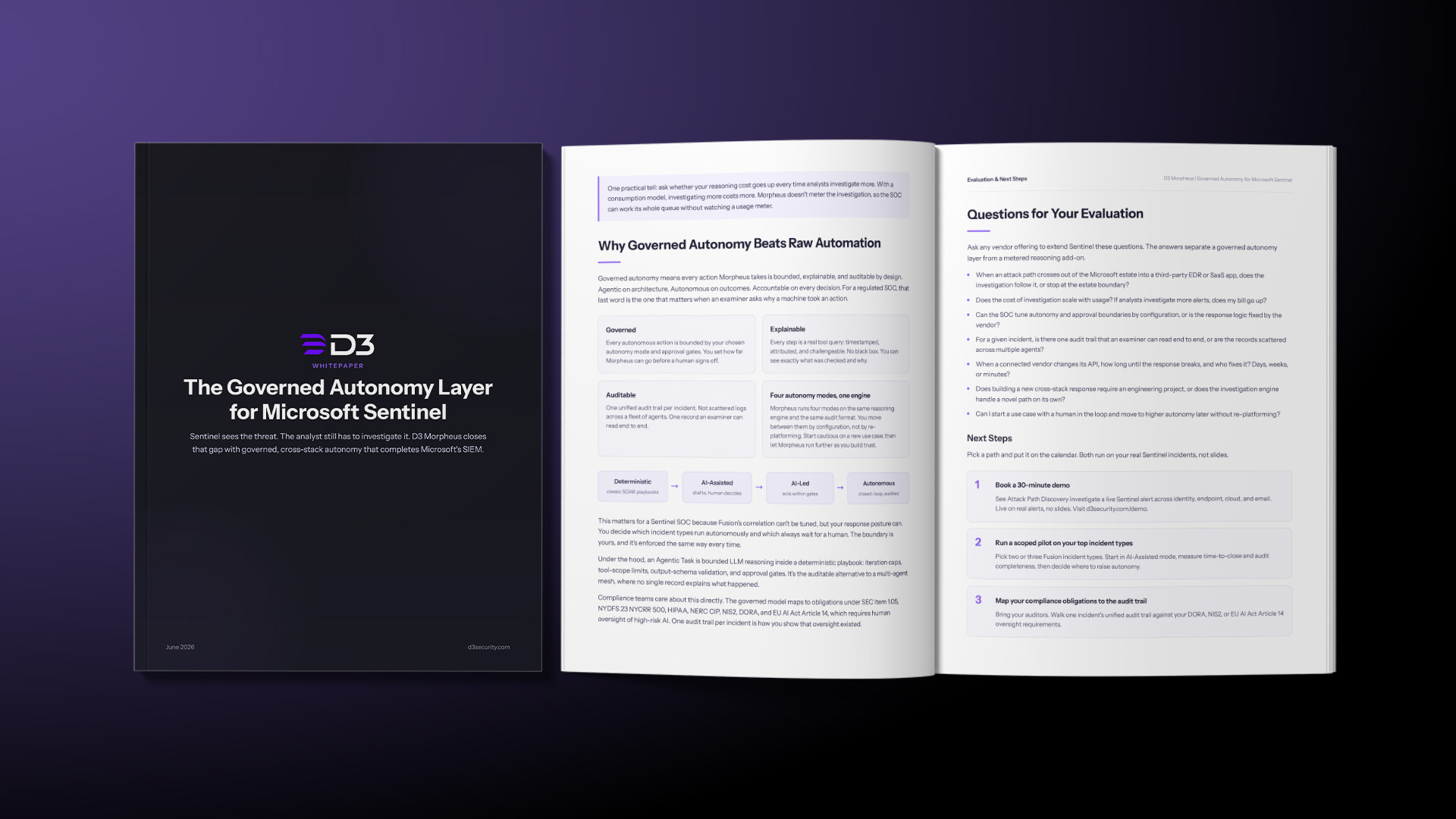
Executive Summary
Microsoft Sentinel is one of the strongest data and detection platforms a SOC can run on. It ingests at cloud scale, correlates with Fusion, and pushes high-fidelity alerts. Then the work stops being Sentinel’s job and becomes the analyst’s. Turning a detection into a governed, cross-stack investigation and a defensible response still lands on a human at a keyboard.
That gap is where alerts pile up. Sentinel’s native automation runs on Azure Logic Apps, which means engineering-heavy playbooks. Fusion’s machine-learning alerts can’t be tuned by the SOC. And Microsoft Security Copilot bills as consumption, metered in Security Compute Units, so the cost of reasoning scales with how much you use it.
D3 Morpheus, the autonomous SOC platform from D3 Security, adds the layer Sentinel doesn’t ship: governed autonomy. Attack Path Discovery investigates every alert at L2 across identity, endpoint, cloud, and email. Four autonomy modes run on one engine. Every incident gets one audit trail. And 800+ self-healing integrations keep the response working when vendor APIs drift.
D3 Security is a member of the Microsoft Intelligent Security Association (MISA). Morpheus is built to complete Sentinel, not compete with it. Microsoft keeps owning the data lake and the detections. Morpheus owns the investigation and the governed response on top.
The short version: Sentinel tells you something happened. Morpheus finds out what, how far it spread, and what to do about it, then either does it or hands your analyst a finished case to approve. One reasoning engine. One audit trail per incident.
This paper maps the specific gap between a Sentinel detection and a closed, defensible case. It shows where Logic Apps and Copilot leave work on the analyst, and how the governed autonomy layer fills it. It also answers the obvious question head-on: isn’t Security Copilot or the new Security Analyst Agent already enough?
Table of Contents
What Sentinel Does Well, and Where It Stops
Microsoft Sentinel is a cloud-native SIEM and the data backbone of a Microsoft-aligned SOC. It pulls telemetry from Defender, Entra, Azure, and hundreds of third-party connectors, runs analytics and Fusion correlation, and surfaces incidents with real signal. For detection and data, it earns its place.
The trouble starts after the alert fires. Sentinel hands you a finding. It doesn’t run the investigation. A Defender for Endpoint alert might be the visible edge of a token-theft chain that touches Entra ID, a SharePoint exfil attempt, and a phishing email three mailboxes over. Pulling that thread is manual. The analyst pivots tool to tool, query to query, and writes up the case by hand.
Three native gaps the SOC feels every day
Automation means Logic Apps
Sentinel’s response automation runs on Azure Logic Apps playbooks. Building anything past a simple notification is an engineering project: connectors, parameters, JSON, and a team that can maintain it. The SOC ends up waiting on developers.
Fusion alerts you can’t tune
Fusion uses Microsoft’s machine-learning models to correlate multi-stage attacks. The detections are useful, but the SOC can’t open the model and adjust it. You take the correlation logic as shipped.
Copilot meters the reasoning
Microsoft Security Copilot bills by consumption in Security Compute Units (SCUs), per Microsoft’s published provisioning model. The more you investigate, the more capacity you provision. Reasoning becomes a line item you watch.
None of this is a knock on Microsoft. A SIEM’s job is to collect, detect, and correlate, and Sentinel does that at scale. But a detection isn’t a decision. Somewhere between the Fusion incident and the closed ticket, a person has to investigate across the whole stack, decide, act, and prove they were right to act. That work is the gap.
The breaches hide in the long tail. Most SOCs can’t work their full queue, so criticals get attention and everything else gets rubber-stamped closed. A strong detection layer doesn’t fix that. The investigation backlog does the damage.
So the question for a Sentinel-based SOC isn’t whether the detections are good. They are. It’s who does the investigation and the response after the alert, how fast, and whether the result holds up to an auditor. Logic Apps handles deterministic plumbing. Copilot adds metered reasoning over Microsoft telemetry. Neither one closes the cross-stack investigation by itself.
How the Governed Autonomy Layer Sits on Sentinel
The governed autonomy layer is the investigation-and-response tier that takes a Sentinel incident and carries it to a closed, defensible case. Sentinel stays the source of truth for data and detection. Morpheus reads the incident, investigates across the stack, and acts inside your chosen autonomy mode. Nothing about your Sentinel deployment gets ripped out.
Microsoft Sentinel — Data & Detection
Cloud-native SIEM, log ingestion, Fusion correlation, analytics rules. Defender XDR, Entra ID, Azure logs, third-party connectors. Fusion incidents pass down to the layer above.
D3 Morpheus — Governed Autonomy Layer
One reasoning engine, one audit trail per incident, four autonomy modes. Attack Path Discovery runs read-only L2 investigation across identity, endpoint, cloud, and email. The Triage Reasoning Graph supplies purpose-built SOC reasoning with MITRE ATT&CK mapping. Governed action and audit: approval gates and autonomy mode, one unified trail, response executed through 800+ self-healing integrations across endpoint, identity, cloud, email, network, and ticketing, where the threat actually lives.
Figure 1. Sentinel owns data and detection. Morpheus adds the governed investigation-and-response layer on top and executes through 800+ integrations. Publicly available information as of June 2026.
Read it top to bottom. Sentinel collects and detects, then passes a Fusion incident down. Morpheus investigates it at L2, reasons over it with a SOC-specific graph, and acts within the autonomy mode you set. The action runs through D3’s integrations, out to wherever the threat actually lives. The whole path produces one audit trail.
Two Ways to Investigate the Same Alert
Attack Path Discovery is D3’s read-only L2 investigation engine. It traces a single alert across identity, endpoint, cloud, and email, maps the blast radius, aligns findings to MITRE ATT&CK, and drafts remediation. Compare that to what it takes to do the same work with a Logic Apps playbook a developer has to build first.
The Logic Apps path
Alert fires
Sentinel incident
Dev builds playbook
connectors, JSON, params
Analyst pivots tools
manual cross-stack
Write case by hand
copy/paste evidence
Close ticket
hours to days
The Morpheus path
Alert fires
Sentinel incident
APD investigates
identity/endpoint/cloud/email
Blast radius + ATT&CK
auto-mapped
Remediation drafted
in chosen autonomy mode
Closed + audited
under 2 min
Figure 2. The same Sentinel alert, two investigation flows. Logic Apps needs an engineer up front and an analyst in the middle. Morpheus investigates and drafts response on one engine, with the trail captured automatically.
The value is the reasoning the engine applies to every path. With Logic Apps, the playbook only does what someone coded it to do, so a novel attack path means new development. APD investigates the path it finds, every time, because reasoning is the engine. The analyst reviews a finished case.
Up to 95% of alerts are triaged and L2-investigated in under two minutes. Not auto-closed blindly. Investigated, with the evidence attached and the reasoning shown, so a human can approve in seconds or step in when it matters.
And when an API changes underneath you, the response doesn’t quietly break. D3’s integrations are self-healing, with a production MTTR on integration drift of 18 minutes against an industry baseline of 4 to 6 weeks. A hand-built Logic Apps connector that breaks on a Friday is a Monday problem at best.
Isn’t Security Copilot or the Security Analyst Agent Enough?
It’s the fair question, so here’s the direct answer. Microsoft Security Copilot and its agents are good at reasoning over Microsoft telemetry, and that’s exactly their design. They live inside the Microsoft estate and bill by consumption. Morpheus solves a different shape of problem: vendor-neutral investigation across your whole stack, unmetered, inside an autonomy mode you control.
Copilot reasons over the data Microsoft sees. When the attack path crosses into a third-party EDR, a non-Microsoft identity provider, or a SaaS app outside the estate, that’s where a Microsoft-centric agent reaches its edge. Morpheus investigates wherever the threat went, through 800+ integrations, because it isn’t tied to one vendor’s telemetry.
The differences that matter to a SOC
| Dimension | Microsoft Security Copilot / agents | D3 Morpheus |
|---|---|---|
| Investigation scope | Strongest over Microsoft telemetry (Defender, Entra, Sentinel) | Vendor-neutral L2 across identity, endpoint, cloud, email via 800+ integrations |
| Cost model | Consumption, metered in Security Compute Units (per Microsoft’s published model) | Unmetered investigation — reasoning isn’t billed per use |
| Governance | Microsoft’s agent controls within the estate | Four autonomy modes on one engine, approval gates, one audit trail per incident |
| Response execution | Native Microsoft actions; broader response via Logic Apps | Self-healing execution across the stack, 18-min MTTR on integration drift |
| Tuning | Fusion ML correlation isn’t SOC-tunable | SOC-tunable autonomy and approval boundaries by configuration |
Comparison reflects publicly available information as of June 2026. Cost figures describe Microsoft’s published pricing model, not specific dollar amounts.
This isn’t Morpheus versus Microsoft. Run Copilot for fast reasoning over Microsoft data. Run Morpheus for the cross-stack investigation and the governed response that has to hold up later. The two coexist, and D3’s MISA membership reflects that the relationship is built to complement Microsoft’s tooling.
One practical tell: ask whether your reasoning cost goes up every time analysts investigate more. With a consumption model, investigating more costs more. Morpheus doesn’t meter the investigation, so the SOC can work its whole queue without watching a usage meter.
Why Governed Autonomy Beats Raw Automation
Governed autonomy means every action Morpheus takes is bounded, explainable, and auditable by design. Agentic on architecture. Autonomous on outcomes. Accountable on every decision. For a regulated SOC, that last word is the one that matters when an examiner asks why a machine took an action.
Governed
Every autonomous action is bounded by your chosen autonomy mode and approval gates. You set how far Morpheus can go before a human signs off.
Explainable
Every step is a real tool query: timestamped, attributed, and challengeable. No black box. You can see exactly what was checked and why.
Auditable
One unified audit trail per incident. Not scattered logs across a fleet of agents. One record an examiner can read end to end.
Four autonomy modes, one engine
Morpheus runs four modes on the same reasoning engine and the same audit format. You move between them by configuration, not by re-platforming. Start cautious on a new use case, then let Morpheus run further as you build trust.
Deterministic
classic SOAR playbooks
AI-Assisted
drafts, human decides
AI-Led
acts within gates
Autonomous
closed-loop, audited
This matters for a Sentinel SOC because Fusion’s correlation can’t be tuned, but your response posture can. You decide which incident types run autonomously and which always wait for a human. The boundary is yours, and it’s enforced the same way every time.
Under the hood, an Agentic Task is bounded LLM reasoning inside a deterministic playbook: iteration caps, tool-scope limits, output-schema validation, and approval gates. It’s the auditable alternative to a multi-agent mesh, where no single record explains what happened.
Compliance teams care about this directly. The governed model maps to obligations under SEC Item 1.05, NYDFS 23 NYCRR 500, HIPAA, NERC CIP, NIS2, DORA, and EU AI Act Article 14, which requires human oversight of high-risk AI. One audit trail per incident is how you show that oversight existed.
Questions for Your Evaluation
Ask any vendor offering to extend Sentinel these questions. The answers separate a governed autonomy layer from a metered reasoning add-on.
- When an attack path crosses out of the Microsoft estate into a third-party EDR or SaaS app, does the investigation follow it, or stop at the estate boundary?
- Does the cost of investigation scale with usage? If analysts investigate more alerts, does my bill go up?
- Can the SOC tune autonomy and approval boundaries by configuration, or is the response logic fixed by the vendor?
- For a given incident, is there one audit trail that an examiner can read end to end, or are the records scattered across multiple agents?
- When a connected vendor changes its API, how long until the response breaks, and who fixes it? Days, weeks, or minutes?
- Does building a new cross-stack response require an engineering project, or does the investigation engine handle a novel path on its own?
- Can I start a use case with a human in the loop and move to higher autonomy later without re-platforming?
Next Steps
Pick a path and put it on the calendar. Both run on your real Sentinel incidents, not slides.
Book a 30-minute demo
See Attack Path Discovery investigate a live Sentinel alert across identity, endpoint, cloud, and email. Live on real alerts, no slides. Visit d3security.com/demo.
Run a scoped pilot on your top incident types
Pick two or three Fusion incident types. Start in AI-Assisted mode, measure time-to-close and audit completeness, then decide where to raise autonomy.
Map your compliance obligations to the audit trail
Bring your auditors. Walk one incident’s unified audit trail against your DORA, NIS2, or EU AI Act Article 14 oversight requirements.
Complete Your Sentinel SOC
D3 Security builds D3 Morpheus, the AI SOC platform for autonomous alert investigation and accountable response. Morpheus adds the governed autonomy layer on top of Microsoft Sentinel: cross-stack L2 investigation, four autonomy modes on one engine, and one audit trail per incident. D3 Security is a member of the Microsoft Intelligent Security Association (MISA) and is SOC 2 Type II certified, with data residency in the US, Canada, the EU (Ireland), and Japan.
Trusted by security teams at PwC, Scotiabank, S&P Global, Cummins, the London Stock Exchange, and the U.S. Department of Defense. To schedule a demonstration on your real alerts, visit d3security.com.