“Human oversight” sits at the center of every high-stakes AI regulation, and it usually ships as a promise that a human can intervene. Ability on paper means little if nobody can reconstruct afterward what the system actually did. Oversight is an architectural property. A policy checkbox doesn’t create it. The system either retraces its decisions and gates its consequential actions, or it doesn’t. Governance documentation can’t close that gap.
What oversight has to mean when you can’t watch in real time
You can’t watch an autonomous SOC in real time. It runs overnight, at machine speed, across more alerts than any human could shadow. So oversight has to mean two things you can actually build: consequential actions require a human in command, and everything the system does can be retraced afterward with fidelity. Get both right and your oversight survives an audit. Miss one and you have a story.
How the architecture produces the evidence
The first pillar is read-only investigation. The engine that reconstructs an attack path pivots across endpoint, identity, email, network, and cloud telemetry to assemble what happened. It gathers evidence, correlates it, and explains what it found. It has no power to contain, quarantine, or close. That read-only boundary is what makes honest oversight possible. Because investigation can’t act, it can represent uncertainty faithfully, and a human reads the entire path before any consequence lands.
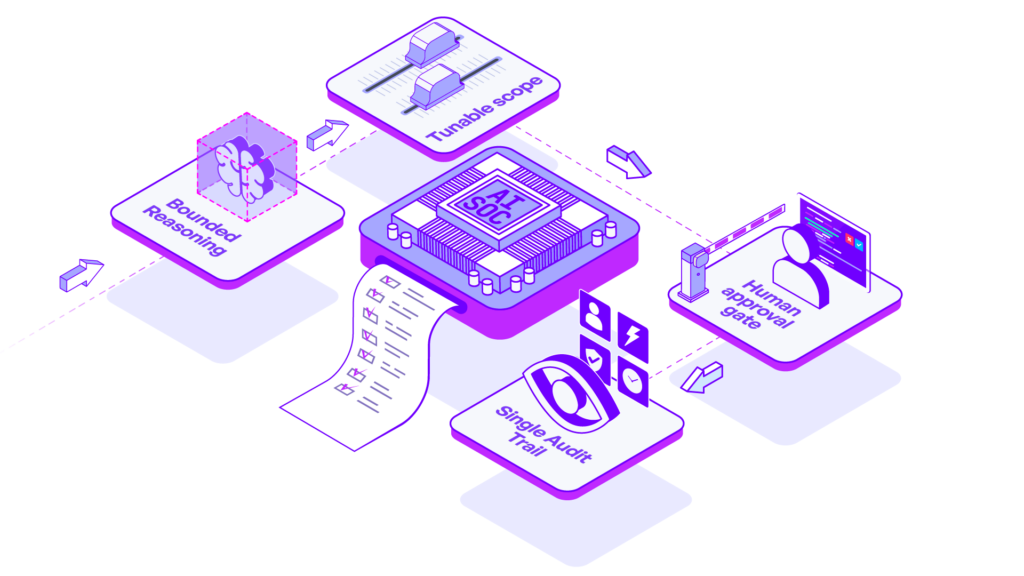
The second pillar is approval-gated, risk-tiered action. Not every action deserves the same friction, and a system that demands sign-off on everything trains people to rubber-stamp. The gates key to the action’s own risk, across autonomy modes that let a team dial how much runs unattended. A human can override at any stage. Every action is reversible and logged. The system grants autonomy where risk is low and holds it back where risk is high, by default, without waiting for an operator to remember the setting.
The third pillar turns the first two into evidence. The investigation is the audit record. Every query, every piece of evidence, every confidence judgment, and every action lands in one chain of custody per incident. The work and the record are the same artifact, so oversight is a byproduct of the system running. Nobody reconstructs intent later in a separate reporting step. When your GRC team maps controls to EU AI Act Article 14, DORA, or NIS2, they map to something that already exists. There’s nothing to manufacture.
Mapping obligations to mechanisms
That’s where the architecture pays off in a risk conversation. Map the obligation to the mechanism and the mapping is direct. Meaningful human oversight maps to the per-incident chain of custody, intervention to the approval gates and override, traceability to the read-only investigation record. It’s the difference between telling an auditor you have a policy and showing them the artifact the policy describes.
None of this is a compliance guarantee, and it shouldn’t be sold as one. Applicability depends on your sector, your obligations, and your GRC team’s judgment. What the architecture gives them is the raw material those judgments need, a system whose decisions you can retrace and whose actions a human governed.
A practical test for any agentic SOC platform you’re evaluating: Ask to see a closed incident and follow the thread: what did it decide, what evidence did it weigh, what action did it take, and where was the human? When that thread is whole and the system captured it automatically, you have control evidence by design. When your team has to assemble it by hand, you don’t have control evidence at all.
Want the obligation-to-mechanism control-mapping summary for your GRC team? Book a governance demo.