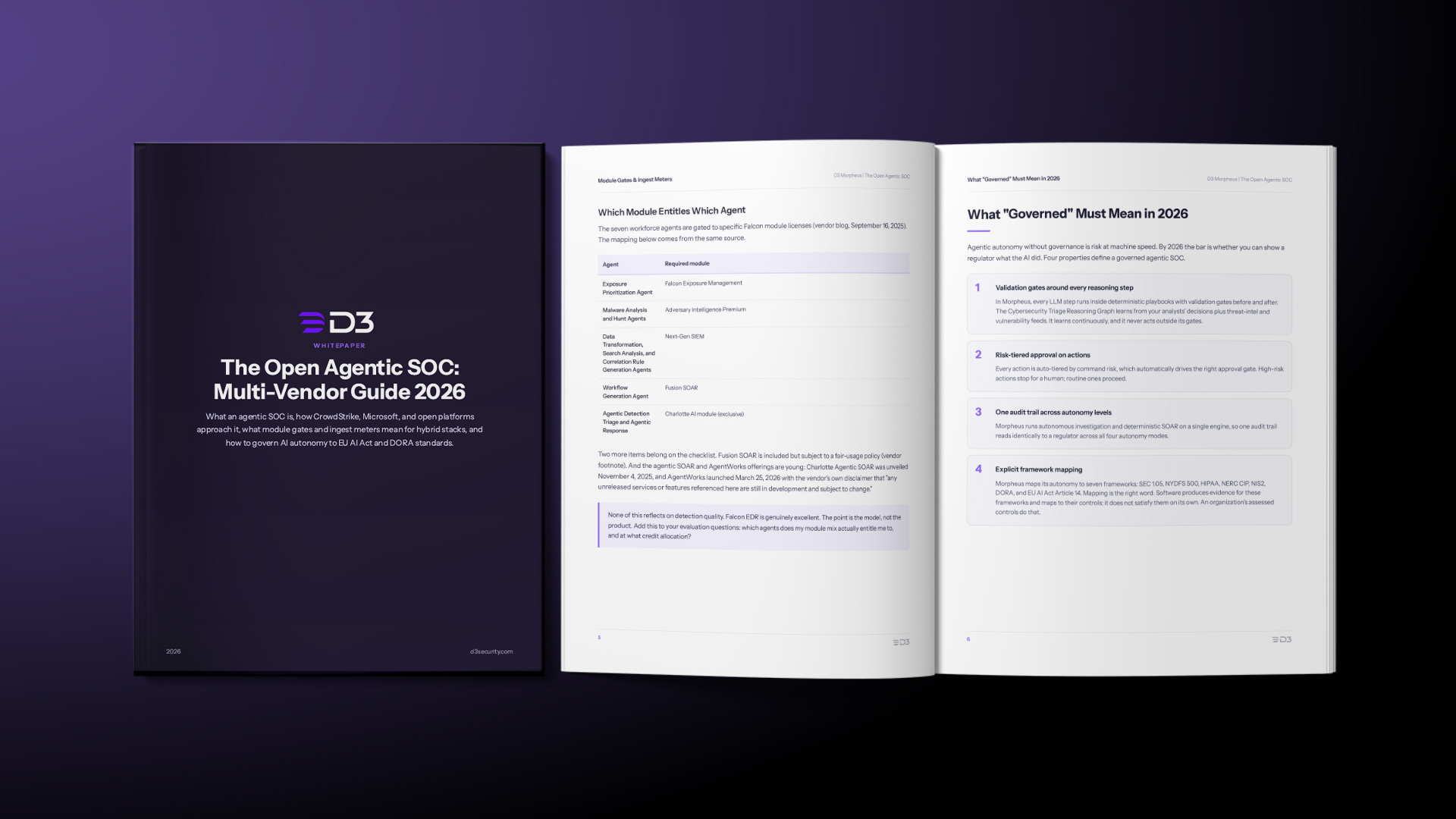
The Open Agentic SOC: Multi-Vendor Guide 2026
The agentic SOC moved from conference talk to budget line over the past year. This guide explains what an agentic SOC is, the two architectures buyers face, the module gates and ingest meters that shape the consolidated model, and what governance has to mean by 2026. Then it shows where D3 Morpheus fits as the open, governed implementation.
Table of Contents
What an agentic SOC is
An agentic SOC is a security operations center where AI agents investigate alerts, run playbooks, and take response actions, with humans setting the bounds. The agents read telemetry, reason over it, and act, rather than waiting for an analyst to drive every step. The category moved from conference talk to budget line over the past year, and the milestones are worth naming.
CrowdStrike launched its seven-agent “Agentic Security Workforce” on September 16, 2025, then unveiled Charlotte Agentic SOAR on November 4, 2025. The AgentWorks Ecosystem followed at RSA 2026 on March 25, 2026, with partners spanning Accenture to NVIDIA. EY began building agentic-SOC services on the model in March 2026. That spend has educated the market and made the agentic SOC the category of 2026.
The buyer question this creates is practical. How do you get an agentic SOC across the stack you actually run, rather than the one a single vendor would prefer you run? Most SOCs are hybrid: a mix of SIEM, identity, cloud security, email, and endpoint tools from several vendors. The answer depends on architecture, and there are two of them.
Two architectures: consolidated vs open
A consolidated agentic SOC puts the agents inside one vendor’s platform and economics. The agents are forged on that platform, run directly in it, and act on telemetry the platform already holds. CrowdStrike states this plainly: its agents are “forged on the Falcon platform” and built “directly in the Falcon platform” (vendor blog, September 16, 2025; AgentWorks press release, March 25, 2026). For an estate that is close to 100% one vendor, this is coherent. The data is already there, the agents sit on top of it, and the billing follows one model.
An open agentic SOC runs the agents across the tools you already own. The agents operate on top of your existing SIEM, EDR, and identity stack instead of requiring you to move telemetry into a single platform first. The trade-off is integration breadth: an open platform has to connect cleanly to many vendors and keep those connections working. Morpheus, D3 Security’s platform, takes this route with 800+ self-healing integrations that detect API drift and auto-generate corrective code, with an 18-minute mean connector repair against a 4 to 6 week industry norm.
Consolidated agentic SOC
Agents are forged on and run directly in one vendor’s platform, acting on telemetry the platform already holds. Coherent for an estate that is close to 100% one vendor: the data is there, the agents sit on top, and billing follows one model.
Open agentic SOC
Agents run across the tools you already own, on top of your existing SIEM, EDR, and identity stack, with no move-telemetry-first requirement. The trade-off is integration breadth: the platform has to connect cleanly to many vendors and keep those connections working.
Both architectures are legitimate. The consolidated model is the simpler buy for a single-vendor estate. The open model fits the hybrid majority that runs Splunk, Elastic, Microsoft Sentinel, or Google Chronicle for SIEM; Okta or Microsoft Entra ID for identity; Wiz for cloud security; Google Workspace, Microsoft 365, or Proofpoint for email; a DLP layer such as Netskope, Zscaler, Microsoft Purview, or Forcepoint; and an EDR such as Falcon, Defender, or SentinelOne. The right choice depends on how far your environment sits from a single vendor.
Module gates and ingest meters: what to check before you buy consolidated
The consolidated model carries a billing structure that is easy to miss at evaluation time. Read the fine print along four lines, all from vendor-published materials.
Per device
Falcon bundles are priced per device per year (vendor pricing page, updated January 28, 2026).
Per GB
Acting on telemetry the platform does not already hold means ingesting it. CrowdStrike’s NG-SIEM meters ingest per GB, with a pay-as-you-go rate visible on AWS Marketplace (retrieved June 11, 2026) and committed contracts negotiated separately. The free tier covers 10 GB per day with 7-day retention and no third-party SOAR actions (vendor FAQ blog).
Per credit
Charlotte AI is credit-metered with no public price. The Essentials tier excludes the detection triage agent and the response agent (vendor pricing page footnotes, retrieved June 11, 2026). Charlotte is now a platform entitlement with monthly credits for qualifying-module customers, but credits do not scale with module count, and additional credits are sold separately (vendor blog footnote, September 16, 2025).
Per module
The seven workforce agents are gated to specific Falcon module licenses (vendor blog, September 16, 2025).
The per-module gating maps each agent to a specific Falcon license:
| Agent | Required Falcon module |
|---|---|
| Exposure Prioritization Agent | Falcon Exposure Management |
| Malware Analysis and Hunt Agents | Adversary Intelligence Premium |
| Data Transformation, Search Analysis, and Correlation Rule Generation Agents | Next-Gen SIEM |
| Workflow Generation Agent | Fusion SOAR |
| Agentic Detection Triage and Agentic Response | Charlotte AI module (exclusive) |
Two more items belong on the checklist. Fusion SOAR is included but subject to a fair-usage policy (vendor footnote). And the agentic SOAR and AgentWorks offerings are young: Charlotte Agentic SOAR was unveiled November 4, 2025, and AgentWorks launched March 25, 2026 with the vendor’s own disclaimer that “any unreleased services or features referenced here are still in development and subject to change.” There is one interaction effect to price out. Non-Falcon telemetry pays twice: an ingest meter to get in, and a credit meter to be acted on.
None of this reflects on detection quality. Falcon EDR is genuinely excellent. The point is the model, not the product. Add this to your evaluation questions: which agents does my module mix actually entitle me to, and at what credit allocation?
What “governed” must mean in 2026
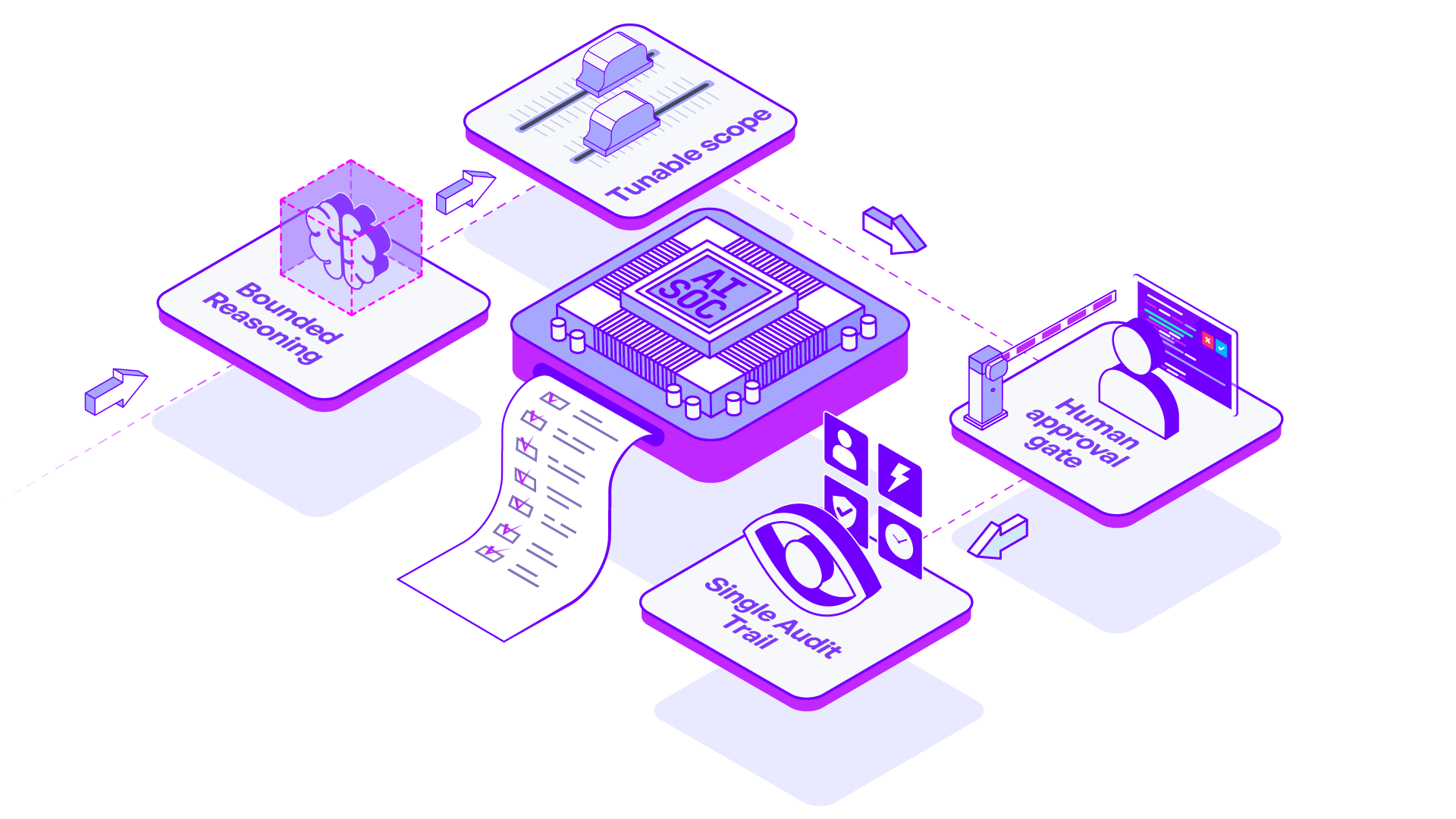
Agentic autonomy without governance is risk at machine speed. By 2026 the bar is whether you can show a regulator what the AI did. Four properties define a governed agentic SOC.
Validation gates around every reasoning step
In Morpheus, every LLM step runs inside deterministic playbooks with validation gates before and after. The Cybersecurity Triage Reasoning Graph learns from your analysts’ decisions plus threat-intel and vulnerability feeds. It learns continuously, and it never acts outside its gates.
Risk-tiered approval on actions
Every action is auto-tiered by command risk, which automatically drives the right approval gate. High-risk actions stop for a human; routine ones proceed.
One audit trail across autonomy levels
Morpheus runs autonomous investigation and deterministic SOAR on a single engine, so one audit trail reads identically to a regulator across all four autonomy modes.
Explicit framework mapping
Morpheus maps its autonomy to seven frameworks: SEC 1.05, NYDFS 500, HIPAA, NERC CIP, NIS2, DORA, and EU AI Act Article 14. Mapping is the right word. Software produces evidence for these frameworks and maps to their controls; it does not satisfy them on its own. An organization’s assessed controls do that.
Morpheus as the open, governed implementation
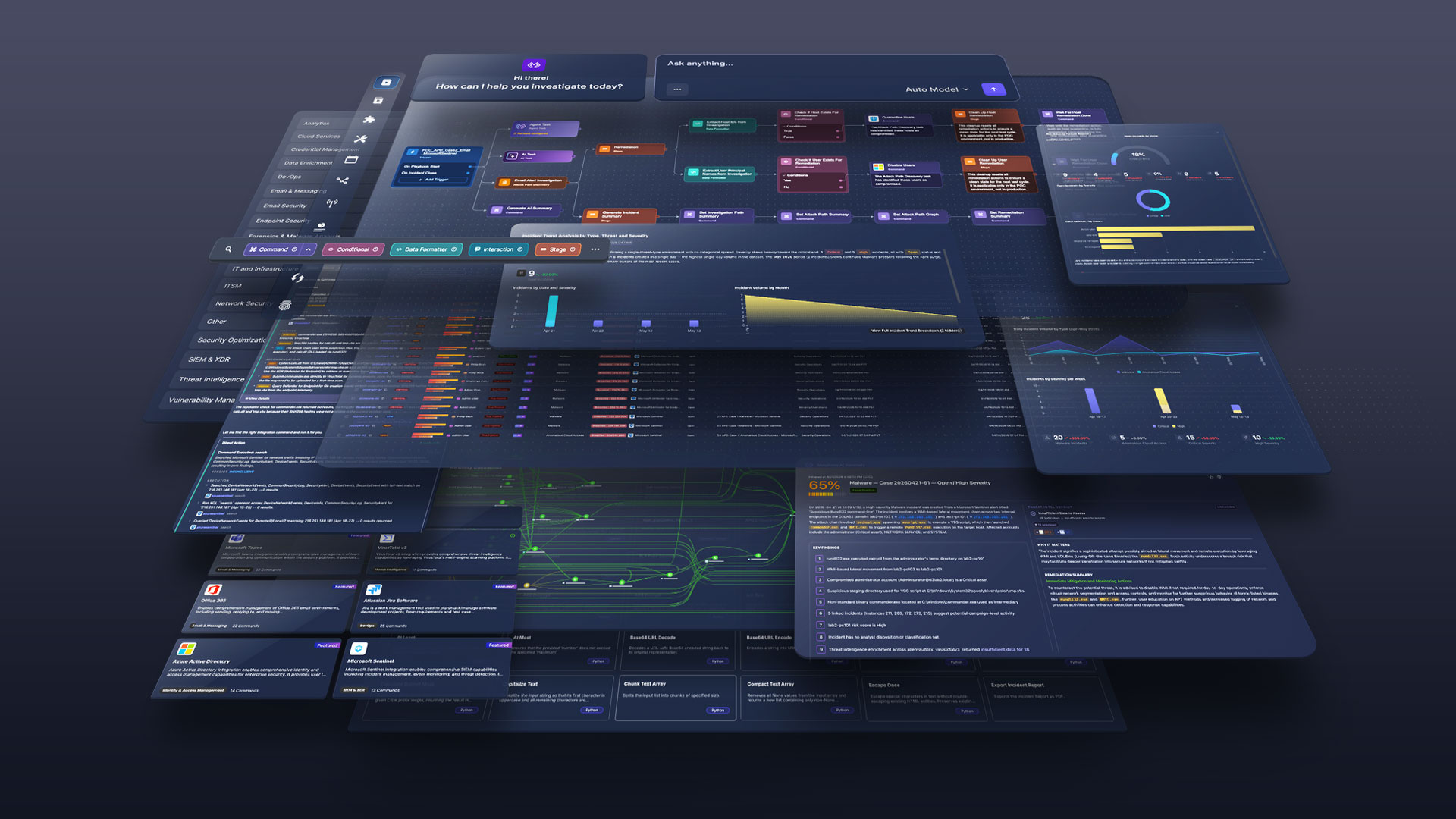
Morpheus delivers the agentic SOC outcome, autonomous investigation plus a modern SOAR, on one engine across the stack you already own. The 800+ self-healing integrations make every tool first-class: your SIEM, whether Splunk, Elastic, Sentinel, or Chronicle; your identity layer in Okta or Entra ID; your Wiz cloud findings; your email security across Google Workspace, Microsoft 365, and Proofpoint; your DLP; and your Falcon EDR. There is no ingest meter to make your own logs actionable, and no credit tier deciding which agents you may use. No agent sits behind a module gate.
The governance travels with it. Every reasoning step is boxed in deterministic playbooks, every action is risk-tiered into approval gates, and one audit trail spans all four autonomy modes. The model layer stays open too, so the architecture is open at both the model and the stack layer.
On price, the position is verbal and simple. Two platforms, an autonomous SOC and a modern SOAR, run on one engine at or under what you pay today. Bring your real numbers: devices, GB per day, credits, modules, retention. We will walk through what the open, governed agentic SOC looks like against them.
Book a demo
See the open, governed agentic SOC work across your real stack. Visit d3security.com/demo.
Frequently Asked Questions
What is the difference between CrowdStrike’s agentic SOC and an open agentic SOC?
CrowdStrike’s agents are built and run in the Falcon platform; availability is tied to Falcon module licenses, and acting on non-Falcon telemetry requires NG-SIEM ingest (per GB) plus Charlotte AI credits (per vendor-published materials, 2025-26). An open agentic SOC, such as D3 Security’s Morpheus, runs autonomous investigation and SOAR across existing tools without ingest or credit meters.
Can you build an agentic SOC without replacing your SIEM?
Yes. Platform-neutral agentic SOC engines operate on top of existing SIEM/EDR/identity stacks. Morpheus integrates 800+ tools with self-healing connectors: SIEMs (Splunk, Elastic, Microsoft Sentinel, Google Chronicle), identity (Okta, Microsoft Entra ID), cloud security (Wiz), email (Google Workspace, Microsoft 365, Proofpoint), and DLP platforms, and runs autonomy and SOAR on one engine beside the SIEM you keep.
How should AI autonomy in a SOC be governed?
Look for validation gates around every LLM step, risk-tiered approval gates on actions, a single audit trail across autonomy levels, and explicit mapping to frameworks such as DORA and EU AI Act Article 14.