Executive Summary
Splunk’s classic playbook editor is deprecated. As of Splunk SOAR (Cloud) 6.2.1, you can no longer create classic playbooks. New automation has to be built in the modern editor. That’s a published fact, not a forecast. And it changes the math for every team still running Splunk SOAR.
Here’s why it matters. If you’re rebuilding playbooks anyway, the question stops being “how do we migrate our classic playbooks” and becomes “what should we rebuild them into.” That’s a rare moment. Most automation teams never get permission to reconsider the platform. The deprecation just handed you that permission.
This paper makes one argument. If you have to re-author your automation, re-author it out of existence. Keep your Splunk SIEM. It’s doing its job. Replace only the SOAR layer with D3 Morpheus, the autonomous SOC platform from D3 Security. Morpheus runs autonomous L2 investigation on every alert, gives you four autonomy modes on one engine, and produces one audit trail per incident. It self-heals across 800+ integrations, so a vendor’s breaking API change is a config repair, not a six-week firefight.
The outcome you should expect: less playbook code to maintain, alerts investigated in under two minutes, and integration drift measured in minutes. D3’s Legacy SOAR Migration Program does the re-authoring for you, free, in 60 days.
The thesis in one line. Keep your SIEM. Retire your SOAR. You were going to rebuild the playbooks regardless. So rebuild them into something that needs far fewer of them.
What this paper is not
This is not an argument against Splunk’s SIEM. Splunk Enterprise Security is a strong detection and data platform, and Morpheus integrates with it directly. This paper is also not a claim that Splunk SOAR is at end-of-life. It isn’t, and we don’t say it is. The specific, sourced fact we build on is narrow and verifiable: classic playbooks can no longer be created, so classic automation has a finite future and re-authoring is already on your roadmap whether you scheduled it or not.
Table of Contents
The Deprecation Is the Forcing Function
The classic playbook editor in Splunk SOAR is deprecated, and as of SOAR Cloud 6.2.1 you cannot create new classic playbooks at all. Existing ones still run. But every new piece of automation now lives in the modern editor, and the long-term direction is clear. This is documented in Splunk’s own release notes, not inferred.
For an automation team, that’s a quiet but real deadline. Classic and modern playbooks are not the same format. They use different building blocks, a different execution model, and different debugging behavior. Moving a non-trivial classic playbook to the modern editor is rarely a copy-paste. It’s a rewrite, with regression testing, in the editor you’re still learning.
So the work is coming. Count the playbooks you actually depend on. Phishing triage, that one EDR containment flow, the ticket-enrichment chain, the dozen integrations stitched together with custom code. Each one needs to be re-authored, re-tested, and re-certified. That’s weeks of senior engineer time you hadn’t planned to spend on a platform you already pay for.
The reframe. A migration you didn’t choose is still a decision you get to make. Before you spend that effort moving classic playbooks into Splunk’s modern editor, ask whether the destination should be Splunk’s editor at all.
The renewal conversation, layered on top
There’s a second pressure, and it’s worth naming carefully. Since Cisco’s acquisition of Splunk closed, customers and analysts have reported renewal and pricing pressure across the Splunk portfolio. We frame that as reported and observed, not as anyone’s stated policy, and we put no dollar figure on it. But it’s a fair thing to weigh. If your renewal is up and your automation needs a rebuild in the same window, you’re effectively re-buying and re-building at once. That’s the moment to look at alternatives before renewing on autopilot.
Rebuild in Splunk’s modern editor
Same maintenance burden. New syntax. You re-author the decision trees and keep maintaining them. (stay)
Rebuild into Morpheus
Autonomous L2. Far fewer playbooks. The reasoning engine replaces most of the decision trees outright. (switch)
Figure 1. The classic editor is deprecated (6.2.1), so you re-author either way. The only open question is the destination. One destination removes most of the work permanently.
Rebuilding in Place Keeps the Part That Hurts
Classic SOAR is a playbook engine, and a playbook is brittle by design. It encodes one analyst’s decision tree into branching logic, then runs that tree forever, until an alert arrives that the author didn’t anticipate, or an integration changes shape underneath it. Re-authoring those same playbooks into a newer editor moves the brittleness; it doesn’t remove it.
Two costs survive any in-place rebuild. The first is investigation. A playbook can gather context and enrich an alert, but it can’t reason about what the evidence means. Someone still has to look. The second is upkeep. Every integration a playbook touches is a dependency, and dependencies break. A vendor ships a breaking API change on a Friday and three of your flows go dark.
The maintenance math nobody budgets for
Industry experience puts integration repair in the range of weeks. When a connector breaks, someone has to notice, diagnose the schema change, rewrite the affected actions, test them, and redeploy. Across a real Splunk SOAR estate with dozens of connected tools, that’s a recurring tax on your most senior people. It never shows up as a line item, but it’s the reason the automation backlog never shrinks.
What “modernize” should actually mean
Modernizing isn’t porting a decision tree to new syntax. It’s removing the decision tree where a reasoning engine can do the work, and shrinking the playbook layer to the deterministic actions that genuinely need to be deterministic. That’s the difference between a migration and a modernization. One gives you the same system in new packaging. The other gives you a smaller, calmer system that investigates on its own.
Keep Your Splunk SIEM. Replace Only the SOAR Layer.
D3 Morpheus is the autonomous SOC platform from D3 Security, and it replaces the SOAR layer without touching your detection stack. Splunk keeps doing detection and data analytics. Morpheus takes the alerts Splunk produces and runs the investigation and response that classic playbooks did by hand. The integration is direct, so this is a layer swap, not a rip-and-replace of your SIEM.
The piece that changes everything is Attack Path Discovery, D3’s read-only L2 investigation engine. When an alert fires, APD doesn’t wait for a human to start poking. It traces the alert across identity, endpoint, cloud, and email, maps the blast radius, aligns findings to MITRE ATT&CK, and drafts the remediation. Read-only by design, so it investigates without changing your environment until you’ve authorized a response.
That’s the work a classic playbook could never do. A playbook gathers; APD concludes. Up to 95% of alerts get triaged and L2-investigated in under two minutes. That means the long tail of your queue, the alerts that today get rubber-stamped closed because nobody has time, actually gets looked at. That’s usually where the breach was hiding.
One engine, four autonomy modes, one audit trail
You don’t have to hand the keys over on day one. Morpheus runs four autonomy modes on the same engine and the same audit format: Deterministic (SOAR), AI-Assisted, AI-Led, and Autonomous. You move between them by configuration, not by re-platforming. Start in Deterministic to mirror what your playbooks do today, then raise autonomy on the use cases you trust as the evidence comes in.
Deterministic
SOAR
AI-Assisted
drafts
AI-Led
within gates
Autonomous
closed-loop
Every autonomous action is governed by your chosen mode and approval gates, explainable as a timestamped chain of real tool queries you can challenge, and auditable as one unified trail per incident. Not a mesh of agents you can’t reconstruct after the fact. One reasoning engine, one record.
BEFORE
Splunk SIEM handles detection. Classic SOAR playbooks handle manual L2 and carry the upkeep burden.
AFTER
Splunk SIEM is unchanged. D3 Morpheus handles autonomous L2 and response, with self-healing integrations and one audit trail.
Figure 2. The SIEM stays. Only the SOAR layer is replaced, by an engine that investigates for you.
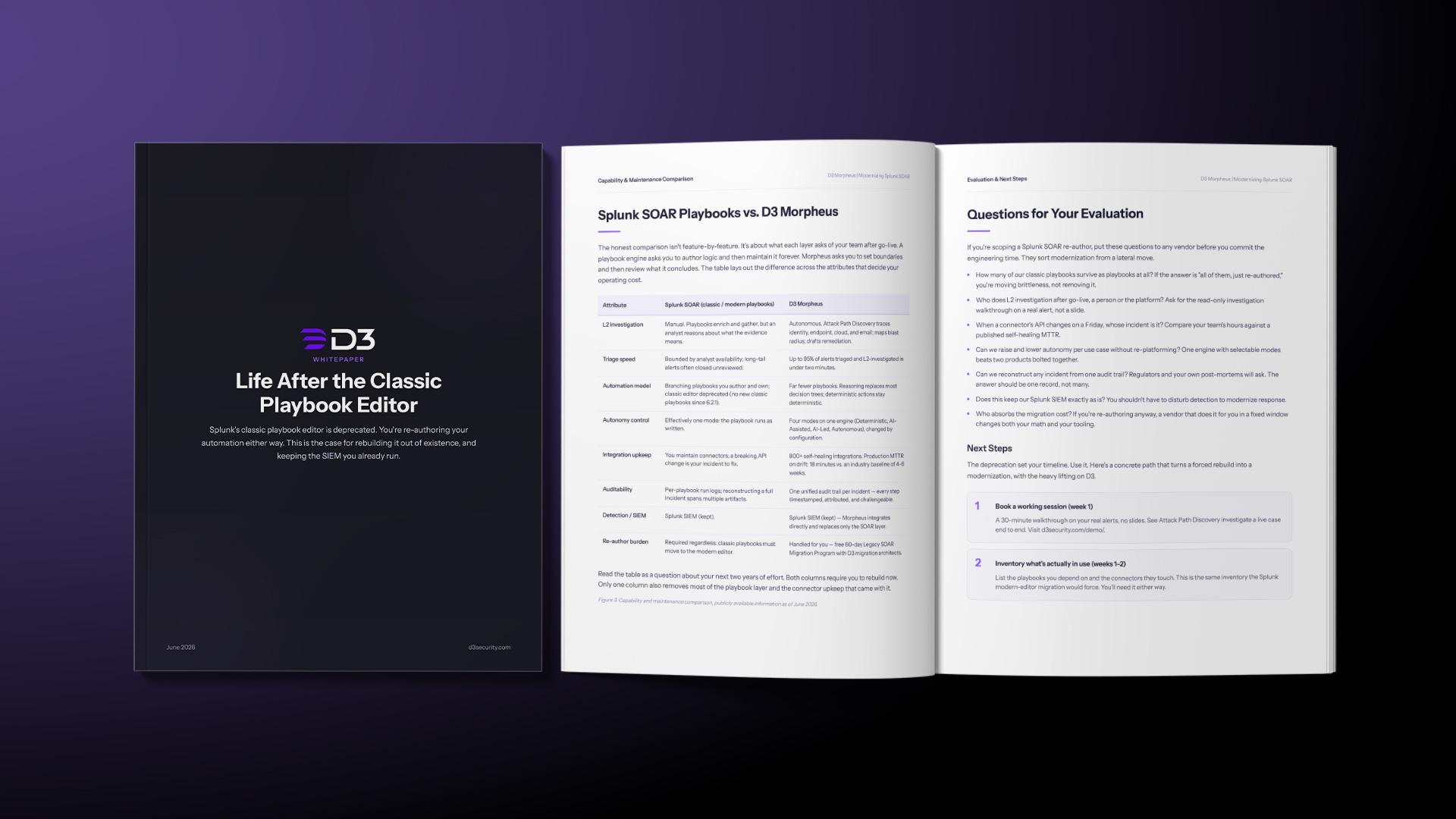
Splunk SOAR Playbooks vs. D3 Morpheus
The honest comparison isn’t feature-by-feature. It’s about what each layer asks of your team after go-live. A playbook engine asks you to author logic and then maintain it forever. Morpheus asks you to set boundaries and then review what it concludes. The table lays out the difference across the attributes that decide your operating cost.
| Attribute | Splunk SOAR (classic / modern playbooks) | D3 Morpheus |
|---|---|---|
| L2 investigation | Manual. Playbooks enrich and gather, but an analyst reasons about what the evidence means. | Autonomous. Attack Path Discovery traces identity, endpoint, cloud, and email; maps blast radius; drafts remediation. |
| Triage speed | Bounded by analyst availability; long-tail alerts often closed unreviewed. | Up to 95% of alerts triaged and L2-investigated in under two minutes. |
| Automation model | Branching playbooks you author and own; classic editor deprecated (no new classic playbooks since 6.2.1). | Far fewer playbooks. Reasoning replaces most decision trees; deterministic actions stay deterministic. |
| Autonomy control | Effectively one mode: the playbook runs as written. | Four modes on one engine (Deterministic, AI-Assisted, AI-Led, Autonomous), changed by configuration. |
| Integration upkeep | You maintain connectors; a breaking API change is your incident to fix. | 800+ self-healing integrations. Production MTTR on drift: 18 minutes vs. an industry baseline of 4–6 weeks. |
| Auditability | Per-playbook run logs; reconstructing a full incident spans multiple artifacts. | One unified audit trail per incident — every step timestamped, attributed, and challengeable. |
| Detection / SIEM | Splunk SIEM (kept). | Splunk SIEM (kept) — Morpheus integrates directly and replaces only the SOAR layer. |
| Re-author burden | Required regardless: classic playbooks must move to the modern editor. | Handled for you — free 60-day Legacy SOAR Migration Program with D3 migration architects. |
Read the table as a question about your next two years of effort. Both columns require you to rebuild now. Only one column also removes most of the playbook layer and the connector upkeep that came with it.
Figure 3. Capability and maintenance comparison, publicly available information as of June 2026.
Questions for Your Evaluation
If you’re scoping a Splunk SOAR re-author, put these questions to any vendor before you commit the engineering time. They sort modernization from a lateral move.
- How many of our classic playbooks survive as playbooks at all? If the answer is “all of them, just re-authored,” you’re moving brittleness, not removing it.
- Who does L2 investigation after go-live, a person or the platform? Ask for the read-only investigation walkthrough on a real alert, not a slide.
- When a connector’s API changes on a Friday, whose incident is it? Compare your team’s hours against a published self-healing MTTR.
- Can we raise and lower autonomy per use case without re-platforming? One engine with selectable modes beats two products bolted together.
- Can we reconstruct any incident from one audit trail? Regulators and your own post-mortems will ask. The answer should be one record, not many.
- Does this keep our Splunk SIEM exactly as is? You shouldn’t have to disturb detection to modernize response.
- Who absorbs the migration cost? If you’re re-authoring anyway, a vendor that does it for you in a fixed window changes both your math and your tooling.
Next Steps
The deprecation set your timeline. Use it. Here’s a concrete path that turns a forced rebuild into a modernization, with the heavy lifting on D3.
Book a working session (week 1)
A 30-minute walkthrough on your real alerts, no slides. See Attack Path Discovery investigate a live case end to end. Visit d3security.com/demo/.
Inventory what’s actually in use (weeks 1–2)
List the playbooks you depend on and the connectors they touch. This is the same inventory the Splunk modern-editor migration would force. You’ll need it either way.
Run the free 60-day Legacy SOAR Migration Program (weeks 2–10)
D3 migration architects re-author your automation into Morpheus at no cost, keeping your Splunk SIEM in place. Start in Deterministic mode to mirror today, then raise autonomy where you trust it.
Measure against your baseline (day 60+)
Compare triage time, long-tail coverage, and integration MTTR against your Splunk SOAR numbers. Decide on evidence, not on a renewal deadline.
Keep your SIEM. Retire your SOAR. The rebuild is already scheduled by the deprecation. The only choice left is whether you rebuild into the same maintenance burden or out of it.
D3 Security
D3 Security builds D3 Morpheus, the autonomous SOC platform that triages, investigates, and responds to alerts with accountability built in. Its design principle is the governance trinity: agentic on architecture, autonomous on outcomes, accountable on every decision. Every action is governed by your chosen autonomy mode, explainable as a chain of real tool queries, and auditable as one trail per incident.
Morpheus runs on one reasoning engine, not a fleet of agents you can’t reconstruct after the fact. It investigates up to 95% of alerts in under two minutes, maintains 800+ self-healing integrations with an 18-minute production MTTR on drift, and supports defensibility requirements including SEC Item 1.05, NYDFS 23 NYCRR 500, HIPAA, NERC CIP, NIS2, DORA, and EU AI Act Article 14. It deploys on Microsoft Azure with data residency in the US, Canada, EU (Ireland), and Japan, with on-premises available. D3 is a Microsoft Intelligent Security Association member and SOC 2 Type II.
Teams at PwC, Scotiabank, S&P Global, Cummins, Cybereason, the U.S. Department of Defense, and the London Stock Exchange use D3 to run security operations. Learn more at d3security.com.