Executive Summary
The math facing every Security Operations Center (SOC) is unforgiving. Enterprise SIEMs generate 100,000+ alerts per day. The average SOC has 5–10 analysts. Even the fastest analyst cannot triage more than 40 alerts per hour. The result: over 67% of alerts go uninvestigated, 40% are never triaged at all, and confirmed real threats slip through unnoticed.
Most organizations respond to this crisis by tuning SIEM rules — raising thresholds, suppressing alert categories, or adding exclusion filters. This reduces volume but also reduces visibility. Every suppressed alert type is a detection you paid to build and then chose to ignore. The false positive problem does not disappear; it hides.
D3 Security’s Morpheus AI — an AI Autonomous SOC platform built on a Cybersecurity Triage Reasoning Graph — takes a fundamentally different approach. Instead of suppressing alerts, Morpheus AI investigates every one. It queries your existing SIEM for context, correlates across your full security stack, builds investigation timelines, traces attack paths, and delivers a decision-ready verdict to analysts. Alert volume drops 70–90% not because alerts are hidden, but because Morpheus AI resolves them autonomously and escalates only confirmed threats.
Key takeaway: You do not need to replace your SIEM to reduce false positives. You need an AI investigation layer that works beside it — querying it for context, enriching its alerts, and delivering verdicts instead of noise.
The Alert Fatigue Crisis: Why Tuning Your SIEM Is Not Enough
Alert fatigue is the most cited operational challenge in security operations. SOC analysts receive thousands of alerts daily, the overwhelming majority of which are false positives, duplicates, or low-fidelity detections. The downstream effects compound: analyst burnout drives 3–5 year average tenure, institutional knowledge walks out the door, and remaining staff inherit growing queues of uninvestigated events.
How Do I Reduce False Positives in My SIEM Without Replacing It?
This is the question security leaders ask most often. The instinct is to tune the SIEM itself — adjusting correlation rules, adding exclusion lists, increasing severity thresholds. These approaches reduce noise but carry hidden costs:
| Tuning Approach | What It Does | Hidden Cost |
|---|---|---|
| Raise severity thresholds | Suppresses low/medium alerts from analyst queues | Low-severity alerts often indicate early-stage reconnaissance; suppressing them creates blind spots for kill-chain progression |
| Add IP/domain exclusion lists | Blocks known-good entities from triggering alerts | Exclusion lists go stale; compromised internal assets remain trusted while attackers pivot through them |
| Consolidate duplicate rules | Merges overlapping detection logic | Reduces detection diversity; novel attack variants that match only one rule lose coverage |
| Increase correlation time windows | Requires more events before firing an alert | Slow attacks deliberately space activity to avoid time-based correlation; wider windows miss them entirely |
| Suppress alert categories | Removes entire alert types from analyst view | Every suppressed category is a detection investment abandoned; reactivation after a breach is costly and slow |
The fundamental problem: SIEM tuning trades visibility for volume reduction. Morpheus AI eliminates this tradeoff by investigating every alert — including those a tuned SIEM would suppress.
The SOC Math Problem
The gap between alert volume and analyst capacity is not a staffing problem that hiring can solve. It is a structural mismatch between machine-speed detection and human-speed investigation.
| Metric | Typical Enterprise SOC | With Morpheus AI |
|---|---|---|
| Daily SIEM alerts | 100,000+ | 100,000+ (all ingested) |
| Alerts investigated | ~33,000 (33%) | 100,000 (100%) |
| Alerts triaged to resolution | ~60,000 (60%) | 100,000 (100%) |
| False positive rate (pre-triage) | 40–70% | 40–70% (same input) |
| Alerts escalated to analysts | All surviving alerts | Only confirmed threats (~5–10%) |
| Average triage time per alert | 15–30 minutes (manual) | <2 minutes (autonomous) |
| Analyst hours on Tier-1 triage/day | 40+ hours across team | <4 hours (review only) |
| Mean time to respond (MTTR) | 4–24 hours | Under 20 minutes |
Critical distinction: Morpheus AI does not reduce the number of alerts your SIEM generates. It investigates all of them — and only surfaces the ones that require human judgment.
Why Hiring More Analysts Cannot Solve the Math
At 40 alerts per hour, a single analyst investigates roughly 320 alerts in an 8-hour shift. To manually investigate 100,000 daily alerts would require 312 analysts working full shifts with zero breaks. No enterprise SOC operates at this scale. Even tripling headcount from 5 to 15 analysts addresses less than 5% of the gap.
The economics reinforce the constraint. Security analysts command $95,000–$140,000 annual salaries in North America (2025 data). Tripling staff adds $950,000–$1.4M annually in labor alone — and still leaves 95% of alerts uninvestigated.
How Morpheus AI Autonomous Alert Triage Works
Morpheus AI operates as an AI investigation layer that sits beside your existing SIEM. It does not ingest logs separately, does not require a data migration, and does not compete for budget with your SIEM renewal. It queries your SIEM through native APIs to build context around every alert.
The Five-Stage Autonomous Triage Pipeline
Alert Ingestion
Morpheus AI receives every alert from the SIEM via API. No filtering, no suppression, no pre-selection. Every alert enters the pipeline.
Context Collection
The Cybersecurity Triage Reasoning Graph queries the SIEM, EDR, identity provider, cloud security, and other tools for enrichment data: user history, asset context, network connections, prior incidents.
Multi-Dimensional Correlation
Morpheus AI correlates alert data across all connected tools. It identifies related events, traces lateral movement, maps to MITRE ATT&CK techniques, and builds an investigation timeline.
Attack Path Analysis
For alerts showing potential threat activity, Morpheus AI traces the full attack path — from initial access through lateral movement to potential impact — using the Attack Path Discovery framework.
Verdict & Playbook
Morpheus AI delivers a verdict (true positive, false positive, or requires human review) with confidence scoring, generates a bespoke response playbook, and escalates confirmed threats to analysts.
Total per-alert investigation time: under 2 minutes. This includes the same enrichment, correlation, and analysis steps a human Tier-2 analyst would perform — executed autonomously, 24/7, at machine speed.
What makes this different from SOAR playbooks: Legacy SOAR executes the same pre-built workflow every time an alert fires. Morpheus AI reasons about each alert individually — adapting its investigation steps, enrichment queries, and correlation logic to the specific context of every event. No two investigations follow the same path.
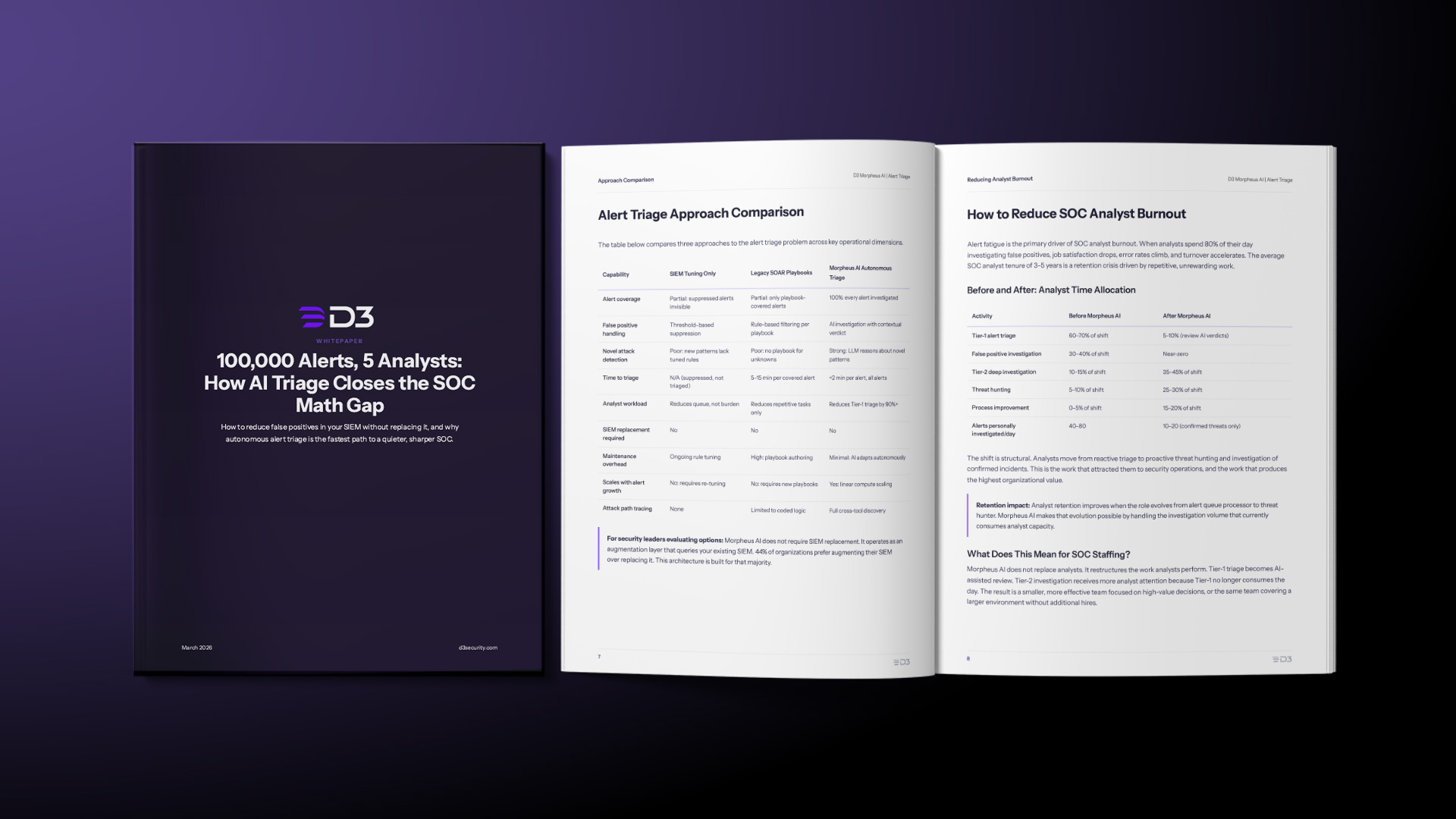
Alert Triage Approach Comparison
The table below compares three approaches to the alert triage problem across key operational dimensions. For clarity, each dimension is scored explicitly.
| Capability | SIEM Tuning Only | Legacy SOAR Playbooks | Morpheus AI Autonomous Triage |
|---|---|---|---|
| Alert coverage | Partial — suppressed alerts are invisible | Partial — only alerts with matching playbooks | 100% — every alert investigated |
| False positive handling | Threshold-based suppression | Rule-based filtering per playbook | AI investigation with contextual verdict |
| Novel attack detection | Poor — new patterns lack tuned rules | Poor — no playbook exists for unknowns | Strong — LLM reasons about novel patterns |
| Time to triage | N/A (suppressed, not triaged) | 5–15 min per playbook-covered alert | <2 min per alert, all alerts |
| Analyst workload impact | Reduces queue, not investigation burden | Reduces repetitive tasks only | Reduces Tier-1 triage by 90%+ |
| SIEM replacement required | No | No | No |
| Maintenance overhead | Ongoing rule tuning | High — playbook authoring/versioning | Minimal — AI adapts autonomously |
| Scales with alert growth | No — requires re-tuning | No — requires new playbooks | Yes — linear compute scaling |
| Attack path tracing | None | Limited to coded logic | Full cross-tool attack path discovery |
For security leaders evaluating options: Morpheus AI does not require SIEM replacement. It operates as an augmentation layer that queries your existing SIEM and enriches its output with autonomous investigation. 44% of organizations prefer augmenting their SIEM over replacing it — this is the architecture built for that majority.
How to Reduce SOC Analyst Burnout
Alert fatigue is the primary driver of SOC analyst burnout. When analysts spend 80% of their day investigating false positives, job satisfaction drops, error rates climb, and turnover accelerates. The average SOC analyst tenure of 3–5 years is not a reflection of career mobility — it is a retention crisis driven by repetitive, unrewarding work.
Before and After: Analyst Time Allocation
| Activity | Before Morpheus AI | After Morpheus AI |
|---|---|---|
| Tier-1 alert triage | 60–70% of shift | 5–10% (review AI verdicts) |
| False positive investigation | 30–40% of shift | Near-zero |
| Tier-2 deep investigation | 10–15% of shift | 35–45% of shift |
| Threat hunting | 5–10% of shift | 25–30% of shift |
| Process improvement | 0–5% of shift | 15–20% of shift |
| Alerts personally investigated/day | 40–80 | 10–20 (confirmed threats only) |
The shift is structural. Analysts move from reactive triage to proactive threat hunting and investigation of confirmed incidents. This is the work that attracted them to security operations, and the work that produces the highest organizational value.
Retention impact: Analyst retention improves when the role evolves from alert queue processor to threat hunter. Morpheus AI makes that evolution possible by handling the investigation volume that currently consumes analyst capacity.
What Does This Mean for SOC Staffing?
Morpheus AI does not replace analysts. It restructures the work analysts perform. Tier-1 triage becomes AI-assisted review. Tier-2 investigation receives more analyst attention because Tier-1 no longer consumes the day. The result is a smaller, more effective team focused on high-value decisions — or the same team covering a larger environment without additional hires.
Deployment: Adding Morpheus AI to Your Existing SIEM
Morpheus AI deploys alongside your current SIEM with no migration, no log re-ingestion, and no disruption to existing detection rules. The platform connects via native API integrations to your SIEM and security stack.
Supported SIEM Integrations
Morpheus AI integrates with all major SIEM platforms including Splunk, Microsoft Sentinel, IBM QRadar, Elastic SIEM, Google Chronicle, CrowdStrike Falcon LogScale, and others. The Self-Healing Integration framework ensures these connections adapt automatically when vendors update their APIs or schemas.
Deployment Timeline
Connect
API integration with SIEM and primary security tools; alert pipeline configuration. Duration: 1–2 days.
Baseline
Morpheus AI observes alert patterns, learns environment-specific context, calibrates confidence scoring. Duration: 5–7 days.
Shadow Mode
Autonomous triage runs in parallel with analyst workflow; verdicts compared for accuracy validation. Duration: 7–14 days.
Production
Full autonomous triage with analyst-in-the-loop review for high-severity escalations. Duration: Day 14+.
Total time to value: 2–4 weeks. No SIEM replacement. No log migration. No detection rule rewrite. Morpheus AI queries your SIEM — it does not replace it.
Questions for Your Evaluation
- What percentage of your daily SIEM alerts are investigated by an analyst today?
- How many hours per week does your team spend on Tier-1 triage versus threat hunting?
- What is your current false positive rate, and how much visibility have you traded to reduce it?
- How long does it take to triage a single alert from detection to disposition?
- What is your current analyst turnover rate, and what do you attribute it to?
- If every alert were investigated, how many more true threats would you expect to find?
- How would your SIEM investment ROI change if 100% of its detections were actually investigated?
- What is the cost of a missed true positive that was suppressed by tuning?
Next Steps
If the alert triage gap described in this paper reflects your SOC’s reality, consider the following actions:
Quantify your current gap.
Measure the percentage of daily alerts investigated, average triage time, and analyst time spent on false positives. These baseline metrics define the improvement opportunity.
Evaluate augmentation before replacement.
44% of organizations prefer augmenting their SIEM over replacing it. Morpheus AI is built for this model — it queries your SIEM, not competes with it.
Request a Morpheus AI demonstration.
See autonomous triage applied to your environment’s alert types, your tool stack, and your investigation workflows.
Pilot in shadow mode.
Run Morpheus AI alongside your current process for 14 days. Compare AI verdicts against analyst decisions to validate accuracy before committing.
About D3 Security
D3 Security is the maker of Morpheus AI, an AI Autonomous SOC platform that replaces legacy Security Orchestration, Automation and Response (SOAR) products. Morpheus AI uses a Cybersecurity Triage Reasoning Graph to investigate every alert autonomously — collecting context, correlating across the full security stack, tracing attack paths, and generating bespoke response playbooks at runtime.
Morpheus AI sits beside your SIEM as the investigation and response intelligence layer. It does not ingest logs separately, does not require a migration, and does not compete for budget with your SIEM renewal. It makes the SIEM investment you already have work harder.
Learn more at d3security.com or contact D3 Security at 1-800-608-0081 or [email protected].