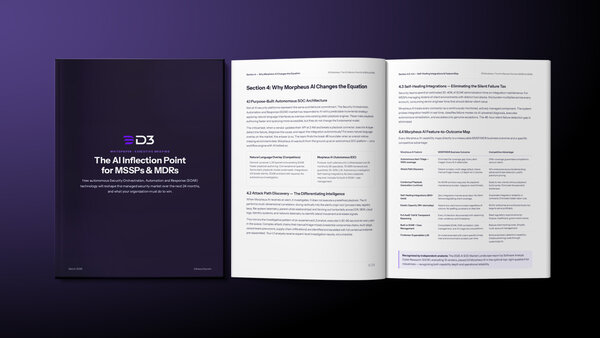
How Autonomous SOC Technology Will Reshape the MSSP and MDR Market Over the Next 24 Months—and What Your Organization Must Do to Win
Executive Summary
The managed security services market is approaching a structural discontinuity. Over the next 24 months, artificial intelligence will not merely augment how MSSPs and MDR providers deliver services. It will redefine the economic model that determines which organizations thrive, which stagnate, and which cease to compete.
This briefing is for the COOs, CFOs, and Presidents responsible for the strategic and financial trajectory of their organizations. The technology is not emerging — it is here. The market bifurcation has already begun.
The fundamental dynamic is straightforward: human analyst capacity is finite, expensive, and constrained by hiring pipelines and burnout cycles. Morpheus AI capacity is elastic, cost-efficient, and scales with compute, not headcount. MSSPs and MDR providers that deploy Morpheus AI will emerge with structural advantages their competitors cannot close through hiring alone.
Those that wait face a compounding deterioration: falling behind on SLA guarantees, overwhelmed by alert volume spikes, slowed in onboarding new clients, and losing analysts to attrition. The math is unforgiving and the window for action is narrowing.
Table of Contents
- Section 1: The Market Forces Driving AI Adoption
- Section 2: How AI Transforms the MSSP/MDR Economic Model
- Section 3: The 24-Month Horizon
- Section 4: Why Morpheus AI Changes the Equation
- Section 5: The Diverging Path — Winners and Those Who Flounder
- Section 6: Strategic Roadmap for MSSP and MDR Leadership
- Section 7: The Business Case in Summary
Section 1: The Market Forces Driving AI Adoption
1.1 The Alert Volume Crisis Is Not Improving
The average enterprise SOC now ingests between 1,000 and 10,000 security alerts per day. Large environments exceed 20,000. MSSPs managing dozens of enterprise accounts are therefore processing millions of alerts monthly. Industry research documents that 67% of these alerts go uninvestigated — not because analysts are negligent, but because the math is structurally impossible.
A single L1 analyst, working productively for 7 hours per shift, can thoroughly triage approximately 21 alerts to the 20-minute industry standard. At a moderate rate of 2,000 alerts per day for a single client, an MSSP requires approximately 95 L1 FTEs and 57 L2 FTEs — 152 analysts for one enterprise account. No MSSP operates at this ratio. None can.
1.2 The Talent Pipeline Cannot Close the Gap
The 2025 ISC2 Cybersecurity Workforce Study documents a global shortage of 4.8 million cybersecurity professionals — a 19% year-over-year increase. The global workforce must grow by 87% to meet demand. It grew by 0.1% last year.
For MSSPs, this crisis is existential. Average analyst tenure runs under 18 months. Annual turnover exceeds 30%. Every departure takes client-specific context and hard-won investigation patterns with it. Worse, hiring requires carrying labor cost before new revenue materializes — every new client relationship begins with a negative-margin period.
1.3 AI-Native Competitors Are Already in Your Market
Your enterprise clients are watching AI reshape every labor-intensive function — and beginning to ask whether their MSSP operates with the same leverage they pursue internally. A security buyer who just restructured their finance team around AI will not indefinitely accept SLA terms built around human triage throughput.
A cohort of AI-native managed security entrants is entering your market now. They are not encumbered by legacy tooling, inherited playbook debt, or analyst-to-client ratios built around human capacity. They will undercut your pricing, offer SLAs you cannot match, and absorb client environments you cannot profitably serve. The window to get ahead of this is measured in months, not years.
Section 2: How AI Transforms the MSSP/MDR Economic Model
2.1 From Headcount-Bound to Compute-Bound
The traditional MSSP cost structure is fundamentally headcount-bound. Every incremental unit of alert capacity requires an incremental analyst. Every unexpected spike threatens SLA compliance. The cost curve is linear and rises before revenue materializes.
Morpheus AI inverts this model. It processes alerts in parallel, continuously, without shift boundaries or cognitive limits. A single Morpheus AI deployment handles over one million alerts per day, the equivalent of approximately 6,000 human analysts working simultaneously. The marginal cost of an additional alert is a compute cost, not a labor cost.
2.2 The Revenue-Per-Analyst Multiplier
In a Morpheus AI deployment serving an enterprise client with 2,000 daily alerts, human analysts shift to outcome management: reviewing AI triage decisions, handling the 0.14% of alerts requiring human judgment, conducting threat hunts, and maintaining client relationships. A team of 8–12 senior analysts manages what previously required 50–60. Revenue per analyst employed expands by 4–6×.
This is documented fact. A large Master MSSP implementing Morpheus AI went from processing 144,000 monthly alerts to focusing on just 200 requiring human attention — with the same team. Response times compressed from 30–60 minutes to 30 seconds–3 minutes on automated alerts.
Traditional MSSP Model
50–60 analysts per 2,000 daily alerts. Triage is the bottleneck. Scaling requires proportional headcount increase.
Morpheus AI Model
8–12 analysts per 2,000 daily alerts. AI handles triage autonomously. Scaling requires compute, not headcount.
2.3 The Market Consolidation Thesis
When one class of competitors serves 10× the alert volume with the same headcount, the former absorbs the market share of the latter. The MSSP market has historically fragmented because alert capacity was linearly constrained. Morpheus AI removes that constraint.
Section 3: The 24-Month Horizon
The bifurcation has already started. Here is how the next 24 months play out for MSSP and MDR providers, based on observed early-adopter trajectories and market dynamics.
Organizations that move now capture the deployment learning curve while competitors evaluate. Early movers build operational experience that cannot be replicated by later procurement. Get Morpheus AI into production, connect it to client environments through 800+ pre-built integrations, and begin shifting analyst workflows from triage processing to outcome management.
AI-enabled MSSPs will have documented performance data to offer SLA terms traditional competitors cannot match. This is when your existing clients begin receiving competitive proposals. Organizations that have not deployed by this point will defend accounts rather than grow them. Replacing a lost enterprise account typically costs 24–36 months of its margin contribution.
The MSSP market bifurcates structurally. AI-enabled providers demonstrate 100% alert coverage, sub-2-minute triage, documented breach impact reduction, and compliance-grade audit trails. Pricing pressure from AI-native entrants compresses margins for traditional operators. Organizations that waited are restructuring under pressure, from a position of margin erosion rather than expansion.
Immediate Actions
Begin Morpheus AI evaluation against current alert volumes. Deploy in pilot against highest-friction client environment. Document triage metrics before/after.
Medium-Term Deployment
Expand Morpheus AI to all enterprise accounts. Restructure analyst workflows from triage to outcome management. Begin SLA renegotiations with measured performance data.
Long-Term Positioning
Transition pricing model to AI-enabled margin economics. Acquire new clients at transformed capacity/margin profile. Establish market position as AI-enabled provider.
The compounding advantage: Organizations that build AI-enabled margins first will have the investment capacity to extend their lead. The next 90 days determine whether your organization is building the advantage or defending against someone else’s.
Section 4: Why Morpheus AI Changes the Equation
4.1 Purpose-Built Autonomous SOC Architecture
Not all AI security platforms represent the same architectural commitment. The Security Orchestration, Automation and Response (SOAR) market has responded to AI with a predictable incremental strategy: applying natural language interfaces as overlays onto existing static playbook engines. These make playbook authoring faster and querying more accessible, but they do not change the fundamental model.
The critical test: when a vendor updates their API at 2 AM and breaks a playbook connector, does the AI layer detect the failure, diagnose the cause, and repair the integration autonomously? For every natural language overlay on the market, the answer is no. The team finds the break 48 hours later when an analyst notices missing enrichment data. Morpheus AI was built from the ground up as an autonomous SOC platform — not a workflow engine with AI bolted on.
| Approach | Architecture | Autonomous Investigation | Integration Self-Healing |
|---|---|---|---|
| General-purpose LLM overlay | LLM applied to existing SOAR platform | No — executes static playbooks | No — 48-hour silent failures |
| Cybersecurity Triage Reasoning Graph | Autonomous SOC platform with built-in SOAR + case management | Yes — 30–90 seconds per alert | Yes — real-time monitoring + autonomous repair |
4.2 Attack Path Discovery — The Differentiating Intelligence
When Morpheus AI receives an alert, it investigates. It does not execute a predefined playbook. The AI performs multi-dimensional correlation: diving vertically into the alert’s origin tool (process trees, registry keys, file system telemetry, parent-child relationships) and fanning out horizontally across EDR, SIEM, cloud logs, identity systems, and network telemetry to identify lateral movement and related signals.
This mirrors the investigative pattern of an experienced L2 analyst, executed in 30–90 seconds for every alert in the queue. Complex attack chains that manual triage misses (credential compromise chains, multi-stage ransomware precursors, supply chain infiltrations) are identified and escalated with full contextual evidence pre-assembled. Your L1 analysts receive expert-level investigation results, not a checklist.
- Vertical dive: Deep analysis of the originating detection tool’s telemetry for context, parent-child chains, and related signals
- Horizontal correlation: Cross-referencing against EDR, SIEM, cloud logs, identity systems, and network telemetry for lateral movement
- Context assembly: Full attack context and evidence pre-assembled for analyst review, not checklist-driven triage
4.3 Self-Healing Integrations — Eliminating the Silent Failure Tax
Security teams spend an estimated 30–40% of SOAR administration time on integration maintenance. For MSSPs managing dozens of client environments with distinct tool stacks, this burden multiplies across every account, consuming senior engineer time that should deliver client value.
Morpheus AI treats every connector as a continuously monitored, actively managed component. The system probes integration health in real time, classifies failure modes via AI-powered diagnosis, executes autonomous remediation, and escalates only genuine exceptions. The 48-hour silent failure detection gap is eliminated.
4.4 Morpheus AI Feature-to-Outcome Map
Every Morpheus AI capability maps directly to a measurable MSSP/MDR business outcome and a specific competitive advantage:
- Autonomous triage: 100% alert coverage vs. 33% manual capacity. SLA guarantees your competitors cannot match.
- Attack path discovery: Credential compromise chains and lateral movement escalations competitors miss. Documented breach impact reduction.
- Self-healing integrations: Elimination of 30–40% SOAR administration overhead. Senior engineer capacity freed for client growth.
- Audit-grade trails: Complete context and reasoning for every alert decision. Compliance documentation automated.
Section 5: The Diverging Path — Winners and Those Who Flounder
5.1 The Anatomy of an AI-Enabled MSSP Winner
The MSSPs and MDR providers that emerge dominant over the next 24 months share a common profile. They move from headcount-bound to compute-bound. They restructure their analyst workforce from high-volume triage processors to high-value outcome managers: auditing AI decisions, managing the exceptions requiring human judgment, conducting proactive threat hunts, and building client relationships. They renegotiate contracts to reflect what autonomous triage enables. They price new business on AI-enabled margin economics.
5.2 The Anatomy of an Organization That Flounders
The organizations that do not move face compounding deterioration across three reinforcing pressures:
Competitive Pressure
AI-enabled MSSPs offer coverage guarantees, response time SLAs, and pricing traditional operators cannot match. Client acquisition becomes progressively harder and retention increasingly expensive. Defending accounts against competitors with superior economics requires price concessions that compress already-thin margins.
Capacity Crisis
Alert volumes continue growing; the analyst talent shortage deepens. The gap between alert capacity and analyst capacity widens. Organizations without structural automation face a binary choice: honor SLA commitments at a labor cost that destroys margin, or fail to honor SLAs and lose the accounts. Neither is sustainable.
Talent Drain
The best analysts prefer employers offering elevated, AI-augmented roles over organizations where the job remains high-volume manual triage. Organizations that delay AI adoption will find their analyst quality deteriorating as their best people move to more sophisticated environments. The cycle is self-reinforcing and rarely escaped on an organization’s own terms.
Section 6: Strategic Roadmap for MSSP and MDR Leadership
The bifurcation is happening now. The question is not whether AI-autonomous triage will reshape the market — it already is. The question is whether your organization leads or responds.
Immediate Actions — 0 to 90 Days
Begin Morpheus AI evaluation against your current highest-friction client environment. Document baseline triage metrics: alert volume, current coverage percentage, response times, analyst utilization. Run Morpheus AI in parallel and compare. The performance gap will clarify the decision. Deploy in pilot. Build operational expertise while competitors are still evaluating.
Medium-Term — 90 Days to 12 Months
Expand Morpheus AI to all enterprise accounts. Restructure analyst workflows from triage processing to outcome management: escalation decision review, exception handling, threat hunting, client relationship management. Conduct SLA renegotiations with documented before/after performance data. Begin pricing new business on AI-enabled economics. You now have competitive data your sales team can deploy against new prospects.
Long-Term Positioning — 12 to 24 Months
Establish your market position as an AI-enabled provider. Transition your pricing model to reflect compute-bound economics. Acquire market share from traditional operators who delayed. Continue extending your operational lead — the learning curve is steep and time is your ally if you moved early.
Section 7: The Business Case in Summary
For CFOs: The Financial Argument
Evaluate Morpheus AI deployment against the alternative: continuing to fund headcount-based triage expansion in a market where analyst costs rise, analyst availability declines, and competitive pricing pressure compresses margins. The question is not whether AI deployment has a cost (it does). The question is whether the cost of deployment is lower than the cost of the competitive position you will occupy without it.
For COOs and Presidents: The Strategic Argument
The managed security market is not returning to its state of 18 months ago. Alert volumes will continue to grow. The analyst talent shortage will deepen before it improves. AI-native entrants will continue entering your market with cost structures you cannot match through incremental efficiency gains.
Morpheus AI is not a point solution for a specific problem. It is a platform replacement of the headcount-bound constraint that currently limits every dimension of your growth: account capacity, margin structure, SLA capability, client acquisition, and analyst retention.