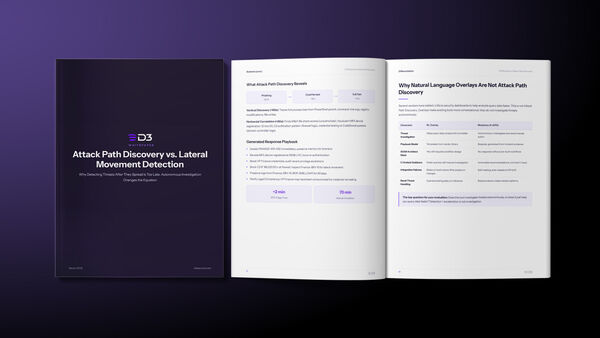
Executive Summary
Lateral movement detection tools are critical SOC components. They monitor east-west network traffic, flag anomalous authentication patterns, and alert when attackers move between systems. They are also, by definition, reactive.
The core thesis: Attack Path Discovery (APD) represents a structural alternative. Rather than waiting for lateral movement to occur and then detecting it, APD autonomously traces how threats propagate across tools and time, correlating signals across the entire security stack to build a complete threat narrative for every alert in under two minutes.
APD complements lateral movement detection by addressing the structural gap that detection alone cannot close.
D3 Morpheus AI operationalizes APD on every incoming alert using the Cybersecurity Triage Reasoning Graph developed over 24 months by 60 domain specialists.
The Lateral Movement Problem: Speed, Stealth, and Structural Gaps
Lateral movement attacks (defined by MITRE ATT&CK TA0008 techniques including Pass the Hash, RDP abuse, Lateral Tool Transfer, and PowerShell/WMI/PsExec abuse) remain a critical pivot point in the kill chain. Three fundamental challenges make detection-only approaches inadequate:
Speed Problem
Attackers break out of initial compromise to critical systems in 29 minutes on average (CrowdStrike 2026), with the fastest observed breakout occurring in just 27 seconds. The Akira ransomware group completed lateral movement in under 6 minutes. By contrast, the average SOC analyst takes 56 minutes to begin acting on an alert and 70 minutes to investigate, creating a 41-to-127 minute gap between attacker action and analyst response.
Stealth Problem
82% of malware-free detections (CrowdStrike) mask the true attack narrative. PowerShell abuse appears in 71% of living-off-the-land (LOTL) attacks; legitimate credentials used in 35% of cloud incidents generate zero alerts. Attackers move silently through authorized channels, making detection on behavioral anomaly alone insufficient.
Cross-Domain Problem
Hybrid identity estates spanning Active Directory, Entra ID, and SaaS platforms create blind spots. Black Hat USA 2025 demonstrated novel AD lateral movement techniques that evade traditional detectors. Gartner predicts 60% of organizations will experience lateral movement through IoT by 2026. Devices like these often evade traditional NDR (Network Detection and Response) sensors that cannot inspect them.
What Lateral Movement Detection Tools Do Well and Their Limitations
What They Do Well
Modern lateral movement detection combines multiple specialized approaches:
Network Detection and Response (ExtraHop RevealX, Vectra AI): real-time protocol analysis
User and Entity Behavior Analytics (Exabeam, Insider Threat platforms): behavioral baselining
Microsegmentation (Elisity, Zero Trust architectures): post-compromise visibility
Endpoint Detection and Response (CrowdStrike, SentinelOne): host-level correlation
Five Structural Limitations
1. Reactive by Design
Detect after attacker has already moved. Alerts fire only once lateral movement is in progress or complete.
2. Single-Domain Visibility
NDR sees network, EDR sees endpoint, UEBA sees identity. None correlate all simultaneously across the full security stack.
3. Alert Without Context
Flags event between system A and B but provides no why, what was accessed, or what attacker’s next step will be.
4. False Positive Burden
50%+ false positive rates (99% in academic studies) erode analyst trust. Contributes to 67% uninvestigated alerts.
5. No Investigation Capability
Detect but don’t investigate the full attack chain. SOC analyst must manually connect signals across tools.
What Is Attack Path Discovery?
Definition: Autonomous, multi-dimensional correlation of security telemetry to trace how a threat propagates across tools and time. APD ingests real-time alert data, correlates signals across the entire security stack (network, endpoint, identity, cloud, email), and reconstructs the complete attacker path with evidence and context.
Two-Axis Correlation Model
| Axis | Traditional Approach | Attack Path Discovery |
|---|---|---|
| North-South (Vertical) | Single tool deep-dive; e.g., EDR traces process tree on one host | Vertical + horizontal; traces origin signal through all available logs |
| East-West (Horizontal) | Tool-to-tool isolation; NDR alert separate from EDR alert | Full-stack correlation; connects network event to endpoint action to identity change |
APD vs. Traditional Attack Path Analysis
Traditional Attack Path Analysis (APA) maps potential vulnerability chains proactively, identifying hypothetical paths attackers could exploit. It is inventory-driven and runs offline.
Morpheus AI’s Attack Path Discovery operates on real-time alert data, tracing actual attacker activity as it happens. It is investigative and autonomous—no manual correlation required.
Head-to-Head Comparison
| Capability | LM Detection Tools | Attack Path Discovery (Morpheus) |
|---|---|---|
| Detection Timing | After lateral movement occurs | On initial alert; correlates prior activity |
| Scope of Analysis | Single domain (network/endpoint/identity) | Full-stack correlation (800+ integrations) |
| Investigation Depth | Alert; requires manual follow-up | Complete attack path from origin to impact |
| Context Awareness | Behavioral anomaly; lacks “why” | Evidence-linked narrative with timeline |
| Response Generation | Alert only; analyst writes playbook | Auto-generated, bespoke response actions |
| Integration Model | Requires native connectors to each tool | API-agnostic; self-healing integrations |
| Analyst Dependency | High; 56-70 min to investigate | Low; triage in <2 minutes |
| Scalability | Alert volume scales analyst workload | Scales autonomously with volume |
| Novel Threat Handling | Signature/anomaly based; misses unknowns | Reasoning-based; adapts to new patterns |
| Time to Triage | 56–127 minutes (avg analyst response) | <2 minutes (autonomous) |
APD in Action: A Real-World Scenario
Incident: Phishing alert targeting VP of Finance. Credential harvester link clicked at 09:14 UTC.
What Lateral Movement Detection Tools See
Alert 1: EDR Dashboard
09:45 UTC | Suspicious PowerShell execution on FINANCE-WS-042
Alert 2: NDR Console
09:52 UTC | RDP connection Finance-WS-042 → Finance-SRV-15
Alert 3: UEBA Platform
10:08 UTC | Unusual share access, M&A_Strategy_2026
Analyst View: 3 separate alerts across 3 dashboards. No correlation. Manual investigation: 70 minutes to connect signals.
What Attack Path Discovery Reveals
09:14
<60s
<120s
Vertical Discovery (<60s): Traces full process tree from PowerShell parent, command-line args, registry modifications, file writes.
Horizontal Correlation (<60s): Finds M&A file share access (unauthorized), fraudulent MFA device registration (Entra ID), C2 exfiltration pattern (firewall logs), credential testing on 3 additional systems (domain controller logs).
Generated Response Playbook
Isolate FINANCE-WS-042 immediately; preserve memory for forensics
Revoke MFA device registered at 09:58 UTC; force re-authentication
Reset VP Finance credentials; audit recent privilege escalations
Block C2 IP 185.220.101.x at firewall; inspect Finance-SRV-15 for lateral movement
Preserve logs from Finance-SRV-15 (RDP, SMB, LDAP) for 90 days
Notify Legal/Compliance; VP Finance may have been compromised for credential harvesting
How Morpheus AI Implements Attack Path Discovery
Morpheus AI is a purpose-built cybersecurity AI platform that operationalizes APD at scale.
Cybersecurity Triage Reasoning Graph
24 months of development by 60 domain specialists. Built on real SOC data, incident response timelines, and attack patterns. The model understands kill-chain semantics, MITRE ATT&CK context, and the temporal relationships between security events.
Self-Healing Integrations
800+ tool connectors with autonomous API drift correction. When a vendor updates an API endpoint or schema, Morpheus auto-detects the change and adapts automatically. This eliminates integration maintenance overhead that plagues traditional SOAR deployments.
Contextual Playbook Generation
Morpheus generates bespoke response actions based on the actual evidence discovered during investigation. A credential-based lateral movement incident receives different remediation than a zero-day exploit, even if both flag the same alert.
Customer-Expandable Intelligence
Organizations customize Morpheus’s reasoning for their environment. Add internal threat intelligence, define custom IOCs, or configure risk-scoring rules unique to your architecture. The platform learns from your feedback, improving accuracy over time.
Built-In SOAR: Static and Autonomous Playbooks
Static playbooks handle known, repeatable response patterns. Autonomous playbooks generate on-demand for novel or complex threats. No rip-and-replace required; Morpheus integrates with your existing SOAR investment.
Why Natural Language Overlays Are Not Attack Path Discovery
Several vendors have added LLMs to security dashboards to help analysts query data faster. This is not Attack Path Discovery. Overlays make existing tools more conversational; they do not investigate threats autonomously.
| Dimension | NL Overlay | Morpheus AI (APD) |
|---|---|---|
| Threat Investigation | Helps query data; analyst still correlates | Autonomous; investigates and recommends action |
| Playbook Model | Templates from vendor library | Bespoke, generated from incident evidence |
| SOAR Architect Need | Yes; still requires workflow design | No; responds without pre-built workflows |
| L1 Analyst Guidance | Faster queries; still manual investigation | Actionable recommendations; minimal L1 input |
| Integration Failures | Relies on tool’s native APIs; breaks on changes | Self-healing; auto-adapts to API drift |
| Novel Threat Handling | Queries existing data; no inference | Reasons about unseen attack patterns |
Questions for Your Evaluation
When evaluating lateral movement detection tools and investigating APD, use these questions to clarify vendor capabilities:
Next Steps
Assess your current state
Map your alert volume, analyst triage time, and investigation coverage gap. Quantify the cost of missed or slow responses.
Schedule a threat investigation demo
See how Morpheus AI investigates a real lateral movement incident end-to-end in under 2 minutes.
Validate integration readiness
Confirm that your current security tools (SIEM, NDR, EDR, UEBA, cloud platforms) are supported by Morpheus.
Plan pilot deployment
Start with a focused alert stream (e.g., lateral movement detection tool output) to measure MTTR reduction and false positive reduction.
Learn More
To schedule a demonstration and see how Morpheus AI investigates lateral movement attacks end-to-end, visit d3security.com.
D3 Security | 1-800-608-0081 | [email protected]