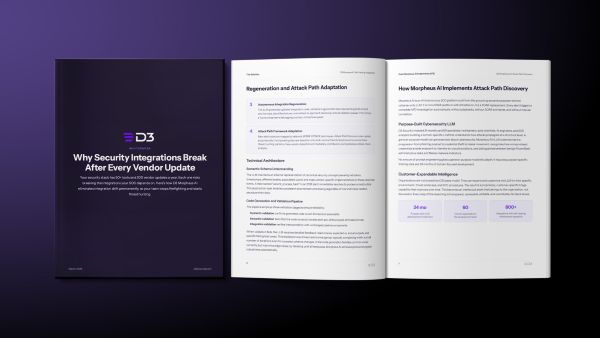
Executive Summary
Integration drift happens when third-party security tool updates break existing integrations with other platforms. Your organization uses roughly 50 security tools. Each releases 4 to 6 updates per year. That creates disruptions every 6 weeks on average: new alert schemas, modified APIs (API drift), and restructured data formats open visibility gaps precisely when new threats appear. Self-healing integrations are purpose-built to detect these breaks automatically, analyze root causes, regenerate connectors, and adapt to new API schemas. Integration maintenance currently consumes engineering capacity that should go toward threat hunting and detection engineering.
D3 Security’s Morpheus AI, an AI Autonomous SOC platform that replaces legacy Security Orchestration, Automation and Response (SOAR) products, solves this with Self-Healing Integrations. A Cybersecurity Triage Reasoning Graph continuously monitors every data feed, detects drift within minutes, analyzes the semantic meaning of changes, regenerates integration code autonomously, and adapts the Attack Path Discovery framework to incorporate new detection types.
The result: integration remediation that completes in hours instead of weeks, zero visibility gaps during vendor transitions, and engineering teams freed from reactive maintenance to focus on strategic security work.
Who Should Read This
This whitepaper is for SOC leaders, security engineers, and IT decision-makers evaluating how to maintain continuous security visibility across a growing, constantly evolving vendor ecosystem, without scaling integration maintenance headcount linearly with tool count.
The Integration Drift Problem
Detection and alert drift is an inevitable consequence of the adversarial nature of cybersecurity. Attackers modify their tactics, techniques, and procedures (TTPs) to evade detection. Security vendors respond with updated detection logic, which often changes alert schemas, severity calculations, and API structures. These changes cascade downstream, breaking the integrations that security operations depend on.
During the gap between a vendor’s update and an integration repair, organizations face partial or complete loss of visibility into specific threat categories. Sophisticated attacks succeed during these windows because the alerts designed to detect them never reach the analysts who could respond.
How Drift Manifests
Schema Drift
New or renamed fields, changed data types, restructured alert payloads. Parsers fail silently. Alerts ingest but with missing or malformed data that bypasses automation.
API Drift
Modified endpoints, changed authentication mechanisms, restructured pagination, updated rate limits. Data ingestion stops entirely or returns incomplete results.
Detection Logic Drift
New alert categories, modified severity calculations, additional context fields. Triage workflows miscategorize or ignore new alert types entirely.
The Scale Nobody Talks About
A typical enterprise security stack includes 50+ tools: EDR platforms, cloud security across AWS, Azure, and GCP, network detection, identity providers, email security gateways, and specialized tools for containers, APIs, and application security. Each vendor operates on its own release cycle.
The math is unforgiving: 50 tools × 4–6 updates/year = potential integration disruptions every few weeks. Traditional maintenance cannot keep pace. Every disruption creates a window where new threats go undetected.
The Hidden Cost of Manual Maintenance
Beyond direct security risks, integration drift imposes operational costs that compound over time. Engineering teams spend disproportionate hours on reactive integration fixes instead of strategic security improvements. Knowledge silos form as individual engineers become experts on specific vendor integrations, creating single points of failure. Documentation falls behind, making each successive fix harder.
Context-Switching Tax
Engineers working on automation projects drop everything for critical integration breaks. Regaining momentum on strategic work takes hours, multiplied across dozens of disruptions per year.
Knowledge Silos
When the one engineer who understands a vendor’s integration is unavailable, MTTR spikes. Tribal knowledge doesn’t scale, and documentation is always outdated.
Opportunity Cost
Every hour spent fixing a broken parser is an hour not spent building new detections, tuning alert fidelity, or developing response playbooks for emerging threats.
Talent Burnout
Skilled engineers hired for detection development spend their time maintaining integrations. Retention drops. The remaining team inherits more maintenance. The cycle accelerates.
Why Legacy SOAR Platforms Can’t Solve This
Traditional SOAR platforms treat integrations as static connectors, configured once and assumed to remain stable. When a vendor updates their API or schema, SOAR platforms break just like everything else. The manual integration maintenance cycle that SOAR was supposed to eliminate persists, just in a different form.
Morpheus AI takes a fundamentally different approach. As an AI Autonomous SOC platform that replaces legacy SOAR, Morpheus AI understands, monitors, and regenerates integrations autonomously. Where legacy platforms depend on static connectors, Morpheus maintains its own operational integrity.
The SOAR paradox: Legacy SOAR platforms promise automation but can’t automate the one thing that keeps them running: integration maintenance. Morpheus AI eliminates this dependency entirely.
Why SOAR Can’t Solve Integration Drift
SOAR platforms use static connectors: hardcoded mappings that break when vendor APIs change. The platform that orchestrates your response cannot automate its own maintenance. This architectural limit is what D3 calls the SOAR ceiling: the point where orchestration stops being helpful because the integrations feeding it have degraded.
Self-healing integrations take a fundamentally different approach. Instead of static connector definitions, Morpheus AI uses a Cybersecurity Triage Reasoning Graph that understands security data semantics. When a vendor changes an API schema, the system analyzes the change, understands its meaning, and regenerates the connector code. No human intervention. No engineering tickets. No 7 to 14 day remediation windows.
For organizations evaluating a SOAR alternative, this distinction matters: traditional orchestration breaks when the ecosystem evolves, while self-healing integrations improve alongside it.
D3’s Solution: Self-Healing Integrations
D3 Security recognized that solving integration drift required a fundamentally different approach. The solution needed to understand security data semantics, generate correct code autonomously, and adapt to changes without predefined rules for every scenario. D3’s engineering team built the Cybersecurity Triage Reasoning Graph on a comprehensive corpus of cybersecurity domain knowledge. It is purpose-built to understand attack patterns, lateral movement, and threat indicators at a foundational level:
- Alert schemas from hundreds of security products across EDR, SIEM, cloud security, identity, and email
- API documentation and specifications from major vendor ecosystems
- Integration code patterns, best practices, and real-world drift resolutions
- MITRE ATT&CK framework mappings for attack path correlation
This graph enables the LLM to understand semantic meaning, recognizing that a field named “threat_score” in one product serves the same purpose as “risk_level” in another.
The Four-Phase Self-Healing Process
Minutes, not days
→
LLM-powered semantics
→
Iterative validation
→
Attack path updates
Continuous Drift Detection
The system monitors all integrated data sources in real time, comparing incoming data against established baseline schemas. When an alert arrives with unexpected fields, changed data types, or structural modifications, the system flags the deviation within minutes.
LLM-Powered Change Analysis
The LLM examines new or modified fields to determine semantic meaning by considering field names, data types, relationships, and vendor documentation. It maps the full downstream impact: parsers, transformers, enrichment logic, and routing rules that need updating.
Regeneration and Attack Path Adaptation
Autonomous Integration Regeneration
The LLM generates updated integration code, validates it against test data representing both old and new formats, identifies failures, and refines its approach iteratively until all validation passes. This mimics a human engineer’s debugging process, at machine speed.
Attack Path Framework Adaptation
New alert types are mapped to relevant MITRE ATT&CK techniques. Attack Path Discovery rules update automatically, incorporating the new detection into both vertical (North-South) and horizontal (East-West) hunting patterns. New vendor detections immediately contribute to comprehensive attack chain analysis.
Technical Architecture
Semantic Schema Understanding
The Cybersecurity Triage Reasoning Graph maintains an internal representation of canonical security concepts (severity indicators, timestamps, affected assets, associated users) and maps vendor-specific implementations to these canonical forms. A field named “parent_process_hash” in an EDR alert immediately resolves to process ancestry data. This abstraction layer enables consistent downstream processing regardless of how individual vendors structure their data.
Code Generation and Validation Pipeline
The pipeline employs three validation stages to ensure reliability:
- Syntactic validation confirms generated code is well-formed and executable
- Semantic validation tests that the code correctly handles both pre-drift and post-drift data formats
- Integration validation verifies interoperability with unchanged pipeline components
When validation fails, the graph receives detailed feedback: stack traces, expected vs. actual outputs, and specific failing test cases. This feedback loop drives rapid convergence, typically completing within a small number of iterations even for complex schema changes. Initial code generation handles common cases correctly but may miss edge cases; by iterating until all tests pass, Morpheus AI achieves production-grade robustness automatically.
Self-Healing in Action
Scenario 1: EDR Major Version Upgrade
A leading EDR platform releases a major version introducing new threat detection categories, restructured alert schemas with additional contextual fields, and modified API endpoints with enhanced authentication requirements.
Traditional Approach
Weeks of engineering effort: analyze changelog documentation, update parser code, modify API client code, test changes, deploy updates. Throughout this period, new detections from the upgrade never reach the SOC. Visibility gap: 2–4 weeks.
Morpheus AI Self-Healing
As alerts arrive in the new format, the system detects schema changes within minutes. Morpheus identifies new fields, generates updated parsers, validates against both old and new formats, and updates Attack Path Discovery rules. Total time: hours, with minimal human oversight.
Scenario 2: Cloud Security API Evolution
A cloud security provider migrates from API keys to OAuth, changes pagination, updates rate limiting, and restructures response formats, all in a single release.
Traditional Approach
Multiple engineers needed for authentication refactoring, pagination logic updates, and response parsing changes. Total disruption can span days as each component requires sequential testing. Cloud visibility degrades throughout.
Morpheus AI Self-Healing
The system’s API monitoring detects anomalous response patterns immediately. Morpheus analyzes vendor documentation and observed behavior, generates updated API client code, and validates data ingestion continuity. Cloud security posture remains uninterrupted.
Scenario 3: New Detection Category Introduction
A vendor introduces detection for a previously unknown attack technique. The alert format includes new fields that existing parsers don’t recognize. With traditional maintenance, that detection exists at the vendor but never reaches your SOC. With Self-Healing Integrations, Morpheus AI recognizes the new alert type, maps it to MITRE ATT&CK, and updates Attack Path Discovery, making the new detection immediately operational.
Implementation Considerations
Deployment Architecture
Self-Healing Integrations deploy as a core component of the Morpheus AI platform, operating continuously alongside traditional integration infrastructure. The system requires no special configuration for existing integrations. It monitors all data flows and applies self-healing capabilities universally.
For organizations that want human oversight, Morpheus AI provides configurable approval workflows. Changes can be automatically applied, held for review, or applied with notification. Most organizations begin with review requirements and transition to automatic application as confidence grows.
Measuring Success
Track these metrics to quantify Self-Healing Integrations impact:
- Integration uptime percentage: target 99.9%+ across all data sources
- Mean time to detect and remediate drift: from days/weeks to minutes/hours
- Engineering hours on integration maintenance: reclaim 20–40% of team capacity
- Visibility gap duration: measure the window during vendor updates (target: near-zero)
- New alert type time-to-integration: from weeks to hours for Attack Path Discovery inclusion
Traditional Maintenance vs. Self-Healing
| Metric | Traditional / Legacy SOAR | Morpheus AI Self-Healing |
|---|---|---|
| Drift Detection Time | Hours to days (often discovered by analysts noticing missing data) | Minutes (continuous schema monitoring) |
| Remediation Time | Days to weeks (requires available engineer with vendor-specific knowledge) | Hours (autonomous code generation + validation) |
| Visibility Gap | Full duration of detection + remediation cycle | Near-zero (detection and remediation overlap) |
| Engineering Hours | 20–40% of team capacity on reactive maintenance | Minimal oversight; team focuses on strategic work |
| New Alert Type Integration | Manual: requires parser updates, workflow changes, ATT&CK mapping | Automatic: semantic mapping + Attack Path Discovery update |
| Scalability | Linear: each new tool adds maintenance burden | Constant: LLM handles all integrations uniformly |
| Knowledge Dependencies | High: vendor-specific expertise siloed in individuals | None: Understands all vendor schemas semantically |
Conclusion
Integration drift is one of the most persistent and dangerous problems in security operations. The adversarial dynamic between attackers and defenders guarantees that security products will continue to evolve, and traditional integration maintenance cannot keep pace. The result: visibility gaps that sophisticated attackers exploit precisely when new defenses deploy.
Morpheus AI‘s Self-Healing Integrations solve this structurally. The Cybersecurity Triage Reasoning Graph understands security data semantics, detects drift in minutes, regenerates integration code autonomously, and adapts the Attack Path Discovery framework to incorporate new detection capabilities immediately. Organizations maintain continuous security visibility regardless of how their vendor ecosystem evolves.
As the pace of cybersecurity evolution accelerates, autonomous integration maintenance transitions from competitive advantage to operational necessity. Organizations adopting Self-Healing Integrations today build security operations that improve automatically alongside the threat landscape, rather than struggling to keep pace with it.
Frequently Asked Questions
What is integration drift in cybersecurity?
Integration drift occurs when vendor tool updates break existing security integrations. With 50+ tools releasing 4 to 6 updates annually, disruptions occur every 6 weeks on average. Each disruption creates visibility gaps that persist until engineers manually diagnose the change and rewrite the affected connector.
Why can’t SOAR platforms fix their own integrations?
SOAR uses static connectors: hardcoded mappings that break when vendor APIs change. The platform cannot automate its own maintenance because it lacks semantic understanding of the data flowing through its integrations. This architectural limit is the SOAR ceiling.
How do self-healing integrations work?
Self-healing integrations use four phases: Detect (monitor API calls for failures and schema deviations), Analyze (identifies root cause by comparing old and new schemas), Regenerate (automatically rewrite the connector code), and Adapt (validate the fix and update the Attack Path Discovery framework). The entire cycle takes 45 minutes to 2 hours.
How much engineering time does Morpheus self-healing save?
Organizations typically reclaim 20 to 40 percent of security engineering capacity by eliminating manual connector maintenance and vendor update management. A single integration failure that previously required 7 to 14 days of engineering work resolves autonomously in under 2 hours.