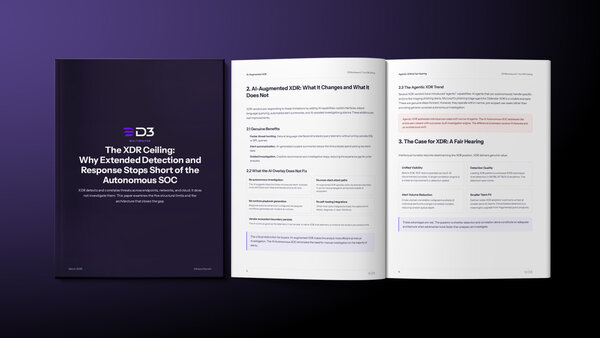
Executive Summary
Extended Detection and Response (XDR) emerged as the market’s answer to tool sprawl. By unifying telemetry from endpoints, networks, email, cloud workloads, and identity systems into a single correlation engine, XDR promised what no individual point product could deliver: cross-domain visibility and faster threat detection.
That promise is partially fulfilled. XDR does correlate signals across domains. It does reduce the number of disconnected consoles analysts must monitor. Leading XDR platforms achieved strong detection scores in MITRE ATT&CK Evaluations, demonstrating that the detection layer works.
But detection and correlation are only the beginning. XDR, by design, stops at precisely the point where the SOC’s hardest problems begin.
XDR detects a threat and surfaces a correlated alert. A human analyst must then investigate that alert: determine scope, trace lateral movement, assess impact, build a timeline, decide on containment, and execute response. This investigation phase is where 80% of analyst time is consumed, and where XDR provides no autonomous capability.
even after XDR correlation
by manual investigation
capability in standard XDR
The result is a category that has improved detection without reducing the operational burden on human analysts. Alert volume goes down through correlation. Investigation workload stays the same. The bottleneck simply moves from “too many alerts” to “too many correlated incidents requiring manual investigation.”
This paper examines five structural limitations of the XDR model, evaluates the AI-augmented XDR approach now entering the market, steelmans the strongest arguments for XDR, and presents the AI Autonomous SOC as the architectural successor. All claims are cross-referenced against at least two independent sources.
Table of Contents
- 1. The Structural Limitations of XDR
- 2. AI-Augmented XDR: What It Changes and What It Does Not
- 3. The Case for XDR: A Fair Hearing
- 4. The AI Autonomous SOC: From Detection to Decision
- 5. D3 Morpheus AI: The AI Autonomous SOC in Practice
- 6. Capability Comparison
- 7. Questions for Your Evaluation
- 8. Next Steps
1. The Structural Limitations of XDR
XDR solved a real problem. Before XDR, SOC analysts switched between EDR, NDR, SIEM, and cloud security consoles to manually correlate signals that belonged to the same incident. XDR unified that telemetry into a single view. This contribution is genuine.
However, the model carries five inherent constraints that become more acute as attack sophistication increases. These are not implementation failures. They are architectural limits of the XDR paradigm itself.
1.1. Detection Without Investigation
XDR detects threats and correlates signals across domains. It does not investigate them. When XDR surfaces a correlated incident, the analyst must determine whether the activity is malicious, trace the full scope of compromise, identify affected systems, build a timeline, and decide on response actions. This investigation phase is the SOC’s most expensive function. XDR does not reduce investigation workload. The analyst bottleneck is preserved intact.
1.2. Vendor Lock-In and Ecosystem Dependency
Native XDR platforms work best within the vendor’s own product ecosystem. A native XDR platform cannot interact with solutions not offered by its provider, creating lock-in that few enterprises can fully commit to. Open XDR addresses this by ingesting telemetry from multiple vendors, but the quality of cross-vendor correlation rarely matches native implementations. Organizations face a choice between depth (native, locked-in) and breadth (open, shallow).
1.3. The Correlation Ceiling
XDR correlation is rule-based: predefined detection logic mapped to known threat behaviors, typically aligned to MITRE ATT&CK techniques. This works for known attack patterns. It does not work for novel techniques, living-off-the-land attacks that mimic legitimate business activity, or multi-stage campaigns that unfold across days in ways not anticipated by the correlation rules.
1.4. Response Fragmentation
XDR platforms offer automated response actions (isolate an endpoint, block an IP, disable a user account). These are individual tactical actions, not coordinated response workflows. When an incident spans multiple domains (phishing leading to credential theft, lateral movement, and data exfiltration), the response requires a sequence of coordinated actions guided by investigation findings. XDR provides the tactical building blocks. It does not orchestrate them. For that, organizations must layer a Security Orchestration, Automation and Response (SOAR) platform on top, adding another product and maintenance burden.
1.5. Staffing Dependency Unchanged
XDR changes what analysts do (fewer consoles, correlated rather than raw alerts) but does not reduce how many analysts are needed. Investigation, decision-making, and response coordination remain fully human-dependent. Industry surveys consistently report 70%+ SOC analyst burnout, driven primarily by investigation workload. XDR optimizes detection. The investigation layer, where burnout originates, remains untouched.
The XDR Coverage Paradox
The more tools an organization deploys for better detection coverage, the wider the gap between what XDR can see and what it can act on. More telemetry means more correlated incidents requiring investigation. More incidents require more analyst hours. The staffing dependency scales with the detection surface.
Endpoints, network, cloud
Rule-based detection
Alert to analyst
80% of analyst time
Tactical, not orchestrated
before XDR consolidation
from leading XDR vendors
reduced by XDR alone
2. AI-Augmented XDR: What It Changes and What It Does Not
XDR vendors are responding to these limitations by adding AI capabilities: copilot interfaces, natural language querying, automated alert summaries, and AI-assisted investigation guidance. These additions are real improvements.
2.1 Genuine Benefits
- Faster threat hunting. Natural language interfaces let analysts query telemetry without writing complex KQL or SPL queries.
- Alert summarization. AI-generated incident summaries reduce the time analysts spend parsing raw event data.
- Guided investigation. Copilots recommend next investigation steps, reducing the experience gap for junior analysts.
2.2 What the AI Overlay Does Not Fix
No autonomous investigation
The AI suggests steps but does not execute them. Analysts must still follow each step and decide what to do next.
No cross-stack attack paths
AI-augmented XDR operates within its telemetry boundary. It cannot trace propagation across tools outside its ecosystem.
No runtime playbook generation
Response actions remain pre-configured. No bespoke workflows generated per incident at runtime.
No self-healing integrations
When third-party integrations break, the copilot cannot detect, diagnose, or repair the failure.
Vendor ecosystem boundary persists
The AI is only as good as the telemetry it can access. In native XDR, that telemetry is limited to the vendor’s own product suite.
2.3 The Agentic XDR Trend
Several XDR vendors have introduced “agentic” capabilities: AI agents that can autonomously handle specific actions like triaging phishing alerts. Microsoft’s phishing triage agent for Defender XDR is a notable example. These are genuine steps forward. However, they operate within narrow, pre-scoped use cases rather than providing general-purpose autonomous investigation.
3. The Case for XDR: A Fair Hearing
Intellectual honesty requires steelmanning the XDR position. XDR delivers genuine value:
Unified Visibility
Before XDR, SOC teams operated across 5–15 disconnected consoles. A single correlation engine is a material improvement in detection speed.
Detection Quality
Leading XDR platforms achieved 100% technique-level detection in MITRE ATT&CK Evaluations. The detection layer works.
Alert Volume Reduction
Cross-domain correlation collapses hundreds of individual alerts into a single correlated incident, reducing analyst queue depth.
Smaller Team Fit
Gartner notes XDR adoption is primarily aimed at smaller security teams. Consolidated detection is a meaningful upgrade from fragmented point products.
4. The AI Autonomous SOC: From Detection to Decision
The AI Autonomous SOC extends beyond XDR’s detection-and-correlation model to deliver what the SOC actually needs: autonomous investigation and response. A purpose-trained cybersecurity LLM investigates every alert autonomously, generates contextual response workflows at runtime, and delivers triage reports comparable to L2 analyst depth.
Any source, any vendor
Full stack, vendor-agnostic
Generated per incident
Transparent, editable
investigation
at L1 cost
cycle time
5. D3 Morpheus AI: The AI Autonomous SOC in Practice
D3 Morpheus AI is the first platform to fully operationalize the AI Autonomous SOC model. Its architecture addresses every structural limitation of XDR documented in this paper.
1 Purpose-Built Cybersecurity LLM
Developed over 24 months by 60 specialists. Understands attack propagation across tools and time. Customer-expandable and fully transparent.
2 Attack Path Discovery on Every Alert
Vertical (N–S) deep inspection into the origin tool, horizontal (E–W) across the full stack. Reasons about propagation across vendors XDR cannot see.
3 Contextual Playbook Generation
Bespoke response workflows generated per incident at runtime. Coordinated orchestration based on alert context and SOC preferences.
4 AI SOP + Copilot + Self-Healing
Natural language playbooks with API calls and AI agent tasks. Autonomous drift detection across 800+ integrations. Built-in SOAR engine.
5 Vendor-Agnostic: Sits Above Any Detection Layer
Morpheus AI sits above your existing detection layer (XDR, SIEM, EDR, or any combination) and adds autonomous investigation. The architecture is additive. Keep your detection investment and add the investigation layer it lacks.
6. Capability Comparison
The following reflects capabilities typically found in XDR platforms (native, open, and AI-augmented) against D3 Morpheus AI. Individual vendor capabilities vary. Information current as of March 2026.
| Capability | D3 Morpheus AI | XDR (Native / Open / AI-Augmented) |
|---|---|---|
| Investigation Model | Autonomous on every alert | Detection + manual analyst investigation |
| Cybersecurity LLM | Purpose-built; customer-expandable | General-purpose AI copilot |
| Attack Path Discovery | Autonomous; proprietary graph; any vendor | Rule-based correlation within ecosystem |
| Vendor Lock-In | Vendor-agnostic across 800+ tools | Native: ecosystem lock-in. Open: variable |
| Response Model | Contextual playbooks generated at runtime | Pre-configured tactical actions |
| Self-Healing Integrations | Autonomous drift detection and repair | Manual maintenance required |
| Triage Depth | Comparable to L2 analyst | Detection leads for human investigation |
| Case Management | Integrated in platform | Separate product required |
| SOAR Capability | Built-in alongside AI | Separate SOAR product required |
| Staffing Impact | Reduces analyst dependency | Investigation staffing unchanged |
| Records Filtering | Noise removal with measurable ratio | Not typically available |
| Pricing | Predictable; no token fees | Per-endpoint or per-seat licensing |
7. Questions for Your Evaluation
1. When your XDR surfaces a correlated incident at 2 AM, what happens next? Does an autonomous system investigate, or does the alert wait for a human?
2. What percentage of correlated incidents from your XDR still require manual investigation before a response decision can be made?
3. How many security tools in your environment are outside your XDR vendor’s ecosystem? What visibility do you have into threats that traverse those boundaries?
4. How much analyst time is spent on investigation versus detection review? If XDR reduces detection workload by 50%, does investigation workload decrease proportionally?
5. How many separate products do you operate for detection, orchestration, and case management? What is the total cost of ownership?
6. Does your current platform deliver investigation depth comparable to an L2 analyst on every alert, or does quality depend on who is on shift?
7. If your XDR vendor changes their ecosystem strategy, how locked in are you? What is the switching cost?
8. Can your current platform trace attack paths across vendors, or only within a single vendor’s telemetry?
8. Next Steps
Personalized Demo
Live Morpheus AI demonstration showing autonomous investigation compared side-by-side with your current XDR investigation workflow.
Proof of Value (POV)
Deploy Morpheus AI against a subset of your alert stream. Measure investigation depth and time-to-resolution against your current XDR + manual workflow.
TCO Analysis
XDR + SOAR + case management + analyst staffing for manual investigation + integration overhead. Full comparison.
Complementary Architecture
Morpheus AI sits above your existing XDR. Keep your detection investment. Add the autonomous investigation layer it lacks.