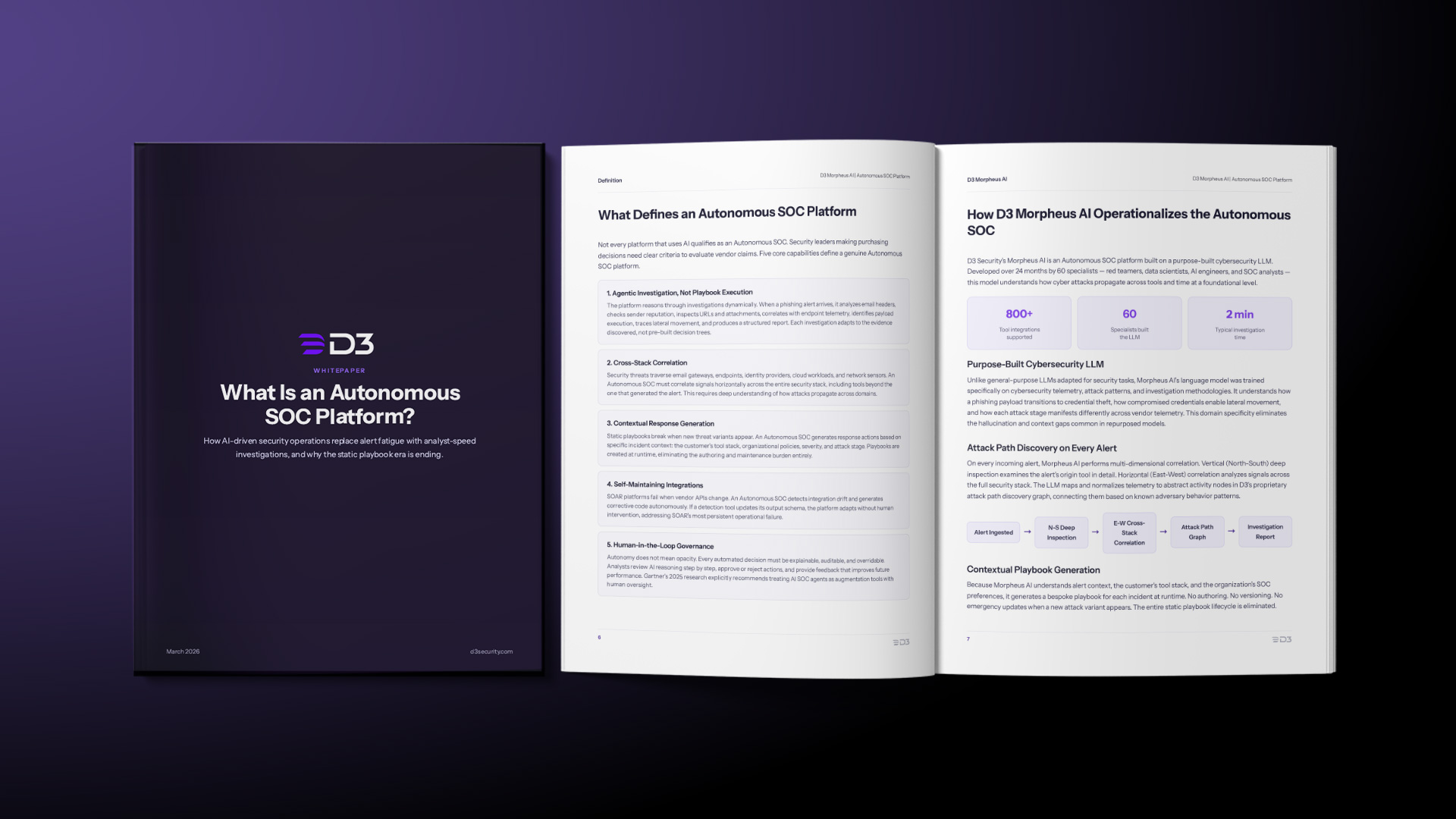
Executive Summary
Security Operations Centers (SOCs) face a structural crisis. The average organization receives thousands of security alerts daily. Nearly half go uninvestigated. False positive rates routinely exceed 50%. Meanwhile, 4.8 million cybersecurity positions remain unfilled globally, and 71% of SOC analysts report burnout.
Traditional Security Orchestration, Automation and Response (SOAR) platforms promised to solve this through playbook automation. They introduced their own complexity instead: brittle integrations, static playbooks that lag behind evolving threats, and engineering overhead most security teams cannot sustain.
An Autonomous SOC platform is the next evolution. It replaces the rigid playbook model with agentic AI that reasons through investigations, correlates signals across the entire security stack, and generates contextual response actions in real time. The goal: remove the manual labor consuming 70%+ of analyst time on repetitive Tier-1 tasks so they can focus on judgment-intensive work that actually reduces organizational risk.
This paper defines what an Autonomous SOC platform is, examines the evidence for why the market is moving in this direction, identifies what differentiates a genuine Autonomous SOC from AI-augmented tooling, and explains how D3 Security’s Morpheus AI operationalizes these capabilities in production today.
Table of Contents
- The SOC Is Broken: Quantifying the Problem
- From SOAR to Autonomous: The Evolution
- What Defines an Autonomous SOC Platform
- How D3 Morpheus AI Operationalizes the Autonomous SOC
- The Competitive Landscape
- Honest Assessment: Limitations and Risks
- Questions for Your Evaluation
- Next Steps
- Sources
The SOC Is Broken: Quantifying the Problem
Alert Volume Overwhelms Human Capacity
The average enterprise SOC ingests alerts from 28+ security tools. Organizations face approximately 4,484 alerts per day. Analysts spend an average of 70 minutes fully investigating a single alert, and 56 minutes pass before anyone acts. Human-scale investigation cannot keep pace with machine-scale alert generation.
False Positives Dominate the Queue
Devo’s 2024 SOC Performance Report found 53% of all alerts are false positives. Academic research published by USENIX documented environments exceeding 99% false positive rates. The consequence: 40% of alerts are never investigated, and 61% of security teams report ignoring alerts that later proved critical.
Analyst Burnout Is an Existential Threat
ISC2’s 2025 Cybersecurity Workforce Study documents 4.8 million unfilled cybersecurity positions globally, with 750,000 in the United States alone. For the first time, budget constraints overtook talent scarcity as the primary driver. Among working analysts, 71% report burnout, one-third are considering leaving the profession, and annual turnover runs 15–25%.
The Economics Are Unsustainable
Tier-1 analysts earn $50,000–$75,000/year. Tier-2 analysts earn $75,000–$110,000. SOC managers command $110,000–$170,000. Personnel costs consume 65–70% of total SOC budgets. Every analyst hour spent on a false positive is a direct cost with zero security return.
From SOAR to Autonomous: The Evolution
Pre-2015
2015–2022
2022–2025
2025–Present
Manual SOC (Pre-2015)
Analysts manually triaged alerts in SIEM consoles, investigated across individual tool dashboards, and documented findings in spreadsheets. Every step required human action. This model worked when alert volumes were low and security stacks were small.
SOAR Platforms (2015–2022)
Security Orchestration, Automation and Response (SOAR) platforms introduced playbook-driven automation. Analysts defined workflows connecting security tools through API integrations. SOAR reduced time-to-response for known categories but created new problems: playbooks required constant maintenance, integrations broke when vendors updated APIs, and engineering overhead often exceeded team capacity. Both Gartner and Forrester retired their dedicated SOAR evaluations by 2025.
AI-Augmented SOC (2022–2025)
LLMs began assisting analysts with alert enrichment, natural-language querying, and recommended response actions. Copilot-style assistants answered questions and summarized incident data. These tools improved productivity but remained reactive. The human still initiated every investigation and made every decision.
Autonomous SOC (2025–Present)
Agentic AI architectures reason through multi-step investigations independently. Instead of static playbooks, AI agents analyze alert context, correlate signals across the full stack, generate investigation hypotheses, execute enrichment, and produce structured findings. Analysts shift from executing investigations to reviewing AI-generated conclusions.
What Defines an Autonomous SOC Platform
Not every platform that uses AI qualifies as an Autonomous SOC. Security leaders making purchasing decisions need clear criteria to evaluate vendor claims. Five core capabilities define a genuine Autonomous SOC platform.
1. Agentic Investigation, Not Playbook Execution
The platform reasons through investigations dynamically. When a phishing alert arrives, it analyzes email headers, checks sender reputation, inspects URLs and attachments, correlates with endpoint telemetry, identifies payload execution, traces lateral movement, and produces a structured report. Each investigation adapts to the evidence discovered, not pre-built decision trees.
2. Cross-Stack Correlation
Security threats traverse email gateways, endpoints, identity providers, cloud workloads, and network sensors. An Autonomous SOC must correlate signals horizontally across the entire security stack, including tools beyond the one that generated the alert. This requires deep understanding of how attacks propagate across domains.
3. Contextual Response Generation
Static playbooks break when new threat variants appear. An Autonomous SOC generates response actions based on specific incident context: the customer’s tool stack, organizational policies, severity, and attack stage. Playbooks are created at runtime, eliminating the authoring and maintenance burden entirely.
4. Self-Maintaining Integrations
SOAR platforms fail when vendor APIs change. An Autonomous SOC detects integration drift and generates corrective code autonomously. If a detection tool updates its output schema, the platform adapts without human intervention, addressing SOAR’s most persistent operational failure.
5. Human-in-the-Loop Governance
Autonomy does not mean opacity. Every automated decision must be explainable, auditable, and overridable. Analysts review AI reasoning step by step, approve or reject actions, and provide feedback that improves future performance. Gartner’s 2025 research explicitly recommends treating AI SOC agents as augmentation tools with human oversight.
How D3 Morpheus AI Operationalizes the Autonomous SOC
D3 Security’s Morpheus AI is an Autonomous SOC platform built on a purpose-built cybersecurity LLM. Developed over 24 months by 60 specialists — red teamers, data scientists, AI engineers, and SOC analysts — this model understands how cyber attacks propagate across tools and time at a foundational level.
Purpose-Built Cybersecurity LLM
Unlike general-purpose LLMs adapted for security tasks, Morpheus AI’s language model was trained specifically on cybersecurity telemetry, attack patterns, and investigation methodologies. It understands how a phishing payload transitions to credential theft, how compromised credentials enable lateral movement, and how each attack stage manifests differently across vendor telemetry. This domain specificity eliminates the hallucination and context gaps common in repurposed models.
Attack Path Discovery on Every Alert
On every incoming alert, Morpheus AI performs multi-dimensional correlation. Vertical (North-South) deep inspection examines the alert’s origin tool in detail. Horizontal (East-West) correlation analyzes signals across the full security stack. The LLM maps and normalizes telemetry to abstract activity nodes in D3’s proprietary attack path discovery graph, connecting them based on known adversary behavior patterns.
Contextual Playbook Generation
Because Morpheus AI understands alert context, the customer’s tool stack, and the organization’s SOC preferences, it generates a bespoke playbook for each incident at runtime. No authoring. No versioning. No emergency updates when a new attack variant appears. The entire static playbook lifecycle is eliminated.
Self-Healing Integrations
When APIs drift, schemas change, or detection outputs shift across 800+ integrations, Morpheus AI detects the change and generates corrective code autonomously. This directly addresses SOAR’s most persistent operational challenge: the silent-failure windows that traditional deployments accept as a cost of doing business.
AI SOP (Standard Operating Procedures)
D3’s AI SOP lets customers build natural-language playbooks combining API call tasks, data processing tasks, and AI agent tasks per their own standard operating procedures. Every analyst interaction (approving or overriding automated actions) produces quality data that continuously improves triage accuracy. The system uses agentic AI with error correction and human-in-the-loop oversight.
Customer-Expandable LLM
Customers expand and customize the LLM for their specific environment, threat landscape, and SOC procedures. The result is a proprietary, customer-specific triage capability that improves over time. The entire customization process is transparent: full visibility into how the model reasons, every step reviewable, editable, and overridable.
AI Copilot
The copilot suggests tasks on the fly based on alert data, user feedback, and completed task results. Unlike general-purpose copilots that only query when asked, Morpheus AI’s copilot is grounded in the purpose-built cybersecurity LLM and understands the full investigation context.
Built-In SOAR Engine
Morpheus AI includes a full SOAR engine alongside autonomous capabilities. Run both models simultaneously: static playbooks where deterministic behavior is required, autonomous triage where AI adds value. Transition on your timeline. No rip-and-replace.
Tool Consolidation
Morpheus AI consolidates autonomous automation, traditional SOAR, and case management in a single platform. Compare TCO against the combined cost of SOAR + case management + AI tooling + integration labor.
Predictable Pricing
Morpheus AI’s architecture does not waste tokens. D3 absorbs token costs and offers flat-rate pricing with no usage-based fees. No surprise bills when alert volumes spike.
The Competitive Landscape
The Autonomous SOC market fragments along two axes: AI-native investigation platforms and evolved workflow automation platforms. Understanding these distinctions helps security leaders match vendor capabilities to operational requirements.
| Capability | D3 Morpheus AI | AI-Native Investigators | Evolved SOAR |
|---|---|---|---|
| Investigation Model | Agentic AI with purpose-built cybersecurity LLM | Pre-trained AI agents mimicking analyst techniques | AI-enhanced playbook automation |
| Playbook Approach | Contextual runtime generation + built-in static SOAR | AI-driven investigation paths | Low-code/no-code static playbooks |
| Integration Maint. | Self-healing: auto-detects and fixes API drift | Vendor-maintained connectors | Manual maintenance required |
| LLM Architecture | Purpose-built cybersecurity LLM, customer-expandable | Pre-trained security models | General-purpose LLM integration |
| Case Management | Integrated natively | Requires external tool | Built-in or integrated |
| Pricing Model | Flat-rate, no token fees | Varies by vendor | Tiered, often usage-based |
| Migration Path | Run static SOAR + autonomous simultaneously | New platform deployment | Incremental AI layer addition |
AI-Native Investigators include vendors such as Dropzone AI. Evolved SOAR includes vendors such as Torq, Swimlane, and Tines. Palo Alto Networks Cortex XSIAM represents a converged XDR/SOAR/AI model not directly comparable to standalone SOAR.
Honest Assessment: Limitations and Risks
Any honest evaluation must address the risks. Organizations that adopt Autonomous SOC platforms without understanding the limitations will face operational problems.
The Myth of Full Autonomy
No Autonomous SOC platform operates without human oversight. “Autonomous” describes the investigation model, not the governance model. Analysts still review findings, approve high-impact response actions, and handle edge cases. Organizations expecting to eliminate their SOC team will be disappointed and exposed.
AI Reliability Risks
LLMs can hallucinate, make incorrect assumptions, and mis-prioritize threats. Purpose-built models reduce but do not eliminate this risk. Robust safeguards, explainable reasoning, and human review checkpoints are non-negotiable requirements for any production deployment.
Skill Erosion
Multiple research firms warn that over-dependence on automation may degrade foundational analysis skills over time. Organizations must invest in analyst development alongside AI adoption to maintain institutional capability.
Integration Complexity
An estimated 30% of SOC leaders expect challenges integrating AI into production security operations by 2027. Self-healing integrations address this risk directly, but organizations should plan for a transition period.
How Morpheus AI Mitigates These Risks
- Explainability: Every investigation produces step-by-step reasoning that analysts can review, edit, and override.
- Human-in-the-loop: AI SOP captures analyst approvals and corrections, creating continuous improvement feedback loops.
- Gradual adoption: Built-in SOAR allows organizations to run static and autonomous models simultaneously, transitioning on their own timeline.
- Customer-expandable LLM: Organizations maintain control over how the model reasons about their specific environment.
- Transparent reasoning: Every step is reviewable. No black-box decisions. Analysts see exactly what the AI concluded and why.
Questions for Your Evaluation
These questions separate genuine Autonomous SOC capability from marketing claims:
- Is the AI model purpose-built for cybersecurity, or is it a general-purpose LLM with a security wrapper?
- Can the platform investigate alerts across your entire security stack, or only within specific tool categories?
- Does the platform generate playbooks contextually at runtime, or require static playbook authoring?
- How does the platform handle integration drift when vendor APIs change?
- Can analysts see, review, and override every step of the AI’s reasoning?
- Does the pricing model include token or usage-based fees that scale unpredictably?
- Can the platform run alongside your existing SOAR investment during transition?
- Does the vendor provide case management natively, or require another tool purchase?
- Can you customize and expand the AI model for your specific environment?
- What evidence does the vendor provide for investigation accuracy and false positive reduction?
Next Steps
The Autonomous SOC is operational today. Organizations relying on manual triage and static playbooks will fall further behind as alert volumes grow, talent gaps widen, and adversaries accelerate.
Audit Your Current SOC Metrics
Measure alert-to-investigation ratio, MTTR, false positive rate, and analyst utilization. These baselines quantify the gap an Autonomous SOC platform must close.
Map Your Integration Requirements
Identify which security tools generate the highest alert volumes and which require cross-stack correlation. This determines which platform capabilities matter most.
Request a Proof-of-Concept
Evaluate Morpheus AI against your actual alert data. The platform’s value is measurable: investigation time, false positive reduction, and analyst hours recovered.
Sources
All claims in this paper are based on publicly available research and D3 Security product documentation. Key sources:
- ISC2, 2025 Cybersecurity Workforce Study
- Devo, 2024 SOC Performance Report
- Gartner, Innovation Insight: AI SOC Agents, October 2025
- Gartner, Top Cybersecurity Trends for 2026, February 2026
- USENIX Security, “99% False Positives: A Qualitative Study of SOC Analysts”
- Help Net Security, “Why SOCs Are Moving Toward Autonomous Security Operations in 2026”
- Security Today, “How Agentic AI Will Shape the Autonomous SOC at Scale”, March 2026
- Forrester, Total Economic Impact of Palo Alto Networks Cortex XSIAM, 2025
- CyberDefenders, “SOC Alert Fatigue: Causes, Impact & AI Solutions”, 2025
- The Hacker News, “How Top CISOs Solve Burnout and Speed Up MTTR”, February 2026
- D3 Security, Morpheus AI Product Documentation, 2026
About D3 Security
D3 Security is a cybersecurity company founded in 2012 and headquartered in Vancouver, Canada. Its flagship product, Morpheus AI, is an Autonomous SOC platform built on a purpose-built cybersecurity LLM combining AI-driven alert triage, contextual playbook generation, self-healing integrations across 800+ tools, a full SOAR engine, and integrated case management in a single platform with predictable, flat-rate pricing.
Contact: Website: d3security.com | Phone: 1-800-608-0081 | Email: [email protected]