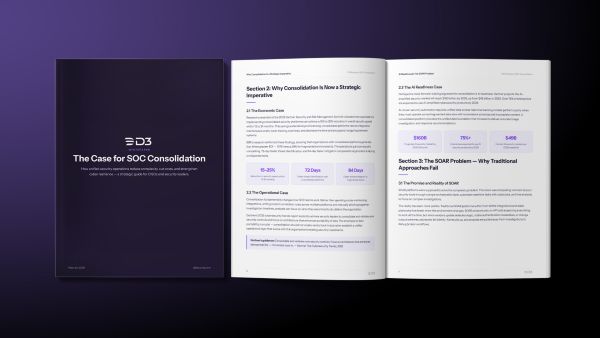
Executive Summary
The average Security Operations Center (SOC) manages 83 tools from nearly 30 vendors. Gartner reports that 75% of organizations now pursue vendor consolidation, up from 29% in 2020. The instinct is correct: sprawl creates blind spots, burns out analysts, and drains budgets.
But most consolidation efforts stop at reducing license counts. They merge dashboards, collapse vendors, and declare victory. That misses the real problem. Tool sprawl is a symptom. The root cause is an architecture built on static playbooks, manual correlation, and integrations that break silently every time a vendor ships an update.
True consolidation means replacing three entire product categories with a single platform: AI triage point products (DropZone, 7AI, Prophet Security), SOAR platforms (Tines, Torq, Palo Alto XSOAR), and standalone case management. Morpheus AI does exactly this, while adding capabilities none of those products offer individually: autonomous attack path discovery, self-healing integrations, and contextual playbooks generated at runtime from live evidence.
Who should read this: CISOs, SOC directors, and security architects evaluating consolidation, especially those running separate SOAR, AI triage, and case management products and paying the integration tax to connect them.
Key argument: Consolidating into another SOAR (or bolting an AI chatbot onto your existing one) doesn’t change the architecture. Morpheus AI replaces the SOAR, the AI triage bolt-on, and the case management system in a single platform with the Cybersecurity Triage Reasoning Graph that investigates at L2 analyst depth on every alert.
Table of Contents
- Tool Sprawl Is the Symptom, Not the Disease
- Three Product Categories. One Platform.
- Why AI Overlays and Bolt-Ons Don’t Solve the Problem
- Three Capabilities That Make Consolidation Actually Work
- Inside Morpheus AI: What You Get When You Consolidate to One Platform
- Production Results
- Questions for Your Evaluation
- Next Steps
Tool Sprawl Is the Symptom, Not the Disease
The average enterprise SOC receives 4,400+ alerts per day; large organizations face 10,000+. Sixty-seven percent go uninvestigated. Sixty-one percent of SOC teams admit to ignoring alerts later confirmed as genuine compromise. Reducing tool count delivers real savings, typically 30–40% on licensing, but doesn’t solve the five structural failures that cause SOC dysfunction:
1. SOAR Architect Dependency
Static playbooks require a specialized SOAR architect ($150K–$250K/year) to build and maintain. When that person leaves, institutional knowledge walks out. Most organizations have one, a single point of failure.
2. Playbook Sprawl
Mature SOAR deployments accumulate hundreds of playbooks, each requiring ongoing updates as tools, APIs, and threats change. Often takes 12–18 months before delivering ROI.
3. Static Logic in a Dynamic Threat Landscape
A phishing playbook runs the same 15–20 steps whether the target is an intern or the CFO. It cannot adjust based on who was targeted or whether lateral movement occurred. Static playbooks achieve only 30–40% coverage at maturity.
4. Silent Integration Failures
With 50+ tools shipping 4–6 updates per vendor per year, enterprises face 200–300 disruptions annually. Alerts stop flowing, enrichment vanishes, and response actions fail, creating the blind spots attackers exploit.
5. The L1 Analyst Gap
Junior analysts execute expert-designed workflows without investigative guidance. The 4.8-million-person workforce gap (19% YoY increase) ensures this problem only deepens.
Three Product Categories. One Platform.
Most SOCs run three separate product categories that should be one system: an AI triage tool, a SOAR platform, and a case management solution. Each requires its own licensing, integrations, and specialist knowledge, and the seams between them create the failures described on the previous page. Morpheus AI replaces all three.
Category 1: AI Alert Triage Products (DropZone, 7AI, Prophet Security)
These products reduce alert noise by classifying individual alerts as benign or malicious. Useful, but they stop at L1 classification. They do not trace attack paths across tools, discover lateral movement, or generate investigation workflows. When they flag an alert as suspicious, a human analyst still does the actual investigation. Morpheus AI performs autonomous investigation at L2 depth on every alert, tracing the full attack path across EDR, SIEM, identity, cloud, and network tools. It doesn’t classify alerts. It investigates them.
Category 2: SOAR Platforms (Tines, Torq, Palo Alto XSOAR)
SOAR platforms automate pre-defined response workflows. They depend on SOAR architects to build and maintain static playbooks, creating the architect dependency, playbook sprawl, and static-logic limitations described above. Adding an LLM chat interface (as several now offer) makes authoring faster but doesn’t change the static model. Morpheus AI generates contextual playbooks at runtime from live evidence. No architect required. No playbook library to maintain.
Category 3: Case Management (Standalone ticketing and investigation tracking)
Separate case management forces analysts to context-switch between investigation and documentation tools, copying evidence, updating tickets, and maintaining audit trails manually. Morpheus AI includes integrated case management: investigations, evidence chains, audit trails, and team collaboration in a single interface. Cases are created automatically from investigations with full context attached.
The consolidation math: A SOC paying separately for SOAR + AI triage + case management carries three license costs, three integration engineering efforts, and three vendor relationships. Morpheus AI delivers all three capabilities, plus self-healing integrations and Attack Path Discovery that none of those categories offer, in a single subscription pricing model.
Why AI Overlays and Bolt-Ons Don’t Solve the Problem
The security industry’s response to SOAR limitations has been to add natural language interfaces or offer AI triage as a separate product. Neither approach addresses the structural failures.
| Capability | AI Triage Products | NLP Overlay on SOAR | Morpheus AI |
|---|---|---|---|
| Alert handling | L1 classification only | Via existing playbooks | Full L2 investigation |
| Attack path discovery | No | No | Cross-stack trace |
| Playbook generation | No | Faster static authoring | Runtime from evidence |
| SOAR architect needed | N/A | Yes | No |
| Integration self-healing | No | No | 15 min detect, 45 min repair |
| Case management | No | Separate product | Built-in, auto-populated |
| Off-hours coverage | Classification only | No investigation | Full L2 depth, 24/7 |
The Multi-Agent Complexity Trap
Some vendors propose multi-agent AI architectures. This introduces its own problems: agent sprawl replaces playbook sprawl, hallucinations cascade through orchestration chains, and teams need engineers who understand prompt engineering, LLM behavior, and cybersecurity simultaneously, an even scarcer skill set than SOAR architects.
The key distinction: AI triage products classify individual alerts. SOAR platforms automate static workflows. Neither traces attack paths, generates contextual playbooks, or heals its own integrations. Morpheus AI does all three, which is why it replaces both categories entirely.
Three Capabilities That Make Consolidation Actually Work
The platform replacing your fragmented stack must solve the structural failures that created the sprawl. That requires three capabilities most consolidation platforms, and all AI triage point products, lack entirely.
1. Attack Path Discovery
Morpheus AI traces attack paths vertically through the origin tool (process trees, payload analysis) and horizontally across your entire stack (EDR, SIEM, identity, cloud, network), building a complete timeline of attacker activity in under two minutes per alert.
2. Contextual Playbook Generation
Morpheus AI generates playbooks at runtime from four layers of context: alert-specific evidence, cross-stack correlation data, environmental context (tool stack, asset criticality, network topology), and SOC preferences (escalation policies, compliance). No SOAR architect. No playbook library. Up to 95% of alerts triaged in under two minutes.
3. Self-Healing Integrations
Morpheus AI monitors all 800+ integrations continuously. When drift occurs (schema changes, API breaks, authentication failures), the platform detects it within 15 minutes, analyzes the change, regenerates the connector autonomously, and validates stability. Under 45 minutes total versus 10 days manual.
| Metric | Manual Maintenance | Self-Healing (Morpheus AI) |
|---|---|---|
| Time to detect drift | Hours to days | Under 15 minutes |
| Time to repair | Avg. 10 days | Under 45 minutes |
| Engineering capacity | 20–40% ongoing | 5–10% oversight |
| Scaling to 100+ tools | Linear cost growth | Constant: no added burden |
Inside Morpheus AI: What You Get When You Consolidate to One Platform
Built on the Cybersecurity Triage Reasoning Graph developed over 24 months by 60 specialists, Morpheus AI eliminates the dependencies that created your fragmented stack.
| What It Replaces | How Morpheus AI Delivers It |
|---|---|
| AI triage products (DropZone, 7AI, Prophet) | Attack Path Discovery: autonomous L2-depth investigation per alert at full L2 depth, not L1 classification. Full cross-stack trace, not single-tool noise filtering. |
| SOAR platforms (Tines, Torq, XSOAR) | Built-in SOAR with static playbook support alongside contextual playbook generation. Teams transition at their own pace. Static and AI-driven automation run simultaneously. |
| Case management | Integrated case management with complete audit trails, evidence chains, and team collaboration. Cases auto-populated from investigations. No context switching. |
| Threat intel platforms | Contextual enrichment during Attack Path Discovery: IOCs, reputation data, and MITRE ATT&CK mapping woven into investigations automatically. |
Integration Resilience
Self-healing integrations across 800+ tools. No dedicated integration engineering team. New tools plug in without re-architecture.
Built-In SOAR: No Forced Migration
Existing playbooks continue to run while teams expand AI-driven automation. The platform tracks the ratio of deterministic (rule-based) to LLM-driven decisions, so leadership sees exactly how much is automated, how much is AI-assisted, and how much remains manual.
Customer-Expandable LLM
Unlike platforms dependent on third-party LLM APIs, Morpheus AI’s Cybersecurity Triage Reasoning Graph is customer-expandable. Organizations train the model on their environment, threat landscape, and SOC procedures, building a proprietary investigation capability that improves continuously. Data never leaves the customer’s control.
Production Results
These metrics come from production Morpheus AI deployments, not lab benchmarks.
What 99.86% Alert Reduction Actually Means
Morpheus AI autonomously investigates every alert at L2 depth, closes the definitively benign ones, and surfaces only those requiring human judgment. This is fundamentally different from AI triage products (DropZone, 7AI, Prophet) that classify alerts: Morpheus AI has already traced the attack path, correlated across tools, and generated a response playbook before the analyst opens the case.
The Cost Comparison
AI-triaged alerts cost a fraction of human analyst triage. A SOC handling 144,000 monthly alerts sees substantial savings when autonomous triage handles the volume. No AI triage point product matches this because none eliminates downstream investigation work. They still require an analyst to investigate every flagged alert.
Analyst Impact
71% of SOC analysts report burnout; 64% consider leaving within a year. The driver is repetitive manual correlation across fragmented tools. Morpheus AI eliminates that work. Analysts become strategic operators: reviewing completed investigations, conducting threat hunts, and engineering new detections.
Quality validation: Morpheus AI proves quality through visible attack paths, simulated ground truth testing, and outcome metrics. Every investigation exposes its full reasoning chain. If the AI is wrong, it’s visibly wrong, and the system learns through its deterministic/LLM hardening lifecycle.
Questions for Your Evaluation
These questions expose the structural capabilities (or limitations) of any platform under consideration.
Are you paying for separate SOAR, AI triage, and case management?
Calculate the combined TCO: licensing, integration engineering, maintenance, and staffing across all three. A unified platform should deliver all three at lower total cost with zero integration risk between them.
Does the platform discover attack paths, or just classify individual alerts?
AI triage products (DropZone, 7AI, Prophet) classify alerts. Attack Path Discovery traces the full chain across tools and time. This distinction determines whether consolidation improves efficiency or upgrades your security posture.
How many SOAR architects do you employ, and what happens if one leaves?
If the answer is “significant disruption,” your SOAR platform (Tines, Torq, XSOAR) hasn’t solved the architect dependency. It’s just the vendor hosting it.
How long does it take to discover and repair an integration failure?
If measured in days, every vendor update creates a visibility gap. No SOAR platform or AI triage product monitors its own integrations. Morpheus AI detects and repairs drift autonomously.
Can the platform investigate autonomously at L2 depth during off-hours?
Most attacks don’t wait for business hours. AI triage products only classify; SOAR platforms only execute pre-built workflows. Morpheus AI investigates at full depth 24/7.
Can your current platform transition to autonomous investigation?
If you select a SOAR-only or triage-only product now, can it evolve? Morpheus AI includes built-in SOAR: static and AI-driven automation run simultaneously on your timeline.
Next Steps
Request a Demonstration
See Attack Path Discovery, Contextual Playbook Generation, and Self-Healing Integrations on live security data. Understand how Morpheus AI replaces your existing SOAR, AI triage, and case management in a single platform.
Run a Proof-of-Value (POV)
Deploy Morpheus AI alongside your current stack. Measure alert reduction, triage time, investigation depth, and integration stability against your existing workflow, within two weeks.
TCO Analysis
Map your current SOAR + AI triage + case management costs against Morpheus AI. Include integration engineering, SOAR architect staffing, and analyst time on manual correlation.
Migration Planning
Morpheus AI includes built-in SOAR for parallel operation. Existing playbooks continue running while AI-driven automation expands. No hard cutover. Transition at your pace.