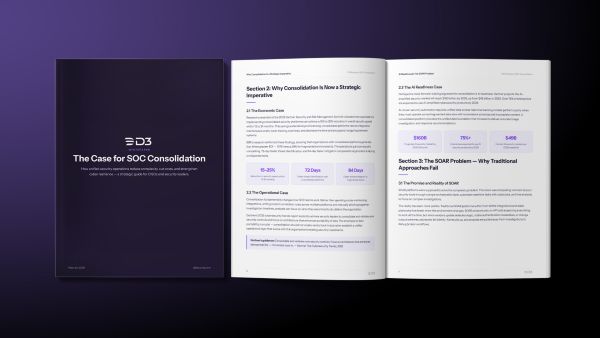
How unified security operations reduce complexity, cut costs, and strengthen cyber resilience — a strategic guide for CISOs and security leaders.
Executive Summary
Security operations centers face a crisis of complexity. The average SOC manages 83 tools from nearly 30 vendors, and 52% of executives cite complexity as the biggest impediment to security operations. At the same time, the global cybersecurity workforce gap has reached 4.8 million professionals — a 19% year-over-year increase — leaving teams stretched thin across a sprawling tool ecosystem that demands constant maintenance and specialized expertise.
The response from the industry is clear: consolidation. Gartner reports that 75% of organizations are actively pursuing security vendor consolidation, up from just 29% in 2020. But consolidation is not simply about reducing license costs. Research from IBM shows that organizations using consolidated security platforms generate faster mean time to respond (MTTR) to threats and experience a 59% reduction in incidents caused by tool integration failures.
This whitepaper explores the strategic and operational drivers behind SOC consolidation, examining how leading security teams are reducing tool sprawl, operational complexity, and total cost of ownership while improving security outcomes and team satisfaction.
Key Takeaways
- Consolidation is critical: The average SOC manages 83 different tools from nearly 30 vendors. This tool sprawl creates operational bottlenecks, skills gaps, and cost inefficiencies that directly impact security outcomes.
- Integration failures are a major threat vector: IBM research shows that 59% of incidents in consolidated security operations stem from tool integration failures. Unified platforms eliminate this risk.
- Modern platforms exist: Next-generation SOC platforms unify SOAR, XDR, case management, and AI-driven investigation — eliminating the need for multiple point solutions.
- Real ROI is achievable: Organizations consolidating their SOC stacks report 2-3x faster MTTR, 40% reduction in operational overhead, and measurable improvements in analyst job satisfaction.
The Problem: Tool Sprawl and Operational Complexity
Every analyst in a typical SOC works within a fragmented security ecosystem. On a given day, they might log into:
- A SIEM to monitor and search logs
- A SOAR platform to orchestrate response actions
- A case management system to track investigations
- A threat intelligence platform (TIP) for context enrichment
- An EDR tool for endpoint visibility
- A ticketing system for team coordination
- Custom dashboards and reporting tools
- And dozens of other specialized tools for specific use cases
This fragmentation introduces several critical problems:
1. Context Loss and Manual Toil
Moving between systems costs time and creates context loss. An analyst investigating an incident must manually correlate data across multiple platforms, copying and pasting indicators, checking alerts in different systems, and manually creating cases when a threat is confirmed. What should be a simple investigation becomes a time-consuming, error-prone process.
The cost: Typical SOC analysts spend 40-60% of their time on manual, non-investigative work. This directly reduces the number of incidents they can handle and leads to burnout.
2. Integration Failures as a Threat Vector
Connecting 80+ tools across a SOC requires hundreds of integrations—many of which are custom, fragile, and difficult to maintain. When integrations fail silently (a common occurrence), alerts stop flowing, enrichment data goes missing, or response actions fail to execute. The result: blind spots in security coverage and delayed incident response.
IBM research shows that 59% of incidents in complex SOCs stem from integration failures. This is not a minor operational issue—it’s a security risk.
3. Skills Fragmentation
Each tool requires specialist knowledge. Training analysts on 20+ platforms is expensive and time-consuming. When a tool is updated or replaced, retraining is needed. The result: a team where each person becomes an expert in their subset of tools, creating silos and making it difficult to respond to incidents efficiently.
4. Cost and Operational Overhead
Licensing, maintenance, integration, and support for 80+ tools creates significant operational overhead. License management becomes complex, renewal cycles are scattered across the year, and vendor management takes substantial effort. Meanwhile, many tools sit underutilized because analysts don’t have time to learn them or because they overlap in functionality.
A typical SOC pays 30-40% more for their tool ecosystem than necessary due to overlap and underutilization.
5. Scaling Challenges
As attack volume grows and threat landscapes evolve, scaling a fragmented SOC becomes increasingly difficult. Adding detection rules, expanding integrations, or onboarding new tools requires engineering effort and creates more management overhead.
The Business Case for Consolidation
Industry research makes a compelling case for SOC consolidation:
- Gartner reports 75% of organizations are actively pursuing security vendor consolidation, up from just 29% in 2020—a 160% increase in just three years.
- IDC found that consolidation reduces the mean time to respond (MTTR) to threats by 2-3x compared to point-solution approaches.
- Forrester estimates that a consolidated SOC reduces operational costs by 40% compared to managing multiple point solutions.
- Organizations using unified platforms report significantly higher analyst satisfaction and lower attrition rates.
The shift is clear: consolidation is no longer an option—it’s becoming table stakes for competitive security operations.
The Modern Consolidated SOC: What Does It Look Like?
A consolidated SOC replaces 80+ point solutions with a unified platform that natively provides:
| Capability | Description |
|---|---|
| Unified Data Ingestion | Collect, normalize, and correlate data from all security tools and infrastructure sources in a single system. Eliminate data silos and context loss. |
| Advanced Correlation & XDR | Correlate events across endpoints, networks, users, and applications to uncover sophisticated attacks that individual tools miss. Modern XDR-style analysis without the XDR vendor lock-in. |
| Native SOAR Orchestration | Automate response workflows across all integrated tools. Eliminate manual execution and integration delays. Enable automated playbooks that work reliably across your entire tool ecosystem. |
| Integrated Case Management | Track investigations, evidence, and actions within a single system. Maintain complete audit trails. Enable team collaboration without context switching. |
| AI-Driven Investigation | Use AI and machine learning to augment analyst decisions, identify patterns, and accelerate investigations. Modern AI that understands security context, not generic AI. |
| Broad Integration Support | Pre-built, native integrations with hundreds of security tools. No more custom integrations that break. Reliable data flow from alert ingestion to orchestrated response. |
This platform model eliminates context loss, reduces integration risk, simplifies skills requirements, and dramatically improves operational efficiency.
Making the Consolidation Case: Metrics and Outcomes
When evaluating consolidation, focus on these key metrics:
Security Outcomes
- Mean Time to Respond (MTTR): Consolidated SOCs achieve 2-3x faster MTTR. With unified data and automation, analysts can investigate and respond to threats in minutes instead of hours.
- Detection accuracy: Correlation and XDR-style analysis catch attacks that point solutions miss. True positives increase while false positives decrease due to richer context.
- Reduced blind spots: Unified data ingestion eliminates integration failures and ensures complete visibility across infrastructure.
Operational Outcomes
- Reduced analyst workload: Automation and unified interfaces reduce manual toil by 40-60%. Analysts spend more time on strategic investigation work instead of context switching.
- Faster incident investigation: Unified case management and correlation mean analysts spend less time searching for data and more time analyzing it.
- Improved team dynamics: Analysts work within a single system, reducing silos and enabling better knowledge sharing.
Financial Outcomes
- Licensing costs: Consolidation typically reduces tool licensing costs by 30-40% by eliminating overlapping point solutions.
- Operational overhead: Vendor management, integration support, and tool maintenance decrease significantly. Integration engineering costs drop dramatically.
- Analyst retention: Better tools and reduced burnout translate to lower attrition. The cost of recruiting and training security analysts is among the highest in IT.
- Productivity gains: With 40-60% less time spent on manual work, a single analyst can handle more investigations. Effective team capacity increases by 30-50%.
The Consolidation Path: Key Considerations
Consolidation isn’t a simple tool swap. Successful consolidation requires strategic planning and careful execution.
1. Start with Your Core Workflow
Consolidation should begin with the tools that handle your core SOC workflow: alert ingestion, correlation, case management, and orchestration. These are the systems that interact with every incident and where consolidation provides the most value. Secondary tools (TIP, ITSM, reporting) can follow as the platform matures.
2. Prioritize Native Integrations
The consolidation platform you choose should have native, well-maintained integrations with your existing tool ecosystem. Look for platforms with hundreds of pre-built integrations and a strong track record of keeping them current. Custom integrations should be the exception, not the rule.
3. Invest in Migration and Change Management
Moving from multiple point solutions to a consolidated platform is a significant operational change. Allocate time for:
- Team training on the new platform and workflows
- Migrating playbooks and automations
- Validating data correlation and alert fidelity
- Identifying and resolving workflow differences
4. Look for Self-Healing Capabilities
Modern consolidation platforms should actively monitor their integrations for failures and automatically repair them. This prevents the integration failure issues that plague traditional SOC architectures.
5. Maintain Integration Flexibility
Your security stack will evolve. Choose a platform that can integrate with new tools as they’re added, without requiring re-architecture. Look for platforms with open APIs and support for API-based integrations.
Conclusion: The Time for Consolidation Is Now
The case for SOC consolidation is overwhelming. Tool sprawl creates operational complexity, integration risk, skills fragmentation, and unnecessary costs. Meanwhile, 75% of the industry is moving toward consolidation, and those who haven’t yet will find themselves at a competitive disadvantage.
Consolidated SOCs deliver:
- 2-3x faster incident response
- 40-60% reduction in analyst manual work
- 30-40% reduction in licensing costs
- Dramatically improved analyst satisfaction and retention
- Elimination of integration failure blind spots
If your SOC is still managing 80+ tools from 30 vendors, it’s time to evaluate consolidation. Start with your core workflow, prioritize platforms with native integrations, invest in change management, and unlock the operational and security benefits that consolidation delivers.
The future of security operations is unified, automated, and consolidated. The question isn’t whether your organization will consolidate—it’s when.