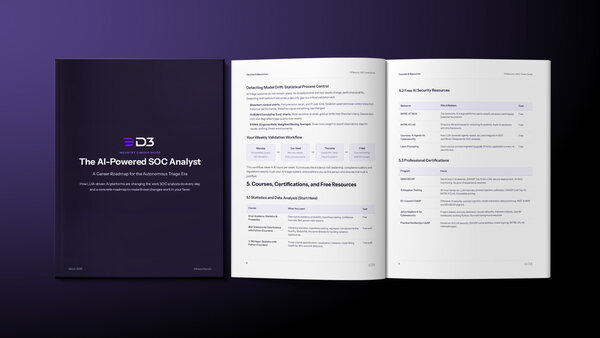
Executive Summary
If you work in a Security Operations Center (SOC), you’ve heard the rumors. AI is coming for your job. LLM-powered platforms can triage alerts faster than you can open a ticket. Autonomous Security Orchestration, Automation and Response (SOAR) tools are handling investigations that used to be your bread and butter.
We understand the anxiety. It’s rational. But the data tells a different story than the headlines.
Organizations are not planning mass analyst layoffs. They cannot fill the seats they already have. What AI platforms change is which tasks you spend your time on. The repetitive, burnout-inducing work (manually triaging thousands of alerts per day, rubber-stamping false positives) is being absorbed by machines. The work that remains is more complex, more strategically valuable, and better compensated.
There is also a harder truth. The economics are driving this transition as much as the technology. When an AI platform can triage an alert for roughly $0.27 and a human analyst costs over $2.50 per alert at industry-standard depth, executives will automate that work. This is already happening.
This paper is a practical career guide. D3 Security’s team of 60 professionals (data scientists, red teamers, SOC analysts, AI engineers, and software developers) spent 24 months building an AI-autonomous triage product called Morpheus AI. We have seen, from the inside, exactly how this technology works and where it is headed. We wrote this guide because we want to help you prepare for what is coming.
Table of Contents
- What Is Actually Happening to SOC Work
- The Numbers Behind the Transition
- How Your Daily Work Will Change
- Your Skills Roadmap
- Courses, Certifications, and Free Resources
- Emerging Roles You Can Grow Into
- The Mindset Shift
- Next Steps
1. What Is Actually Happening to SOC Work
1.1 The Work That Is Being Automated
Purpose-built cybersecurity LLMs, trained on MITRE ATT&CK techniques, incident response data, and real-world attack patterns, perform the following at machine speed:
- Alert ingestion and normalization. Parsing alerts from dozens of tools with different taxonomies into a unified analytical framework.
- Enrichment and correlation. Cross-referencing each alert against threat intelligence, asset criticality, user behavior baselines, and recent alert history, simultaneously, in seconds.
- Triage decisions. Classifying alerts as true positive, false positive, or requiring escalation, with a full reasoning chain. These platforms close 90–95% of Tier-1 alerts autonomously.
- Dynamic playbook generation. The most advanced platforms generate contextual, situation-specific response workflows at runtime, replacing static, pre-built playbooks.
- Investigation summaries. Human-readable timelines and reports that analysts review and approve, rather than build from scratch.
As documented in D3 Security’s “Who Watches the AI?” whitepaper, a deployed MSSP customer reported a 99.86% alert reduction, from 144,000 monthly alerts requiring human attention to just 200, with 95% of alerts triaged in under 2 minutes.
1.2 The Economics Executives Are Looking At
D3 Security’s analysis in “6 Minutes and a Prayer” (February 2026) lays out the math bluntly: properly triaging 2,000 daily alerts at the 20-minute industry standard requires roughly 152 analyst FTEs. Most SOCs operate at one-third of that headcount, leaving each analyst just 6.7 minutes per alert, barely enough for a cursory glance. An estimated 75–83% of daily alerts are rubber-stamped or ignored entirely.
At that industry-standard depth, a fully burdened analyst costs over $2.50 per alert. An AI triage platform processes the same alert in 30–90 seconds with deeper contextual analysis, at approximately $0.27 per alert. That is a 10x cost differential on routine triage work.
This is about economic gravity. Executives will redirect the $2.50-per-alert spend toward human judgment, oversight, threat hunting, and strategic analysis where machines fall short. That is the work you need to own.
1.3 The Work That Is Not Being Automated
- Threat hunting. Proactive, hypothesis-driven investigation requires creative reasoning LLMs cannot initiate. 64% of security professionals identify this as where AI-freed time delivers the greatest value (SANS 2025).
- Detection engineering. Writing SIGMA rules, YARA rules, and custom detection queries requires deep understanding of your specific environment and adversaries.
- AI triage validation and statistical auditing. Every autonomous triage system needs rigorous human oversight. Auditing AI decisions using statistical methods is an entirely new competency.
- Playbook review and optimization. When AI platforms generate contextual playbooks dynamically, humans audit the response logic, validate edge cases, and refine generation parameters.
- Stakeholder communication. Translating technical findings into business risk language for executives remains a high-value human skill.
- Incident command. Complex incidents involving legal, privacy, or regulatory considerations require human judgment.
- Security architecture. Structuring your detection stack and designing defensive coverage requires strategic thinking tied to your business context.
AI is absorbing the $0.27-per-alert work that burns you out. The work that builds your career stays with you. The gap between those two categories is where your future lives.
2. The Numbers Behind the Transition
The biggest threat to your SOC career is the manual triage grind driving you out of the profession before you reach the seniority where the work gets interesting. AI platforms that absorb the triage burden are the thing most likely to keep you in this career long enough to advance.
3. How Your Daily Work Will Change
| Activity | Before AI Triage | After AI Triage |
|---|---|---|
| First hour | Clear overnight backlog. Close obvious false positives. | Review AI triage summary. Validate flagged edge cases. Check statistical dashboard for drift. Begin threat hunt. |
| Alert triage | Manually review 60–80 alerts/shift. 6–7 min each. Skip context. | Review the 5–10% AI escalated for human judgment. Full context provided. |
| Investigation | Correlate data manually across 5–8 tools. Build timeline from scratch. | AI provides correlated timeline and evidence package. You validate, add judgment, make the call. |
| Playbook review | Run the same static playbooks repeatedly. | Review AI-generated contextual playbooks. Audit response logic for edge cases. |
| Detection tuning | Rarely. No time. Maybe suppress noisy rules. | Analyze AI false positive patterns. Write detection rules. Close coverage gaps. |
| AI validation | Not applicable. | Review weekly confusion matrix. Track precision, recall, F1 by alert category. |
| Threat hunting | Ad hoc, when time permits. Usually never. | Structured, daily activity using AI correlation data. |
| End of shift | Still behind. Hand off a full queue. | Queue clear. Hand off hunt findings, detection improvements, AI validation notes. |
If a 10-person SOC team reclaims three hours per analyst per day, that’s roughly 7,800 hours per year available for threat hunting, detection engineering, AI validation, and security architecture work.
For SOC managers: your metrics evolve from ticket throughput to threat hunt findings, detection coverage improvements, AI decision accuracy rates (precision, recall, F1 by category), and mean dwell time reduction. The analysts who can build validation dashboards become your most valuable team members.
4. Your Skills Roadmap
You do not need a data science degree. You need to understand how LLM-driven security tools think so you can direct them effectively, validate their outputs statistically, and build capabilities on top of them.
Foundation (Months 1–3)
Learn your AI platform deeply. Understand LLM fundamentals: tokenization, context windows, hallucination, confidence scoring. Master prompt engineering for security. Study MITRE ATT&CK and ATLAS. Start learning basic statistics: confusion matrices, precision, recall, F1 scores, hypothesis testing.
Applied Skills (Months 4–9)
Review and audit AI-generated playbooks. Build an AI triage validation framework (see Section 4.1). Write detection content (SIGMA, YARA). Conduct AI-augmented threat hunting. Learn Python scripting for API interaction, data parsing, and statistical visualization with Pandas, NumPy, and Matplotlib.
Specialization & Leadership (Months 10–18)
Choose a specialization (AI SOC architect, triage quality analyst, threat hunt lead, governance specialist). Train others. Contribute to the community. Stack credentials by combining security certs (GCIA, GCIH, CISSP) with AI-security certifications and statistics.
4.1 Building Your AI Triage Validation Framework
When an AI platform triages thousands of alerts per day, someone needs to answer: Is it getting those decisions right? That someone should be you. D3 Security’s companion whitepaper “Who Watches the AI?” (March 2026) provides the complete statistical test plan, including sampling calculations, hypothesis tests, acceptance gate criteria, and a built-in validation dashboard design. What follows here is the practical foundation every analyst needs to get started.
The Confusion Matrix
Every AI triage decision falls into four categories:
True Positive (TP)
AI classified alert as malicious; it was genuinely malicious. Correct.
True Negative (TN)
AI classified alert as benign; it was genuinely benign. Correct.
False Positive (FP)
AI classified alert as malicious; it was actually benign. Wastes analyst time.
False Negative (FN)
AI classified alert as benign; it was actually malicious. The dangerous one.
The Metrics That Matter for SOC AI Validation
Precision (Positive Predictive Value)
Of all alerts the AI flagged as malicious, what percentage were actually malicious? TP / (TP + FP). High precision = fewer wasted analyst escalations.
Recall (Sensitivity / True Positive Rate)
Of all genuinely malicious alerts, what percentage did the AI catch? TP / (TP + FN). Low recall = real threats slipping through. The most dangerous SOC failure mode.
F1 Score
Harmonic mean of precision and recall: 2 × (P × R) / (P + R). An F1 of 0.95+ indicates reliable AI triage. Track weekly by alert category.
The analyst who can walk into a meeting, put a confusion matrix on the screen, and say “Our AI triage has precision of 0.97 and recall of 0.93 for ransomware alerts, but recall drops to 0.81 for credential-based attacks. Here’s my plan to address it” is the analyst who gets promoted. That is the language of data-driven security leadership.
Detecting Model Drift: Statistical Process Control
AI triage systems do not remain static. As threats evolve and tool stacks change, performance drifts. Detecting drift before it becomes a security gap is a critical validation skill.
- Shewhart control charts. Plot precision, recall, and F1 over time. Establish upper and lower control limits from historical performance. Breaches signal something has changed.
- CUSUM (Cumulative Sum) charts. More sensitive to small, gradual shifts than Shewhart charts. Detects slow drift that degrades triage quality over weeks.
- EWMA (Exponentially Weighted Moving Average). Gives more weight to recent observations. Ideal for rapidly shifting threat environments.
Your Weekly Validation Workflow
This workflow takes 4–6 hours per week. It produces the evidence trail leadership, compliance auditors, and regulators need to trust your AI triage system, and positions you as the person who ensures that trust is justified.
5. Courses, Certifications, and Free Resources
5.1 Statistics and Data Analysis (Start Here)
| Course | What You Learn | Cost |
|---|---|---|
| Khan Academy: Statistics & Probability | Descriptive statistics, probability, hypothesis testing, confidence intervals. Self-paced video lessons. | Free |
| IBM: Statistics for Data Science with Python (Coursera) | Inferential statistics, hypothesis testing, regression. Introduces Pandas, NumPy, Matplotlib, the same libraries for building validation dashboards. | Free audit |
| U. Michigan: Statistics with Python (Coursera) | Three-course specialization: visualization, inference, model fitting. Depth for SPC and drift detection. | Free audit |
5.2 Free AI Security Resources
| Resource | Why It Matters | Cost |
|---|---|---|
| MITRE ATT&CK | The taxonomy AI triage platforms use to classify adversary techniques. Essential foundation. | Free |
| MITRE ATLAS | 15 tactics, 66 techniques for attacking AI systems. Audit AI decisions with this framework. | Free |
| Coursera: AI Agents for Cybersecurity | How LLM-powered agents reason, act, and integrate in SOC workflows. Designed for SOC analysts. | Free |
| Learn Prompting | Open-source prompt engineering guide. Directly applicable to every AI security tool. | Free |
5.3 Professional Certifications
| Program | Focus |
|---|---|
| SANS SEC411 | GenAI and LLM defense. OWASP Top 10 for LLMs, secure deployment, AI+SOC monitoring. No prior AI experience required. |
| Antisyphon Training | 16-hour hands-on: LLM internals, prompt injection, jailbreaks, OWASP LLM Top 10, MITRE ATLAS. Accessible pricing. |
| EC-Council COASP | Offensive AI security: prompt injection, model extraction, data poisoning. NIST AI RMF and ISO 42001 aligned. |
| Johns Hopkins AI for Cybersecurity | Project-based: anomaly detection, neural networks, malware analysis. Jupyter notebooks, working Python. No math background required. |
| Practical DevSecOps CAISP | Hands-on AI/LLM security: OWASP vulnerabilities, model signing, MITRE ATLAS methodologies. |
6. Emerging Roles You Can Grow Into
These roles did not exist three years ago. They combine security expertise with AI fluency and statistical rigor. The supply of qualified candidates is close to zero.
| Role | What You Do | How You Get There |
|---|---|---|
| AI Triage Quality Analyst | Audit AI triage decisions using statistical methods. Build confusion matrices. Track precision/recall/F1 by category. Detect drift with SPC charts. | Start with statistics courses. Build a validation framework. Track AI decisions weekly. |
| AI SOC Engineer | Design, deploy, and optimize AI-driven detection and response pipelines across your security stack. | Build playbook audit experience. Learn API integration. Get hands-on with platform tuning. |
| Detection Content Developer | Author, test, and maintain detection rules (SIGMA, YARA, KQL) informed by AI-generated data and validation metrics. | Start writing detection rules now. Use AI insights to identify coverage gaps. |
| Threat Hunt Lead (AI-Augmented) | Lead proactive hunting using AI correlation data to form hypotheses. Validate with human investigation. | Volunteer for hunting activities. Build a methodology. Document findings. |
| AI Governance Specialist | Define policies for AI-assisted security decisions. Set escalation thresholds and statistical acceptance criteria. | Natural path for SOC managers. Combine operational experience with AI and compliance knowledge. |
| SOC AI Program Manager | Oversee AI SOAR deployment. Measure ROI using validation metrics. Align AI capabilities with business risk. | Build metrics-driven management experience. Translate AI data into executive risk language. |
7. The Mindset Shift
| What You Might Be Thinking | What the Evidence Shows |
|---|---|
| “AI will take my job.” | AI will take the $0.27-per-alert work driving 70% of your peers out within three years. What remains pays more. |
| “I’m being replaced by a machine.” | You’re being promoted from processing alerts to directing and validating the machine. Oversight is a higher-level function. |
| “I don’t understand AI or statistics.” | Analysts learning now are building a 12–18 month head start. Khan Academy and Coursera are free. The window to be early is closing. |
| “Management just wants fewer people.” | ISC2 data shows organizations can’t fill the seats they have. They need each analyst more effective, not fewer analysts. |
The analysts who will be displaced are the ones who refused to grow beyond the tasks that were automated.
8. Next Steps
If You Are a SOC Analyst
- Start this week: enroll in Khan Academy Statistics and Coursera AI Agents for Cybersecurity. Both free, both immediately relevant.
- Visit atlas.mitre.org. Spend two hours learning how AI systems can be attacked.
- Request access to your organization’s AI triage platform training environment.
- Pick one certification from Section 5. Complete it within 90 days.
- Build your first validation framework: sample 50 AI triage decisions, classify them manually, build a confusion matrix, calculate precision and recall. One exercise. More useful than any whitepaper.
If You Are a SOC Manager
- Identify two analysts with aptitude for AI-augmented work. Invest in their training, including statistics.
- Establish new KPIs: threat hunt findings, detection coverage, AI accuracy (precision, recall, F1), mean dwell time.
- Build a skills development budget case. Frame it as retention strategy. Use the burnout attrition data.
- Draft your AI governance framework: autonomous decision boundaries, escalation protocols, statistical acceptance criteria.
- Present the business case: $0.27 vs. $2.50+ per alert, hours recovered, coverage improvements, retention benefits.
About D3 Security
D3 Security builds AI-driven security operations platforms used by enterprise, government, and managed security service providers globally. Our AI-autonomous triage product, Morpheus AI, was built over 24 months by a team of 60 professionals (data scientists, red teamers, SOC analysts, AI engineers, and software developers). That team gave us a front-row seat to exactly how LLM-driven triage works, where it excels, where it falls short, and what skills security professionals need to thrive alongside it.
We wrote this guide because we believe the SOC analyst community deserves honest, practical career guidance from people who understand the technology deeply enough to separate reality from hype. Your SOC career is evolving. The tedious parts are falling away. What comes next depends on what you decide to learn right now.
References & Further Reading
D3 Security. “6 Minutes and a Prayer: The Math That Proves Your SOC Is Gambling with Every Alert It Cannot Properly Triage.” D3 Security Whitepaper, February 2026.
D3 Security. “Who Watches the AI? A Statistical Framework for Proving Your SOC Triage Actually Works.” D3 Security Whitepaper, March 2026.
ISC2. 2025 Cybersecurity Workforce Study. December 2025.
SANS Institute. 2025 SOC Survey. 2025.
IBM Security. Cost of a Data Breach Report. 2025.
Ghosal, S. et al. Out-of-Distribution Detection and Data Drift Monitoring using SPC. arXiv:2402.08088, 2024.
World Economic Forum. Future of Jobs Report 2025.
This guide is provided for career development purposes. D3 Security is a vendor of AI-driven security operations platforms. Courses and certifications listed are independent, third-party programs not affiliated with D3 Security.