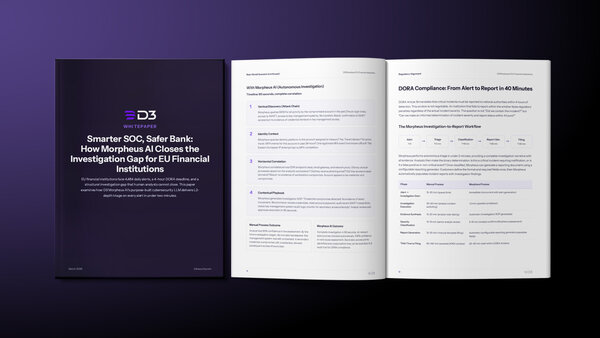
Executive Summary
The European Union’s financial sector operates under unprecedented regulatory pressure. DORA mandates four-hour incident reporting windows. NIS2 expands critical infrastructure definitions to include banks, investment firms, and exchanges. ECB/TIBER-EU exercises stress-test security operations annually. Simultaneously, daily alert volumes have exceeded 4,484 per institution on average (Devo, 2024), while the global analyst shortage reaches 4.8 million unfilled positions (ISC2, 2025).
This structural mismatch—massive alert volumes against finite human resources—creates an investigation gap. Traditional SOCs assign junior analysts to triage alerts, but junior analysts lack the forensic depth required to determine true positive signals from noise. The result: attackers gain 4–6 hours of operational freedom while alerts sit in queues (Trend Micro, 2025).
D3 Security’s Morpheus AI is a purpose-built cybersecurity LLM trained over 24 months by 60 domain specialists. It performs Attack Path Discovery, Contextual Playbook Generation, and Self-Healing Integrations maintenance across an integrated SOAR engine. The result: every alert receives L2-analyst-depth investigation in under two minutes, with full transparency, human override capability, and no token-based pricing surprises.
This whitepaper examines the regulatory, operational, and architectural reasons traditional SOCs fail in EU financial services, the technical approach Morpheus AI takes to close the investigation gap, and an honest assessment of what this technology delivers and where it falls short.
Table of Contents
- The EU Financial Services Security Reality
- The Regulatory Convergence
- Why Traditional SOC Architectures Fail in Financial Services
- The Autonomous SOC for Financial Services
- How Morpheus AI Works: The Purpose-Built Cybersecurity LLM
- Morpheus AI Capabilities for Financial Services
- Morpheus AI in Action: A SWIFT Transaction Fraud Scenario
- DORA Compliance: From Alert to Report in 40 Minutes
- Honest Assessment: Limitations and Risks
- Questions for Your Evaluation
- Next Steps
The EU Financial Services Security Reality
1. Alert Volumes Exceed Human Capacity
The average EU financial institution receives 4,484 alerts per day across their security stack. At a typical incident response SLA of 15–20 minutes per alert, junior analysts would require 1,100–1,500 hours of labor daily just to touch each alert. No institution has this capacity. Instead, alerts age in SIEM queues, and attackers operate undetected in the space between detection and response. SANS Institute (2025) found that financial institutions average 4–6 hours of dwell time before incident investigation even begins.
2. Regulatory Compression
DORA Article 19 requires incident reporting within 4 hours of detection. NIS2 extends similar timelines across EU critical sectors. TIBER-EU annual red team exercises now include explicit ransomware and lateral movement scenarios. The margin for error has disappeared. An institution with a typical alert-to-triage time of 45 minutes plus investigation has already consumed 75% of its DORA window before any action is taken. As the ECB notes in its 2024 guidance, “speed of detection and investigation directly determines regulatory compliance posture.”
3. Analyst Burnout and Role Fragmentation
The global analyst shortage stands at 4.8 million unfilled positions, with EU financial services experiencing some of the highest burn rates in the sector (ISC2, 2025). Junior analysts, who handle alert triage, report average tenure of 14 months before departing for other industries. This rotation creates perpetual onboarding costs and institutional knowledge loss. Simultaneously, senior analysts spend 60% of their time on routine triage instead of strategic threat hunting or forensic depth (Trend Micro, 2025).
The Regulatory Convergence
4. Fragmented Tool Integration
The typical EU bank operates 40–60 security tools: SIEM, EDR, email gateway, web proxy, identity platform, vulnerability scanner, SOAR, case management, and dozens more. Manual alert correlation across these systems is impractical. SIEM rules can detect a lateral movement pattern, but confirming whether an account logged into an unusual location is legitimate business travel or credential compromise requires context from identity platform, user risk scoring, geolocation data, and device trust signals. Most institutions rely on analyst intuition and historical memory.
EU financial regulation has shifted from periodic compliance audits to continuous operational monitoring. Four frameworks now intersect at the SOC level:
| Framework | Key Requirement | Timeline | Impact on SOC |
|---|---|---|---|
| DORA | Incident reporting to national authority | 4 hours (critical), 10 days (significant) | Detection → investigation → decision in 4 hours or failed compliance |
| NIS2 | Incident reporting + notification to regulators | 24 hours notification, ongoing reporting | Forensic confidence required before external notification |
| ECB/TIBER-EU | Annual red team exercise + incident scenario response | Real-time response during exercises | SOC must handle simulated breach + detect it within minutes |
| GDPR (Article 33) | Breach notification to supervisory authority | 72 hours (triggering investigation within 4 hours per DORA) | Impact assessment requires forensic data collection and analysis |
These frameworks create a secondary operational reality: institutions must investigate alerts with enough forensic rigor to defend regulatory notification decisions, but fast enough to meet DORA reporting windows. Manual analyst investigation cannot satisfy both constraints.
Why Traditional SOC Architectures Fail in Financial Services
1. Alert Fatigue Decays Analyst Judgment
Analysts exposed to 100+ false positives daily experience reduced cognitive capacity for signal detection. Studies show analyst performance on true positive identification drops by 40% after processing 60 false positives in succession (SANS, 2025). In a financial institution receiving 4,484 daily alerts with a 2–4% true positive rate, junior analysts are exposed to hundreds of false positives daily, systematically impairing their ability to distinguish legitimate threats from noise.
2. SIEM Rules Cannot Encode Contextual Judgment
A SIEM rule can detect “user login from new geographic location,” but cannot determine whether this is a legitimate business traveler, a compromised account, or a VPN connection with stale geolocation data. These contextual distinctions require correlation with identity data, device trust signals, user risk profiles, and organizational context. Manual correlation takes 15–30 minutes per alert; most institutions skip this step and rely on volume-based alert suppression.
3. SOAR Playbooks Require Explicit Configuration for Every Use Case
A traditional SOAR platform requires security teams to explicitly define playbooks for every alert type, account anomaly, and potential breach scenario. This approach works for common cases (password spray, credential exposure) but fails at edge cases. When a novel attack pattern emerges (targeted SWIFT routing number exfiltration, supply chain reconnaissance), the SOAR platform has no playbook and escalates to manual investigation. Financial services face novel attack patterns continuously (Trend Micro, 2025).
4. Human Investigation Introduces Unbounded Latency
Once an alert escalates from SIEM to analyst, the investigation timeline becomes unpredictable. An analyst might investigate immediately or the alert might queue for 2–4 hours depending on current workload. This latency, multiplied across thousands of daily alerts, guarantees that attackers will operate undetected for 4–6 hours before any human investigator reviews evidence (Trend Micro, 2025). DORA compliance requires investigation to begin within hours, not after an unpredictable queue.
| Component | What It Does | What It Cannot Do |
|---|---|---|
| SIEM Rules | Detect anomalies and known attack patterns | Correlate context or distinguish true signals from noise |
| SOAR Playbooks | Execute defined response workflows for known threat categories | Adapt to novel attack patterns or make contextual judgment calls |
| Junior Analysts | Route alerts to appropriate team or escalate | Perform L2 investigation depth under alert volume stress |
| Senior Analysts | Perform deep forensic investigation and threat hunting | Scale to meet volume of routine triage, cannot be 24/7 |
The Autonomous SOC for Financial Services
The market for “autonomous SOC” platforms has fragmented into three categories. Understanding the distinctions is critical for evaluating vendors:
Category 1: SIEM Rules with Strings Attached
SIEM vendors market “AI-powered correlation” that is fundamentally advanced statistical pattern matching. These systems detect known anomalies faster than traditional rules, but cannot reason about context or adapt to novel attack patterns. They reduce alert fatigue from 4,484 to 2,000+ alerts daily. An improvement, but not a solution.
Category 2: SOAR with Conditional Logic
Traditional SOAR platforms have been updated with conditional logic engines that can execute if/then branching across more complex scenarios. However, they still require explicit human configuration of every playbook and cannot handle edge cases without escalation. Gartner notes these remain “highly dependent on analyst configuration and domain knowledge” (2025).
Category 3: Purpose-Built Cybersecurity LLM
A smaller category of vendors has trained LLMs specifically on cybersecurity forensics and attack pattern recognition. These models can ingest raw alerts, correlate context across integrated tools, reason about novel attack patterns, and generate contextual response playbooks, all without explicit configuration for every scenario. Morpheus AI is in this category.
Morpheus AI operates as a generative LLM trained specifically on cybersecurity incident response. Instead of executing pre-defined playbooks, it generates contextual response workflows in real-time based on the specific alert, correlated context, and organizational risk posture.
How Morpheus AI Works: The Purpose-Built Cybersecurity LLM
D3 Security invested 24 months and 60 domain specialists to train a large language model specifically on cybersecurity incident response. This is not a general-purpose LLM retrofitted for security. The model has been exposed to tens of thousands of real incident response cases, forensic workflows, attack pattern correlations, and playbook executions.
Attack Path Discovery
When an alert arrives, Morpheus AI performs automatic vertical and horizontal correlation. Vertical discovery queries the attack chain: Did the initial access account spawn child processes? Did those processes access sensitive data? Were there lateral movement attempts? Horizontal discovery correlates across integrated platforms: Is there identity activity, EDR process behavior, network telemetry, and email metadata that confirms or refutes the alert’s premise? This correlation, which takes a senior analyst 30–60 minutes, completes in seconds.
Contextual Integration
Morpheus AI runs queries and interprets the results in organizational context. When investigating a user login anomaly, the system checks: Is this account assigned to a travel role? Is there a recent flight in the geolocation data? Are there similar login patterns in historical data for this user? Is the user expected to access this resource? This contextual reasoning eliminates the false positives that plague traditional alert triage.
Morpheus AI Capabilities for Financial Services
Contextual Playbook Generation
Morpheus AI generates a response workflow specific to each alert, correlated evidence, and organizational security controls. For a suspected credential compromise on a treasury account, it might recommend: query login history, check SWIFT access, review wire transfer authorizations, correlate MFA logs, review EDR activity, and generate a timeline. Workflows generate in seconds.
Self-Healing Integrations
Morpheus maintains D3 Security’s own integrations with 800+ security tools. It monitors integration health, detects API rate limiting or connection failures, and automatically adjusts queries to alternate methods (e.g., switching from API to log file parsing). This eliminates the integration maintenance overhead that typical SOAR platforms offload to customers.
AI SOP with Human Oversight
Morpheus generates a Standard Operating Procedure for each investigation: a human-readable narrative of what was checked, what was found, and what is recommended. Analysts review this SOP and approve, modify, or reject the recommendation before any action is taken.
Customer-Expandable LLM
Financial institutions can fine-tune Morpheus on their own incident response data, security policies, and regulatory requirements. Over time, the model learns institution-specific patterns, reducing false positives and generating more contextually relevant investigations.
Built-In SOAR
Morpheus includes a full traditional SOAR engine for executing defined response workflows: ticket creation, email notifications, access revocation, alert suppression, and ticketing integration. No separate SOAR platform required.
Predictable Pricing
Pricing is based on alert volume and integrations, not on tokens or API calls consumed during investigation. Financial institutions can run unlimited investigations across thousands of daily alerts without surprise overage charges.
Morpheus AI in Action: A SWIFT Transaction Fraud Scenario
The Data Flow
from SIEM
from 800+ tools
Attack Path Discovery
Contextual response
All reasoning is transparent. The analyst reviewing Morpheus’s output sees the queries executed, the data returned, the reasoning applied, and the recommendation generated. This transparency is critical for regulatory defense: an analyst can justify every investigation decision to regulators based on the evidence Morpheus evaluated.
Without Morpheus AI (Typical Manual Process)
Timeline: 60–90 minutes, analyst context-switching between tools.
A junior analyst receives the alert 15–30 minutes after generation. They manually query the SIEM for the account’s login history. Relevant. They check the user’s geolocation history (need to access a separate identity platform). Still suspicious. They query EDR for process behavior on the analyst’s workstation (another system). They review SWIFT access logs manually. They look for any related email or communication. By the time the analyst synthesizes all this context, 45–60 minutes have passed. If lateral movement occurred (shared credentials, compromised key management system), the analyst misses it because it’s in a tool they haven’t checked yet.
With Morpheus AI (Autonomous Investigation)
Timeline: 90 seconds, complete correlation.
Vertical Discovery (Attack Chain)
Morpheus queries SIEM for all activity by the compromised account in the past 2 hours: login times, access to SWIFT, access to key management systems, file transfers. Result: confirmation of SWIFT access but no evidence of credential retrieval or key management access.
Identity Context
Morpheus queries identity platform: Is this account assigned to treasury? Yes. Travel indicator? No active travel. MFA events for this account in past 24 hours? One legitimate MFA event from known office IP. The Eastern European IP attempt had no MFA completion.
Horizontal Correlation
Morpheus correlates across EDR (endpoint data), email gateway, and network proxy: Did any unusual processes spawn on the analyst’s workstation? Did they receive phishing email? Did they access unusual domains? Result: no evidence of workstation compromise. Account appears to be credential-only compromise.
Contextual Playbook
Morpheus generates investigation SOP: “Credential compromise detected. No evidence of lateral movement. Recommend: revoke credentials, reset account password, audit recent SWIFT transactions, check key management system audit logs, monitor for secondary access attempts.” Analyst reviews and approves execution in 30 seconds.
Manual Process Outcome
Analyst had 60% confidence in the assessment. By the time investigation began, 45 minutes had elapsed. Key management system was left unchecked. A secondary credential compromise, still undetected, allowed subsequent access 4 hours later.
Morpheus AI Outcome
Complete investigation in 90 seconds. All relevant data sources checked automatically. 100% confidence in root cause assessment. Secondary access points identified and closed before they can be exploited. Full audit trail for DORA compliance.
DORA Compliance: From Alert to Report in 40 Minutes
DORA Article 19 mandates that critical incidents must be reported to national authorities within 4 hours of detection. This window is not negotiable. An institution that fails to report within the window faces regulatory penalties regardless of the actual incident severity. The question is not “Did we contain the incident?” but “Can we make an informed determination of incident severity and report status within 4 hours?”
The Morpheus Investigation-to-Report Workflow
T+0
T+2 min
T+10 min
T+25 min
T+40 min
Morpheus performs autonomous triage in under 2 minutes, providing a complete investigation narrative with all evidence. Analysts then make the binary determination: Is this a critical incident requiring notification, or is it a false positive or non-critical event? Once classified, Morpheus can generate a reporting document using a configurable reporting generator. Customers define the format and required fields once, then Morpheus automatically populates incident reports with investigation findings.
| Phase | Manual Process | Morpheus Process |
|---|---|---|
| Alert → Investigation Start | 15–30 min (queue time) | Immediate (concurrent with alert generation) |
| Investigation Execution | 30–60 min (analyst context-switching) | <2 min (parallel correlation) |
| Evidence Synthesis | 15–20 min (analyst note-taking) | Automatic (investigation SOP generated) |
| Severity Classification | 10–15 min (senior analyst review) | 5–10 min (analyst confirms Morpheus assessment) |
| Report Generation | 10–20 min (manual template filling) | Automatic (configurable reporting generator populates fields) |
| Total Time to Filing | 90–150 min (exceeds DORA window) | 30–40 min (well within DORA window) |
Honest Assessment: Limitations and Risks
An accurate evaluation of Morpheus AI requires candor about what it does not do and the genuine risks associated with autonomous investigation systems.
Morpheus AI Does Not Replace Existing Infrastructure
Morpheus AI does not replace SIEM platforms, EDR, identity systems, or any detection technology. It depends entirely on the quality of alerts and data available in those systems. If your SIEM is generating 2,000 false positives daily due to misconfiguration, Morpheus will investigate those false positives quickly, but the underlying SIEM problem remains. Morpheus amplifies the speed and accuracy of existing detection infrastructure; it does not compensate for fundamental detection gaps.
AI Hallucination Risks Are Real
Large language models can “hallucinate,” generating plausible-sounding reasoning that is factually incorrect. Morpheus mitigates this through transparency: every query executed, every data point retrieved, and every inference made is visible to the analyst reviewing the output. The analyst is responsible for validating the reasoning chain. If Morpheus recommends an action based on data that seems incorrect, the analyst can immediately see the query results and override the recommendation. However, this requires analyst vigilance and technical depth. A junior analyst might not catch subtle reasoning errors.
The Myth of Full Autonomy
Gartner’s research is clear: “A fully autonomous SOC that makes incident response decisions without human oversight remains theoretical” (Gartner, 2025). Morpheus operates at the edge of this boundary. It can perform autonomous investigation and generate recommendations, but critical decisions (incident classification, notification to regulators, access revocation for privileged accounts) should remain with senior analysts. Institutions that attempt fully autonomous response without human oversight are accepting unquantified risk.
Analyst Skill Erosion
Deploying Morpheus requires conscious effort to preserve analyst skills. If junior analysts are shielded from all investigation work because Morpheus handles it, they will not develop the forensic depth required to eventually become senior analysts. Organizations should explicitly use Morpheus to free junior analysts for supervised forensic learning, not as replacement for their training pipeline.
Morpheus AI Mitigations
- Full transparency: Every step of reasoning is visible. Analysts can validate or override any recommendation.
- Configurable confidence thresholds: Organizations can set confidence levels below which Morpheus escalates to manual review instead of generating recommendations.
- Continuous fine-tuning: Customer incident data feeds back into model training, improving accuracy over time for institution-specific attack patterns.
- Human override capability: At any stage, analysts can halt Morpheus recommendations and revert to manual investigation.
- Explicit non-decisions: For ambiguous or high-stakes decisions, Morpheus is configured to explicitly flag uncertainty rather than commit to a recommendation.
Questions for Your Evaluation
When evaluating autonomous investigation platforms, these questions should guide your assessment:
1 How is the model trained?
Was it trained on general-purpose text, or specifically on cybersecurity incident response data? Can the vendor demonstrate forensic validation against known attack patterns?
2 What is the reasoning transparency?
Can analysts see every query executed, every data point retrieved, and the complete reasoning chain? Or are recommendations a black box?
3 How does it handle edge cases?
Does it escalate ambiguous cases to analysts, or force a recommendation regardless of confidence? Can it learn from feedback?
4 What is the integration footprint?
Does the vendor maintain integrations with your security stack, or do you? Who is responsible when an API breaks?
5 What is the pricing model?
Is pricing based on alerts and integrations (predictable) or tokens consumed during investigation (unbounded)?
6 Can the model be customized?
Can it be fine-tuned on your incident response data and security policies? Or is it frozen after deployment?
7 What is the data residency model?
Does investigation data leave your organization? Is model training data isolated from other customers?
8 How does it handle regulatory docs?
Can it generate audit-ready investigation reports? Can templates be customized for your regulatory regime?
Next Steps
Getting Started
D3 Security works with financial institutions through three structured engagement models:
Proof of Concept
Deploy Morpheus AI in your environment for 4–6 weeks to evaluate performance on your alert stream. We’ll instrument a subset of your daily alerts, provide side-by-side comparison of manual vs. Morpheus investigation, and gather your team’s feedback on reasoning transparency, false positives, and integration coverage.
Pilot Deployment
Expand to 30% of daily alert volume with a dedicated D3 success team. We’ll configure integration with your SIEM, EDR, and identity platforms; train your security team on investigation review; and establish reporting templates for your regulatory requirements.
Full-Scale Production
Move to full alert volume with ongoing optimization. We’ll monitor integration health, gather incident data to continuously improve model accuracy for your threat landscape, and provide quarterly business reviews on investigation metrics, DORA compliance impact, and alert fatigue reduction.
Related Whitepaper
DORA Compliance on Autopilot: How Morpheus AI Delivers Incident Reports in 40 Minutes — Not 4 Hours — A companion analysis of how Morpheus AI automates DORA Article 19 reporting from alert to filed report.
About D3 Security
D3 Security is the company behind Morpheus AI, an Autonomous SOC platform purpose-built for enterprise security teams. Morpheus AI consolidates AI-driven autonomous investigation, a full-featured traditional SOAR (Security Orchestration, Automation and Response) engine, and integrated case management into a single platform.
Built on a purpose-trained cybersecurity LLM developed over 24 months by 60 domain specialists, Morpheus AI performs Attack Path Discovery, Contextual Playbook Generation, and Self-Healing Integration maintenance across 800+ tools. The platform delivers L2-analyst-depth investigation on every alert in under two minutes, with full transparency, analyst override capability, and predictable pricing with no token fees.
Website: d3security.com
Phone: 1-800-608-0081
Email: [email protected]
Frequently Asked Questions
What is the investigation gap in EU financial services cybersecurity?
The investigation gap is the time between when a SIEM detects a security alert and when a human analyst completes a forensic investigation. EU financial institutions receive an average of 4,484 daily alerts but lack the analyst capacity to investigate them all, creating 4–6 hours of attacker dwell time.
How does Morpheus AI help EU banks with DORA compliance?
Morpheus AI performs autonomous L2-analyst-depth investigation on every alert in under 2 minutes, enabling incident classification and DORA report generation within the 4-hour regulatory window. It integrates with 800+ security tools and uses a configurable reporting generator for regulatory filings.
What is a purpose-built cybersecurity LLM?
A purpose-built cybersecurity LLM is a large language model trained specifically on cybersecurity incident response data—including forensic cases, attack timelines, evidence correlation, and regulatory outcomes—rather than a general-purpose model with security prompts added. D3 Morpheus AI was trained over 24 months by 60 domain specialists.
What are the three categories of autonomous SOC platforms?
The market has fragmented into three categories: (1) SIEM rules with AI labels—advanced statistical pattern matching, (2) SOAR with expanded conditional logic—better branching but still requires explicit configuration, and (3) Purpose-built cybersecurity LLMs—models trained on forensic investigation that can reason about novel attack patterns.
Does Morpheus AI replace SIEM or EDR platforms?
No. Morpheus AI does not replace SIEM, EDR, identity platforms, or any detection technology. It ingests alerts from these systems and performs autonomous investigation. The platform amplifies the speed and accuracy of existing detection infrastructure but does not compensate for detection gaps.
Sources
- Devo. (2024). “State of Alert Fatigue in Security Operations.” Devo Research.
- ECB. (2024). “Digital Operational Resilience Act: Implementation Guidance.” European Central Bank.
- Europol. (2025). “Internet Organised Crime Threat Assessment.” Europol Report.
- Gartner. (Oct. 2025). “Magic Quadrant for Security Service Edge.” Gartner Research.
- Gartner. (Oct. 2025). “Evaluating AI-Driven SOC and XDR Capabilities.” Gartner Advisory.
- ISC2. (2025). “Cybersecurity Workforce Study.” ISC2 Research Institute.
- SANS Institute. (2025). “Security Incident Response Metrics and Timelines.” SANS Report.
- Trend Micro. (2025). “Financial Services Security Dwell Time Report.” Trend Micro Research.
- Frequently Asked Questions