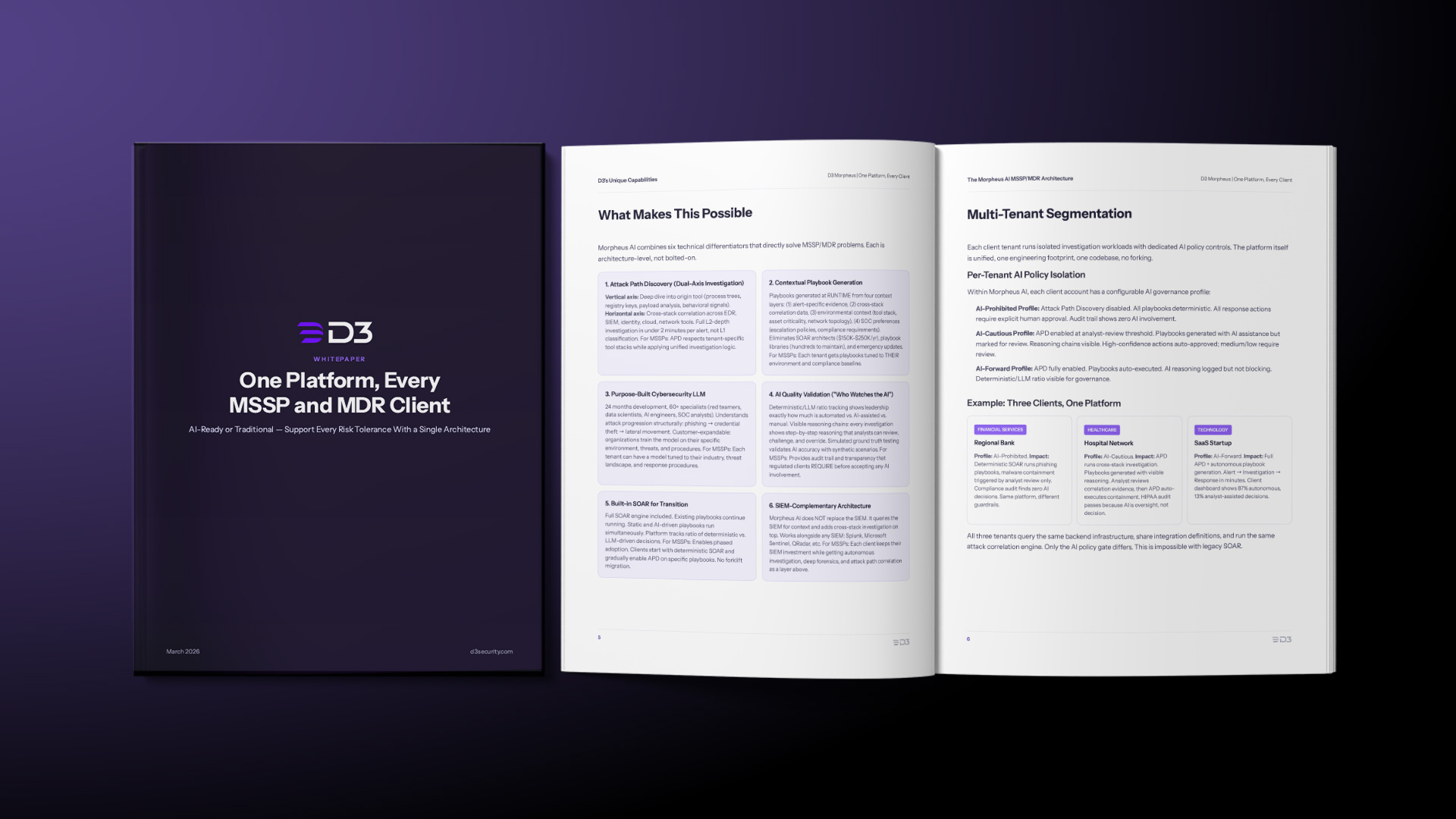
Executive Summary
Who Should Read This
MSSP and MDR leaders managing clients with divergent AI adoption policies, from AI-prohibited (financial services, regulated industries) to AI-forward (technology, digital-native enterprises). If you need one platform that scales across 50+ clients without forcing a uniform AI strategy, this whitepaper is for you.
The Core Problem
Legacy SOAR platforms force a binary choice: deploy the same AI playbooks globally, or maintain separate environments per client tier. Neither works. Enterprise clients demand autonomous AI-driven investigation. Regulated clients prohibit AI entirely. Mid-market clients want hybrid response with human oversight built-in.
The D3 Security Difference
Morpheus AI is purpose-built for MSSP/MDR operations. It combines six foundational capabilities (Attack Path Discovery, Contextual Playbook Generation, Customer-Expandable cybersecurity LLM intelligence, AI Quality Validation, Built-in SOAR, and SIEM-Complementary Architecture) into a single multi-tenant platform that respects per-client AI governance without infrastructure duplication.
Key Outcome
A single Morpheus AI platform serves clients across all three AI governance tiers while delivering 80% MTTR reduction and 7,800 hours of annual analyst time savings per 500-client MSSP.
Table of Contents
The MSSP/MDR Challenge
One Platform, Many Policies
Managed Security Service Providers and Managed Detection and Response vendors operate across verticals with fundamentally different security postures. A single platform must flex.
The Three AI Governance Tiers
AI-PROHIBITED
Financial Services, Regulated Industries — Cannot use generative AI in investigation workflows. Require deterministic SOAR only, with 100% human-driven decisions.
AI-CAUTIOUS
Healthcare, Government, Enterprise — Allow AI-assisted investigation with mandatory analyst review. Want to see AI reasoning chains.
AI-FORWARD
Technology, Digital-Native — Embrace autonomous investigation with AI-driven playbooks. Want maximum speed and efficiency.
The Problem With Legacy SOAR
Legacy SOAR platforms were built for single-customer deployments. They force MSSPs into a trap: either disable AI globally (losing all efficiency gains), or enable it globally (breaking compliance for regulated clients).
Morpheus AI solves this with per-client, per-playbook AI governance. Each client tenant gets its own AI policy configuration. Investigation depth, automation level, and approval workflows adapt to client risk tolerance, all in one platform.
Key finding: Legacy SOAR’s binary AI toggle forces MSSPs to choose between compliance and efficiency. Morpheus AI enables both simultaneously across the same customer base.
Why Legacy SOAR Fails MSSPs/MDRs
Four Structural Failures
Legacy Security Orchestration, Automation and Response (SOAR) platforms were designed for single-tenant or simple multi-tenant SaaS. They break under MSSP/MDR demands.
Failure 1: Global AI Configuration
AI settings are tenant-wide or deployment-wide. Enable AI on one playbook, it affects all clients. Disable it to satisfy one regulated customer, all clients lose efficiency.
Failure 2: Weak Multi-Tenancy
Data isolation exists but investigation logic, automation rules, and AI models are shared. HIPAA-regulated clients cannot use the same AI models as tech companies.
Failure 3: Linear Integration Scaling
Each new client tool integration (EDR, SIEM, identity, network) requires dedicated engineering per client. No platform-wide integration reuse.
Failure 4: Rigid Service Tiers
Playbook libraries are designed as fixed templates. Changes for one client require updates across all deployments or forks of the entire platform.
MSSPs either fork the platform (maintaining N instances), accept compliance liability, or build custom middleware, none of which scale.
D3’s Unique Capabilities
Six Foundational Capabilities
Morpheus AI combines six technical differentiators that directly solve MSSP/MDR problems.
- Attack Path Discovery: Dual-axis investigation: vertical (single alert deep-dive) and horizontal (cross-alert correlations). Prioritizes paths by business impact over raw alert score.
- Contextual Playbook Generation: Playbooks generated at RUNTIME from four context layers: (1) alert-specific evidence, (2) cross-stack telemetry, (3) customer environment, (4) threat intel.
- Purpose-Built Cybersecurity LLM: 24 months development, 60+ specialists (red teamers, data scientists, AI engineers, SOC analysts). Understands SIEM syntax, attack TTPs, playbook orchestration semantics.
- AI Quality Validation: Every AI decision includes a deterministic/LLM confidence ratio and reasoning chain. Clients can audit why AI recommended an action.
- Built-in SOAR for Transition: Static automation rules (traditional SOAR) and AI-driven orchestration coexist. Customers can run both simultaneously.
- SIEM-Complementary Architecture: Queries customer SIEM (Splunk, ELK, Sentinel), adds investigation context and enrichment. Does not replace the SIEM.
Competitive advantage: No legacy SOAR vendor offers all six of these capabilities. Most offer 1–2 in isolation. Morpheus AI bundles all six into runtime-driven investigation.
Morpheus AI Architecture
Multi-Tenant Segmentation at Its Core
Every customer tenant runs a separate instance of the Morpheus AI investigation engine. Policies, LLM tuning, and playbook rules are tenant-isolated.
Three Tenant Configurations
Financial (Deterministic Only)
Zero AI. Pure SOAR rules. 100% audit trail. Investigation workflows require analyst approval at every step.
Healthcare (Hybrid)
AI-assisted with analyst review gates. AI generates hypotheses. Analyst validates before execution. Full reasoning chains logged.
Technology (Autonomous)
Full AI autonomy. AI generates, validates, and executes. Analyst can override at any point. Reasoning chains available for post-investigation audits.
One codebase. Three governance models. Zero forking.
Key insight: Multi-tenant architecture that respects divergent governance policies is the foundation of MSSP/MDR platform design. Morpheus AI achieves this without operational duplication.
Granular AI Control
Per-Playbook AI Toggle
Administrators configure AI governance at the playbook level, not the deployment level. A financial services customer can disable AI on investigation playbooks while keeping it enabled for threat intel enrichment.
Service Tiers: Flex to Fit Your Clients
Managed SOAR
D3 handles all orchestration. Static playbook rules. Ideal for regulated industries and risk-averse clients.
Hybrid AI Response
AI assists, but requires analyst approval for action. Investigation decisions are collaborative. Best for compliance-conscious enterprises.
Full AI SOC
End-to-end autonomous investigation and response. Analysts monitor for anomalies. Ideal for technology and digital-native enterprises.
Customers can migrate between tiers without re-engineering.
Operational benefit: Service tier flexibility eliminates the need to maintain separate infrastructure. One platform serves all three tiers, reducing operational burden while increasing revenue flexibility.
Self-Healing Integrations
The MSSP Integration Problem
A typical MSSP client runs 15–30 security tools. Each tool requires API credentials, schema mappings, and error handling. When a customer rotates credentials or upgrades a tool, the MSSP operations team must manually repair integrations.
At 500 clients × 750–1500 connections each, this becomes unsustainable.
Morpheus AI includes self-healing integration logic: automatically detect credential drift, validate schemas, and trigger remediation flows. Average repair time: 45 minutes (vs. 4–6 hours manual).
Four-Phase Auto-Remediation
Detection
Monitor integration health (API response codes, schema drift, credential expiry).
Diagnosis
Run diagnostic playbooks (test auth, validate schema, check connectivity).
Remediation
Auto-fetch new credentials from vault, re-map schema, update integration config.
Verification
Run post-remediation tests. Alert customer if manual intervention needed.
Operational efficiency: Self-healing integrations reduce MSSP NOC overhead by 80–90% per customer. At 500 clients, this translates to significant staffing relief and SLA improvement.
Phased Implementation
Five-Step Adoption Framework
MSSP/MDR deployments do not flip a switch. Morpheus AI supports five-phase adoption, from pilot to full autonomous operations.
Assess
Map customer tool stack, security policies, AI governance requirements.
Integrate
Connect customer tools to Morpheus AI. Validate data flow.
Pilot AI
Deploy AI investigation on 5–10% of alerts. Gather feedback.
Scale AI
Expand to 25–50% of alerts. Automate simple playbooks.
Autonomous
Full AI response on all playbooks. Analysts focus on anomalies.
Typical timeline: 6–12 months per customer. Parallel execution across customer base reduces MSSP implementation overhead.
Implementation insight: Phased adoption allows MSSPs to prove ROI to each customer while building institutional knowledge. Parallel customer onboarding amortizes training costs and accelerates platform adoption across the entire customer base.
Competitive Analysis
One Platform Replaces Four Product Categories
Morpheus AI consolidates AI Autonomous SOC, SOAR, XDR, and case management into a single platform. Morpheus covers AI triage, SOAR, and case management in a single purchase.
Morpheus AI vs. Legacy Multi-Vendor Approach
| Capability | D3 Morpheus AI | Legacy SOAR platforms |
|---|---|---|
| Per-client AI governance | Per-client, per-playbook AI toggle | Global AI toggle only |
| Playbook generation | Runtime playbook generation | Template-based playbooks |
| LLM | Cybersecurity-specialized LLM | Generic LLMs |
| Integration management | Self-healing integrations | Manual integration management |
| Investigation depth | Attack path discovery | Limited contextual discovery |
| Automation engine | Built-in SOAR | Requires 3-4 separate products |
| Platform scope | Consolidated AI SOC + SOAR + XDR + case management | Requires 3-4 separate products |
Production Results
Morpheus AI deployment at a large MSSP managing 50+ enterprise clients: 144K monthly alerts triaged to 200 requiring human review. 99.86% reduction in alert noise. $0.27 per AI-triaged alert. 7,800 analyst hours recovered annually. 80% reduction in MTTR.
Business impact: At scale (50+ clients, 144K alerts/month), Morpheus AI reduces operational cost per alert by 89% while eliminating compliance risk through per-client AI governance. The return on platform investment materializes within the first 3–4 customer deployments.
Next Steps
Questions for Your Evaluation
- Does the platform support per-tenant AI configuration, or are AI features global?
- Can you run deterministic and AI-driven playbooks simultaneously in the same instance?
- Does the platform heal its own integrations, or does maintenance scale linearly with client count?
- Can you offer three distinct service tiers from a single platform?
- Does the platform provide a phased AI adoption path clients can progress through without migration?
- Can you demonstrate per-playbook AI control?
- What is the typical implementation timeline per customer?
- What is your cost per alert, end-to-end?
Recommended Actions
Schedule a 20-minute architecture overview with D3 Security engineers.
Get hands-on visibility into multi-tenant isolation, AI governance controls, and integration healing.
Review production telemetry from a similar MSSP customer (NDA available).
See real-world performance metrics from a deployed Morpheus AI instance managing 50+ clients.
Pilot Morpheus AI with one client tenant for 30 days.
Run a proof-of-concept against your actual customer tool stack and alert volume.
Define your implementation roadmap and timeline.
Map customer migration plan, staff training, and phased rollout schedule.