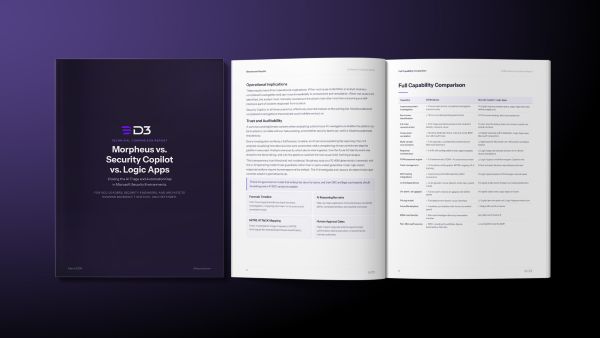
Technical Comparison Report
For SOC Leaders, Security Engineers, and Architects Running Microsoft Sentinel and Defender.
Closing the AI Triage and Automation Gap in Microsoft Security Environments.
Executive Summary
If your security operations center runs Microsoft Sentinel and Defender, you have probably asked the same question hundreds of SOC leaders are asking right now: what fills the AI triage and automation gap that Microsoft’s native tools leave open?
Microsoft Security Copilot and Logic Apps are both legitimate answers to parts of that question. Security Copilot is an AI-assisted analyst tool that helps teams query logs, generate summaries, and explore security data using natural language. Logic Apps is a workflow automation platform that can trigger on Sentinel alerts and execute predefined sequences of actions. Both are deeply integrated into the Microsoft ecosystem. Both are available under Microsoft licensing.
Neither, however, was built to autonomously investigate a security alert from the moment it fires to the moment it is resolved, without human initiation.
D3 Morpheus was. It is the AI-driven, autonomous security operations layer that completes what Sentinel detects, operates alongside Defender and Entra, and delivers the L1 and L2 investigation quality that Logic Apps cannot reason and Security Copilot requires analysts to drive.
This report is written for SOC leaders and security engineers who are running a Microsoft-heavy environment and evaluating whether native Microsoft tools are sufficient, or whether a dedicated AI SOC platform should be part of the stack. We will be direct about what each tool does well, where each falls short, and where the combination produces results that none achieves alone.
What Each Tool Actually Does
Before comparing these platforms, it is important to establish an honest baseline of what each one was designed to do and what it was not designed to do. Marketing language in the security industry frequently overstates capability. This section anchors the comparison in product function, not product positioning.
Microsoft Security Copilot
Security Copilot is an AI assistant for security teams. It is embedded in the Microsoft Defender XDR console and accessible via a standalone portal. Analysts interact with it using natural language: asking questions about incidents, requesting summaries, querying log data, and exploring security entities.
Security Copilot is genuinely useful for experienced analysts who know what questions to ask. It accelerates log querying, reduces the time to understand what an alert contains, and lowers the barrier to common investigation tasks for team members with less experience.
Security Copilot is not an autonomous investigation engine. It waits for an analyst to initiate a query, relies on analyst direction to trace attack paths, and cannot reconstruct a kill chain on its own. In head-to-head testing against D3 Morpheus across three real-world phishing attack scenarios, Security Copilot failed to identify root cause in any of the three. Morpheus identified root cause in all three.
The fundamental constraint is architectural. Security Copilot is a conversational AI operating primarily within the Defender ecosystem’s own alert and entity data. It excels at helping analysts explore data they have already identified as relevant.
Microsoft Logic Apps
Logic Apps is Microsoft Azure’s workflow automation platform. When integrated with Microsoft Sentinel, it can be triggered by Sentinel alert rules and execute sequences of actions: querying APIs, sending notifications, creating tickets, running enrichment lookups, and invoking Azure Functions for custom logic.
For Microsoft-native automation workflows, Logic Apps is capable and familiar. Teams already invested in Azure typically have Logic Apps expertise on staff, and the tool integrates cleanly with the Microsoft services that dominate enterprise environments.
However, Logic Apps shares the same architectural limitations as traditional Security Orchestration, Automation and Response (SOAR) platforms:
Workflow-native, not intelligence-native
Logic Apps executes predefined sequences. It has no ability to reason about alert context or decide which actions are appropriate based on what an alert reveals; it executes the actions a human engineer designed in advance.
Engineering-intensive to build and maintain
Building Logic Apps workflows for complex security scenarios requires significant Azure and security engineering expertise. Maintaining them as the threat landscape and tool stack evolve requires ongoing labor.
No autonomous investigation
Logic Apps can trigger automated actions when Sentinel fires an alert. The investigation work remains with human analysts: tracing attack paths, assessing blast radius, determining lateral movement, and generating contextual response recommendations all fall outside its capabilities.
Integration maintenance
Like all SOAR-style platforms, Logic Apps workflows break when the APIs they depend on change. API updates, authentication drift, and schema changes require manual discovery and repair, a recurring engineering cost that compounds over time.
D3 Morpheus
D3 Morpheus is an AI-driven autonomous SOC platform. When an alert fires, whether from Microsoft Sentinel, Defender, or any of 800+ integrated security tools, Morpheus autonomously initiates a complete investigation without waiting for an analyst to direct it.
The investigation is powered by a purpose-built cybersecurity LLM developed over 24 months by a 60-person specialist team including red teamers, data scientists, and SOC analysts. This model was not trained for general purposes. It was built specifically to understand how attacks propagate across kill chains, how threat signals correlate across disparate security tools, and how investigation evidence chains should be constructed.
The core investigative capability is Attack Path Discovery: a process that simultaneously traces alerts vertically through origin tool telemetry (finding root cause) and horizontally across the full security stack (tracking lateral movement). It correlates signals across Sentinel, Defender, Entra, email security, network telemetry, and cloud applications, building a complete threat narrative spanning 6–8+ kill chain stages.
Morpheus also ships a full SOAR engine, integrated case management, and self-healing integrations in a single platform, eliminating the need for adjacent tooling.
Any source
800+ tools
Root cause
6–8+ stages
Human-approved
Head-to-Head Benchmark
D3 Security ran three phishing attack scenarios against both Morpheus and Microsoft Security Copilot in controlled lab environments configured to mirror common enterprise deployments. All scenarios used Microsoft infrastructure including Microsoft 365, Active Directory, Defender for Endpoint, Defender for Office 365, Defender for Cloud Apps, and network perimeter security with DLP capabilities.
The central question: can the platform trace an alert back to the actual root cause of the attack, across a multi-stage kill chain, without human intervention?
| Scenario | D3 Morpheus | Security Copilot |
|---|---|---|
| Phishing Malware + Lateral Movement | ✓ ROOT CAUSE IDENTIFIED Full kill chain reconstructed from phishing email through macro execution, persistence, and lateral movement spanning 6+ stages. |
✗ FAILED Returned an error due to entity volume limitations; could not generate an investigation summary. |
| Phishing Credential Theft + Mailbox Compromise | ✓ ROOT CAUSE IDENTIFIED Ingested evidence across 4 data sources. Connected forwarding rule alert through credential theft, traced browser session to attacker infrastructure, identified original phishing email as root cause. |
✗ FAILED Identified forwarding rule as Initial Access indicator but did not connect to credential theft, fraudulent login page, or originating phishing email. |
| Phishing OAuth Consent + Cloud Exfiltration | ✓ ROOT CAUSE IDENTIFIED Connected cloud exfiltration alert to OAuth consent grant, user interaction with phishing infrastructure, and original phishing email delivery. |
✗ FAILED Produced a chronological timeline of individual alerts but did not link them to the originating phishing email. |
Operational Implications
These results have direct operational implications. When root cause is identified, an analyst receives a completed investigation and can move immediately to containment and remediation. When root cause is not identified, the analyst must manually reconstruct the attack chain (the most time-consuming and skill-intensive part of incident response) from scratch.
Security Copilot, in all three scenarios, effectively returned analysts to the starting line. Morpheus delivered completed investigations that analysts could validate and act on.
Trust and Auditability
A common and legitimate concern when evaluating autonomous AI investigation is whether the platform can be trusted to correlate without hallucinating, and whether security teams can verify it. Morpheus addresses this directly.
Every investigation surfaces a full forensic timeline, an AI narrative explaining the reasoning chain, link analysis visualizing how data sources were connected, and a complete log of every enrichment step the platform executed. Analysts see exactly which alerts were ingested, how the Azure AD identity event was linked to the Sentinel log, and why the platform reached the root cause it did. Nothing is opaque.
This transparency is architectural, not incidental. Morpheus runs on a 70–80% deterministic framework, with the LLM operating inside those guardrails rather than in open-ended generative mode. High-impact response actions require human approval by default. The AI investigates and reasons; the deterministic layer controls what it is permitted to do.
Forensic Timeline
Full chronological evidence chain for every investigation, mapping each alert to its source and correlation logic.
AI Reasoning Narrative
Step-by-step explanation of how Morpheus connected alerts, correlated entities, and reached root cause.
MITRE ATT&CK Mapping
Every investigation stage mapped to MITRE techniques for standardized threat classification.
Human Approval Gates
High-impact response actions require analyst confirmation before execution. AI recommends; humans authorize.
Full Capability Comparison
| Capability | D3 Morpheus | Security Copilot / Logic Apps |
|---|---|---|
| Autonomous alert investigation | ✓ Fires on alert arrival; completes investigation autonomously | ✗ Copilot requires analyst query; Logic Apps executes defined steps only |
| Root cause identification | ✓ 3/3 in controlled phishing benchmark | ✗ 0/3 in same testing; alert summaries only |
| Kill chain reconstruction | ✓ 6–8+ stage narratives across email, endpoint, identity, network, cloud | ✗ Alert-level timelines; does not connect events into attack narrative |
| Cross-stack correlation | ✓ Sentinel, Defender, Entra, network, email, 800+ non-Microsoft tools | ⚠ Copilot operates within Defender; Logic Apps uses Microsoft connectors |
| Multi-vendor environments | ✓ Fully agnostic; correlates Microsoft and non-Microsoft telemetry | ⚠ Optimized for Microsoft; non-Microsoft correlation limited |
| Response orchestration | ✓ Full IR with configurable human approval gates | ⚠ Logic Apps can execute actions; no AI-driven recommendations |
| SOAR playbook engine | ✓ Full deterministic SOAR + AI autonomous mode | ⚠ Logic Apps is a workflow engine; Copilot is not |
| Case management | ✓ AI timelines, entity graphs, MITRE mapping, SLA tracking | ✗ Not included; Sentinel case features are basic |
| Self-healing integrations | ✓ Autonomous API drift detection; 800+ connectors | ✗ Logic Apps breaks on API changes; manual repair |
| LLM independence | ✓ LLM-agnostic; Azure OpenAI, Anthropic, private model | ✗ Copilot is Microsoft-hosted; no model substitution |
| On-prem / air-gapped | ✓ Full on-prem, hybrid, air-gapped; ISO 27001, GDPR | ✗ Copilot cloud-only; Logic Apps on Azure |
| Pricing model | ✓ Flat deployment-based; no per-alert fees | ⚠ Copilot per compute unit; Logic Apps per execution |
| Azure Marketplace | ✓ Available; purchasable with Azure committed spend | ✓ Native Microsoft products |
| MISA membership | ✓ Microsoft Intelligent Security Association member | N/A (Microsoft product) |
| Non-Microsoft sources | ✓ 800+ including CrowdStrike, Splunk, SentinelOne, Palo Alto | ⚠ Limited third-party depth |
Where Each Tool Belongs in Your Stack
This comparison is not a case for choosing between Microsoft tools and D3 Morpheus. The most effective Microsoft security environments use Microsoft’s detection and identity capabilities for what they do exceptionally well, and deploy Morpheus as the autonomous investigation and response layer that closes the gap between detection and resolution.
Microsoft Sentinel
A strong SIEM for threat detection, log aggregation, and correlation. D3 Morpheus integrates natively with Sentinel, ingesting alerts and writing case data and investigation results back to Sentinel workspaces. The two platforms are designed to work together.
Microsoft Defender
Defender for Endpoint, Identity, Office 365, and Cloud Apps provide deep detection across Microsoft workloads. Morpheus ingests telemetry from all of them as input to Attack Path Discovery. Defender’s capabilities are enhanced, not replaced.
Entra and Intune
Entra provides identity and access context essential for investigating credential theft, privilege escalation, and lateral movement. Intune provides device compliance context for endpoint risk scoring. Both remain core infrastructure.
Non-Microsoft Products
Most enterprise environments are not purely Microsoft. Morpheus’s 800+ integrations span CrowdStrike, SentinelOne, Splunk, Zscaler, Wiz, Okta, Palo Alto, AWS Security Hub, and hundreds more, all feeding into Attack Path Discovery.
Strategic Flexibility
Security stacks change. Vendors get acquired. New tools displace incumbent ones. Because Morpheus is LLM-agnostic and integration-agnostic, adding or swapping a security tool does not require re-engineering your investigation or response logic. Morpheus adapts. Organizations that commit to a Microsoft-plus-Morpheus architecture today are not locked into the rest of today’s stack.
Morpheus sits above vendor churn as the durable investigation and orchestration layer, giving security leaders the agility to evolve their tooling without rebuilding their SOC automation program from scratch each time.
Total Cost of Ownership
For Microsoft shops evaluating these options, the cost comparison must account for the full operational picture, not just license fees.
The Logic Apps Build Cost
-
Security-focused workflows require Azure engineers who understand both security and Azure services, a combination that commands $150K–$200K+ salaries. -
Each workflow must be designed, built, tested, and maintained separately. As the security tool stack changes, workflows require updating. -
When a vendor API changes or an Azure connector fails, workflows break silently and require manual diagnosis and repair. -
The investigation gap is permanent: Logic Apps will never perform AI-driven cross-stack investigation. That cost (analyst time) persists regardless of how many workflows you build.
The Security Copilot Usage Model
Security Copilot’s value is directly proportional to how much analyst time is invested in using it. Analysts need to know what questions to ask, understand the data sources available to query, and have the investigative experience to interpret the results. Security Copilot amplifies experienced analysts; it still requires experienced analysts on staff, and alerts that no analyst has time to open go uninvestigated.
The Morpheus Cost Advantage
Morpheus is priced on deployment size, not execution count. Every alert is investigated at the same per-unit cost as the first. There are no overages, no per-investigation charges, and no consumption-based scaling fees.
-
Eliminated SOAR engineering labor: Morpheus generates contextual playbooks autonomously. Organizations deploy and maintain Morpheus with a single engineer, compared to dedicated teams for Logic Apps at scale. -
Self-healing integrations: When Microsoft updates an API — Defender, Entra, Sentinel — Morpheus detects the drift and repairs the affected connector automatically. Manual discovery, support tickets, and investigation gaps are eliminated. -
100% alert coverage: Every alert is investigated. The 40%+ that typically go uninvestigated in human-only SOC models are all covered, at no additional cost per alert. -
Azure Marketplace procurement: Organizations with MACC can apply committed spend to Morpheus, meaning the platform can be procured through existing Microsoft budget lines without opening a new vendor contract.
Greenlighting a Microsoft + Morpheus Environment
Most SOC leaders who evaluate Morpheus arrive at the same conclusion quickly: the platform solves the right problem. The harder conversation is internal: making the case to the stakeholders who control budget, risk posture, and procurement.
What the SOC Leader Needs to Believe First
The SOC leader needs to be honest about what the existing stack actually delivers end-to-end. Sentinel fires alerts. Defender provides telemetry. But how many alerts go uninvestigated each day? How long does a genuine L2 investigation take? What is the real MTTR on complex, multi-stage incidents? If the answers reveal a gap between detection and autonomous resolution, that gap is the case for Morpheus, and the internal conversation starts there.
Tell the CFO: This Is a Cost Reduction
Frame the financial case around what Morpheus eliminates. It replaces the SOAR engineering labor required to build and maintain playbooks, typically one to three dedicated automation engineers at $150K–$200K+ each. It removes the 30–40% of SOC admin time consumed by integration repair. It consolidates SOAR, AI investigation, and case management into one platform. And because Morpheus is available on Azure Marketplace, there is no new vendor contract to open. It draws from a spend commitment the organization has already made.
Tell the Executive Team: This Reduces Breach Risk
Alerts that go uninvestigated are not low-risk by definition; they are unknown-risk. Initial access events routinely look like noise. Morpheus investigates 100% of alerts at L2 depth, which means the attack that would have been missed at 2 AM on a Saturday is now investigated and escalated in under two minutes. The business case is not efficiency. It is exposure.
Tell GRC and Legal: This Closes an Auditability Gap
Frameworks including SOC 2, ISO 27001, DORA, NIS2, and HIPAA increasingly require documented root cause analysis and demonstrable incident response timelines. Morpheus automatically generates a full evidence chain, investigation timeline, MITRE ATT&CK mapping, and response audit trail for every case, without analyst effort. Morpheus also supports on-premises and air-gapped deployment for data residency obligations.
Tell the CTO: This Is Sound Architecture
Morpheus is LLM-agnostic: the organization can run Azure OpenAI today and substitute a different model tomorrow without re-platforming. Self-healing integrations mean the platform adapts to API changes automatically. Step-by-step AI reasoning is exposed and auditable at every stage. This is not a black-box AI deployment. It is an auditable, maintainable, extensible security operations layer.
Tell the CISO: This Is the Autonomous SOC Done Right
Every vendor in security is adding AI. The difference is where the AI sits and what it actually does. Copilot sits at the analyst’s elbow and waits for questions. Logic Apps sits behind the scenes and runs pre-scripted flows. Morpheus sits in the center of the SOC and operates: it ingests alerts, investigates autonomously, builds a full evidence chain, maps to MITRE ATT&CK, and either resolves or escalates with human-approval gates at every critical step. The CISO is not buying a feature. They are buying an operational model.
Conclusion
Microsoft Security Copilot and Logic Apps are genuinely useful tools, for what they were built to do. Copilot helps analysts move faster through data they have already decided to examine. Logic Apps executes the automation sequences an engineer designed in advance. Both belong in a mature Microsoft security environment. Neither closes the gap between detection and autonomous resolution.
The benchmark data makes the gap concrete. In controlled testing across three real-world phishing attack scenarios run entirely on Microsoft infrastructure, Security Copilot identified root cause in none of them. Morpheus identified root cause in all three, tracing complete kill chains across email, endpoint, identity, and cloud, without analyst direction. Logic Apps cannot reason its way to those conclusions at all; it executes only what it was pre-programmed to do.
D3 Morpheus fills that gap: automatically, in under two minutes, on 100% of alerts, and executes response with human-approved controls, full audit trails, and zero per-alert cost. It integrates natively with Sentinel, Defender, Entra, and 800+ other tools, ships directly on Azure, and is purchasable with Azure committed spend your organization has already made.
For Microsoft shops, the question was never whether to replace Sentinel or Defender. It is what investigates the threats they detect: autonomously, completely, and at a speed no analyst team can match alone. Morpheus is that layer. It is what makes the Microsoft security stack operationally complete.