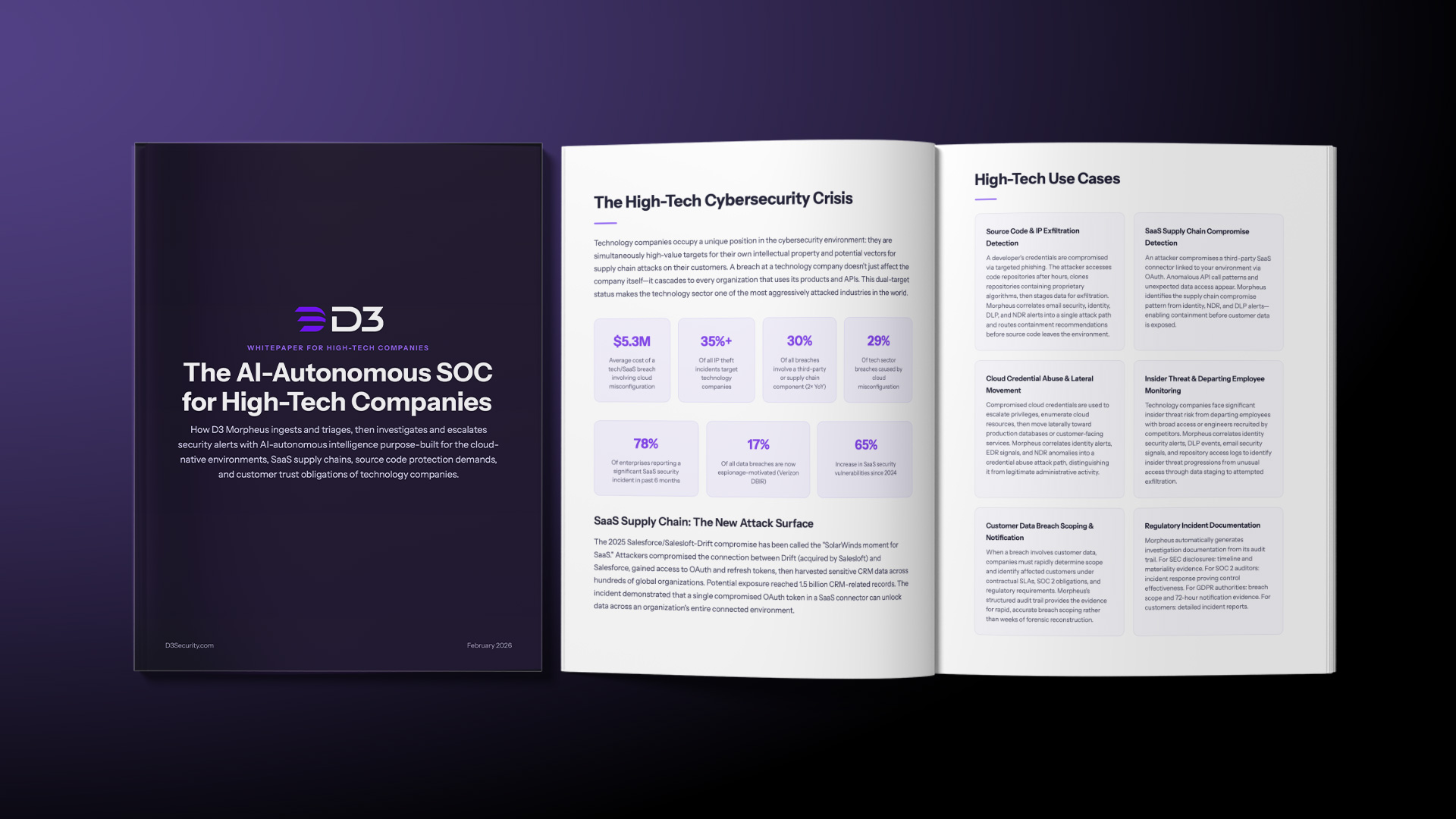
How D3 Morpheus ingests and triages, then investigates and escalates security alerts with AI-autonomous intelligence purpose-built for the cloud-native environments, SaaS supply chains, source code protection demands, and customer trust obligations of technology companies.
EXECUTIVE SUMMARY
High-tech companies face a unique cybersecurity paradox: they build the digital infrastructure the world depends on, yet they are among the most targeted organizations for cyberattacks. Technology companies experience over one-third of all intellectual property theft incidents. Cloud misconfigurations cause 15 percent of breaches, with an average incident cost of $5.3 million. Third-party and SaaS supply chain breaches have doubled to 30 percent of all incidents. And every breach at a technology company cascades to the customers who depend on its products and services. D3 Morpheus is an AI-autonomous SOC purpose-built to address these converging pressures. The following outcomes summarize what Morpheus delivers for high-tech organizations:
Protect Source Code and IP by Identifying Exfiltration Campaigns in Real Time
Source code repositories, product architectures, proprietary algorithms, and customer data represent the core assets of technology companies. Morpheus ingests alerts from SIEM, EDR, firewalls, NDR, email security, DLP, and identity security and uses its attack path discovery framework to correlate the indicators of IP exfiltration, including unusual repository access patterns and credential misuse, lateral movement toward development environments, and anomalous data transfers. State-sponsored campaigns and insider threats, plus credential-based attacks, that would take human analysts days to piece together are surfaced in minutes.
Reduce Mean Time to Investigate from Hours to Minutes
Technology companies generate massive alert volumes across sprawling cloud-native and hybrid multi-cloud environments. Morpheus autonomously triages and adds context before investigating alerts, with severity assessed based on asset sensitivity and customer data exposure, plus service availability impact, in minutes. Analyst time shifts away from repetitive triage and toward high-value decision-making on validated findings.
Detect SaaS Supply Chain and Third-Party Compromises Before They Reach Your Customers
The 2025 Salesforce/Salesloft-Drift compromise demonstrated how a single SaaS supply chain attack can cascade across hundreds of organizations. Morpheus ingests alerts from firewalls, NDR, DLP, and identity tools monitoring API connections, OAuth integrations, and third-party service interactions. It identifies supply chain compromise patterns before they propagate to your environment or, critically, to your customers.
Maintain SOC 2 and Customer Trust with Fully Auditable Alert Intelligence
Every action Morpheus takes is fully transparent and auditable: what alert data was analyzed, what reasoning was applied, how conclusions were drawn, and what actions were recommended. This structured audit trail provides the verifiable evidence that SOC 2 auditors, customer security reviewers, and enterprise procurement teams require. When customers ask how an incident affecting their data was handled, the answer is documented at every step, from ingestion through resolution.
Support SEC’s 4-Business-Day Disclosure with Pre-Assembled Evidence
Publicly traded technology companies must disclose material cybersecurity incidents on Form 8-K within four business days. Morpheus automatically generates investigation documentation: timeline and evidence chain alongside scope of impact and classification rationale, from the structured audit trail it produces for every alert, accelerating both materiality determination and disclosure preparation.
Scale SOC Capacity Across Cloud-Native Environments Without Proportional Headcount
Technology companies operate complex, fast-changing environments spanning multiple cloud providers and SaaS platforms, plus development pipelines and customer-facing services. Morpheus handles the high-volume work of alert triage, investigation, enrichment, and correlation autonomously while keeping humans in control of remediation decisions. This allows organizations to handle the exponentially growing alert surface without proportionally expanding SOC headcount.
Table of Contents
The High-Tech Cybersecurity Crisis
Threat Overview
Technology companies occupy a unique position in the cybersecurity environment: they are simultaneously high-value targets for their own intellectual property and potential vectors for supply chain attacks on their customers. A breach at a technology company doesn’t just affect the company itself. It cascades to every organization that uses its products and APIs. This dual-target status makes the technology sector one of the most aggressively attacked industries in the world.
SaaS Supply Chain: The New Attack Surface
The 2025 Salesforce/Salesloft-Drift compromise has been called the “SolarWinds moment for SaaS.” Attackers compromised the connection between Drift (acquired by Salesloft) and Salesforce, gained access to OAuth and refresh tokens, then harvested sensitive CRM data across hundreds of global organizations, including major technology companies alongside cybersecurity vendors and financial institutions. Potential exposure reached 1.5 billion CRM-related records. The incident demonstrated that a single compromised OAuth token in a SaaS connector can unlock data across an organization’s entire connected environment.
Enterprises now use over 1,400 cloud services on average, yet security teams are aware of less than 30 percent of these applications. This shadow IT visibility gap creates blind spots where sensitive data flows through unvetted channels. Compromised API keys and OAuth tokens contributed to 15 percent of all SaaS data exposure events in 2025. Every third-party connector or marketplace app and API connection is a potential entry point.
Source Code and IP Theft
Technology companies experience over one-third of all intellectual property theft incidents. Source code repositories and product architectures, proprietary algorithms and AI model weights, plus customer data are targeted by both financially motivated cybercriminals and state-sponsored espionage groups. Espionage-motivated breaches have grown to approximately 17 percent of all incidents, with many groups pursuing both financial and intelligence objectives simultaneously. Hacked GitHub repositories and compromised CI/CD pipelines, plus insider theft of source code can damage the company’s competitive position and compromise the security of every customer running its software.
Cloud Misconfiguration and Identity-Based Attacks
Cloud misconfiguration caused 29 percent of technology sector breaches, with compromised credentials as the leading cause of cloud-based breaches at 37 percent. The shared responsibility model means that even when cloud providers maintain strong infrastructure security, customer-side misconfigurations (overly permissive IAM roles, exposed storage buckets, misconfigured network policies, or unrotated API keys) create persistent attack opportunities. Identity has become the new perimeter, and identity-based attacks now bypass traditional network security entirely.
Customer Cascade Risk
When a technology company is breached, the impact extends far beyond its own operations. Customers who depend on the company’s products and APIs are exposed. This cascade risk is both a security concern and a business existential threat: customer churn increases 3.5 to 4 times following breaches involving customer data loss. For SaaS providers and cloud platforms, a significant breach can destroy customer trust and market position in ways that exceed the direct financial cost.
Why Traditional SOC Models Fail High-Tech Companies
Traditional SOAR platforms and legacy SIEM tools were designed for on-premises, perimeter-based security models. They fail technology companies in several critical ways:
Cloud-Native Environments Outpace Static Playbooks
Technology companies operate across multiple cloud providers, container orchestration platforms, and serverless functions alongside SaaS services. Static playbooks cannot keep pace with the fast-changing, ephemeral nature of cloud-native infrastructure where workloads spin up and down continuously.
No Visibility Across SaaS Environments
Traditional SOAR has no native visibility into OAuth token flows or API dependency chains within the interconnected SaaS environment that defines modern technology operations. The supply chain attacks that pose the greatest risk are invisible to tools designed for network perimeter defense.
Alert Volume Exceeds Human Capacity
Technology companies generate orders of magnitude more security telemetry than traditional enterprises. Cloud workload alerts and identity events, API anomalies, plus container security findings and endpoint detections create an alert flood that overwhelms SOC teams relying on manual triage.
No Context for Developer Environment Sensitivity
Traditional SOAR treats an alert on a production database the same as an alert on a test environment. It cannot recognize that a credential compromise in a CI/CD pipeline or a lateral movement toward a source code repository represents an existential threat to the company and its customers.
Integration Maintenance at Cloud Scale
Technology companies operate dozens of security tools across multiple cloud environments. Every API change or tool update breaks SOAR integrations. At cloud scale, integration maintenance alone can consume the majority of SOC capacity.
D3 Morpheus: The AI-Autonomous SOC
D3 Morpheus is purpose-built to solve these problems. As an AI-autonomous SOC, Morpheus ingests alerts from across a technology company’s existing security stack (SIEM, EDR, network firewalls, NDR, email security, DLP, and identity security) and applies the Cybersecurity Triage Reasoning Graph and attack path discovery framework to autonomously triage and investigate those alerts, correlating them into usable intelligence. Morpheus’s AI is customizable to each organization’s specific practices, every action and decision is fully transparent and auditable, and remediation recommendations are routed to human analysts for approval.
Cybersecurity Triage Reasoning Graph
Morpheus is powered by a large language model trained on cybersecurity threat intelligence and attack methodologies, including adversary TTPs. It distinguishes between supply chain compromise propagation and source code exfiltration staging versus cloud credential abuse or ransomware pre-encryption activity, prioritizing based on the technology company context: customer data exposure and service availability impact alongside IP sensitivity.
Attack Path Discovery Framework
Morpheus correlates alerts across all ingestion sources and time windows. In the technology company context, this means connecting a phishing email targeting a developer to a compromised SSO credential to unauthorized access to a code repository to anomalous data transfer patterns. The framework reconstructs the complete attack path, from initial access through lateral movement to the target, surfacing multi-stage campaigns that span cloud, SaaS, and on-premises environments.
Initial Access
Compromised
Lateral Movement
Detected & Blocked
Organization-Customizable AI
Morpheus’s AI is configured for each technology company’s asset sensitivity hierarchy and cloud architecture, plus development environment topology and incident response procedures. The platform generates organization-specific playbooks and learns from alert patterns, improving triage accuracy over time. Self-healing connectors automatically adapt when security tools change, which is critical in environments where the security stack changes continuously.
Human-in-the-Loop Remediation
Morpheus routes remediation recommendations to human analysts for approval. In technology environments, this ensures that containment actions account for service availability and customer impact, given the complex dependencies that characterize cloud-native architectures. When configured to do so, Morpheus can execute approved actions proactively, but human authority is maintained by default.
Full Transparency and Auditability
Every action produces a complete, structured audit trail. This supports SOC 2 Type II audit requirements, customer security questionnaires, and SEC cybersecurity disclosure obligations. The complete logic chain for every decision is available for SOC analysts, compliance teams, auditors, and customers.
High-Tech Use Cases
Source Code and IP Exfiltration Detection
A developer’s credentials are compromised via targeted phishing. The attacker uses those credentials to access code repositories after hours, clones repositories containing proprietary algorithms, then begins staging data for exfiltration. Morpheus correlates the email security alert with the identity anomaly, the DLP events on the repository, and the NDR traffic pattern into a single attack path, then routes the finding with containment recommendations to analysts before the source code leaves the environment.
SaaS Supply Chain Compromise Detection
An attacker compromises a third-party SaaS connector linked to your environment via OAuth. Anomalous API call patterns and unexpected data access begin appearing. Morpheus identifies the supply chain compromise pattern from identity, NDR, and DLP alerts. This enables containment of the compromised connector before customer data is exposed.
Cloud Credential Abuse and Lateral Movement
Compromised cloud credentials are used to escalate privileges and enumerate cloud resources, then move laterally toward production databases or customer-facing services. Morpheus correlates the identity alerts (unusual login patterns, privilege escalation), EDR signals (reconnaissance tool execution), and NDR anomalies (unusual east-west traffic) into a credential abuse attack path, distinguishing it from legitimate administrative activity.
Insider Threat and Departing Employee Monitoring
Technology companies face significant insider threat risk from departing employees and contractors with broad access, or engineers recruited by competitors. Morpheus correlates identity security alerts and DLP events alongside email security signals and repository access logs to identify insider threat progressions, from unusual access patterns through data staging to attempted exfiltration.
Customer Data Breach Scoping and Notification
When a breach involves customer data, technology companies must rapidly determine scope and identify affected customers, then prepare notifications under contractual SLAs, SOC 2 obligations, and regulatory requirements. Morpheus’s structured audit trail provides the investigation evidence (what was accessed, when, from where, and how much data was involved). The result is rapid, accurate breach scoping rather than weeks of forensic reconstruction.
Regulatory Incident Documentation
Morpheus automatically generates investigation documentation from its structured audit trail. For SEC disclosures: timeline and scope alongside materiality evidence. For SOC 2 auditors: incident response documentation that proves control effectiveness. For GDPR supervisory authorities: breach scope plus 72-hour notification evidence. For customer contractual obligations: detailed incident reports.
Regulatory and Compliance Alignment
Technology companies operate under a complex mix of regulatory requirements and industry standards, plus customer-driven compliance obligations:
| Framework | Primary Requirement | Morpheus Capability |
|---|---|---|
| SOC 2 Type II | Controls over security, availability, processing integrity, and confidentiality; continuous monitoring; incident response documentation | Complete audit trail for every alert; incident response records that prove control effectiveness; continuous monitoring evidence |
| SEC Cybersecurity Rules | Material incident disclosure (Form 8-K, 4 business days); annual risk management disclosures (Form 10-K) | Pre-assembled investigation documentation; accelerated materiality determination; governance evidence |
| GDPR | 72-hour breach notification to supervisory authorities; data protection impact assessments; records of processing activities | Breach scope determination from alert correlation; pre-assembled notification documentation; data access audit trail |
| CCPA/CPRA | Consumer data breach notification; reasonable security measures; data subject access request support | Customer data exposure scoping from investigation records; audit trail of data access events |
| NIST CSF 2.0 | Risk-based cybersecurity framework: Govern, Identify, Protect, Detect, Respond, Recover | Autonomous Detect/Respond/Recover alignment; customizable risk prioritization; governance documentation |
| EU Cyber Resilience Act | Mandatory cybersecurity requirements for products with digital elements; vulnerability handling; incident reporting | Continuous alert monitoring supporting vulnerability and incident handling obligations |
| EU NIS2 / DORA | 24/72-hour incident reporting; supply chain security; technology provider accountability for operational stability | Real-time investigation documentation; supply chain monitoring; audit trail for technology provider obligations |
| FedRAMP / StateRAMP | Security controls for cloud service providers serving government; continuous monitoring; incident response | Continuous monitoring evidence; structured incident response documentation; complete audit trail |
Implementation and Deployment
D3 Morpheus connects to a technology company’s existing security infrastructure without replacing tools or disrupting production environments.
Environment Discovery and Setup
Morpheus connects to existing security tools across cloud, on-premises, and hybrid environments. Self-healing connectors adapt to tool changes automatically. The platform maps the organization’s technology environment including cloud workloads, SaaS connections, development pipelines, and customer-facing services.
Customization and Calibration
AI is configured for the organization’s asset sensitivity hierarchy, cloud architecture, development environment topology, and incident response procedures. Organization-specific playbooks are generated and alert processing begins with technology-contextualized intelligence.
Operational Rollout
Analysts begin reviewing pre-investigated findings and remediation recommendations. The platform improves over time through analyst feedback and organization-specific alert pattern learning.
Morpheus operates alongside existing security operations and compounds in value as its AI becomes increasingly tuned to the organization’s cloud architecture and threat profile.
The Case for Autonomous Alert Intelligence
Technology companies face a cybersecurity challenge that is structurally different from other industries. The attack surface is cloud-native and fast-changing, expanding with every new service deployment. The threat actors include both financially motivated criminals and state-sponsored groups pursuing IP theft. Every breach carries cascade risk to customers. And compliance requirements span SOC 2, SEC rules and GDPR, plus an expanding set of customer-driven security requirements.
D3 Morpheus represents a fundamentally different approach: an AI-autonomous SOC that ingests alerts from across the entire security stack, triages and investigates with the Cybersecurity Triage Reasoning Graph, reconstructs complete attack paths across cloud, SaaS, and on-premises environments, then routes validated findings to human analysts for approval.
Your customers trust you with their data and their operations, and their business continuity. That trust depends on security operations that match the sophistication of the threats targeting technology companies, not tools designed for a simpler threat environment.