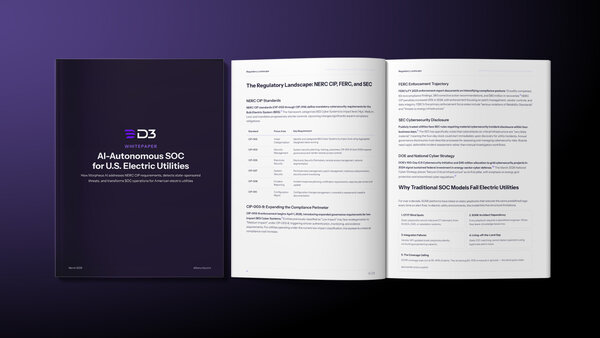
Executive Summary
Electric grid cybersecurity faces its most serious test. The U.S. electric grid is under sustained, state-sponsored pre-positioning for disruption. In February 2024, CISA, the FBI, and the NSA jointly confirmed that Chinese state-sponsored actors (Volt Typhoon) had compromised U.S. critical infrastructure networks, including energy systems, for future disruptive and destructive operations.
This is not theoretical. The Colonial Pipeline attack demonstrated what a single ransomware event does to energy infrastructure: a five-day shutdown, fuel shortages across the Eastern seaboard, and $4.4 million in ransom paid through a compromised VPN credential with no multi-factor authentication.
Simultaneously, the regulatory environment is tightening. NERC CIP-003-9 enforcement begins April 2026 with expanded governance requirements. FERC increased CIP penalties 20% in 2024. SEC disclosure rules classify cyberattacks on critical infrastructure as “very likely material,” requiring disclosure within four business days.
This paper examines why U.S. electric utilities must move beyond traditional SOAR to AI-autonomous security operations, how regulatory and threat pressures accelerate that transition, and what D3 Security’s Morpheus AI delivers in production environments.
Table of Contents
- ● The U.S. Electric Utility Threat Landscape
- ● The Regulatory Landscape: NERC CIP, FERC, and SEC
- ● Why Traditional SOC Models Fail Electric Utilities: The Case for an AI SOC
- ● Morpheus AI: Core Capabilities
- ● Morpheus AI for Electric Utility Environments
- ● U.S. Utility Regulatory Documentation Requirements
- ● Electric Utility Use Cases
- ● Measured Impact from Production Deployments
- ● How Morpheus AI Supports NERC CIP Compliance
- ● Questions for Your Evaluation
- ● Next Steps
| Capability | Traditional SOAR | AI-Autonomous SOC (Morpheus AI) |
|---|---|---|
| Detection Logic | Static playbooks (250–500 predefined steps) | Purpose-built cybersecurity LLM with behavioral correlation |
| OT/IT Correlation | Separate monitoring, manual correlation | Cross-domain alert correlation across OT and IT |
| Living-off-the-Land Detection | Signature-based; misses legitimate tool abuse | Behavioral anomaly detection across tools and time |
| NERC CIP Evidence | Manual documentation effort | Continuous auditable evidence as byproduct of operations |
| Integration Maintenance | Breaks on API changes; manual fixes | Self-healing integrations that auto-adapt |
| Scaling Model | Linear: more alerts = more analysts needed | Coverage increases with AI maturity, not headcount |
| Deployment Timeline | 12–18 months for full playbook library | Weeks to production value |
The U.S. Electric Utility Threat Landscape
Average weekly cyber attacks against U.S. utilities have quadrupled since 2020. The reasons are structural: the electric grid connects operational technology (OT) systems designed decades ago without security to modern IT networks, creating attack paths that traverse both domains. Add distributed energy resources (DER security), smart meters, and vendor remote access, and the attack surface expands faster than traditional SOC models can cover.
Volt Typhoon: Pre-Positioning for Disruption
Volt Typhoon represents a fundamentally different threat category than ransomware. These are not financially motivated criminals. They are state-sponsored operators using “living-off-the-land” techniques (exploiting legitimate administrative tools and stolen credentials rather than deploying malware) to blend into normal network traffic and maintain long-term access. The FBI disrupted Volt Typhoon’s KV Botnet operating through hundreds of compromised SOHO routers in January 2024, but the broader campaign targeting energy, water, and communications infrastructure continues.
OT/IT Convergence: The Expanding Attack Surface
73% of organizations experienced OT-impacting breaches in 2024, up from 49% in 2023. SCADA systems (built for reliability, not security)—a core SCADA cybersecurity challenge— now connect to IT networks for remote monitoring and management. Human-Machine Interfaces (HMIs) are the most frequently targeted SCADA components, with web-based interfaces creating authentication bypass and encryption gaps visible from internet-facing business networks.
Supply Chain Exposure
The SolarWinds attack affected over 18,000 organizations including utilities, demonstrating that third-party software with privileged network access creates systemic risk. Utility-sector organizations showed higher SolarWinds Orion observation rates than most other sectors. The lesson: vendor trust is not a security control. Monitoring vendor connections requires the same continuous correlation capability applied to internal network traffic.
The Workforce Reality
Only 20% of electric utility companies feel confident they have adequate cybersecurity talent. Most cybersecurity professionals are trained in IT security, not OT/ICS—creating a structural skill mismatch. Utility compensation lags behind financial and technology sectors, and experienced OT security professionals are approaching retirement. Any SOC model that requires proportionally more analysts to handle growing alert volume is incompatible with this reality.
The Regulatory Landscape: NERC CIP, FERC, and SEC
NERC CIP Standards
NERC CIP standards (CIP-002 through CIP-014) define mandatory cybersecurity requirements for the Bulk Electric System (BES). The framework categorizes BES Cyber Systems by impact level (High, Medium, Low) and mandates progressively stricter controls. Upcoming changes significantly expand compliance obligations.
| Standard | Focus Area | Key Requirement |
|---|---|---|
| CIP-002 | Asset Categorization | Identify and categorize BES Cyber Systems by impact level using Aggregated Weighted Value scoring |
| CIP-003 | Security Management | System security planning, training, awareness. CIP-003-9 (April 2026) expands governance and vendor remote access controls |
| CIP-005 | Electronic Security | Electronic Security Perimeters, remote access management, network segmentation |
| CIP-007 | System Security | Ports/services management, patch management, malicious code prevention, security event monitoring |
| CIP-008 | Incident Reporting | Incident response planning, notification requirements, response plan review and update |
| CIP-010 | Configuration Mgmt | Configuration change management, vulnerability assessments, baseline documentation |
CIP-003-9: Expanding the Compliance Perimeter
CIP-003-9 enforcement begins April 1, 2026, introducing expanded governance requirements for low-impact BES Cyber Systems. Entities previously classified as “Low Impact” may face recategorization to “Medium Impact” under CIP-002-8, triggering stricter authentication, monitoring, and evidence requirements. For utilities operating under the current low-impact classification, this represents a material compliance cost increase.
FERC Enforcement Trajectory
FERC’s FY 2025 enforcement report documents an intensifying compliance posture: 10 audits completed, 63 noncompliance findings, 260 corrective action recommendations, and $80 million in recoveries. NERC CIP penalties increased 20% in 2024, with enforcement focusing on patch management, vendor controls, and data integrity. FERC’s five primary enforcement focus areas include “serious violations of Reliability Standards” and “threats to energy infrastructure.”
SEC Cybersecurity Disclosure
Publicly traded utilities face SEC rules requiring material cybersecurity incident disclosure within four business days. The SEC has specifically noted that cyberattacks on critical infrastructure are “very likely material,” meaning the four-day clock could start immediately upon discovery for utility incidents. Annual governance disclosures must describe processes for assessing and managing cybersecurity risks. Boards need rapid, defensible incident assessment rather than manual investigation workflows.
DOE and National Cyber Strategy
DOE’s 100-Day ICS Cybersecurity Initiative and $45 million allocation to grid cybersecurity projects in 2024 signal sustained federal investment in energy-sector cyber defense. The March 2026 National Cyber Strategy places “Secure Critical Infrastructure” as its first pillar, with emphasis on energy grid protection and streamlined cyber regulations.
Why Traditional SOC Models Fail Electric Utilities
For over a decade, SOAR platforms have relied on static playbooks that execute the same predefined logic every time an alert fires. In electric utility environments, this model hits five structural limitations.
1. OT/IT Blind Spots
Static playbooks cannot interpret OT telemetry from SCADA, EMS, or substation systems.
2. SOAR Architect Dependency
Every playbook requires a specialized engineer. When they leave, knowledge leaves too.
3. Integration Failures
Vendor API updates break playbooks silently, consuming engineering capacity.
4. Living-off-the-Land Gap
Static IOC matching cannot detect operators using legitimate admin tools.
5. The Coverage Ceiling
SOAR coverage tops out at 30–40% of alerts. The remaining 60–70% is manual or ignored — the blind spots state-sponsored actors exploit.
Morpheus AI: Core Capabilities
D3 Security’s Morpheus AI is not a playbook engine. It is a purpose-built AI-autonomous SOAR platform trained exclusively for cybersecurity operations. Unlike legacy platforms that bolt general-purpose language models onto automation engines, Morpheus AI‘s underlying purpose-built LLM was trained on thousands of security investigations, forensic methodologies, and attack narratives.
Four Core Capabilities
1 Cybersecurity LLM
Purpose-built for understanding threat context, attack narratives, and investigation logic. Reads alert streams in their native format and synthesizes investigation strategy without predefined playbooks.
2 Attack Path Discovery
Correlates alerts across 800+ integrations (SIEM, EDR, NDR, cloud, identity, OT) to map complete attack narratives in real-time. Surfaces lateral movement, privilege escalation, and data exfiltration without static signatures.
3 Contextual Playbook Generation
Generates investigation workflows dynamically for each alert type and threat context. CPG adapts to your actual tool stack, integration schema, and investigation methodologies.
4 Self-Healing Integrations
Detects when integration APIs change and automatically adjusts data pipelines. Eliminates the integration maintenance tax that consumes engineering resources at utilities.
Morpheus AI for Electric Utility Environments
Beyond its core capabilities, Morpheus AI addresses challenges specific to electric utility security operations.
OT/IT Alert Correlation (Requires Configuration)
When configured, Morpheus AI can ingest alerts from both IT security tools (SIEM, EDR, identity, email) and OT monitoring platforms (ICS/SCADA anomaly detection, network monitoring for industrial protocols, substation security systems). Attack Path Discovery then correlates alerts across both domains, identifying (for example) when compromised IT credentials are used to access OT network segments, or when lateral movement from a corporate workstation targets SCADA HMI interfaces.
Living-off-the-Land Detection
The purpose-built cybersecurity LLM understands that administrative tool usage patterns can indicate pre-positioning even when individual actions appear legitimate. By correlating timing, frequency, target systems, and cross-tool behavioral patterns, Morpheus AI surfaces anomalies that signature-based detection and static playbooks miss.
NERC CIP Compliance Support
Morpheus AI‘s continuous monitoring, audit trail generation, and investigation documentation capabilities support compliance across multiple CIP standards simultaneously. Automated alert triage produces timestamped evidence chains. Attack Path Discovery supports vulnerability assessment context for CIP-010. Integration monitoring addresses CIP-005 electronic security perimeter requirements.
DER Security and Smart Grid Security (Requires Configuration)
As distributed energy resources quadruple capacity on the U.S. grid, each solar inverter, battery system, EV charger, and aggregation platform becomes a potential entry point. When configured, Morpheus AI can ingest alerts from DER monitoring tools and correlate them with broader grid security telemetry, identifying compromised DER assets used as pivot points into control system networks.
Report Writer: Honest Guidance
Morpheus AI includes a Report Writer module that generates incident investigation documentation in standardized formats. Report Writer requires configuration. It does not auto-populate complex incident narratives. Configuration involves mapping your tool stack to report templates, defining business context (criticality levels, affected systems, compliance implications), and validating the output format for your regulatory documentation.
U.S. Utility Regulatory Documentation Requirements
Once configured, the Report Writer module can support documentation for the following U.S. regulatory frameworks:
- ● NERC CIP incident reporting (CIP-008): Reportable cybersecurity incidents require notification to the Electricity ISAC within defined timeframes. Investigation records support incident classification, scope assessment, and response documentation.
- ● NERC CIP audit evidence (CIP-007, CIP-010): Continuous monitoring data, patch management records, and configuration change documentation formatted for NERC audit requirements.
- ● SEC Form 8-K (publicly traded utilities): Material incident disclosure within four business days. Investigation data supports materiality assessment with quantified scope and impact analysis for critical infrastructure incidents.
- ● DOE/CISA voluntary reporting: Structured incident data supporting CISA Shields Up reporting and DOE CESER information sharing requirements.
- ● FERC compliance documentation: Audit-ready evidence packages addressing FERC enforcement focus areas including reliability standards compliance and cybersecurity risk management.
Electric Utility Use Cases
State-Sponsored Pre-Positioning Detection
Morpheus AI correlates alerts from EDR, identity, NDR, and when configured, OT monitoring to identify living-off-the-land techniques consistent with state-sponsored pre-positioning. It surfaces behavioral anomaly patterns (unusual administrative tool usage, atypical access timing, cross-domain lateral movement) that individually appear benign but collectively indicate persistent threat activity.
SCADA/ICS Compromise Identification (Requires Configuration)
When attackers target SCADA systems, alerts generate across OT anomaly detection, network monitoring, and IT security tools. When configured for OT environments, Morpheus AI correlates these into a unified attack narrative, tracing the path from initial IT network access through lateral movement to OT system targeting, and recommends containment that accounts for operational availability requirements.
Ransomware Kill Chain Interruption
Morpheus AI correlates alerts from email security, identity, EDR, NDR, and firewalls to identify ransomware kill chains in progress. It surfaces the complete attack path with recommended containment actions for analyst approval, often before encryption disrupts grid management systems, control centers, or customer-facing operations.
Supply Chain and Vendor Compromise
Morpheus AI ingests alerts from firewalls, NDR, and DLP monitoring vendor and third-party connections. When alerts correlate in patterns consistent with supply chain compromise (similar to the SolarWinds attack pattern), the platform identifies the pattern and escalates with recommended containment before a vendor breach cascades into grid operations.
DER Fleet Security Monitoring (Requires Configuration)
As DER deployments expand, when configured, Morpheus AI can monitor alerts from DER management platforms, inverter communication systems, and aggregation platform security tools. When anomalous behavior at distributed assets correlates with broader network indicators, the platform identifies potential compromise of DER assets being used as entry points into control system networks.
Human-in-the-Loop Remediation
While Morpheus AI autonomously triages, investigates, and correlates at machine speed, remediation actions are routed to human analysts for review and approval. In electric utilities, where a wrong automated action could trip protective relays, disrupt generation dispatch, or affect grid stability, human oversight is an operational safety requirement.
Measured Impact from Production Deployments
Morpheus AI production deployments across enterprise security environments document consistent operational impact:
These results reflect deployments in mixed IT/OT environments similar to U.S. electric utilities. Specific outcomes vary based on baseline SOC maturity, tool stack composition, and investigation methodology.
How Morpheus AI Supports NERC CIP Compliance
Morpheus AI‘s autonomous capabilities support compliance across multiple NERC CIP standards simultaneously:
| NERC CIP Standard | How Morpheus AI Helps |
|---|---|
| CIP-003 (Security Mgmt) | Automated governance documentation, security awareness through continuous investigation records, vendor remote access monitoring |
| CIP-005 (Electronic Security) | Continuous monitoring of electronic security perimeters, cross-boundary traffic correlation, remote access anomaly detection |
| CIP-007 (System Security) | Security event monitoring across 800+ integrations, malicious code behavior detection through correlation, patch prioritization via APD context |
| CIP-008 (Incident Reporting) | Automated investigation timelines with timestamped evidence chains supporting E-ISAC notification requirements |
| CIP-010 (Config Mgmt) | Continuous configuration monitoring, vulnerability contextualization within active attack paths, baseline deviation alerting |
| CIP-013 (Supply Chain) | East-West correlation across vendor connections, third-party behavioral anomaly detection, supply chain compromise pattern identification |
Questions for Your Evaluation
Before evaluating any AI-autonomous SOC platform (including Morpheus AI), electric utility security leaders should consider:
Next Steps