Executive Summary
Palo Alto Networks has signaled the end of XSOAR as a standalone, actively developed product. In October 2025, XSOAR professional services SKUs entered end-of-sale, with Cortex AgentiX announced as its successor. For XSOAR customers, this creates both urgency and opportunity.
D3 Security offers XSOAR customers a direct migration path to Morpheus AI, a purpose-built Autonomous SOC platform that replaces static playbook automation with AI-driven investigation, self-healing integrations, and native attack path discovery. Organizations that migrate gain a fundamentally more capable security operations platform at better pricing, with superior support, backed by a vendor whose sole mission is autonomous SOC.
Why Now? Palo Alto has entered XSOAR end-of-sale. The product is in managed decline. Migration to XSIAM requires a costly platform uplift with significant re-implementation. Morpheus AI delivers immediate capability gains through a structured, low-disruption migration path. D3 Security is 100% focused on autonomous SOC; XSOAR was always a secondary priority for Palo Alto.
Table of Contents
The XSOAR Problem: What Customers Are Telling Us
Security teams running XSOAR consistently report the same friction points. These are not edge cases. They are architectural limitations of a platform built before AI-driven SOC was possible.
Integration Fragility
XSOAR connectors to non-Palo Alto tools break silently. When CrowdStrike updates its Falcon API, when Microsoft changes an Azure AD endpoint, when AWS modifies IAM policy structures, XSOAR integrations can fail without alerting the team. Security operations discover broken automation at the worst possible moment: during an active incident.
Legacy Architecture
XSOAR was designed for playbook-driven automation, a model where human analysts pre-define every decision tree. AI capabilities in the Cortex portfolio require upgrading to XSIAM, an entirely separate platform with a substantial licensing uplift. The AI is an add-on, not a foundation.
Palo Alto Ecosystem Bias
XSOAR is optimized for organizations standardized entirely on Palo Alto products. In practice, virtually every enterprise runs a multi-vendor stack. Third-party integrations are slower to update, less tested, and documented inconsistently.
The Product Is Being Sunset
The October 2025 end-of-sale announcement for XSOAR professional services is the clearest possible signal: Palo Alto is migrating its SOC automation strategy to XSIAM. XSOAR customers face a forced migration. The only question is where.
Why Morpheus AI: Five Reasons to Make the Move
1. More Than a Better SOAR: An Autonomous SOC
XSOAR automates predefined playbooks. Morpheus AI autonomously investigates, triages, and responds. The difference is architectural:
- XSOAR executes steps a human defined in advance
- Morpheus AI uses AI to understand the incident, map the attack path, determine the appropriate response, and execute, without requiring a human to have anticipated the exact scenario
This is a generational shift in how security operations work. Your analysts move from managing automation to supervising autonomous outcomes.
2. Better Pricing: AI Included, Not Upsold
XSOAR customers who want AI-driven detection and response are pushed toward XSIAM, a full platform migration at significantly higher cost. D3 Security takes a different approach:
- Morpheus AI autonomous capabilities are included in the platform, not a premium add-on tier
- Migration pricing reflects the realistic cost of a competitive displacement. Your team will find D3 commercially collaborative
- Lower total cost of ownership: fewer broken integrations mean fewer hours spent on maintenance and firefighting
3. A Vendor Whose Entire Focus Is Your Problem
Palo Alto Networks is a $100B+ company with product lines spanning firewalls, SASE, cloud security, endpoint, and more. XSOAR was a $560M acquisition that has never been a top-three product priority. Every roadmap decision, every engineering sprint, every support escalation is filtered through a portfolio of competing priorities.
D3 Security builds one product: Morpheus AI. Every engineering investment, every integration, every support resource is directed at making autonomous SOC better. Our roadmap is your roadmap.
4. Support That Actually Supports You
XSOAR customers on standard support tiers consistently report documentation gaps, slow escalation paths, and support engineers without deep platform expertise. Premium support at Palo Alto is a significant additional investment.
D3 Security provides dedicated, expert support with deep product knowledge as a standard. We are not routing tickets through a global support tier designed for an 80,000-customer base across dozens of products. Your issues reach engineers who know Morpheus AI at a code level.
5. Self-Healing Integrations: The Architecture Advantage
XSOAR’s integration fragility is a consequence of architecture. XSOAR was designed before the scale of multi-vendor API volatility was understood. Fixing it would require rebuilding the platform.
Morpheus AI Self-Healing Integrations were built into the architecture from the start. The platform monitors integration health continuously, detects API drift or failures, and automatically remediates, with full audit trail. Your SOC automation runs 24/7, not 24/7 minus the hours your team spends fixing broken connectors.
Morpheus AI Self-Healing Integrations detect, diagnose, and automatically repair broken connectors, ensuring your automation never goes dark.
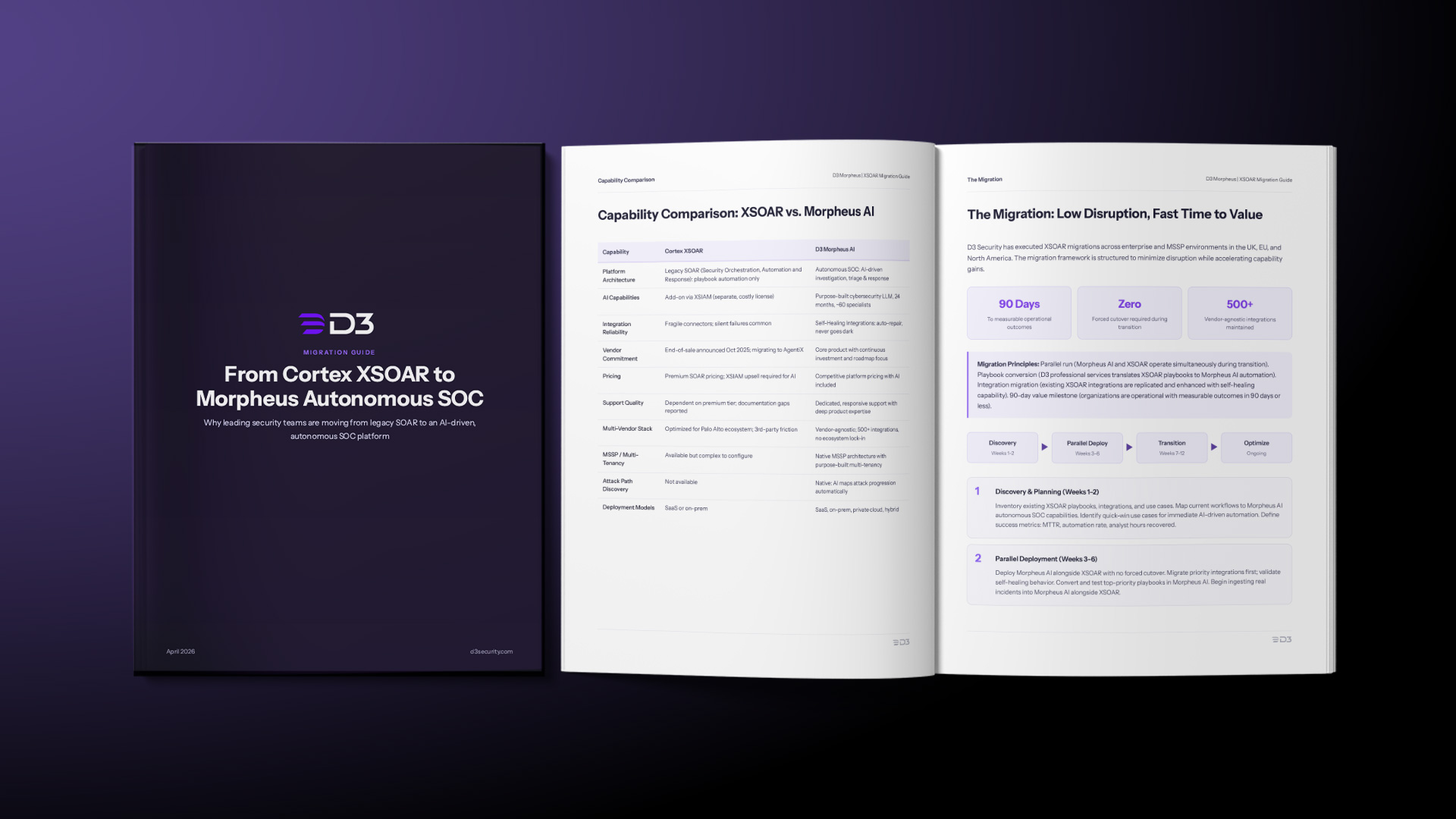
Capability Comparison: XSOAR vs. Morpheus AI
| Capability | Cortex XSOAR | D3 Morpheus AI |
|---|---|---|
| Platform Architecture | Legacy SOAR (Security Orchestration, Automation and Response): playbook automation only | Autonomous SOC: AI-driven investigation, triage & response |
| AI Capabilities | Add-on via XSIAM (separate, costly license) | Purpose-built cybersecurity LLM, 24 months, ~60 specialists |
| Integration Reliability | Fragile connectors; silent failures common | Self-Healing Integrations: auto-repair, never goes dark |
| Vendor Commitment | End-of-sale announced Oct 2025; migrating to AgentiX | Core product with continuous investment and roadmap focus |
| Pricing | Premium SOAR pricing; XSIAM upsell required for AI | Competitive platform pricing with AI included |
| Support Quality | Dependent on premium tier; documentation gaps reported | Dedicated, responsive support with deep product expertise |
| Multi-Vendor Stack | Optimized for Palo Alto ecosystem; 3rd-party friction | Vendor-agnostic; 500+ integrations, no ecosystem lock-in |
| MSSP / Multi-Tenancy | Available but complex to configure | Native MSSP architecture with purpose-built multi-tenancy |
| Attack Path Discovery | Not available | Native: AI maps attack progression automatically |
| Deployment Models | SaaS or on-prem | SaaS, on-prem, private cloud, hybrid |
The Migration: Low Disruption, Fast Time to Value
D3 Security has executed XSOAR migrations across enterprise and MSSP environments in the UK, EU, and North America. The migration framework is structured to minimize disruption while accelerating capability gains.
Migration Principles: Parallel run (Morpheus AI and XSOAR operate simultaneously during transition). Playbook conversion (D3 professional services translates XSOAR playbooks to Morpheus AI automation). Integration migration (existing XSOAR integrations are replicated and enhanced with self-healing capability). 90-day value milestone (organizations are operational with measurable outcomes in 90 days or less).
Weeks 1–2
Weeks 3–6
Weeks 7–12
Ongoing
Discovery & Planning (Weeks 1–2)
Inventory existing XSOAR playbooks, integrations, and use cases. Map current workflows to Morpheus AI autonomous SOC capabilities. Identify quick-win use cases for immediate AI-driven automation. Define success metrics: MTTR, automation rate, analyst hours recovered.
Parallel Deployment (Weeks 3–6)
Deploy Morpheus AI alongside XSOAR with no forced cutover. Migrate priority integrations first; validate self-healing behavior. Convert and test top-priority playbooks in Morpheus AI. Begin ingesting real incidents into Morpheus AI alongside XSOAR.
Transition & Optimization (Weeks 7–12)
Progressive workload shift from XSOAR to Morpheus AI. Analyst training on autonomous SOC supervision model. Attack path discovery activated across live incident data. Decommission XSOAR after full validation and stability period.
Continuous Improvement (Ongoing)
Quarterly business reviews with D3 Security team. Roadmap co-development: customer feedback directly shapes product. Ongoing playbook and automation expansion. Access to new Morpheus AI capabilities as they ship, with no separate upgrade licensing.
What XSOAR Customers Have Found After Migrating
Organizations that have completed the migration from XSOAR to Morpheus AI consistently report improvements across five areas:
Reduced Integration Maintenance
Self-healing eliminates most connector break/fix cycles. Teams that previously spent hours per week troubleshooting broken XSOAR integrations report near-zero maintenance overhead on Morpheus AI.
Faster Incident Investigation
AI-driven triage replaces manual playbook execution for common incident types. Analysts supervise autonomous investigations instead of manually stepping through decision trees.
Lower Total Cost
Platform pricing plus reduced analyst overhead outperforms the combined cost of XSOAR and the XSIAM migration path. Organizations avoid the significant licensing uplift required to access AI through Palo Alto’s stack.
Better Multi-Vendor Coverage
Vendor-agnostic integrations perform consistently across the full security stack. Teams no longer experience second-class treatment for non-Palo Alto tools.
Higher Analyst Satisfaction: Teams spend less time on automation maintenance and more time on real threats. The shift from managing playbooks to supervising AI-driven outcomes changes the nature of analyst work for the better.
About D3 Security
D3 Security is the developer of Morpheus AI, the industry’s leading Autonomous SOC platform. Founded in Vancouver, BC, D3 Security serves enterprise and MSSP customers across North America, Europe, and Asia-Pacific.
Morpheus AI combines a purpose-built LLM, trained over 24 months by approximately 60 security specialists, with self-healing integrations, native attack path discovery, and autonomous investigation and response capabilities.
Unlike competitors who apply AI as a feature layer on legacy SOAR architecture, Morpheus AI was designed as an autonomous SOC platform from the ground up. D3 Security is singular in its mission: to make security operations autonomous, resilient, and continuously improving.