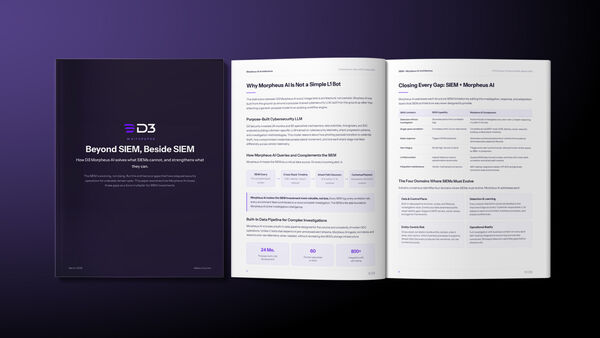
Executive Summary
The SIEM market is at an inflection point. Seventy-three percent of security leaders are evaluating alternative SIEM solutions (Sumo Logic, 2025). Gartner places AI SOC agents at the Peak of Inflated Expectations. Startups and incumbents argue over whether SIEM is dying, evolving, or being reborn.
The debate misses the point. SIEMs are not going away. The global SIEM market is projected to reach $13.55 billion by 2029, growing at 13.7% CAGR. SIEMs remain essential for log aggregation, compliance, and correlation. In May 2025, CISA and NSA published joint guidance explicitly recommending SIEM and SOAR (Security Orchestration, Automation and Response) implementation as foundational security infrastructure.
But SIEMs were never designed to investigate. They detect, aggregate, and alert. They do not trace attack paths across tool boundaries. They do not generate contextual response playbooks. They do not autonomously correlate vertical and horizontal telemetry to produce L2-analyst-depth triage on every alert. That investigation gap (not the SIEM itself) is what attackers exploit.
D3 Security’s Morpheus AI is an Autonomous SOC platform built on a purpose-trained cybersecurity LLM that closes this gap. Morpheus AI queries the SIEM to build context around alerts, correlates across the full security stack, builds investigation timelines, follows attack paths, and generates bespoke response playbooks at runtime. It performs multi-dimensional investigation at L2 analyst depth on every alert, in under two minutes, 24/7.
Table of Contents
- Why Morpheus AI Is Not a Simple L1 Bot
- Closing Every Gap: SIEM + Morpheus AI
- Morpheus AI Capabilities That Amplify SIEM Value
- SIEM + Morpheus AI in Action: BEC Attack Scenario
- Honest Assessment: Limitations and Counter-Arguments
- Stop Investigating Alerts Manually. Start in Under 2 Minutes.
Why Morpheus AI Is Not a Simple L1 Bot
The distinction between D3 Morpheus AI and L1 triage bots is architectural, not cosmetic. Morpheus AI was built from the ground up around a purpose-trained cybersecurity LLM, built from the ground up rather than attaching a general-purpose model to an existing workflow engine.
Purpose-Built Cybersecurity LLM
D3 Security invested 24 months and 60 specialists (red teamers, data scientists, AI engineers, and SOC analysts) building a domain-specific LLM trained on cybersecurity telemetry, attack progression patterns, and investigation methodologies. This model reasons about how phishing payloads transition to credential theft, how compromised credentials enable lateral movement, and how each attack stage manifests differently across vendor telemetry.
How Morpheus AI Queries and Complements the SIEM
Morpheus AI treats the SIEM as a critical data source. On every incoming alert, it:
Built-In Data Pipeline for Complex Investigations
Morpheus AI includes a built-in data pipeline designed for the volume and complexity of modern SOC operations. Unlike L1 bots that depend on pre-processed alert streams, Morpheus AI ingests, normalizes, and reasons over raw telemetry when needed, without recreating the SIEM’s storage infrastructure.
Closing Every Gap: SIEM + Morpheus AI
Morpheus AI addresses each structural SIEM limitation by adding the investigation, response, and adaptation layers that SIEM architecture was never designed to provide.
| SIEM Limitation | SIEM Capability | Morpheus AI Complement |
|---|---|---|
| Detection without investigation | Generates alerts from correlated logs | Autonomously investigates every alert with L2-depth reasoning in under 2 minutes |
| Single-pane correlation | Correlates within its own data stores | Correlates across 800+ tools (EDR, identity, cloud, network), building unified attack timelines |
| Static response | Triggers SOAR playbooks | Generates contextual playbooks at runtime from evidence; eliminates static playbook lifecycle |
| Alert fatigue | Sends high volume of alerts | Triages every alert autonomously; reduces human review queue by 99%+ in production |
| Limited context | Ingests feeds but cannot operationalize dynamically | Queries SIEM data to build context, enriches with cross-stack correlation and attack path analysis |
| Integration maintenance | Vendor-maintained connectors | Self-healing integrations detect API drift and generate corrective code autonomously |
The Four Domains Where SIEMs Must Evolve
Industry consensus identifies four domains where SIEMs must evolve. Morpheus AI addresses each:
Data & Control Plane
Built-in data pipeline enriches, routes, and filters by investigative value. Continuous data awareness audits observability gaps. Supports MCP servers, vector stores, and agentic frameworks.
Detection & Learning
Every analyst interaction produces feedback that improves triage accuracy. Customer-expandable LLM adapts to each environment, business processes, and analyst preferences.
Entity-Centric Risk
Cross-stack correlation builds entity context: what it does, who owns it, which business processes it supports. Attack Path Discovery produces risk narratives, not raw numerical scores.
Operational Reality
Full investigation with business context on every alert. Self-healing integrations ensure log sources stay connected. Blindspot detection identifies gaps before attackers do.
Morpheus AI Capabilities That Amplify SIEM Value
Attack Path Discovery on Every Alert
Multi-dimensional correlation: vertical (North–South) deep inspection and horizontal (East–West) cross-stack tracing. Maps telemetry to abstract activity nodes in a proprietary attack graph. Structured investigation report in minutes.
Contextual Playbook Generation
Generates a bespoke playbook for each incident at runtime. No authoring, no versioning, no emergency updates. The playbook is born from evidence, not a template library. Eliminates the static playbook lifecycle.
Self-Healing Integrations
When APIs drift or schemas change across 800+ integrations, Morpheus AI detects and generates corrective code autonomously. Eliminates silent-failure windows that plague SOAR and SIEM connectors.
AI SOP: Natural-Language Playbooks
Build natural-language playbooks combining API calls, data processing, and AI agent tasks per your SOC procedures. Every analyst interaction produces quality data for continuous improvement.
Customer-Expandable LLM
Customize the LLM for your specific threat landscape, environment, and SOC procedures. Financial services face different patterns than healthcare. The result is a proprietary triage capability that improves over time.
Built-In SOAR: Start Static, Go Autonomous
Run static playbooks and autonomous AI-driven triage simultaneously. Transition on your timeline, with no forced migration, no rip-and-replace. Deterministic where needed, autonomous where it adds value.
Predictable Pricing Without Token Fees
Other vendors charge per token or per alert. D3 Security absorbs token costs and offers flat-rate pricing. Organizations are not penalized for processing more alerts, a significant cost differentiator in an AI market where usage-based billing creates unpredictable spend.
SIEM + Morpheus AI in Action: BEC Attack Scenario
A business email compromise alert targets the VP of Finance. The SIEM detects the alert based on a correlation rule matching known BEC indicators.
SIEM Alone: 60–90 Minutes
L1 analyst reviews alert, checks email gateway, confirms suspicious link. Escalates to L2. L2 manually queries EDR, identity logs, network flows, and cloud access. After 60–90 minutes of manual correlation, discovers VP clicked phishing link, entered credentials, attacker accessed M&A file share. Static BEC playbook triggers but overlooks M&A data exposure.
SIEM + Morpheus AI: Under 2 Minutes
Morpheus AI queries the SIEM for correlated events, traces full attack chain through email and endpoint, pivots across the entire security stack, and discovers: fraudulent MFA registration, M&A file share access, data exfiltration to external server. Generates bespoke playbook covering endpoint isolation, credential reset, MFA removal, perimeter blocking, legal notification.
Morpheus AI Investigation Steps
SIEM Query & Context Build
Pulls all correlated events: prior alerts, login history, email delivery logs, related correlation rule matches. SIEM data becomes the investigation foundation.
Vertical Discovery (Origin Tool Deep Dive)
Traces full attack chain within email and endpoint: phishing delivery, link click, credential submission to fake login page, session token capture. Process tree analysis reveals credential-only attack with no malware for EDR to flag.
Horizontal Correlation (Cross-Stack)
Discovers: new MFA device from foreign IP, M&A file share downloads, credential tests against three internal systems, and data exfiltration to external server via network telemetry.
Contextual Playbook Generation
Generates response: isolate endpoint, revoke sessions, remove fraudulent MFA, block exfiltration server, scan file share for scope, notify legal and compliance, initiate board notification per breach protocol.
Honest Assessment: Limitations and Counter-Arguments
Credibility demands acknowledging what Morpheus AI does not do and where legitimate concerns exist.
The SIEM Is Not Going Anywhere
CISA and NSA’s May 2025 joint guidance recommends SIEM implementation. The question is what you layer on top.
The “Collapse Back Into SIEM” Argument
SIEM vendors are adding AI. But adding an LLM chat layer to a SIEM does not produce autonomous investigation any more than cruise control produces autonomous driving.
AI Reliability Risks
Purpose-built models reduce hallucination but do not eliminate it. Every Morpheus AI step is reviewable, editable, and overridable. Human-in-the-loop is structural.
The Myth of Full Autonomy
No platform operates without human oversight. “Autonomous” describes the investigation model, not the governance model.
How D3 Mitigates These Risks
Explainability: Every investigation produces step-by-step reasoning analysts can review and override.
Human-in-the-loop: AI SOP captures analyst approvals and corrections for continuous improvement.
Gradual adoption: Built-in SOAR allows static and autonomous models simultaneously.
Customer-expandable LLM: Organizations control how the model reasons about their environment.
Deterministic/LLM ratio tracking: Proven patterns harden into deterministic code; the LLM engages only for novel threats.
Stop Investigating Alerts Manually. Start in Under 2 Minutes.
Request a demonstration of Morpheus AI processing a real alert from your security stack—including the SIEM query, cross-stack correlation, attack path discovery, and contextual playbook generation.
D3 Security | 1-800-608-0081 | d3security.com