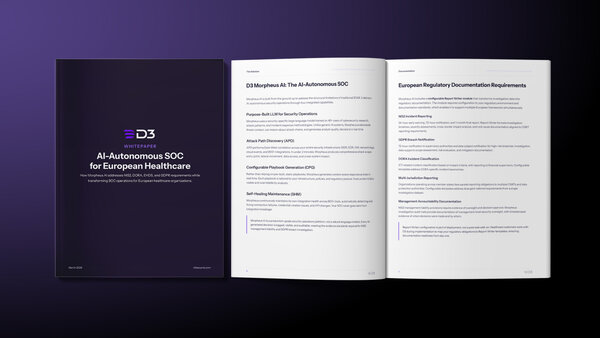
Executive Summary
European healthcare cybersecurity is entering its most regulated era. The convergence of NIS2, DORA, the European Health Data Space (EHDS), and the EU Healthcare Cybersecurity Action Plan creates overlapping obligations that require automated, auditable security operations. Manual processes scaled by adding headcount cannot address these requirements.
ENISA data shows ransomware accounts for 54% of cyber threats targeting European healthcare, with hospitals representing 42% of all healthcare incidents.1 NIS2 mandates 24-hour early warning, 72-hour notification, and one-month final reporting for significant incidents. These timelines are incompatible with traditional SOC investigation speeds.
The stakes are personal: NIS2 introduces direct management liability for cybersecurity failures, with fines reaching €10 million or 2% of global turnover.2 This paper examines why European healthcare organizations must move beyond legacy SOAR to AI-autonomous security operations, how the regulatory landscape demands this transition, and what D3 Security’s Morpheus AI delivers in production.
Table of Contents
- The European Healthcare Threat Landscape
- The European Regulatory Convergence
- Why Traditional SOC Models Fail Healthcare
- D3 Morpheus AI: The AI-Autonomous SOC
- European Regulatory Documentation Requirements
- Healthcare Use Cases for Morpheus AI
- Measured Impact in Production
- How Morpheus AI Addresses European Regulatory Requirements
- Questions for Your Evaluation
- Next Steps
The European Healthcare Threat Landscape
ENISA’s healthcare sector threat analysis identifies ransomware as the dominant threat vector, with hospitals as the primary target within the sector.1 European healthcare faces structural vulnerabilities similar to the U.S., including legacy systems, complex interconnections, and clinical availability requirements. These vulnerabilities are compounded by the diversity of member state regulatory environments and cross-border health data flows.
Attack Patterns Across Europe
ENISA data reveals distinct patterns in European healthcare attacks:
- Ransomware dominates at 54% of all threats, with attackers specifically targeting organizations during peak clinical activity periods
- Hospitals represent 42% of incidents, followed by health authorities (14%), pharmaceutical industry (9%), and health research (8%)
- Supply chain attacks are accelerating, with shared IT service providers for hospital groups creating single points of failure across multiple facilities
- Cross-border health data exchange (enabled by EHDS) expands the attack surface beyond national boundaries
The Workforce Crisis
Europe faces a cybersecurity workforce gap of over 300,000 positions, with healthcare among the most affected sectors.5 Smaller healthcare organizations (clinics, regional hospitals, social care providers) often lack dedicated security staff. NIS2 extends obligations to these organizations without a corresponding workforce supply to address them.
The European Regulatory Convergence
European healthcare organizations now face simultaneous compliance obligations under multiple frameworks. Each has distinct requirements, timelines, and enforcement mechanisms.
NIS2 Directive
The NIS2 Directive classifies healthcare as an essential sector, imposing the highest level of cybersecurity obligations.2 While the transposition deadline passed in October 2024, implementation varies significantly across member states.
NIS2 Incident Reporting Timeline
| Stage | Deadline | Requirement |
|---|---|---|
| Early warning | 24 hours | Initial notification to CSIRT/competent authority with preliminary assessment |
| Incident notification | 72 hours | Detailed report including severity, impact, indicators of compromise |
| Intermediate report | On request | Status updates on incident handling and recovery progress |
| Final report | 1 month | Comprehensive analysis: root cause, remediation, cross-border impact |
Germany’s NIS2 Implementation Act (NIS2UmsuCG) takes effect July 1, 2025, with sector-specific requirements for healthcare critical infrastructure operators.3 Organizations operating across multiple EU jurisdictions face complex compliance requirements as member states finalize transposition.
Management Liability
NIS2 Article 20 introduces a critical shift: management bodies of essential entities are personally liable for approving cybersecurity risk-management measures and overseeing their implementation.7 Hospital board members, clinic directors, and health system executives face personal legal exposure, not just organizational liability. Documented, auditable security operations are mandatory.
DORA (Digital Operational Resilience Act)
DORA has been in application since January 17, 2025.4 While primarily targeting financial entities, DORA applies to healthcare organizations classified as financial entities or those relying on ICT third-party service providers for critical functions. Key requirements include ICT risk management frameworks, incident classification and reporting, digital operational resilience testing, and third-party risk management.
European Health Data Space (EHDS)
The EHDS entered into force on March 26, 2025, establishing a framework for primary and secondary use of electronic health data.5 EHDS enables cross-border health data access for clinical care and research, creating new data flows that require security monitoring across national boundaries.
EU Healthcare Cybersecurity Action Plan
Published January 15, 2025, the EU Action Plan on Cybersecurity of Hospitals and Healthcare Providers establishes a sector-specific strategy including an early warning service through ENISA, rapid response funding for healthcare incidents, and sector-specific cybersecurity guidance.6
GDPR: The Persistent Baseline
GDPR’s 72-hour breach notification requirement predates NIS2 but remains fully applicable.12 Healthcare organizations must navigate overlapping notification obligations: GDPR to data protection authorities, NIS2 to CSIRTs, and potentially DORA to financial supervisors. These often have different timelines and reporting channels.
Why Traditional SOC Models Fail Healthcare
Legacy SOAR (Security Orchestration, Automation and Response) platforms were designed for enterprises with deep security benches and predictable threat patterns. European healthcare faces a different reality.
Speed Mismatch
24-hour NIS2 early warnings and 72-hour notifications demand triage in minutes, not hours. Traditional SOC playbooks require analyst input at every escalation point.
Staffing Gap
With 300,000+ unfilled cybersecurity roles across Europe, healthcare cannot build out analyst headcount. Scaling SOC operations with manual processes requires proportional hiring, which is impossible in the current labor market.
Audit Trail Failure
Management liability under NIS2 Article 20 requires documented proof of oversight and decision approval. Manual investigations produce inconsistent, incomplete records that won’t survive regulatory scrutiny.
Multi-Framework Complexity
NIS2, GDPR, DORA, and EHDS each demand specific incident documentation and reporting formats. Traditional SOCs generate one report. Healthcare needs four, simultaneously, from one investigation.
Alert Fatigue
Healthcare organizations commonly report 100,000+ daily alerts across their SIEM infrastructure. Manual triage of this volume is impossible, leading to missed incidents and unmet regulatory timelines.
D3 Morpheus AI: The AI-Autonomous SOC
Morpheus AI is built from the ground up to address the structural limitations of traditional SOAR. It delivers AI-autonomous security operations through four integrated capabilities.
Cybersecurity Triage Reasoning Graph
Morpheus uses a security-specific large language model trained on 40+ years of cybersecurity research, attack patterns, and incident response methodologies. Unlike generic AI systems, Morpheus understands threat context, can reason about attack chains, and generates analyst-quality decisions in real time.
Attack Path Discovery (APD)
APD performs East-West correlation across your entire security infrastructure: SIEM, EDR, IAM, network logs, cloud events, and 800+ integrations. In under 2 minutes, Morpheus produces comprehensive attack scope: entry point, lateral movement, data access, and cross-system impact.
Configurable Playbook Generation (CPG)
Rather than relying on pre-built, static playbooks, Morpheus generates context-aware response actions in real time. Each playbook is tailored to your infrastructure, policies, and regulatory posture. Every action is fully visible and overridable by analysts.
Self-Healing Maintenance (SHM)
Morpheus continuously maintains its own integration health across 800+ tools, automatically detecting and fixing connection failures, credential rotation issues, and API changes. Your SOC never goes dark from integration breakage.
European Regulatory Documentation Requirements
Morpheus AI includes a configurable Report Writer module that transforms investigation data into regulatory documentation. The module requires configuration to your regulatory environment and documentation standards, which enables it to support multiple European frameworks simultaneously.
NIS2 Incident Reporting
24-hour early warning, 72-hour notification, and 1-month final report. Report Writer formats investigation timelines, severity assessments, cross-border impact analysis, and root cause documentation aligned to CSIRT reporting requirements.
GDPR Breach Notification
72-hour notification to supervisory authorities and data subject notification for high-risk breaches. Investigation data supports scope assessment, risk evaluation, and mitigation documentation.
DORA Incident Classification
ICT-related incident classification based on impact criteria, with reporting to financial supervisors. Configurable templates address DORA-specific incident taxonomies.
Multi-Jurisdiction Reporting
Organizations operating across member states face parallel reporting obligations to multiple CSIRTs and data protection authorities. Configurable templates address divergent national requirements from a single investigation dataset.
Management Accountability Documentation
NIS2 management liability provisions require evidence of oversight and decision approval. Morpheus investigation audit trails provide documentation of management-level security oversight, with timestamped evidence of when decisions were made and by whom.
Healthcare Use Cases for Morpheus AI
Ransomware Response
Morpheus autonomous triage and attack path discovery deliver L2-quality incident assessment in under 2 minutes, enabling rapid severity determination and 24-hour NIS2 early warnings. APD identifies encrypted file signatures, lateral movement, and ransom note distribution paths.
ePHI Exfiltration
APD traces data movement across SIEM, DLP, cloud storage logs, and egress monitoring tools to determine scope of protected health information accessed or exfiltrated. Report Writer formats findings for GDPR breach notification and data subject assessment.
Supply Chain Compromise
East-West correlation across hospital IT service provider connections detects anomalous patterns in shared infrastructure. Morpheus flags suspicious activity on shared EDR sensors or network segments before it spreads across hospital groups.
Medical Device Security
Medical devices (infusion pumps, monitors, lab analyzers) often operate on isolated networks. Morpheus integrates network TAPs and device logs to detect unauthorized configuration changes or suspicious polling behavior that could compromise clinical safety.
Human-in-the-Loop Triage
Morpheus generates playbooks analysts can inspect and override in real time. For sensitive healthcare operations, analysts maintain full visibility and control while benefiting from AI-speed investigation correlation and decision ranking.
Measured Impact in Production
Morpheus deployments across healthcare organizations (US and international) deliver consistent operational gains:
These metrics come from production deployments where Morpheus has been operational for 6+ months. They represent healthcare organizations of various sizes, from 200-bed regional hospitals to multi-hospital systems with 10,000+ clinical staff. Metrics include both ransomware incidents and routine security operations.
How Morpheus AI Addresses European Regulatory Requirements
The convergence of NIS2, DORA, EHDS, and GDPR creates requirements that align directly with Morpheus AI’s autonomous capabilities:
| Regulatory Requirement | How Morpheus AI Helps |
|---|---|
| NIS2 24-hour early warning | Autonomous triage delivers L2-quality incident assessment in under 2 minutes, enabling rapid severity determination for early warning notifications |
| NIS2 72-hour notification | Attack Path Discovery produces comprehensive incident scope and impact analysis within the notification window |
| NIS2 1-month final report | Complete investigation records, including timestamped evidence, correlation findings, and remediation actions, provide the foundation for root cause analysis |
| GDPR 72-hour breach notification | Rapid scope assessment identifies affected data subjects and data types for supervisory authority notification |
| DORA ICT risk management | Continuous monitoring across 800+ integrations with self-healing maintenance supports ICT operational resilience |
| DORA third-party risk | East-West correlation monitors ICT service provider connections for anomalous patterns indicating supply chain compromise |
| EHDS cross-border data security | APD traces data flows across tool boundaries, including cross-border health data exchanges under the EHDS framework |
| Management liability (NIS2 Art. 20) | Auditable investigation records document oversight and decision-making for management accountability |
Questions for Your Evaluation
Before evaluating any AI-autonomous SOC platform (including Morpheus AI), European healthcare security leaders should consider:
- NIS2 readiness: Can your current SOC support the 24-hour early warning deadline? Do you have the investigation speed to produce a substantive 72-hour notification?
- Multi-framework compliance: How are you managing overlapping obligations under NIS2, GDPR, DORA, and EHDS? Are you addressing each framework separately or seeking unified capabilities?
- Management liability exposure: What documentation exists to demonstrate management oversight of cybersecurity risk-management measures? Would it survive regulatory scrutiny?
- Cross-border operations: If you operate across member states, how are you handling divergent NIS2 transpositions? Can your SOC generate jurisdiction-specific incident reports?
- Workforce sustainability: With 300,000+ unfilled cybersecurity positions across Europe, how does your SOC model scale without proportional headcount increases?
- AI verification: Does the platform provide full code visibility for every automated decision? Can analysts inspect and override AI-generated playbooks?
Next Steps
- Schedule a technical demonstration tailored to your healthcare environment and European regulatory requirements.
- Request a regulatory compliance mapping showing how Morpheus AI supports NIS2, GDPR, DORA, and EHDS obligations for your specific jurisdictions.
- Review production metrics from deployments, including alert reduction ratios, triage time, and analyst hour recovery.
- Evaluate Report Writer configuration for your specific regulatory documentation needs across applicable EU frameworks and member state requirements.
- Assess multi-jurisdiction capability for generating parallel incident reports that map to divergent national transposition requirements.
Footnotes
1 ENISA Threat Landscape: Health Sector, 2023–2025. Ransomware accounts for 54% of healthcare cyber threats; hospitals represent 42% of incidents.
2 Directive (EU) 2022/2555 (NIS2). Transposition deadline: October 17, 2024. NIS2 Directive, Article 34. Essential entities: fines up to €10M or 2% of worldwide annual turnover, whichever is higher.
3 Germany NIS2 Implementation Act (NIS2UmsuCG), effective July 1, 2025. Germany’s transposition adds sector-specific requirements for healthcare critical infrastructure operators.
4 Regulation (EU) 2022/2554 (DORA), in application since January 17, 2025. Applies to healthcare organizations classified as financial entities or relying on ICT third-party service providers for critical functions.
5 Regulation (EU) 2025/327 (European Health Data Space), entered into force March 26, 2025. Establishes framework for primary and secondary use of electronic health data with security requirements.
6 European Commission, EU Action Plan on the Cybersecurity of Hospitals and Healthcare Providers, January 15, 2025. Includes early warning service, rapid response funding, and sector-specific guidance.
7 NIS2 Directive, Article 20. Management bodies of essential entities are personally liable for non-compliance, including approval of cybersecurity risk-management measures and oversight of implementation.
8 IBM/Ponemon, Cost of a Data Breach Report 2025. European healthcare breach costs vary by country but average significantly above cross-industry means.
9 ISC2, 2024 Cybersecurity Workforce Study. European cybersecurity workforce gap estimated at 300,000+ positions, with healthcare among the most affected sectors.
10 Gartner analysts (multiple 2024–2025 reports) have warned that “agent washing” (rebranding legacy automation as AI) is widespread in cybersecurity.
11 Gartner analysts (multiple 2024–2025 reports) have warned that “agent washing” (rebranding legacy automation as AI) is widespread in cybersecurity.
12 Regulation (EU) 2016/679 (GDPR), Article 33. Personal data breach notification to supervisory authority within 72 hours. Article 34: notification to data subjects when high risk to rights and freedoms.
13 CERT-EU and ENISA joint advisories, 2024–2025. Coordinated vulnerability disclosure and incident response frameworks for EU healthcare organizations.