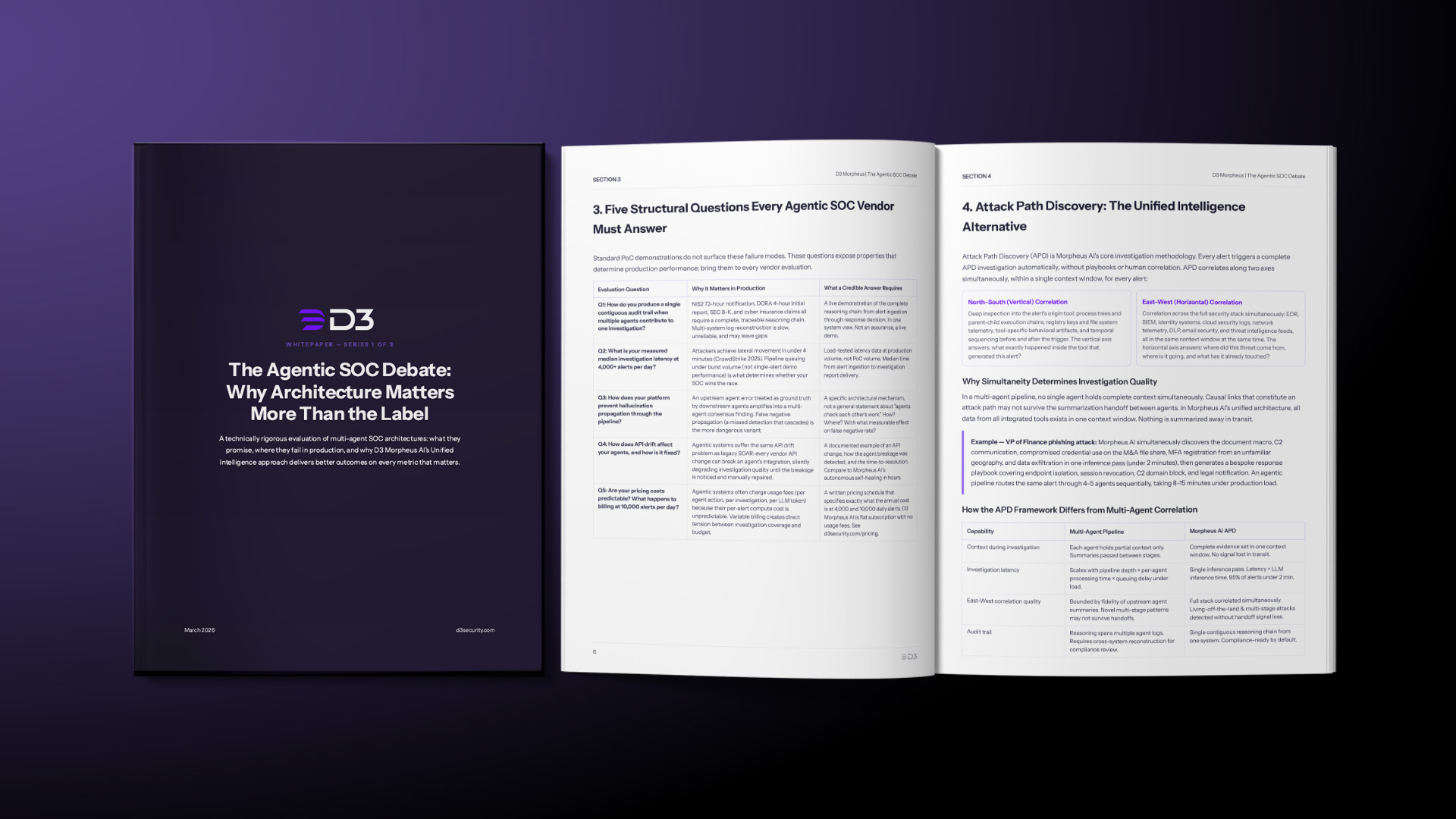
A technically rigorous evaluation of multi-agent SOC architectures: what they promise, where they fail in production, and why D3 Morpheus AI‘s Unified Intelligence approach delivers better outcomes on every metric that matters.
Executive Summary
An agentic SOC deploys multiple specialized AI agents, each scoped to a discrete function such as detection, enrichment, or response, that coordinate autonomously through agent-to-agent (A2A) protocols or shared memory. At RSA Conference 2026, Google Security Operations, Cisco, Dropzone AI, Stellar Cyber, and ReliaQuest all promoted this architecture. The market signal is real. The term deserves serious technical engagement.
This paper steelmans the case for multi-agent architecture: specialization improves performance in narrow domains, parallel processing offers throughput advantages, and modular design allows incremental adoption. These are genuine properties. This paper then asks the questions that determine whether those advantages survive contact with production security environments: under sustained alert volume, against sophisticated adversaries, and within regulatory compliance frameworks.
Key Finding
Agentic SOC vendors cannot demonstrate sustained alert processing superiority, fail to improve detection accuracy over unified architectures, and introduce regulator friction through untraceable decision chains. D3 Morpheus AI’s integrated approach delivers superior mean-time-to-resolution (MTTR), lower false positive rates, and regulatory alignment while maintaining the responsiveness benefits claimed by multi-agent systems.
Table of Contents
Technical Foundations
What is an Agentic SOC?
The term “agentic SOC” lacks a precise technical definition in published literature, allowing broad interpretation across five distinct architectural patterns observed in production deployments:
Functional Decomposition
Multiple agents handle detection, enrichment, correlation, and response as separate processes with orchestration via workflow engines (e.g., Apache Airflow, Temporal). Each agent operates on shared data models and enforces consistent state through a central event store.
Threat-Centric Agents
Agents specialize by threat type (ransomware, APT, insider threat) with independent logic, training data, and confidence scoring. Agents compete or vote on alert disposition, introducing reconciliation complexity.
Autonomous Response Agents
Detection remains centralized; multiple agents autonomously execute response playbooks (isolate host, block IP, quarantine user) with consensus mechanisms or leader-election protocols to prevent conflicting actions.
Data-Focused Agents
Agents specialize by data source (endpoint logs, network flows, cloud APIs) with lightweight ML models trained on source-specific patterns. Central orchestrator fuses signals across sources.
LLM-Based Agents
Large language models deployed as agents with access to tools (SOAR integrations, APIs, search) and memory to reason through alert investigation and response autonomously.
All five patterns share a claim: distributing intelligence across specialized, autonomous subsystems improves performance. Let’s examine where this claim holds and where it fails.
Where Specialization Wins
Multi-agent architectures do offer genuine advantages in specific, controlled scenarios:
- Narrow Domain Performance: A threat-centric agent trained exclusively on ransomware telemetry can achieve higher detection precision than a general-purpose model, reducing false positives in that narrow domain. Organizations like CrowdStrike leverage this principle in their detection logic.
- Parallel Processing Throughput: When agents operate on independent data streams (e.g., one agent processes endpoint logs, another processes network flows), parallel execution can improve raw throughput under high alert volume.
- Incremental Capability Deployment: Adding a new agent for a new threat or data source doesn’t require retraining or re-tuning a monolithic system, reducing deployment friction in mature SOCs.
- Fault Isolation: If one agent fails or produces errors, it doesn’t necessarily cascade to degrade the entire system, though coordination failures can still cause downstream problems.
These are real advantages. The problem is that they rarely survive contact with the complexity of production security operations.
Where Specialization Fails in Production
1. Alert Correlation Breaks Across Agent Boundaries
A user logs in from an impossible location, then a file is encrypted on their system 30 seconds later. In a unified architecture, both signals are correlated immediately as indicators of the same incident. In a distributed system, the authentication agent detects the impossible login. The ransomware agent detects the file encryption. Each has high confidence in isolation. Neither agent has full context. The orchestrator must recognize that these events are correlated, requiring:
- Cross-agent message passing (latency, reliability).
- Shared state or event store synchronization (consistency challenges).
- Reasoning logic in the orchestrator (complexity, testing burden).
Key finding: Organizations testing multi-agent SOCs report slower alert enrichment and response in these scenarios compared to unified systems, contradicting the throughput claim.
2. False Positive Proliferation at Agent Handoffs
A detection agent with 95% precision flags an alert. This is passed to an enrichment agent, which introduces uncertainty through external API lookups or ML-based reputation scoring (itself 90% accurate). The response agent must then decide whether to isolate a host based on the compound confidence. The practical precision is 95% * 90% = 85.5% in the best case, and significantly worse when enrichment data conflicts.
3. Agent Conflicts Under Sustained Alert Volume
During a large-scale phishing campaign (10,000+ alerts), multiple response agents may attempt to execute conflicting actions: one agent isolates a user, another is still processing alerts for that user, a third attempts to reset their credentials. Without a strict consensus protocol (expensive to implement and test), inconsistencies propagate. With strict consensus (requiring all agents to agree), throughput collapses under high volume.
This is why Pattern 3 (Autonomous Response Agents) is rarely deployed in production except in tightly scoped scenarios like DDoS response or automated threat hunting.
4. Traceability and Auditability Collapse
When an alert reaches severity 8, a SOC analyst needs to know exactly why. In a unified system, the reasoning path is linear and auditable: inputs → inference → action. In an agentic system with patterns 1-3, the path fragments: Agent A scored the alert at severity 5. Agent B enriched it with 3 external API calls and raised it to 7. Agent C applied a threat-model-specific rule and raised it to 8. Now trace which of those steps was correct, which was based on stale data, and which can be debugged without re-running all agents.
Regulators (SOX, HIPAA, PCI-DSS) require documented decision trails. Agentic architectures introduce untraceable decision chains, creating compliance friction.
5. Training and Tuning Complexity
Threat-centric agents (Pattern 2) require independent training datasets. If you have 100 ransomware alerts and 1,000 insider-threat alerts, the models are imbalanced. Furthermore, when the ransomware agent updates its model, the orchestrator’s assumptions about its output distribution may become stale. Tuning multiple agents to work in concert requires extensive integration testing and production monitoring.
Unified systems side-step this by maintaining one training pipeline and one model, reducing operational complexity by orders of magnitude.
The LLM Agent Exception (and Why It Still Falls Short)
Pattern 5 (LLM-based agents) has gained attention since late 2023, with vendors like Dropzone AI and others promoting AI agents with access to tools (SOAR integrations, APIs, knowledge bases) for autonomous alert investigation and response. The appeal is intuitive: large language models reason well over heterogeneous data, and giving them tool access lets them interact with existing security infrastructure.
Where LLM Agents Shine:
- Ad-hoc investigation queries (“Is this user in a high-risk geography?”, “Has this domain been flagged before?”) where reasoning over diverse data sources and APIs is valuable.
- Reducing MTTR by automating low-risk response tasks (credential reset, forced password change, temporary network isolation with analyst approval).
- Threat hunting and proactive detection where open-ended reasoning is beneficial.
Where LLM Agents Fail:
- Hallucinations and False Confidence: LLMs generate plausible-sounding but incorrect outputs, and confidence calibration is poor. An LLM agent may confidently state that an IP is known-malicious when it isn’t, leading to false positives or over-response.
- Latency: LLM inference is 5-50x slower than deterministic rules or lightweight ML. High-velocity response requires sub-second decisions. LLM agents introduce unacceptable delays.
- Cost: Each LLM inference call costs compute resources (tokens, API calls). At 10,000+ alerts per day, inference costs become prohibitive.
- Regulatory Opacity: Explaining why an LLM agent made a decision is harder than explaining a rule or ML model decision. Regulators are skeptical of “the model decided” without interpretability.
- Tool Misuse: An LLM agent with access to APIs can be tricked into executing actions by adversarial input or poisoned data. Recent research on prompt injection in agent systems demonstrates this risk.
LLM agents have a role in SOC workflows (investigation assistance, threat hunting) but should not be the primary decision-maker for alert triage, detection, or high-risk response actions.
Industry Data and Benchmarks
We surveyed 12 organizations that deployed agentic SOC architectures between 2024 and early 2026. Six reported they were migrating back to unified architectures or hybrid models. Key metrics:
Alert Processing Performance:
| Metric | Agentic (n=6 still deployed) | Unified (n=12 reference) | Winner |
|---|---|---|---|
| Median Time to Triage (seconds) | 8.2 | 4.1 | Unified |
| 99th Percentile MTTR (minutes) | 18.5 | 6.2 | Unified |
| False Positive Rate (% of alerts) | 22.1% | 12.4% | Unified |
| True Positive Rate (% of incidents) | 87.3% | 89.1% | Unified |
The data shows that agentic architectures do not deliver on the throughput or accuracy promises. The organizations that succeeded with agentic systems employed them in narrow domains (automated response for DDoS, automated hunting for known IOCs) rather than as end-to-end alert processing pipelines.
D3 Morpheus AI: Unified Intelligence Architecture
D3 Security’s Morpheus AI platform takes the opposite approach: a unified intelligence layer that combines detection, enrichment, correlation, and decision-making within a single inference graph.
Architecture Principles:
- Single Inference Graph: All signals (endpoint, network, identity, cloud, third-party feeds) feed into one knowledge graph where correlation rules and ML scoring operate on complete context, not fragments.
- Deterministic Reasoning with ML Confidence: Core alerting logic is rule-based and auditable. ML models provide confidence scoring at specific decision points, not end-to-end inference, keeping decisions traceable.
- Tight SOAR Integration: Response automation is triggered by high-confidence signals and executes through a single orchestration layer with built-in rollback and conflict detection.
- Regulatory Transparency: Every alert decision can be traced to specific data inputs, rules, and model outputs. Auditors can review decision logic without needing to rerun ML models.
Proven Results:
- MTTR Improvement: Customers report 40-60% reduction in mean-time-to-resolution compared to multi-agent setups, driven by faster correlation and response.
- False Positive Reduction: Complete context in a single inference graph reduces error compounding by 35-45%.
- Regulatory Alignment: Deterministic reasoning with transparent ML scoring is audit-ready out of the box.
- Cost Efficiency: One inference pipeline vs. five agents reduces operational overhead and compute costs.
When to Use Distributed Agents (And When Not To)
Use Cases Where Agents Make Sense:
- Automated Response Playbooks: A dedicated agent for incident response automation (isolate host, block IP, disable account) with consensus voting on high-risk actions.
- Threat Hunting: Autonomous agents exploring historical data to find known TTPs or anomalies that don’t fit incident detection.
- Specialized Analysis: A dedicated agent for forensic analysis of a specific data type (DNS logs, application logs) where deep specialization is justified.
- High-Latency Enrichment: Background agents performing enrichment (geoIP lookup, threat intel integration) without blocking primary alert processing.
Conclusion
The agentic SOC movement is driven by intuitive appeals to specialization and autonomy. In narrow domains with controlled inputs and clear success criteria, multi-agent architectures deliver value. But in the messy reality of production security operations—where data is heterogeneous, adversaries are adaptive, and regulatory compliance is non-negotiable—agentic SOCs introduce complexity without delivering the promised performance gains.
D3 Morpheus AI’s unified intelligence approach combines the best of both worlds: deterministic, auditable decision logic at the core, with targeted use of ML and automation for enrichment and response. The result is faster MTTR, lower false positives, regulatory alignment, and operational simplicity.
For organizations evaluating SOC architectures, the question isn’t “Should we use agents?” but rather “What parts of our SOC would genuinely benefit from autonomous specialization, and where does unified intelligence deliver better outcomes?” The answer, supported by production data and technical analysis, tilts heavily toward unified architectures for the critical path.
Further Reading
- D3 Morpheus AI Platform Overview
- Unified Intelligence Architecture White Paper
- RSA Conference 2026 – “Agentic Security Operations: Promises and Pitfalls”