Executive Summary
Your SOC is almost certainly not triaging its alerts. Not all of them. Not even close.
This whitepaper presents a math-driven analysis that exposes an inconvenient truth hiding in plain sight across the cybersecurity industry. Using widely accepted benchmarks—a 20-minute L1 triage standard, a 40-minute L2 investigation norm, and a moderate daily volume of 2,000 alerts—we calculate that a fully staffed SOC requires approximately 152 analyst FTEs just for triage and investigation. The vast majority of organizations operate at roughly one-third of that headcount.
The Core Contradiction
There are only two possibilities: either the SOC has the budget for ~152 analyst FTEs ($17–$20M/year in compensation alone), or alerts are not being properly triaged. For most organizations, the answer is the latter. Every untriaged alert is an open door for an adversary, and post-breach forensics confirm the pattern repeatedly—the detection tools fired, but the process failed to act.
The Solution: AI-Autonomous Triage
This paper makes the case that AI-autonomous SOC triage is not a future aspiration but an immediate operational necessity. Conventional remedies fail: hiring at scale is impossible, SOAR cannot reason, MSSPs face the same math, and tuning creates blind spots. Purpose-built AI platforms like D3 Security’s Morpheus AI—powered by a cybersecurity-trained LLM and Attack Path Discovery—can fully triage 100% of alerts in 30–90 seconds each, with deeper and more consistent analysis than time-starved human analysts can deliver.
Table of Contents
- The Scope of the Problem: Alert Overload Is the Norm
- The ROI Math: When the Numbers Don’t Lie
- The Contradiction: Either the Budget Exists or the Triage Doesn’t
- Why Conventional Approaches Fail
- The AI-Autonomous SOC Triage Paradigm
- Morpheus AI: Purpose-Built for SOC Triage
- The Human-AI SOC
- Quantifying the ROI
- The Uncomfortable Truth & Conclusion
- Appendix A: Alert Volume Scaling Analysis
1. The Scope of the Problem: Alert Overload Is the Norm
The modern enterprise attack surface generates an extraordinary volume of telemetry. Firewalls, EDR platforms, identity providers, cloud workload protection tools, email gateways, and SaaS security posture management systems each produce their own stream of alerts. A typical mid-to-large enterprise SOC ingests between 1,000 and 10,000 alerts per day, with some financial services and critical infrastructure organizations exceeding 20,000.
The challenge is not simply volume—it is the compounding effect of volume, velocity, and variety. Alerts arrive from dozens of disparate tools, each with its own taxonomy, severity scale, and contextual data model. An L1 analyst must normalize the alert, correlate it against known indicators of compromise (IOCs), check asset criticality, examine user behavior baselines, and determine whether the event warrants escalation.
1.1 Industry Benchmarks for Triage Time
Multiple industry studies and practitioner surveys converge on the following time benchmarks for thorough alert triage:
| Triage Tier | Standard Time | Activities Performed |
|---|---|---|
| L1 Triage | 20 minutes | Alert normalization, IOC correlation, asset criticality check, behavior baseline review, escalation decision |
| L2 Investigation | 40 minutes | Deep correlation, timeline reconstruction, lateral movement analysis, containment scoping, disposition |
These numbers assume the analyst has adequate tooling, playbook documentation, and SIEM enrichment. In practice, many environments lack one or more of these, which pushes actual triage times even higher.
2. The ROI Math: When the Numbers Don’t Lie
To expose the contradiction at the heart of SOC operations, we work through a concrete scenario using widely accepted industry parameters.
2.1 Scenario Parameters
2.2 Full-Staff Requirement Calculation
L1 Tier Requirement
Total L1 triage workload = 2,000 alerts × 20 minutes = 40,000 analyst-minutes per day. With 420 productive minutes per FTE per day: Required FTEs = 40,000 ÷ 420 = 95.2 FTEs (roughly 32 analysts per shift).
L2 Tier Requirement
Escalated alerts = 2,000 × 30% = 600 per day. Total L2 workload = 600 × 40 min = 24,000 analyst-minutes/day. Required L2 FTEs = 24,000 ÷ 420 = 57.1 FTEs (~19 analysts per shift).
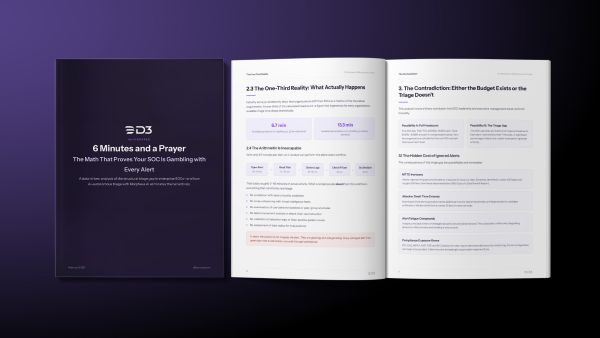
2.3 The One-Third Reality: What Actually Happens
Industry surveys consistently show that organizations staff their SOCs at a fraction of the theoretical requirement. At one-third of the calculated headcount—a figure that is generous for many organizations—available triage time drops dramatically.
2.4 The Arithmetic Is Inescapable
With only 6.7 minutes per alert, an L1 analyst can perform this abbreviated workflow:
That totals roughly 3–4.5 minutes of actual activity. What is conspicuously absent from this workflow is everything that constitutes real triage:
- No correlation with asset criticality databases
- No cross-referencing with threat intelligence feeds
- No examination of user behavior baselines or peer-group anomalies
- No lateral movement analysis or attack chain reconstruction
- No validation of detection logic or false-positive pattern review
- No assessment of blast radius for true positives
3. The Contradiction: Either the Budget Exists or the Triage Doesn’t
This analysis forces a binary conclusion that SOC leadership and executive management must confront honestly:
Possibility A: Full Headcount
The SOC has ~152 FTEs at $110K–$130K each. Total: $16.7M–$19.8M annually in compensation alone. Very few organizations outside the Fortune 100 maintain this investment level.
Possibility B: The Triage Gap
The SOC operates at a fraction of required headcount. Each alert receives less than 7 minutes. A significant percentage of alerts are rubber-stamped or ignored entirely.
3.1 The Hidden Cost of Ignored Alerts
The consequences of this triage gap are quantifiable and immediate:
MTTD Increases
Alerts representing genuine threats sit in queues for hours or days. Breaches identified in under 200 days cost roughly $1M less than those discovered later (IBM Cost of a Data Breach Report).
Attacker Dwell Time Extends
Dismissed initial alerts give adversaries additional time for lateral movement, privilege escalation, and data exfiltration. Median dwell time exceeds 10 days in many verticals.
Alert Fatigue Compounds
Analysts who lack time to investigate properly become desensitized. They close alerts reflexively, degrading detection effectiveness and creating a vicious cycle.
Compliance Exposure Grows
PCI-DSS, HIPAA, NIST CSF, and SEC disclosure rules require demonstrable security monitoring. Cursory triage does not meet this standard. Cyber insurers increasingly require alert response SLAs.
3.2 The Human Toll
Beyond financial and risk implications, the triage gap inflicts measurable damage on the SOC workforce. Analysts tasked with an impossible workload experience chronic burnout, high turnover (the industry average exceeds 30% annually), and a pervasive sense of futility. The cybersecurity workforce shortage—estimated at 3.4 million unfilled positions globally—means that simply hiring more analysts is not a viable strategy.
4. Why Conventional Approaches Fail
4.1 Hiring More Analysts
Staffing to mathematically required levels is cost-prohibitive ($16.7M–$19.8M annually). The global talent shortage makes it operationally impossible. Recruitment timelines stretch 6–12 months per senior analyst.
4.2 Tuning Down Alert Volume
Raising detection thresholds and suppressing noisy rules reduces volume but creates blind spots. Adversaries who understand thresholds can deliberately operate below them. Every suppressed alert category is a voluntary monitoring gap.
4.3 SOAR Playbook Automation
Security Orchestration, Automation, and Response (SOAR) platforms provide workflow automation via deterministic, rule-based playbooks. They can enrich alerts but cannot reason about novel attack patterns, assess ambiguous signals, or make nuanced triage decisions. SOAR reduces mechanical burden but does not replace cognitive triage.
4.4 Outsourcing to MSSPs
Managed Security Service Providers face the same fundamental math. Their analysts still require 15–20 minutes per alert. MSSPs often address volume the same way in-house SOCs do: cursory review and obvious-severity escalation. The triage deficit is transferred, not eliminated.
5. The AI-Autonomous SOC Triage Paradigm
The only way to resolve the structural mismatch between alert volume and human triage capacity is to fundamentally change the triage model. AI-autonomous triage is not a supplementary tool—it is a first-line triage engine performing full cognitive L1 and L2 investigation at machine speed and unlimited scale.
5.1 What AI-Autonomous Triage Means
AI-autonomous triage is distinct from traditional automation in a critical respect: it involves reasoning, not just rule execution. A properly built AI triage system performs contextual analysis that mirrors—and in many dimensions exceeds—what a skilled human analyst does:
- Contextual normalization: Parsing and standardizing alert data from heterogeneous sources into a unified analytical framework
- Multi-source correlation: Cross-referencing against threat intelligence, asset inventory, vulnerability data, and user behavior baselines simultaneously
- Attack chain reasoning: Determining whether the alert represents an isolated event or a step in a multi-stage attack sequence
- False positive assessment: Evaluating likelihood based on historical patterns, detection rule fidelity, and environmental context
- Severity re-calibration: Adjusting raw severity based on asset criticality, user privilege level, and data sensitivity
- Disposition recommendation: Providing a fully justified triage decision with complete evidence trail
5.2 The Scale Advantage
A human analyst can triage 21–28 alerts per 7-hour productive shift at industry-standard depth. An AI triage platform processes the same alert in 30–90 seconds with deeper and more consistent analysis. For 2,000 daily alerts, AI triage completes the entire L1 workload in 28–60 hours of compute time—easily handled by modest cloud deployment processing alerts in parallel.
5.3 Consistency and Auditability
Human triage is inherently variable. Two analysts examining the same alert frequently reach different conclusions, and the same analyst’s judgment degrades measurably over a shift. AI triage produces consistent, repeatable results with a complete reasoning chain that serves as an audit trail for compliance and post-incident review.
6. Morpheus AI: Purpose-Built for SOC Triage
Morpheus AI represents the next generation of AI-autonomous SOC triage, purpose-built with a cybersecurity-trained large language model (LLM) and Attack Path Discovery methodology that goes far beyond what generic AI tools or traditional SOAR can deliver.
6.1 Cybersecurity-Trained LLM
Unlike general-purpose LLMs superficially adapted for security, Morpheus AI’s core model has been trained extensively on cybersecurity-specific corpora:
- MITRE ATT&CK framework techniques, sub-techniques, and real-world procedure examples
- Historical incident response reports and threat intelligence publications
- Detection engineering rule logic and known false-positive patterns across major SIEM and EDR platforms
- Network protocol analysis, malware behavior taxonomies, and vulnerability exploitation chains
- Regulatory and compliance frameworks (NIST, ISO 27001, PCI-DSS, HIPAA)
When Morpheus AI encounters a Kerberoasting alert, it doesn’t merely recognize the term—it understands the attack mechanics, typical indicator patterns, likely follow-on activities, and the environmental factors that distinguish a true positive from a benign service account renewal.
6.2 Attack Path Discovery
Morpheus AI’s most differentiating capability is Attack Path Discovery—an analytical methodology that treats each alert not as an isolated event but as a potential node in an adversary’s operational chain. When Morpheus AI triages an alert, it automatically:
- Maps the alert to MITRE ATT&CK tactics, techniques, and sub-techniques
- Queries for correlated events across reconnaissance, initial access, execution, persistence, privilege escalation, lateral movement, collection, and exfiltration stages
- Assesses the blast radius by identifying connected assets, trust relationships, and accessible data stores
- Evaluates feasibility based on known vulnerabilities, misconfigurations, and active defensive controls
- Generates a visual attack path graph for analyst review on escalated cases
6.3 Full Triage on Every Alert
The most important operational impact: Morpheus AI eliminates the triage gap entirely. Every alert—all 2,000 per day, all 730,000 per year—receives a full, deep triage. No shortcuts, no cursory glances, no alerts silently aging out in a queue. For the first time, SOC leadership can credibly state that every alert has been investigated and dispositioned with a documented rationale.
7. The Human-AI SOC: Elevating Analysts, Not Replacing Them
AI-autonomous triage does not eliminate the need for human analysts. It fundamentally restructures how their time and expertise are allocated. When Morpheus AI handles the full L1 triage workload and provides deep context for escalated events, human analysts are freed to focus on work that genuinely requires human judgment:
Threat Hunting
Proactive, hypothesis-driven investigation that uncovers threats detection tools haven’t flagged yet.
Incident Response
Coordination and cross-functional communication during active security incidents.
Detection Engineering
Building and refining detection rules that feed the alert pipeline—improving the system itself.
Security Architecture
Control validation, adversary tradecraft analysis, and mentoring junior analysts.
In this model, the SOC’s analysts are not overwhelmed by 63 alerts each per day with insufficient time. Instead, they become focused investigators reviewing the 5–10% of alerts that Morpheus AI has flagged as genuinely suspicious, armed with full attack-path context and a complete evidence package. Their job transitions from frantic alert-closing to deliberate, high-value security work.
8. Quantifying the ROI
The financial case for AI-autonomous triage is compelling when measured against the alternatives.
8.1 Cost Avoidance: Analyst Hiring
To close the triage gap by hiring alone, the SOC would need approximately 100 additional FTEs. At $120,000 average fully burdened cost, this represents $12 million per year—assuming the organization could find and hire that many qualified analysts, which is unlikely in the current talent market.
8.2 Risk Reduction: Breach Cost Avoidance
The average cost of a data breach reached $4.88 million in 2024 (IBM). Organizations with AI-driven security operations report breach costs $1.76 million lower. If Morpheus AI prevents even one additional breach per year by catching an alert that would otherwise have been rubber-stamped, the platform pays for itself many times over.
8.3 Operational Efficiency
By reducing alerts requiring human review by 90–95%, Morpheus AI enables the existing team to operate with dramatically higher effectiveness. SOC managers can redeploy analysts toward threat hunting, detection engineering, and incident response—activities that directly reduce organizational risk posture.
9. The Uncomfortable Truth SOC Leaders Must Face
The cybersecurity industry has, for too long, operated under a tacit agreement to avoid quantifying the triage gap. Vendors sell detection tools that generate alerts. SOCs staff analysts to handle those alerts. But no one does the arithmetic to confirm that the alerts are actually being investigated.
The math is unambiguous: a SOC operating at one-third of required headcount physically cannot triage all alerts at the depth the industry considers minimally adequate. The remaining two-thirds of the workload receives a sub-six-minute cursory glance—or is ignored entirely.
This is not a hypothetical risk. Breach after breach, post-incident forensics reveal the same pattern: the alert fired, but it was closed without investigation, lost in a queue, or triaged so quickly that the analyst missed the critical context. The tools detected the threat. The process failed to act on it.
Conclusion and Recommendation
The SOC alert triage crisis is a math problem, and math problems have solutions. The industry’s current approach—hiring analysts to a fraction of the required level and hoping they can triage fast enough—is demonstrably failing.
AI-autonomous triage, purpose-built for cybersecurity and powered by Attack Path Discovery, represents the only scalable solution to this structural deficit. Morpheus AI does not merely augment the SOC—it closes the gap between what the SOC is supposed to do and what it is actually capable of doing.
Deploy AI-Autonomous Triage
Ensure every alert receives the full investigation it demands—100% coverage, zero queue backlogs.
Reallocate Human Analysts
Redirect analyst expertise to high-judgment work: threat hunting, detection engineering, and incident response.
Eliminate Hidden Risk
Close the untriaged alert gap permanently. Every alert investigated, every disposition documented.
Appendix A: Alert Volume Scaling Analysis
The following table extends the ROI analysis across a range of daily alert volumes, illustrating how the triage gap widens as volume increases.
| Daily Alerts | L1 FTEs Required | L2 FTEs Required | Total FTEs | ⅓ Staff FTEs | Annual Cost Gap |
|---|---|---|---|---|---|
| 500 | 24 | 14 | 38 | 13 | $3.0M |
| 1,000 | 48 | 29 | 77 | 26 | $6.1M |
| 2,000 | 95 | 57 | 152 | 51 | $12.1M |
| 5,000 | 238 | 143 | 381 | 127 | $30.5M |
| 10,000 | 476 | 286 | 762 | 254 | $60.9M |
| 20,000 | 952 | 571 | 1,523 | 508 | $121.8M |
The minutes-per-alert figure remains constant at one-third staffing (6.7 minutes) regardless of volume, because both workload and staffing scale proportionally. The absolute number of ignored alerts and the cost gap, however, grow linearly—making the case for AI-autonomous triage even more compelling at higher volumes.