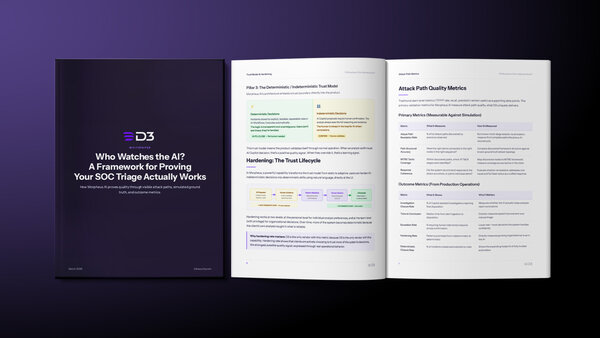
Executive Summary
When an AI system autonomously triages your alerts, the question every security leader must answer is: “How do I prove it works?” The answer requires evidence grounded in what the system actually does, well beyond borrowed statistics or manufacturing-era sampling formulas.
Morpheus AI goes far beyond binary alert classification. It discovers complete attack paths, tracing correlations across tools, mapping MITRE ATT&CK tactics, and reconstructing multi-stage kill chains that rule-based systems and simple AI triage tools miss entirely. That difference demands a fundamentally different approach to validation.
This whitepaper presents D3 Security’s quality framework built on three pillars:
- Visible attack path frameworks: every node, every connection, every reasoning step is visible to the analyst. If a path is wrong, it’s visually obvious.
- Attack simulation with known ground truth: D3 generates realistic multi-stage attacks across hundreds of integrated tools and measures whether Morpheus AI discovers the complete path.
- Outcome metrics from production operations: investigation closure rate, time to conclusion, escalation rate, and hardening rate. Zero separate validation processes, zero additional analyst burden.
The core principle: D3 doesn’t just sort alerts. Morpheus AI shows you the entire attack and how to stop it. Quality proof comes from transparency, attack simulation, and a human-in-the-loop architecture.
Contents
- Why Traditional AI Validation Doesn’t Fit
- Three Pillars of Quality Proof
- Pillar 1: The Attack Path Framework Is Visible
- Pillar 2: Attack Simulation with Known Ground Truth
- Pillar 3: The Deterministic / Indeterministic Trust Model
- Hardening: The Trust Lifecycle
- How Attack Simulation Validates Quality
- Attack Path Quality Metrics
- Validation Dashboard
- What This Means for Your POC
- Questions for Your Evaluation
- Next Steps
Why Traditional AI Validation Doesn’t Fit
Most AI triage validation frameworks measure true positives and false positives on individual alerts, the same confusion matrix approach used for binary classifiers. That approach works for tools that sort alerts into “malicious” or “benign” buckets. Morpheus AI does something fundamentally different.
Morpheus AI discovers attack paths. It doesn’t classify individual alerts; it reconstructs entire kill chains from correlated data across your entire tool stack. When the system builds a path, it also exposes its reasoning: which alerts it correlated, which data elements it considered, and why it concluded those alerts form a coherent attack.
This fundamental architectural difference makes traditional confusion matrices obsolete. A single alert can be part of multiple legitimate attack paths, or no legitimate attack at all. True positives and false positives become meaningless in that context. Instead, what matters is whether Morpheus AI discovers the paths a competent analyst would find, and whether those paths are accurate enough to guide hardening decisions.
Binary Classifiers
Measures: TP/FP rate per alert. No context, no correlation.
Attack Path Discovery
Measures: path completeness, structural accuracy, MITRE coverage.
Traditional confusion matrices were designed for binary decisions: “is this email spam?” Morpheus AI answers a different question: “what is the full attack unfolding across my environment, and how can we stop it?” These are fundamentally incompatible evaluation problems.
This fundamental architectural difference makes traditional confusion matrices obsolete. A single alert can be part of multiple legitimate attack paths, or no legitimate attack at all. True positives and false positives become meaningless in that context. Instead, what matters is whether Morpheus AI discovers the paths a competent analyst would find, and whether those paths are accurate enough to guide hardening decisions.
Three Pillars of Quality Proof
D3’s quality framework rests on three pillars: visible attack path frameworks that expose reasoning, attack simulation with known ground truth that validates discovery capability, and a deterministic/indeterministic trust model that embeds human oversight directly into the automation architecture.
Pillar 1: The Attack Path Framework Is Visible
The output of Attack Path Discovery is a visible framework. Every node, every connection, every reasoning step is exposed to the analyst. If a path is wrong, it’s visually obvious, without statistical sampling.
Every AI decision includes a complete reasoning chain: what data was analyzed, what correlations were found, what conclusion was drawn. The analyst reads the reasoning and confirms or corrects. This is continuous validation built directly into the workflow.
Why this matters: D3 is the only autonomous SOC product that exposes its reasoning as a visible, inspectable framework. This is the most direct form of quality proof possible: transparency that auditors, boards, and insurers can see on demand.
Pillar 2: Attack Simulation with Known Ground Truth
D3’s attack simulation infrastructure connects to hundreds of systems, including EDR, email protection, network protection, IAM, DLP, vulnerability management, and threat intelligence. It generates realistic multi-stage attack chains across these integrations. Because D3 generates the attack, D3 knows the ground truth.
D3 then feeds all the alerts generated by that simulated attack into Morpheus AI. The system has no prior knowledge of the attack’s structure. It must discover the attack paths from the alerts alone, just as it would in production.
The result is a quantifiable measure: what percentage of the known attack does Morpheus AI discover? How structurally accurate is the discovered path? What MITRE ATT&CK tactics does it cover? These metrics matter because the ground truth is known.
Why this matters: Attack simulation with known ground truth is the gold standard for validating discovery systems. It’s used in malware research, red teaming, and forensic analysis because it’s the only way to prove whether you found everything you needed to find.
Pillar 3: The Deterministic / Indeterministic Trust Model
Morpheus AI’s architecture embeds a trust boundary directly into the product. Some decisions execute automatically because the system has high confidence and the organization has approved autonomous action (deterministic). Other decisions require human confirmation because they involve judgment calls, novel patterns, or high-impact decisions (indeterministic).
Deterministic Decisions
Incidents closed by explicit, testable, repeatable rules in AI Workflows. Executes automatically.
The logic is transparent and unambiguous. Users don’t see these; they’re handled.
AUTO-CLOSE → No human needed
Indeterministic Decisions
AI Copilot proposals require human confirmation. The analyst always sees the full reasoning and evidence.
The human is always in the loop for AI-driven conclusions.
CONFIRM → Human validates
This boundary is dynamic. As the system hardens over time—learning from analyst behavior, discovering repeatable patterns, expanding the footprint of deterministic decisions—the system becomes more trustworthy and more autonomous. On day 1, most decisions are indeterministic. On day 90, a meaningful percentage are deterministic, approved by the organization, and supported by confidence scores that auditors can inspect.
Why this matters: Systems that stay the same don’t build trust. Systems that harden do. This model puts organizations in control of their own trust lifecycle and demonstrates that automation and human judgment are not antagonists—they’re partners in a structured, measurable hardening process.
Hardening: The Trust Lifecycle
In Morpheus, a powerful capability transforms the trust model from static to adaptive: users can harden AI-indeterministic decisions into deterministic skills using natural language, directly at the UI.
Hardening works at two levels: at the personal level for individual analyst preferences, and at the team level (with privilege) for organizational decisions. Over time, more of the system becomes deterministic because the client’s own analysts taught it what is reliable.
Why hardening rate matters: D3 is the only vendor with this metric because D3 is the only vendor with this capability. Hardening rate shows that clients are actively choosing to trust more of the system’s decisions, the strongest possible quality signal, expressed through real operational behavior.
How Attack Simulation Validates Quality
Attack simulation validation follows a continuous loop: generate realistic attacks, measure whether Morpheus AI discovers the paths, compare the discovered path to ground truth, score the results on revelation rate, structural accuracy, and MITRE coverage, and feed the results back into model improvement before the next release.
The Five Stages
Internal Validation
D3 uses attack simulation internally to validate and improve Attack Path Discovery, AI Workflows, and AI Copilot before every product release.
POC Demonstration
During proof-of-concept, D3 runs attack simulations in the prospect’s environment. The prospect sees, live and in real time, whether Morpheus AI discovers the simulated attack paths.
Future: Customer Self-Service
Customer-facing attack simulation is planned for a future release, enabling clients to run their own validation drills on demand.
Attack Path Discovery discovers simulated attack paths to a meaningful percentage. The system needs to discover attacks that human analysts would miss, rather than maintain a fixed baseline that gradually degrades.
Attack Path Quality Metrics
Traditional alert-level metrics (TP/FP rate, recall, precision) remain useful as supporting data points. The primary validation metrics for Morpheus AI measure attack path quality, what D3 uniquely delivers.
Primary Metrics (Measurable Against Simulation)
| Metric | What It Measures | How It’s Measured |
|---|---|---|
| Attack Path Revelation Rate | % of full attack paths discovered vs. scenarios observed | Run known multi-stage attacks via simulation; measure % of complete paths Morpheus AI reconstructs |
| Path Structural Accuracy | Were the right alerts connected to the right nodes in the right sequence? | Compare discovered framework structure against known ground truth attack topology |
| MITRE Tactic Coverage | Within discovered paths, which ATT&CK stages were identified? | Map discovered nodes to MITRE framework; measure coverage across tactics in the chain |
| Response Coherence | Did the system recommend response to the attack as a whole, or just to individual alerts? | Evaluate whether remediation addresses root cause and full blast radius as a unified response |
Outcome Metrics (From Production Operations)
| Metric | What It Shows | Why It Matters |
|---|---|---|
| Investigation Closure Rate | % of Copilot-assisted investigations reaching final disposition | Measures whether the AI actually helps analysts reach conclusions |
| Time to Conclusion | Median time from alert ingestion to disposition | Directly measures speed improvement over manual triage |
| Escalation Rate | % requiring human intervention beyond simple confirmation | Lower rate = more decisions the system handles confidently |
| Hardening Rate | Patterns promoted from indeterministic to deterministic | Directly measures growing organizational trust in the AI |
| Deterministic Closure Rate | % of incidents closed automatically by rules | Shows the expanding footprint of fully trusted automation |
| Drift Detection Events | New or unknown record types detected and learned | Indicates the system is adapting to environmental changes |
Note: These metrics are natural outputs of what the product already does. They require zero separate validation, zero statistical sampling, and zero additional analyst burden beyond normal workflow.
Validation Dashboard
The Morpheus AI Validation Dashboard provides a single-pane view of AI triage health, accessible to SOC managers, GRC teams, and auditors. All values shown below are illustrative examples; actual values vary by deployment.
| Section | Content | Audience |
|---|---|---|
| Attack Path Scorecard | Revelation rate, structural accuracy, and MITRE tactic coverage from most recent simulation run. | SOC Manager |
| Outcome Trends | Rolling 7/30/90-day trends for investigation closure rate, time to conclusion, and escalation rate. | SOC Manager |
| Trust Lifecycle | Hardening rate over time. Shows expanding footprint of deterministic decisions. | SOC Mgr / GRC |
| Reasoning Explorer | Browse any Morpheus AI decision. Full reasoning chain, attack path framework, evidence trail. | Analyst / Auditor |
| Audit Export | One-click PDF/CSV export. Pre-formatted for PCI-DSS, HIPAA, NIST CSF reporting. | GRC / Compliance |
All dashboard values are illustrative examples. Actual performance depends on alert volume, tool integrations, threat landscape, and organizational configuration.
What This Means for Your POC
Traditional AI triage vendors ask you to run a 90-day statistical sampling exercise to determine whether their system works. Morpheus AI proves itself through visible, immediate, undeniable evidence.
During Your Proof of Concept
Attack Simulation
D3 runs simulated multi-stage attacks in your environment using your actual tool integrations. You watch Morpheus AI discover the attack paths in real time. You see every node, every connection, every reasoning step.
Live Triage Observation
Morpheus AI processes your real alerts alongside your existing workflow. You compare attack path quality, investigation depth, and time to conclusion against your current process. Results are visible in days, not months.
Outcome Measurement
Within the first two weeks, you have concrete data: investigation closure rates, time to conclusion, escalation rates, and attack path revelation rates against known simulations. Concrete, measurable outcomes from day one.
The difference: Other vendors ask you to believe a confusion matrix computed from sampled alerts. D3 shows you a visible attack path framework, reconstructed from a simulated attack where the ground truth is known. The confusion matrix is a statistical abstraction. The attack path is proof you can see.
Questions for Your Evaluation
Use these questions to evaluate any AI triage system, including Morpheus AI, against the quality evidence your organization requires.
1. Does the system discover attack paths, or just classify individual alerts?
Binary classifiers sort alerts into malicious or benign. Attack Path Discovery reconstructs the full kill chain. Ask which one you’re buying, and demand to see the output framework.
2. Can the vendor run simulated attacks with known ground truth?
If the vendor can generate a realistic multi-stage attack and show you, live, whether their AI discovers the complete path, that’s evidence. If they can only show you aggregate accuracy metrics, ask why.
3. Where is the trust boundary between automation and human judgment?
Understand which decisions execute automatically (deterministic) and which require human confirmation (indeterministic). Can you see the AI’s reasoning before you confirm?
4. What outcome metrics does the system track in production?
Look for investigation closure rate, time to conclusion, and escalation rate. These measure whether the system actually helps. Avoid vanity metrics that sound rigorous but don’t reflect operational reality.
5. Can the system learn from your analysts’ decisions over time?
A system that hardens patterns based on analyst behavior grows more trustworthy the longer it runs. A system that stays static requires the same level of oversight on day 365 as day 1.
Next Steps
Schedule a Morpheus AI Demonstration
See Attack Path Discovery, reasoning chains, and the deterministic/indeterministic trust model in action against live or simulated alert data.
Run an Attack Simulation POC
Deploy Morpheus AI in your environment. Watch it discover simulated attack paths using your actual tool integrations. Measure outcomes within two weeks.
Discuss the Validation Dashboard Roadmap
Provide input on dashboard features, export formats, and compliance requirements specific to your industry and audit obligations.
Learn more at d3security.com
D3 Security | 1-800-608-0081 | [email protected]