The cybersecurity industry is deep in its “agentic AI” phase, hyping swarms of AI agents, each with narrow functions, loosely choreographed to imitate real security work. But let’s be honest: the complexity of managing these agents often outweighs their benefits.
Who governs the agents? Which one is responsible when something breaks? Can you trust decisions made in isolation, with no persistent memory or global context?
At D3 Security, we built Morpheus to avoid those traps. Morpheus is not a bundle of experimental agents. It’s a centralized, persistent, and autonomous SOC engine built for rigorous, enterprise-scale security operations.
What ROI Actually Looks Like in a SOC
SOC leaders shouldn’t measure automation success by raw “time saved.” Real ROI comes from:
- Always-On Operation – 24/7 coverage that never degrades or requires resets.
- True Triage – Every alert investigated in context—not just auto-closed.
- Auditable Actions – Each step mapped to policy, fully logged, and ready for compliance.
- Predictable Scale – One platform orchestrating alerts across your stack with zero sprawl.
Morpheus replaces the fragile swarm of single-task agents with a durable system that learns and adapts.
Metrics That Matter: ROI Benchmarks with Morpheus
Measure value from autonomous security operations using this framework:
Time Saved Per Alert
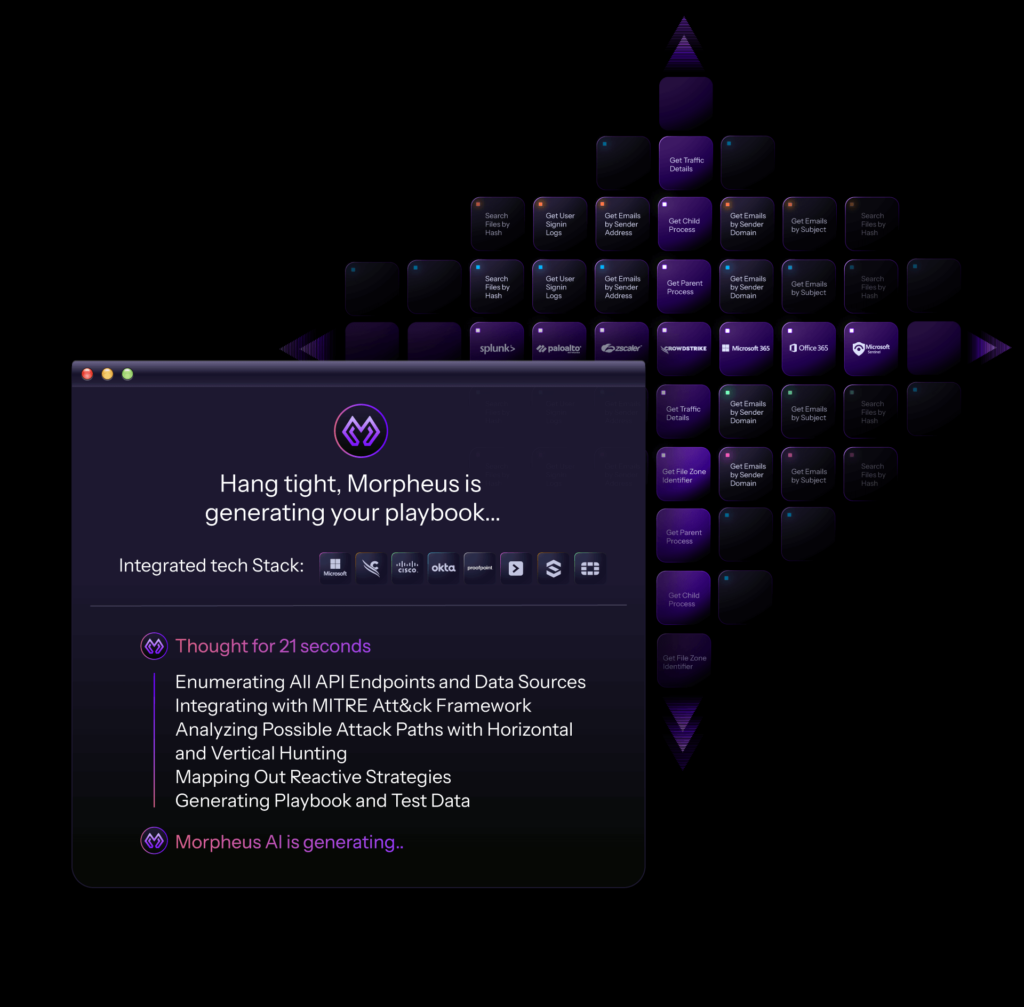
Morpheus routinely cuts alert triage time (by ~10–20 minutes per alert), using structured playbooks powered by deep integrations, contextual enrichment, and persistent state tracking. For most teams, it saves hundreds of hours per week.
Escalations Reduced
Morpheus autonomously resolves a majority of L1 alerts without human involvement by deeply analyzing alerts in context across tools, identities, behaviors, and historical signals. It generates detailed audit trails for every resolution.
Full Audit Trail
Morpheus decides and documents each action. Every automated action is tied to policy, supported by evidence, and ready for compliance review. Analysts know why a decision was made and what alternatives were considered.
Analyst Retention Up
Morpheus uplifts SOC teams out of the grunt work that bogged them down and into the roles they were hired for. Analysts focus on high-impact work, such as threat hunting, purple teaming, and fine-tuning detection logic.
Why We Don’t Do the “Agent” Thing
The agentic AI model is seductive, but fundamentally flawed for enterprise security. Why?
- No hierarchy: Conflicts go unresolved. No single source of truth.
- No persistence: Agents don’t retain memory across alerts or decisions.
- No Governance: Compliance teams have no foothold in the system
- No visibility: Debugging failures is a nightmare in agent sprawl.
Morpheus avoids these problems entirely. As a centralized autonomous SOC engine, it handles all orchestration, investigation, and triage through a unified logic framework with full observability and control.
How to Measure ROI in Your Own SOC
Want to calculate your automation ROI the right way? Follow these steps:
- Establish a baseline: Track alert volume, triage time, and escalation rates.
- Deploy Morpheus in a focused domain: Phishing, EDR, or identity investigations.
- Monitor outcomes: Use built-in dashboards to observe impact in real time.
- Scale based on control, not chaos.
Agentic models require constant tuning. Morpheus improves with use. You don’t have to babysit your bots.
Autonomy That Holds Up in the Real World
Modern security operations require autonomy, not anarchy. Decentralized AI agents may impress in a demo, but they falter under enterprise demands for consistency, auditability, and scale. Morpheus is your SOC’s nerve center: persistent, auditable, and autonomous.
It’s time to stop chasing the latest AI abstraction. Start building the operational core your team can trust.
See how Morpheus brings real ROI to your SOC. Book a demo and discover the difference of centralized autonomy.