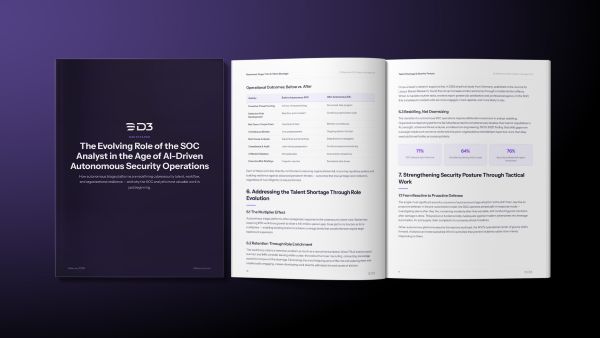
WHITEPAPER
How autonomous triage platforms are redefining cybersecurity talent, workflow, and organizational resilience — and why the SOC analyst’s most valuable work is just beginning.
Executive Summary
The Security Operations Center (SOC) stands at an inflection point. For over a decade, SOC analysts have served as the frontline defenders of enterprise networks, manually triaging thousands of security alerts each day, investigating potential threats, and coordinating incident response. This model, built on human endurance and institutional knowledge, is fracturing under the weight of exponential alert growth, a chronic global talent shortage, and an adversary landscape that evolves faster than any human team can match.
Autonomous SOC platforms like D3 Security’s Morpheus are fundamentally reshaping this paradigm. By leveraging purpose-built artificial intelligence to ingest, investigate, triage, and respond to security alerts at machine speed, the result is clear: analysts stop functioning as ticket processors and start doing the work that actually reduces organizational risk. Threat hunting. Detection engineering. Architecture review. AI decision auditing.
This paper examines that shift. Drawing on workforce data, cross-industry precedents, and operational results from Morpheus deployments, it makes the case that autonomous triage resolves the SOC’s core contradictions: the mismatch between alert volume and analyst capacity, between the need for full coverage and the reality of sustainable workloads, and between firefighting and genuine proactive defense.
Table of Contents
- The Current State of SOC Operations: A System Under Strain
- Autonomous SOC Platforms: The Morpheus Paradigm
- Lessons from Cross-Industry AI Transformation
- The SOC Analyst Before and After Autonomous Triage
- What Hours of Recovered Triage Time Enable
- Addressing the Talent Shortage Through Role Evolution
- Strengthening Security Posture Through Tactical Work
- Implementation Considerations
- Conclusion
1. The Current State of SOC Operations: A System Under Strain
1.1 The Triage Burden
The modern SOC is defined by volume. Industry research indicates that the average enterprise SOC receives approximately 4,484 security alerts per day, with large organizations exceeding 10,000 daily alerts across 28 or more integrated security tools. Security analysts are unable to deal with 67% of these daily alerts. The mean time to investigate a single alert stands at approximately 70 minutes, and fully investigating a single day’s alert queue could take more than 61 working days.
So analysts triage by gut. They develop informal heuristics to decide which alerts get attention and which get quietly dropped. Industry surveys confirm 40% of alerts are never investigated. Sixty-one percent of SOC teams admit to ignoring alerts that later turned out to be real compromises. This isn’t negligence. It’s the rational behavior of professionals whose workload permanently exceeds their capacity.
1.2 Alert Fatigue and Analyst Burnout
Alert fatigue is a quantified operational risk, not a soft HR concern. Seventy-one percent of SOC analysts report burnout. Sixty-four percent are actively considering leaving within the year. A broader ISC2 survey found 76% of security professionals report professional exhaustion.
False positives are the primary driver. Up to 95% of analyst time goes to investigating benign alerts. Trend Micro’s research puts it at 27% of operational hours spent on false positives alone. The downstream effect is predictable: overwhelmed analysts suppress detection rules to manage workload, which creates blind spots, which degrades the security posture the SOC exists to protect.
1.3 The Global Cybersecurity Workforce Crisis
The SOC’s operational strain sits on top of a structural talent deficit. ISC2’s 2025 Workforce Study reports 4.8 million unfilled cybersecurity positions globally, a figure that grew more than 40% in two years. The global cybersecurity workforce needs to grow 87% to meet current demand. In the U.S. alone, approximately 700,000 positions remain open.
SOC analyst roles saw a 31% year-over-year demand increase, but budget constraints have overtaken talent scarcity as the top cause of understaffing. Thirty-three percent of organizations report insufficient budget to staff their security teams. The workforce grew by just 0.1% year-over-year. Meanwhile, analyst tenure keeps shrinking. Some SOCs turn over their entire analyst bench in under 18 months, creating a constant knowledge drain.
2. Autonomous SOC Platforms: The Morpheus Paradigm
2.1 What Morpheus Represents
D3 Security’s Morpheus platform serves as an instructive benchmark for understanding the autonomous SOC category. Morpheus is an AI-powered Security Orchestration, Automation and Response (SOAR) platform that ingests, investigates, triages, and responds to security alerts using a purpose-built cybersecurity large language model (LLM) developed over 24 months by a team of 60 specialists — including red teamers, data scientists, AI engineers, and experienced SOC analysts.
Unlike generic AI wrappers applied to existing SOAR platforms, Morpheus was architecturally designed for autonomous security operations. The platform is approximately 70–80% framework and guardrails, with only 20–30% comprising the LLM itself — a design philosophy that prioritizes reliability and deterministic outcomes over raw generative capability.
2.2 Core Capabilities
Comprehensive Alert Coverage
Morpheus processes 100% of incoming alerts, eliminating the coverage gaps inherent in manual triage. The platform triages 95% of alerts in under two minutes and can handle over one million alerts per day.
Elite-Level Investigation
The platform performs Attack Path Discovery, tracing correlations horizontally across tools and vertically through time-series data. It maps entity relationships and builds coherent threat narratives — mirroring the investigative depth of an experienced Level 2 analyst.
Dynamic Playbook Generation
Rather than relying on static runbooks, Morpheus autonomously creates and executes adaptive, context-aware processing and remediation playbooks tailored to each organization’s unique SOC environment.
Self-Healing Integrations
The system autonomously detects API drift, schema changes, and output shifts across integrated tools, generating corrective code to eliminate the silent failures that plague traditional automation stacks.
2.3 Measured Impact
Early deployments offer compelling performance evidence. A large Master MSSP reported that after implementing Morpheus, their operation went from handling approximately 144,000 alerts to focusing on just 200 alerts per month that required human analyst attention. Response times that previously ranged from 30 to 60 minutes were compressed to between 30 seconds and 3 minutes on automated alerts.
The 2025 AI SOC Market Landscape report, produced by Software Analyst Cyber Research (SACR), evaluated 13 vendors in the autonomous SOC space and placed D3 Morpheus in the optimal top-right quadrant for robustness — recognizing both its capability depth and operational reliability.
3. Lessons from Cross-Industry AI Transformation
3.1 The Pattern of Augmentation, Not Elimination
What’s happening in the SOC has happened before in other industries. AI doesn’t delete roles. It restructures them. A 2025 SSRN analysis projects that 85 million jobs globally will be displaced by AI-driven automation, but 97 million new roles will emerge — a net creation of 12 million positions. The critical difference: the new roles require higher-order judgment, oversight capability, and real domain knowledge.
3.2 Cross-Vertical Precedents
Manufacturing & QA
Autonomous inspection systems replaced manual quality control on production lines. Rather than eliminating quality roles, organizations redeployed personnel to process optimization, exception management, and continuous improvement. Humans who previously inspected individual units now oversee inspection systems and audit their accuracy.
Healthcare Diagnostics
AI-powered diagnostic tools in radiology and pathology perform initial screening of medical images with accuracy rates matching or exceeding human baselines. Physicians have not been displaced — they focus on complex diagnostic cases, patient consultation, and treatment planning.
Financial Services
AI-driven fraud detection and claims processing have automated millions of routine evaluations. Analysts who previously reviewed individual transactions now investigate sophisticated fraud networks, refine detection models, and conduct compliance audits — a direct parallel to the SOC analyst’s evolving role.
The Common Thread
Across every vertical, AI’s effects extend beyond task automation to drive broader transformations in organizational structures, work processes, and skill requirements. The World Economic Forum estimates 39% of current skillsets will become outdated by 2030.
The SOC is no exception. The question is not whether analysts will be needed, but what they will be needed for.
4. The SOC Analyst Before and After Autonomous Triage
4.1 The Pre-Automation Analyst
Without a platform like Morpheus, the typical SOC analyst’s workday is dominated by repetitive, high-volume, low-complexity activities:
- Manually reviewing and triaging hundreds to thousands of alerts per shift
- Correlating data across multiple disconnected security tools
- Investigating false positives that consume up to 95% of operational time
- Documenting findings and escalating confirmed incidents through manual ticket workflows
- Operating under constant time pressure with incomplete information
- Suppressing detection rules as a coping mechanism for unmanageable alert volumes
In this model, the analyst functions as a triage processor. The strategic work — threat hunting, detection engineering, architecture review — stays aspirational. It’s perpetually deferred in favor of queue management.
4.2 The Post-Automation Analyst
When an autonomous platform like Morpheus takes over alert ingestion, investigation, and triage, the analyst’s job changes in kind. The hours previously consumed by manual triage (estimated at three or more hours per analyst per day) become available for work that actually strengthens the organization’s security posture.
AI Auditor & Decision Validator
Analysts review and validate triage decisions made by autonomous systems, ensuring accuracy and identifying edge cases where AI reasoning may require refinement. This oversight function combines security expertise with AI literacy.
Advanced Threat Hunter
With routine alerts handled autonomously, analysts dedicate sustained attention to proactive threat hunting: searching for indicators of compromise, analyzing attacker TTPs, and identifying latent threats. 64% of security professionals identify threat hunting as a top area for AI-enabled time recovery.
Detection Engineer
Analysts shift from consuming detection rules to authoring and refining them. Working alongside autonomous systems, they analyze patterns in AI-triaged data to develop more precise detection logic, reduce false positive rates, and close coverage gaps. This creates a continuous feedback loop that improves both human and machine performance.
Strategic Security Advisor
Freed from operational firefighting, senior analysts contribute to broader security strategy: advising on architecture decisions, conducting red team exercises, evaluating emerging threat landscapes, and translating technical risk into business language for executive leadership.
Automated by Morpheus
AI-driven analysis
Autonomous execution
Edge cases only
Threat hunting, engineering
5. What Hours of Recovered Triage Time Enable
The arithmetic of recovered time is significant. If a SOC team of ten analysts each reclaims three hours per day of manual triage, that represents 30 additional analyst-hours per day, or approximately 7,800 hours per year — available for high-impact security activities.
Operational Outcomes: Before vs. After
| Activity | Before Autonomous SOC | After Autonomous SOC |
|---|---|---|
| Proactive Threat Hunting | Ad hoc, time permitting | Structured, daily program |
| Detection Rule Development | Reactive, post-incident | Continuous optimization cycle |
| Red Team / Purple Team | Quarterly at best | Monthly or continuous |
| Architecture Review | Annual assessment | Ongoing advisory function |
| Root Cause Analysis | Superficial due to backlog | Deep forensic investigation |
| Compliance & Audit | Last-minute preparation | Continuous posture monitoring |
| AI Model Validation | Not applicable | Core analyst competency |
| Executive Risk Briefings | Irregular, reactive | Scheduled, data-driven |
Each of these activities directly contributes to reducing organizational risk, improving regulatory posture, and building resilience against advanced persistent threats — outcomes that manual triage never delivered, regardless of how diligently it was performed.
6. Addressing the Talent Shortage Through Role Evolution
6.1 The Multiplier Effect
Autonomous triage platforms offer a pragmatic response to the cybersecurity talent crisis. Rather than requiring 87% workforce growth to close a 4.8-million-person gap, these platforms function as force multipliers — enabling existing teams to achieve coverage levels that would otherwise require major headcount expansion.
6.2 Retention Through Role Enrichment
The workforce crisis is a retention problem as much as a recruitment problem. When 71% of analysts report burnout and 64% consider leaving within a year, the costs of turnover (recruiting, onboarding, knowledge transfer) compound the shortage. Eliminating the most fatiguing parts of the role and replacing them with intellectually engaging, career-developing work directly addresses the root causes of attrition.
Cross-industry research supports this. A 2025 empirical study from Germany, published in the Journal for Labour Market Research, found that AI can increase worker autonomy through complementary effects. When AI handles routine tasks, workers report greater job satisfaction and professional agency. In the SOC, this translates to analysts who are more engaged, more capable, and more likely to stay.
6.3 Reskilling, Not Downsizing
The transition to autonomous SOC operations requires deliberate investment in analyst reskilling. Organizations deploying platforms like Morpheus need to simultaneously develop their teams’ capabilities in AI oversight, advanced threat analysis, and detection engineering. ISC2’s 2025 finding that skills gaps now outweigh headcount concerns reinforces this point: organizations need deeper expertise more than they need additional bodies processing tickets.
7. Strengthening Security Posture Through Tactical Work
7.1 From Reactive to Proactive Defense
The single most significant security outcome of autonomous triage adoption is the shift from reactive to proactive defense. In the pre-automation model, the SOC operates perpetually in response mode — investigating alerts after they fire, containing incidents after they escalate, and conducting post-mortems after damage is done. This posture is fundamentally inadequate against modern adversaries who leverage automation, AI, and supply chain complexity to compress attack timelines.
When autonomous platforms assume the reactive workload, the SOC’s operational center of gravity shifts forward. Analysts can invest sustained effort in activities that prevent incidents rather than merely responding to them.
7.2 Quantifiable Risk Reduction
The operational improvements enabled by autonomous triage translate directly into quantifiable risk reduction. IBM’s 2025 Cost of a Data Breach report recorded an average breach cost of $4.44 million. Organizations that achieve faster detection and response through autonomous SOC operations can expect material reductions in breach likelihood and impact — savings that compound as the SOC’s proactive capabilities mature.
Furthermore, continuous compliance monitoring — made possible when analysts are freed from triage — reduces audit preparation costs, minimizes regulatory exposure, and demonstrates to boards and regulators that the organization maintains a mature, adaptive security posture rather than a checkbox-driven compliance program.
7.3 Building Organizational Resilience
The shift to tactical work builds genuine organizational resilience. A SOC that dedicates real capacity to threat hunting, detection engineering, and architecture review is preparing for the next threat — which is where the real defensive advantage lives. This forward-looking posture is increasingly recognized as a board-level priority as AI-enabled attacks accelerate in both sophistication and volume.
- Proactive threat hunting identifies adversary footholds before they mature into full compromises, reducing dwell time from an industry average of several weeks to hours or days.
- Continuous detection engineering closes coverage gaps that accumulate when analysts suppress rules to manage alert volume, restoring visibility across the attack surface.
- Regular red and purple team exercises validate defensive controls against real-world attack techniques, identifying weaknesses before adversaries do.
- Security architecture advisory embeds security considerations into infrastructure and application design decisions, reducing the organization’s inherent attack surface.
8. Implementation Considerations
The transition to autonomous SOC operations is not a technology deployment — it is an organizational transformation. Executive leaders should consider the following factors:
Phased Adoption
Implement autonomous triage incrementally, beginning with high-volume, low-complexity alert categories. This allows the organization to build confidence in AI decision-making while maintaining human oversight through the transition.
Analyst Development Investment
Budget for reskilling programs must accompany platform investment. Analysts need training in AI auditing methodologies, advanced threat hunting techniques, and detection engineering — competencies that may not exist in the current team.
Governance and Accountability
Clear frameworks must define the boundaries of autonomous decision-making, escalation protocols for AI-flagged edge cases, and accountability structures for AI-generated triage outcomes.
Metrics Evolution
Traditional SOC metrics centered on ticket throughput and closure time must evolve to reflect the new operational model: threat hunt findings, detection coverage improvements, mean dwell time reduction, and AI decision accuracy rates.
Vendor Evaluation
Not all autonomous SOC platforms are equivalent. The SACR 2025 Market Landscape report’s evaluation framework — assessing robustness, investigation depth, and integration reliability — provides a useful benchmark for distinguishing purpose-built solutions from superficial AI wrappers.
9. Conclusion
The autonomous SOC is an emerging reality. Platforms like Morpheus demonstrate that AI-driven triage can resolve the contradictions that have defined security operations for over a decade: alert volume versus analyst capacity, comprehensive coverage versus sustainable workloads, reactive firefighting versus proactive defense.
The SOC analyst’s role is evolving toward work of significantly greater strategic value. The analyst who previously spent most of each shift processing tickets now conducts threat hunts, validates AI decisions, engineers detection logic, and advises on security architecture. This evolution directly addresses the talent shortage by multiplying existing team capacity and closes the security posture gap by redirecting human expertise toward activities that genuinely reduce organizational risk.
For executive leaders, the path is clear. Organizations that invest in autonomous SOC capabilities while developing their analysts’ higher-order competencies will achieve a compounding advantage: better security outcomes, more resilient operations, and a workforce ready for the demands of an increasingly AI-driven threat environment. Those that delay risk falling behind adversaries and losing the talent necessary to defend the enterprise.
References and Sources
ISC2. 2025 ISC2 Cybersecurity Workforce Study. December 2025.
D3 Security. Introducing Morpheus: Autonomous Investigation, Triage, and Response for SOC Teams. 2025.
Software Analyst Cyber Research (SACR). 2025 AI SOC Market Landscape Report. 2025.
Nartey, J. AI Job Displacement Analysis (2025–2030). SSRN Working Paper #5316265, 2025.
International Journal of Research and Innovation in Social Science (IJRISS). Artificial Intelligence and the Future of Job Security: A Narrative Review of Risks, Resilience, and Policy Responses. 2025.
Journal for Labour Market Research. Artificial Intelligence and Autonomy at Work: Empirical Insights from Germany. Springer Open, 2025.
Ponemon Institute. The State of the SOC Analyst: Burnout, Retention, and Workforce Trends. 2025.
IBM Security. Cost of a Data Breach Report. 2025.
Trend Micro. SOC Alert Management and False Positive Impact Study. 2025.
The Hacker News. The State of AI in the SOC 2025. September 2025.
World Economic Forum. Future of Jobs Report 2025. 2025.
This white paper is intended for informational purposes only. References to specific products and vendors are for illustrative benchmarking and do not constitute endorsement.