

Splunk SOAR vs. Morpheus AI SOC
Stop burning ops and engineering hours on endless technical debt
Morpheus autonomously builds, tests and runs playbooks and cross-stack investigations—so analysts resolve incidents, not debug scripts.

See Morpheus in Action

meet morpheus AI
Autonomous SecOps
Alerts, investigations, playbooks and cases. Everything you need to go from alert to triaged to remediated—across your entire stack.



















HOW IT WORKS
Your AI-Powered Security Automation Solution
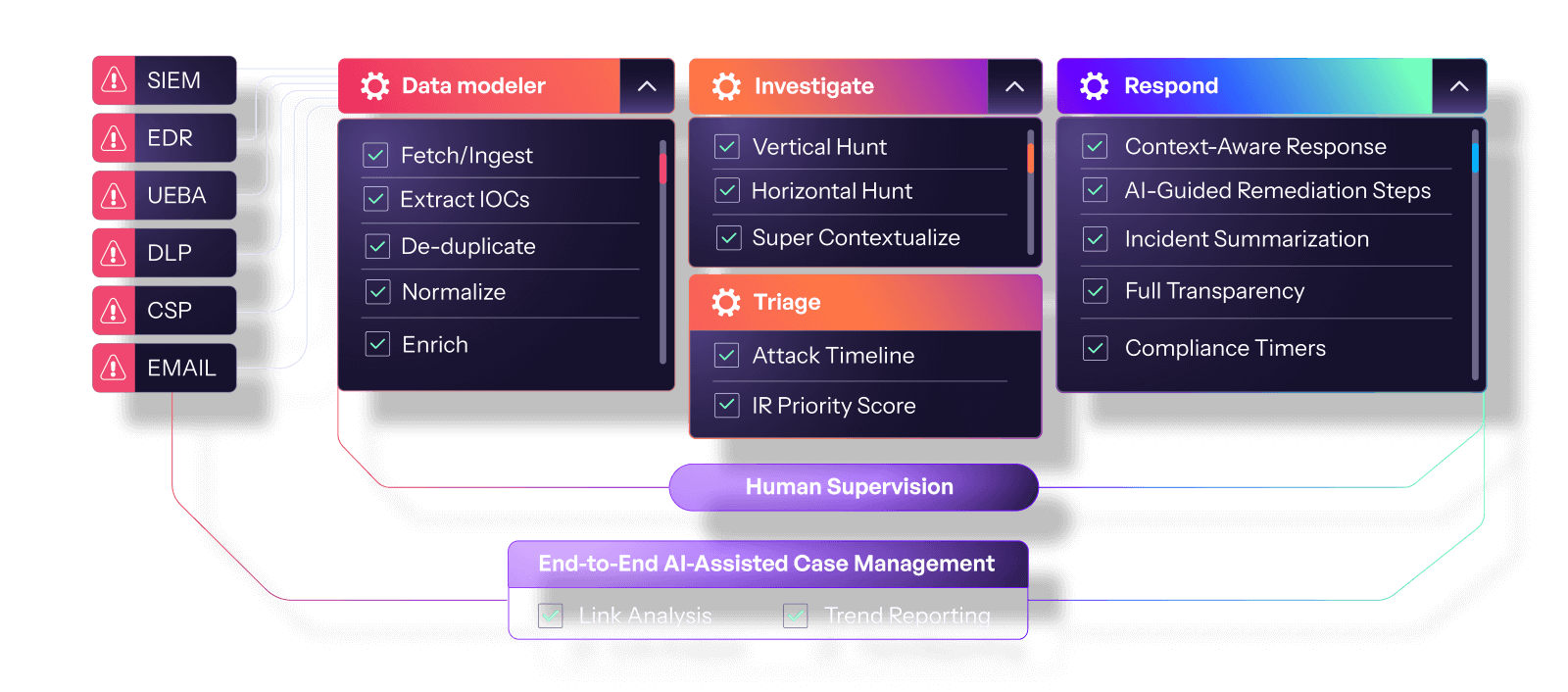
The Morpheus AI SOC product integrates with your tools, creating a unified alert/data structure that enables deep, autonomous investigation across your security stack. Built-in automation, case management and reporting help close the loop.
COMPARE
Fast Outcomes, Not Finicky Playbooks
Tired of coding your automation? You’re not alone. Morpheus runs L1 and L2 SOC ops and accelerates L3, with little to no playbook upkeep.
Morpheus AI
NL‑assisted, dynamic playbooks per alert—no Python debt for day‑to‑day SOC work.
Splunk SOAR (Phantom)
Python-first apps/containers; version drift and debugging can tie up Tier-2 resources in many deployments.
Autonomy + control: AI blended with deterministic flows enable editable actions with guardrails.
Manual coordination persists often—escalations and ticket handoffs may be needed to finish containment/quarantine.
AI-powered analyst workspace includes a forensic timeline of alerts, artifacts, entities in proper chronology.
Artifact handling varies across apps; incident narratives are frequently reconstructed after the fact.
Promotion without drama: approvals, history, env bindings separate dev/test/prod cleanly.
Promotion is commonly manual, with scheduled change windows to sync apps and playbooks safely.
Connection health + platform logs ensure strong, stable SIEM integration.
Eng. and operations weight—Python and manual work—can pull teams away from incident velocity.
trusted Worldwide
Adopted by Enterprises and Top-Tier MSSPs



RETURN ON INVESTMENT
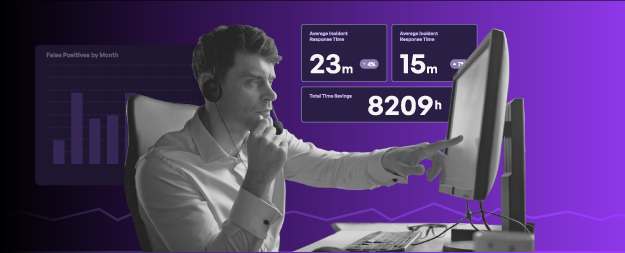
Why pay a premium price for a legacy SOAR?
AI Playbooks



Request your free Splunk SOAR
cost comparison
ai soc features
Get AI Working in Your SOC


Contextual response
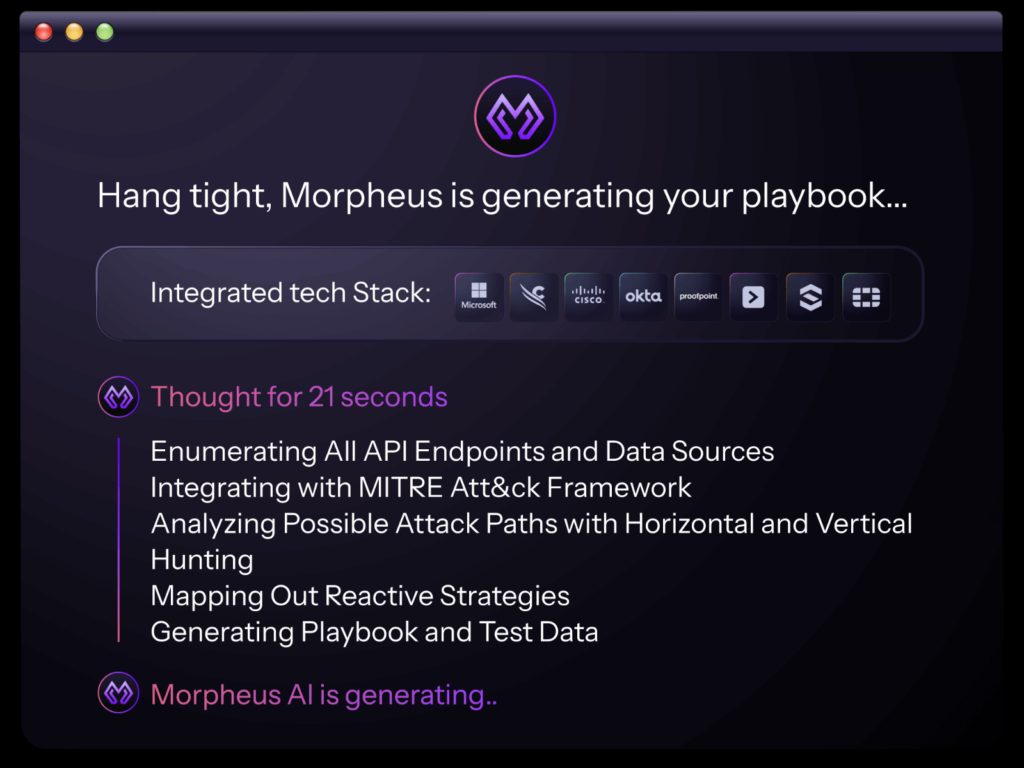
Respond to incidents with speed and precision using Morpheus AI’s contextual playbooks. Whether you prefer drag-and-drop simplicity or the power of AI-driven automation, Morpheus AI generates playbooks tailored to each event, for your environment.
Proactive hunting
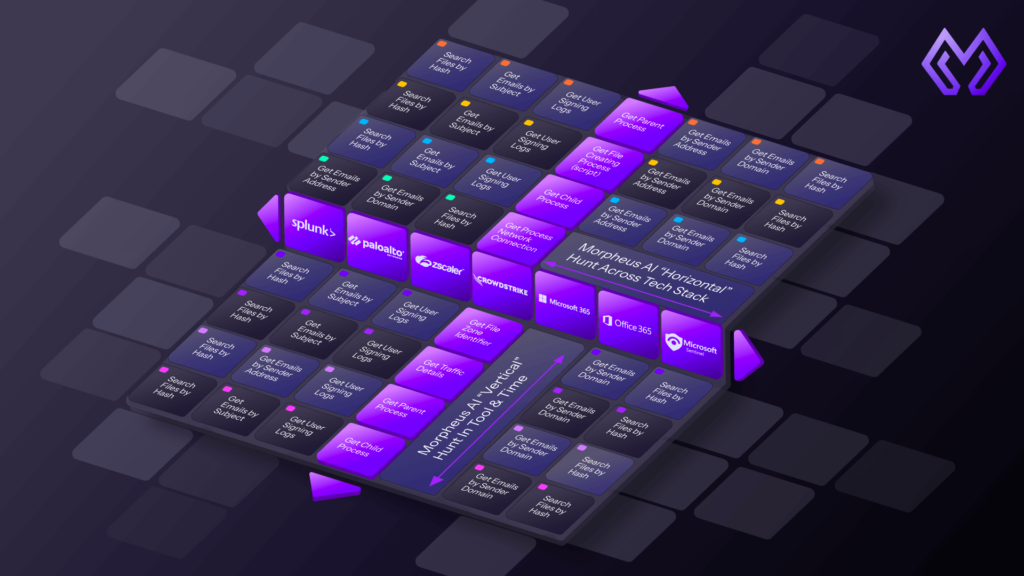
Stay one step ahead of attackers by proactively identifying and neutralizing potential risks. Morpheus AI’s contextual playbooks search horizontally and vertically across your environment, uncovering hidden threats and vulnerabilities.
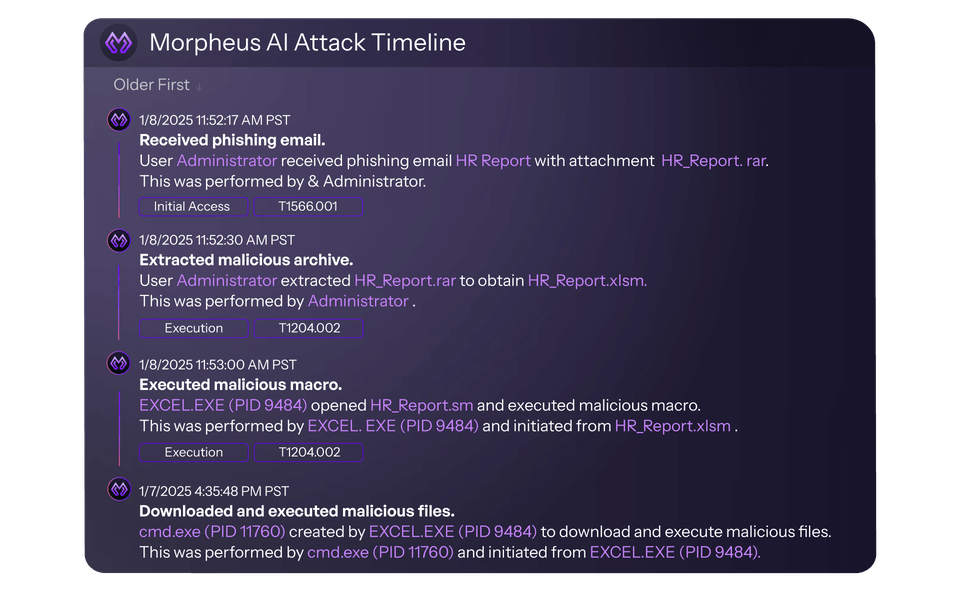
Full-stack timeline
Visualize the entire attack lifecycle with Morpheus AI’s full-stack timeline. From initial access to final impact, our timeline automatically compiles and presents the sequence of events, saving analysts hours of manual effort. Understand the complete story of each incident at a glance, empowering your team to respond swiftly and confidently.
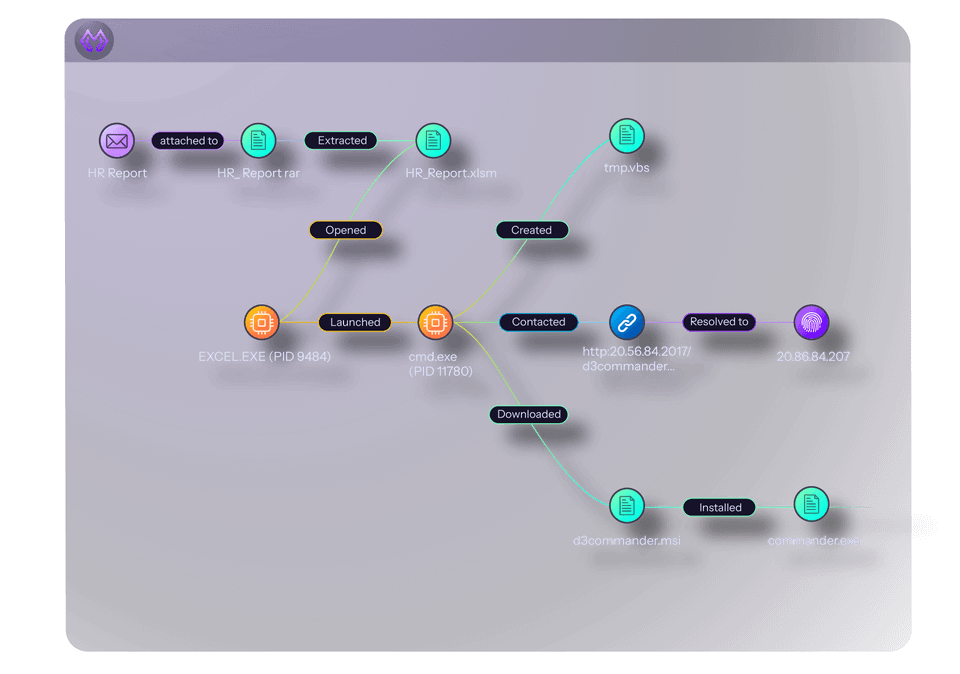
Link analysis
Uncover hidden connections and accelerate investigations with Morpheus AI’s link analysis. Visualize the relationships between artifacts, IOCs, and incidents in an intuitive graph, revealing the full scope of the attack.
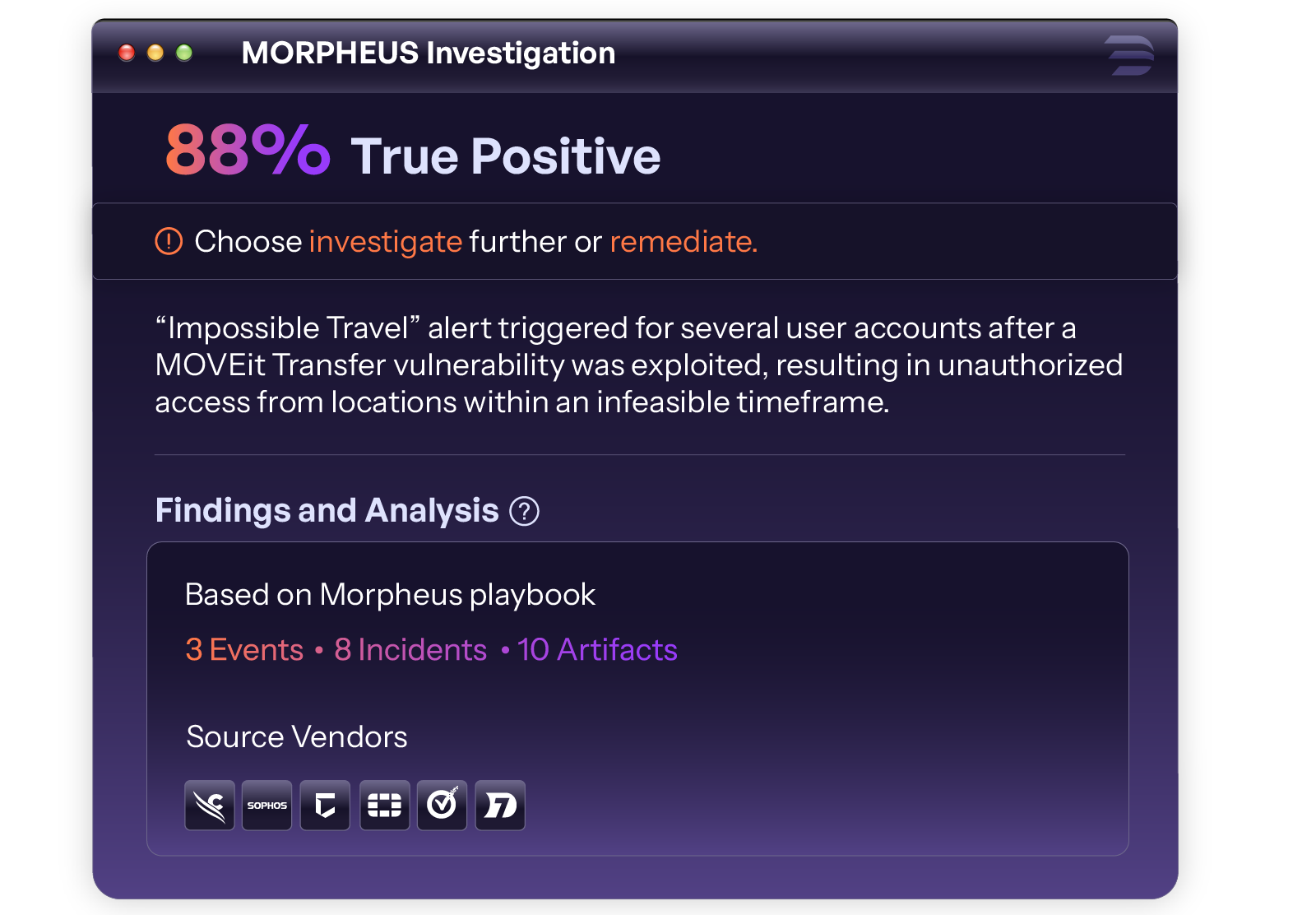
Risk score priority
Ensure no critical threat is overlooked using Morpheus AI’s comprehensive risk scoring. Our incident response priority score combines impact, threat confidence, contextual weight, and mitigation status to accurately assess the severity of each event.
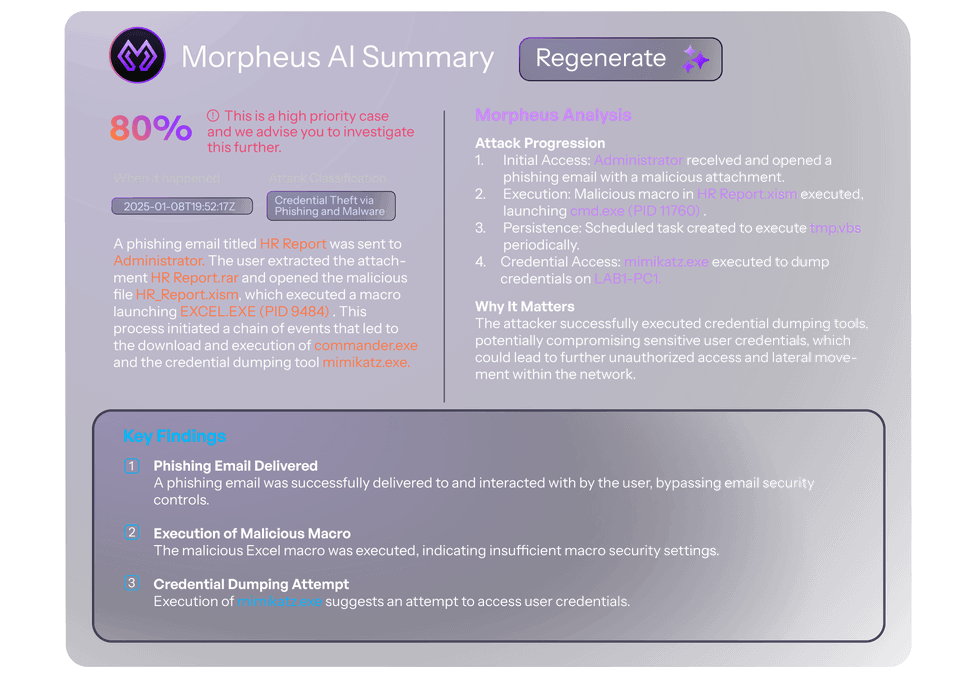
Incident summarization
Reduce investigation time and empower your team with instant access to critical insights. Instantly understand the key details of any incident with Morpheus AI’s AI-driven summaries. Our AI summarization compiles all relevant information into a clear, concise overview, enabling even Tier 1 analysts to quickly grasp the attack methodology.
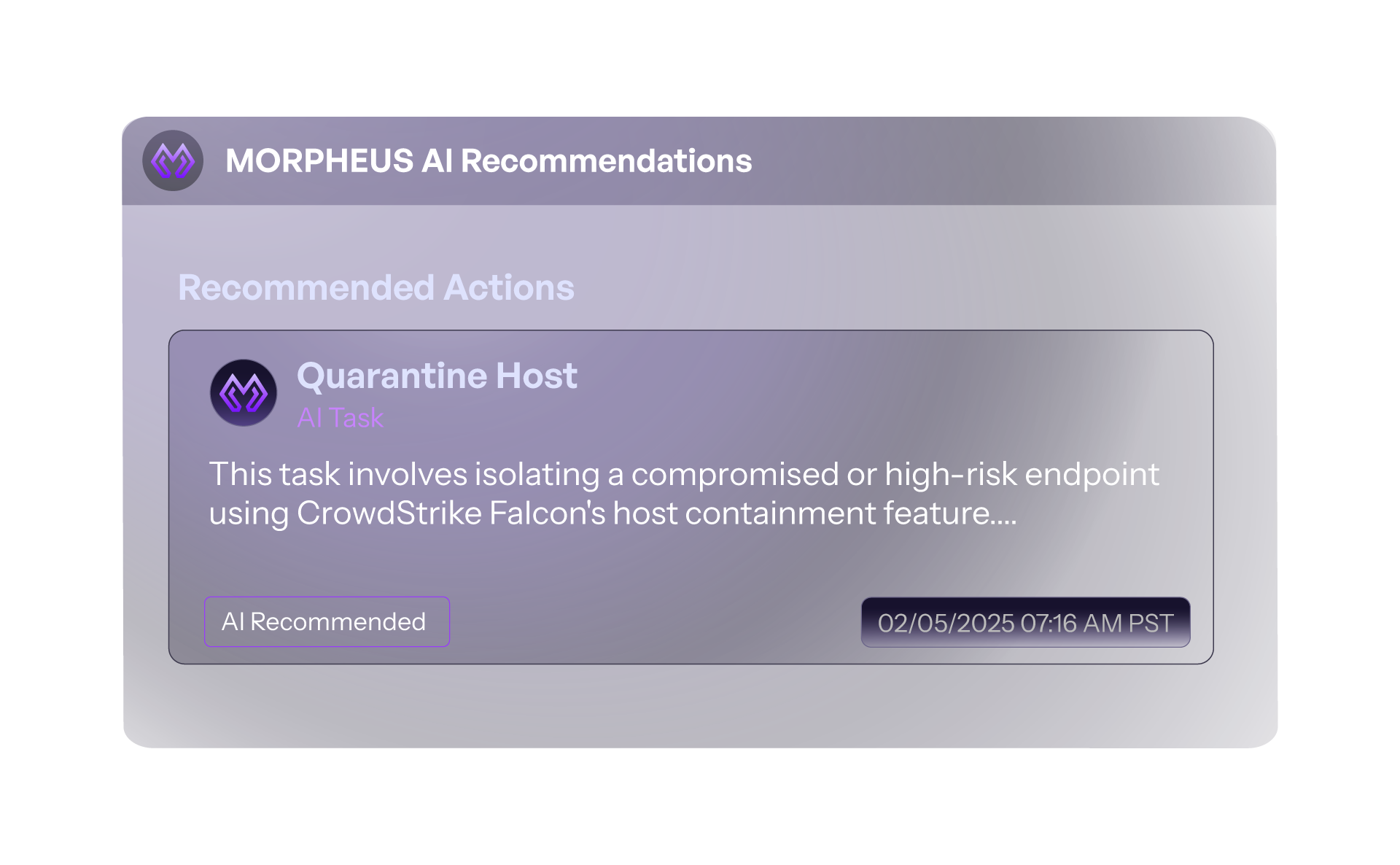
Detailed AI-guided remediation steps for your team
Resolve incidents faster and more effectively with Morpheus AI’s guided remediation. Our AI provides clear, actionable recommendations based on the specific incident and your environment. From quarantining hosts to implementing certificates, Morpheus AI guides your team through the necessary steps to contain and eliminate threats.
Visible code generation
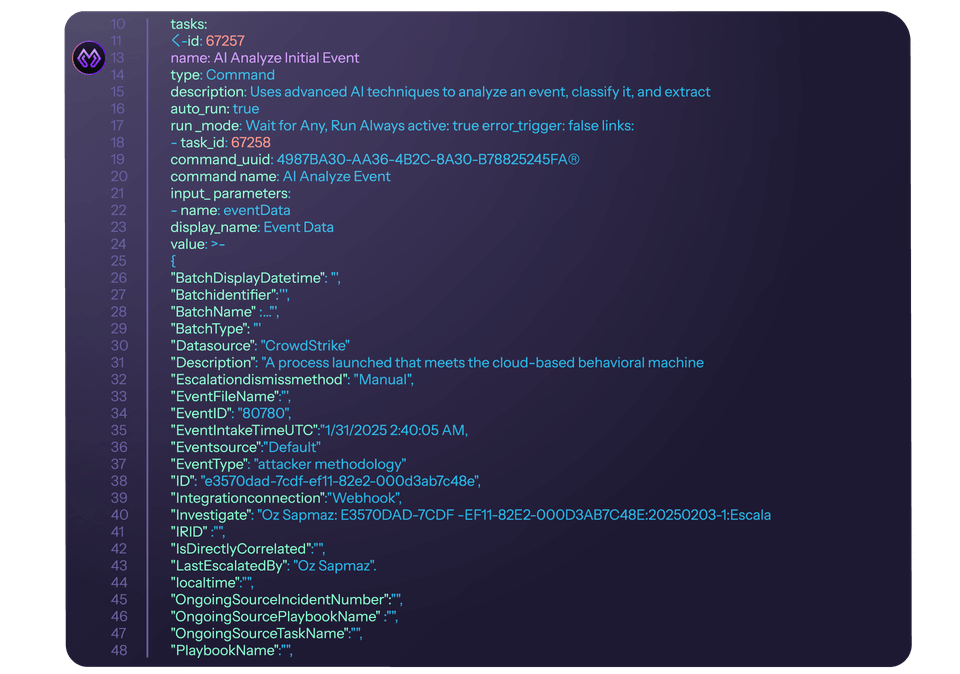
Take control of your security automation with Morpheus AI’s visible code generation. Morpheus provides full access to the back-end Python code for every AI-generated playbook, ensuring complete transparency and customizability. Adapt and optimize your playbooks to meet your unique needs and maintain full control over your security processes.
Modernize Your SOC with Morpheus

Automation You Can Trust, By Design
Morpheus generates, tests, and validates every playbook before it runs, integrating with GitHub for human approval and complete auditability.
- AI-powered unit & integration testing
- GitHub PRs for human approval
- Transparent & auditable YAML logic

Escape the Playbook Backlog
Legacy SOAR often makes automation a coding-heavy project, especially for new use cases, whereas Morpheus generates trusted investigations from live alerts.
- Natural language edits
- Generate playbooks from live data
- Eliminate technical debt

Smarter Spend, Stronger Security
Morpheus aims for fast, defensible ROI by amplifying your existing stack and significantly reducing data needs and engineering overhead.
- Works with current and future products
- Reduce log ingestion needs
- Drastically reduce Python overhead

“We went from 145,000 alerts to under 1,000. That’s a 99% reduction.
Our mean time to detect and mean time to respond have all dropped significantly.”
Frequently Asked Questions
Is Morpheus Really an AI SOC Tool? Isn’t it Just SOAR?
Morpheus is not a SOAR with AI sprinkled on top. It’s an Autonomous SOC platform that generates, tests, and runs playbooks directly from your live data. Unlike SOAR, which relies on manually built runbooks, Morpheus dynamically adapts workflows, correlates alerts across SIEM, EDR, IAM, and cloud, and validates actions with governance steps (unit tests, GitHub PRs, approvals).
Can I Switch from Splunk SOAR to Morpheus?
Yes. Morpheus is designed for easy migration. Instead of rebuilding static playbooks, you can generate automation from active ingestions (e.g., CrowdStrike). Morpheus supports 800+ integrations, CI/CD pipelines, and version control with GitHub, making it straightforward for teams already running Splunk SOAR to switch without downtime.
How Can I See if Morpheus Is Right for Me?
You can request a live demo and see Morpheus handle your own alert data. The platform gives you transparency with open YAML logic, visible code generation, and safe confirmation steps before any high-impact action. That means you get AI-driven speed with full analyst oversight and governance.
What are the key differences between Morpheus and Splunk SOAR?
Playbook Creation
Splunk SOAR emphasizes Python-based apps and playbooks; many automations typically involve coding. Morpheus uses AI to generate playbooks from live alerts, with edits handled through natural-language chat.
Automation Governance
Splunk SOAR promotion is often manual, with scheduled change windows to mitigate risk. Morpheus provides governed promotion with automated tests, AI-suggested fixes, and human approval (e.g., GitHub PRs) for transparent, safer deploys.
Analyst Experience
A builder-centric UX in Splunk SOAR can lead to more escalations and manual work when context isn’t consolidated. Morpheus offers an AI workspace with summaries, attack graphs, and next-best actions to reduce SOC toil and burnout.
Total Cost of Ownership
Splunk SOAR can accrue costs from ongoing Python development and playbook maintenance. Morpheus reduces day-to-day engineering overhead by shipping outcomes without the Python debt (results vary by environment).
Which platform is better for MSSPs and enterprises?
Morpheus scales for multi-tenant MSSPs and enterprise SOCs, offering modular playbooks, case management, and governed automation.
D3 Security is not affiliated with Splunk SOAR. All trademarks are the property of their respective owners. This comparison reflects publicly available information and our team’s evaluation as of October 2025.